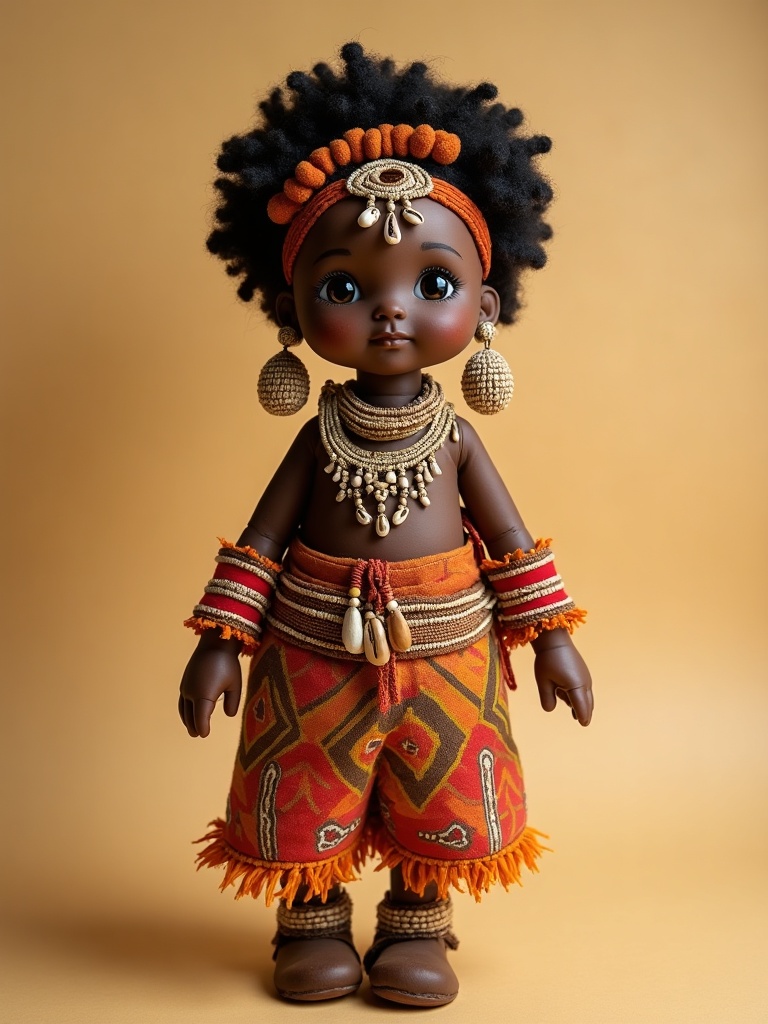
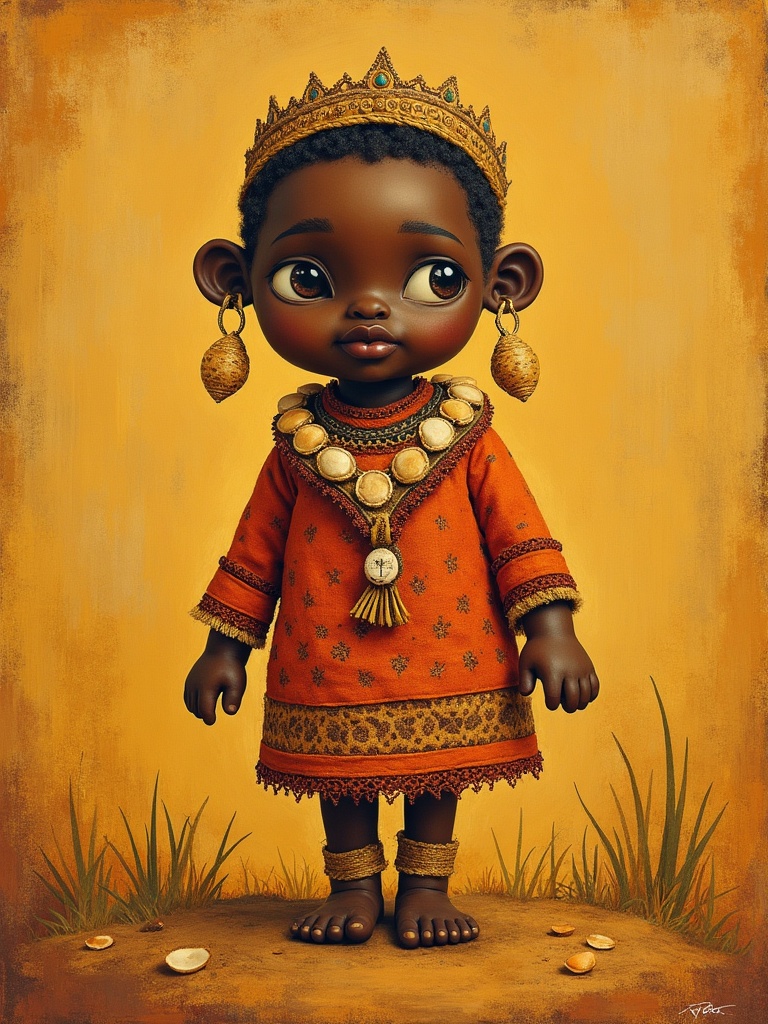
AI design preview — not a photo of the finished handmade doll
Art, Craft & Good Governance
Shyaam a-Mbul
Around 1625 a traveller called Shyaam a-Mbul a-Ngoong returned home with the customs and crafts of distant kingdoms and forged the scattered chiefdoms of the Congo savanna into the Kuba Kingdom — a state so carefully designed it had elected offices, courts and a separation of powers centuries before such ideas were named in Europe.
- People
- Kuba (Bushong)
- Country
- DR Congo
- Region
- Central Africa
- Era
- ≈1625 (founder)
- Theme
- Art, Craft & Good Governance
Make your own
Design your Shyaam a-Mbul
Pick a garment, a hairstyle and a scene, enter the PIN and generate a fresh image of Shyaam a-Mbul with AI.
Each image is generated live with fal.ai.
Generated images
AI design preview — not a photo of the finished handmade doll
No images generated yet — be the first.
Tradition & Origin
Around 1625 a traveller called Shyaam a-Mbul a-Ngoong returned home with the customs and crafts of distant kingdoms and forged the scattered chiefdoms of the Congo savanna into the Kuba Kingdom — a state so carefully designed it had elected offices, courts and a separation of powers centuries before such ideas were named in Europe.
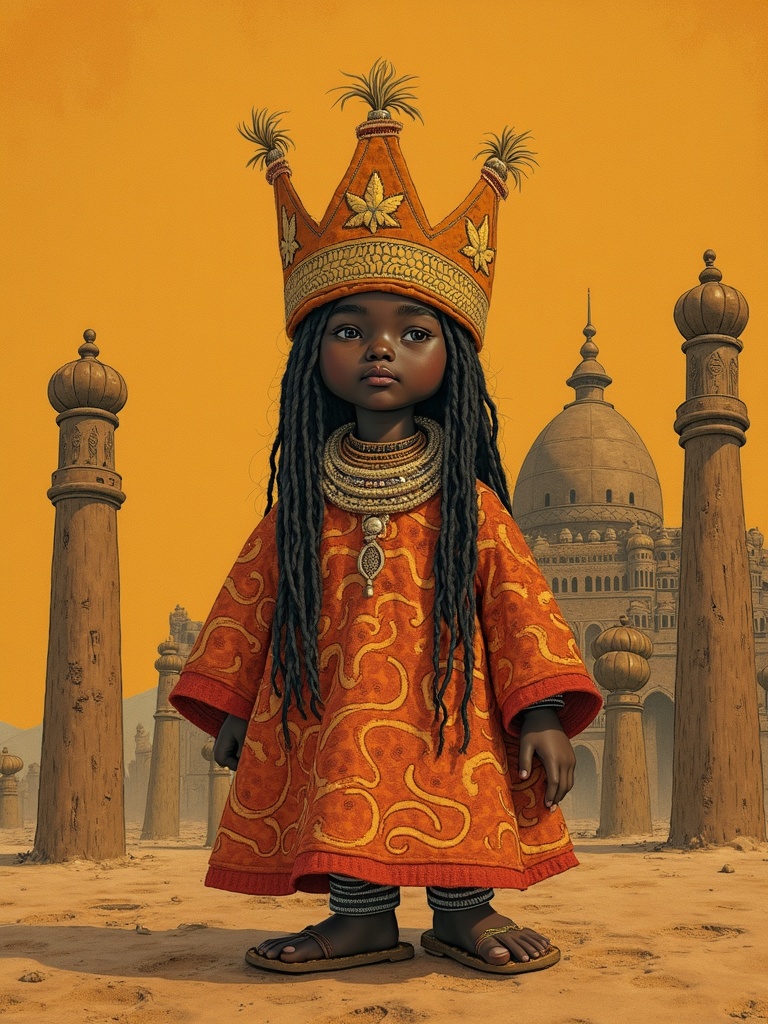
Kuba tradition remembers Shyaam as the adopted son of a Kuba queen who travelled west among the Pende and Kongo peoples, gathering knowledge of foreign technologies and ways of ruling before coming back to overturn the existing order. In roughly 1625 he united the chiefdoms of the Kasai region into a single kingdom centred on the Bushoong clan, with the king — the nyim — at its head. What he built was less a conquest state than a constitution: a merit-based system of titled offices, elected political posts, taxation, a police force and a judiciary with courts and juries. The nyim never ruled alone; he answered to a council on which every Kuba subgroup was represented through its own elites.
Under Shyaam's dynasty the Kuba turned daily life into art. From the fibre of the raffia palm, men wove cloth on the loom and women embroidered it in dense geometric patterns; the Shoowa became masters of a cut-pile "velvet" embroidery, threads worked between warp and weft and then trimmed to a soft, plush pile with no visible knots. Carved palm-wine cups, beaded royal hats and cosmetic boxes carried the same restless invention. Every two days at the royal capital the nyim could proclaim the Itul festival, re-enacting the kingdom's origin myth and the founding Shyaam set in motion.
Shyaam's memory is also bound to the ndop — the royal portrait statue. Begun in the eighteenth century, an ndop was never a literal likeness but a carving of the king's spirit, his soul's double, fed with oil and standing in for him when he was away. Each figure is identified by an ibol, a small personal emblem at its base. Shyaam's emblem is a board of mancala, the strategy game — a fitting sign for the kingdom's master planner. One of the oldest surviving ndop, carved in the late 1700s and showing his mancala board, sits in the British Museum, brought from Mushenge by the Hungarian ethnographer Emil Torday.
The Kuba royal house is not a relic but a living institution. The throne Shyaam founded has passed down an unbroken line of nyims; King Kot a-Mbweeky III has reigned since 1968, counted as the 125th ruler. Out of respect for a living royal house, this figure honours the founder and the office rather than any living person — the idea of governance by council, and a people who made beauty a form of law.
Did you know?
- The Kuba state had an unwritten constitution, elected political offices, a separation of powers, a judiciary with courts and juries, a police force and taxation — and the king was answerable to a council on which every subgroup was represented.DetailsEN
- A Kuba ndop is not a portrait of the dead king but a carving of his spirit — his soul's double — anointed with oil and used to stand in for him in his absence.DetailsEN
- Kuba Shoowa weavers create a raffia 'cut-pile velvet' by passing threads between warp and weft with a needle and trimming them to a short plush pile, leaving no visible stitches or knots.DetailsEN
- Three of the Kuba royal ndop figures in the British Museum were collected at Mushenge by the Hungarian ethnographer Emil Torday in the early 1900s.DetailsEN
He did not just conquer a kingdom — he designed one, and taught that power is safest when it must answer to a council.
Values & Capabilities
Capabilities
◆◆◆◆◆ shows how central a gift is — five diamonds mark a signature strength, fewer mark a supporting one.
He travelled to other kingdoms to learn good governance before he ever ruled.
He made aristocratic titles a reward for excellence, not an accident of birth.
He united 17+ groups into one matrilineal kingdom of councils.
Under him Kuba cloth and sculpture reached world-class refinement.
His royal symbol was the mancala board — patient, calculating wisdom.
Development
1 of 3 stages unlocked
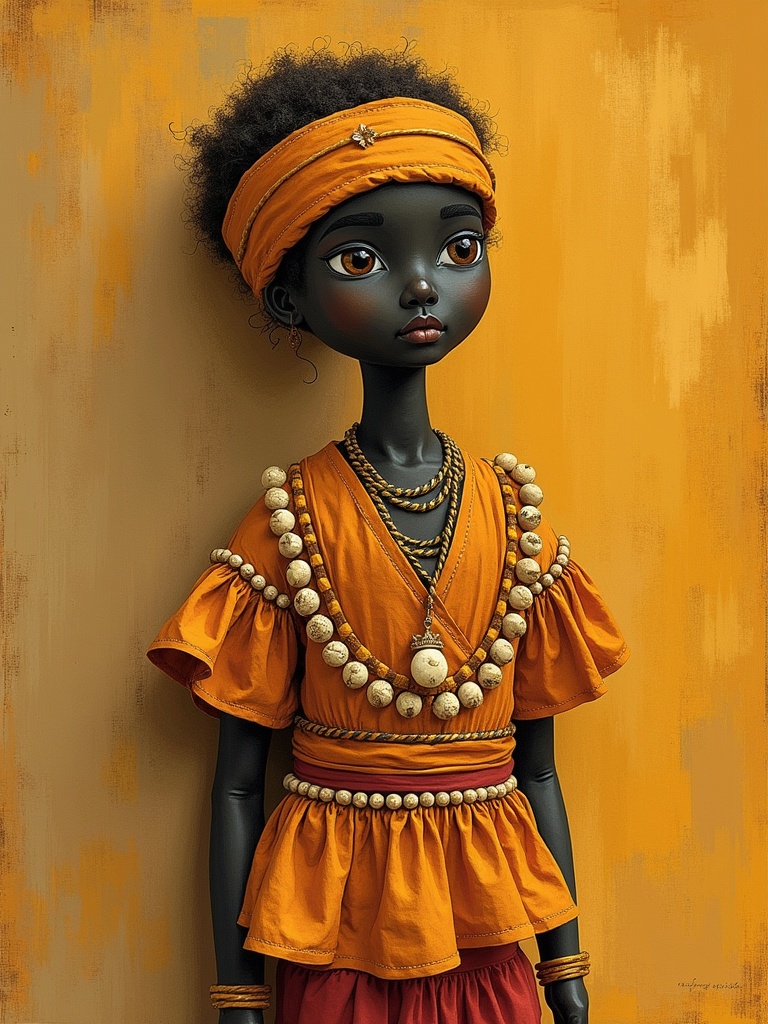
Young Shyaam journeying to learn from the Pende and Kongo kingdoms.
Answer all three to unlock this stage.
Unlock the previous stage first.
Crafting the doll
Garment: real raffia-style cloth with Kuba geometric patterns (cut-pile/embroidered look), cowrie shells & beads (child-safe). Signature attribute: a small mancala board and a folded Kuba cloth. Education card: explains Kuba good governance (merit titles, councils) and that men weave, women embroider — craft as identity, mirroring the Maker Circles. Sizes as standard. Proceeds → Kuba weaving cooperatives (DRC). Kuba patterns & royal regalia are living cultural property — render with Kuba authorities’ approval.
How this doll is made
Shyaam a-Mbul a-Ngoong, founding king of the Kuba Kingdom, is honoured in Kuba material culture above all through royal raffia textiles and the carved ndop portrait-figure tradition said to begin in his era. The look is built from raffia palm fibre cloth, bold geometric cut-pile and appliqué patterning, and prestige regalia heavy with cowrie shells and glass beads, with the deep red of tukula (camwood) reserved for objects of rank.
- Garments 2
- Accessories 3
- Materials 2
- Techniques 3
Garments
- Kuba raffia cloth (cut-pile / Kasai velvet)Plain-weave cloth of raffia palm fibre decorated with dense cut-pile embroidery that gives a velvety surface, together with flat stem-stitch outlines forming bold geometric motifs (diamonds, interlace). This 'Kasai velvet' / shoowa cloth is the signature Kuba prestige textile and the core of any Kuba ceremonial dress.DetailsEN
- Ceremonial overskirt (ntshak)A long wrapped skirt made of many woven raffia rectangles sewn together, then decorated by women with embroidery, cut patterns, and appliqué of contrasting raffia patches. Worn wound around the body on ceremonial occasions as an emblem of prestige and status.DetailsEN
Accessories
- Royal belt (yet)A wide ceremonial belt worn over the raffia skirt by men of rank, built on a fibre/leather base and densely covered with cowrie shells and geometric bands of glass beads (teal, white, dark). The accumulation of precious materials signals the high status of its wearer.DetailsEN
- Prestige cap (laket mishiing)A small coiled-and-woven raffia cap, the foundation for status display: cowrie shells and white, blue, yellow, black and red glass beads are stitched onto it in horizontal bands, with twisted raffia projections. Marks the wearer as a mature, respected member of Kuba society.DetailsEN
- Elephant-form royal mask/headdress (mukenga)A prestige helmet-headdress made from raffia, cowrie shells, glass beads, wood and feathers, taking the form of an elephant trunk as a symbol of rulership; abundant white cowries signal wealth and descent from the founding ancestor, with red parrot feathers as a notable's privilege.DetailsEN
Materials
- Raffia palm fibreStrips drawn from the young fronds of the raffia palm are the base material for all Kuba cloth. The fibre is rubbed by hand to soften it before weaving, and woven cloth is later pounded in a mortar to make it supple enough for embroidery.DetailsEN
- Tukula / camwood red dye (twool) + cowrie & glass beadsTwool (tukula), a deep red substance from the heartwood of camwood-type trees (Pterocarpus / Baphia), dyes prestige cloth and was used on the ndop's plinth; the Kuba regard it as protective. Imported cowrie shells and glass beads — both former currencies — are the precious decorative materials of royal regalia.DetailsEN
Techniques
- Cut-pile (velvet) embroideryWorked by women: short raffia strands are individually inserted with a needle under one or more warp/weft threads, then clipped close to the surface at both ends so the cut ends stand up as a dense raised pile, producing the velvety geometric patterns of 'Kasai velvet' / shoowa cloth.DetailsEN
- Single-heddle loom raffia weavingWorked by men on an inclined, single-heddle loom set at an unusual angle: warp fibres are stretched between two horizontal bars and a heddle bar lifts alternate threads to pass the weft, producing small squares of plain-weave raffia cloth (roughly 26x28 in) that are later joined for skirts and panels.DetailsEN
- Ndop royal portrait-figure carvingA carved wooden seated portrait of a Kuba king, made after his death to hold his spirit rather than his likeness. Each figure is identified by a personal emblem (ibol) on the base; Shyaam a-Mbul a-Ngoong's ndop bears a lele/mancala game board and an ikul peace-knife, and is darkened with camwood. (Honour the tradition; do not depict any living royal.)DetailsEN
How it's made
Every doll is sewn by hand from natural materials — built to last a lifetime and to be repaired, not replaced. Here is the shopping list and the work steps. Sizes: Classic 32 cm (heirloom) · Kidogo 18–20 cm (toddlers, no small parts) · Shule 28 cm (school edition).
Shopping list
- Natural cotton or linen for the body (skin tone), ~0.5 m
- Wool or cotton stuffing — no plastic
- Cotton thread and embroidery floss in matching colours
- Garment fabric in this doll's colours (see the fabrics above)
- Yarn for the hairstyle
- Beads, cowrie shells and trims as shown
- Sharps and embroidery needles, pins, fabric scissors, fabric marker
Work instructions
- Trace and cut the body pattern at your chosen size (Classic 32 cm / Kidogo 18–20 cm / Shule 28 cm).
- Sew the body pieces right sides together, leave an opening, turn and stuff firmly with natural fibre, then close by hand.
- Embroider the face gently and with dignity — no plastic parts for the toddler line.
- Make the hair from yarn following the chosen hairstyle and attach it securely.
- Cut and sew the garment from this doll's fabric, then dress the doll.
- Add the beadwork, shells, trims and any attribute by hand.
- Check every seam and reinforce it — the doll should be lifelong and repairable, with no loose small parts for small children.
Origin & Ethics
How we know this
Founder via oral tradition (★★★★☆); the kingdom & its art are well documented (museum collections worldwide). Describe councils/merit-titles accurately rather than over-romanticising; Kuba patterns/regalia are sacred living property → consent.
Committee: the Kuba royal court (nyim) & DRC cultural bodies, Kuba weavers’ cooperatives, art historians. Living dynasty → real veto.
Sources
- EBSCO Research Starters — Formation of the Kuba Kingdom
- The Ethnic Home — Kuba textiles from the DRC
- Wikipedia — Kuba art
- Kohan Textile Journal — Kuba cloth history
- The British Museum — Ndop figure of King Shyaam aMbul aNgoong, Af1909,1210.1 (wood + camwood, seated king, ikul knife, lele game-board emblem)
- Google Arts & Culture (British Museum) — Ndop wooden carving of King Shyaam aMbul aNgoong, 55cm, spirit-portrait, mancala emblem
- Wikipedia — Kuba textiles: single-heddle loom, cut-pile, appliqué, twool/camwood dye, male/female division of labour
- Brooklyn Museum — Raffia Cut-Pile Cloth (plain-weave raffia, cut pile + flat embroidery, diamond motif)
- Brooklyn Museum — Overskirt (ntshak), Kuba raffia ceremonial skirt
- Cleveland Museum of Art — Royal Belt (yet), cowrie shells + glass beads on fibre/leather, worn over raffia skirt
- The Metropolitan Museum of Art — Prestige Cap (Laket mishiing), coiled raffia with cowries and banded glass beads
- The Metropolitan Museum of Art (Heilbrunn Timeline) — Titleholder Hat (Laket Mishiing), 1974.83.14
- Smithsonian National Museum of African Art — Kuba Cap mask (court regalia object record)
- Conservation OnLine (WAAC Newsletter) — Kuba Textiles: An Introduction (fibre softening, weaving, finishing)
- Smarthistory — Ndop Portrait of a Kuba king (ibol emblem, spirit-portrait function, royal portraiture tradition)
- Khan Academy — Ndop portrait of a Kuba king (AP Art History; carving, posture, mancala emblem)