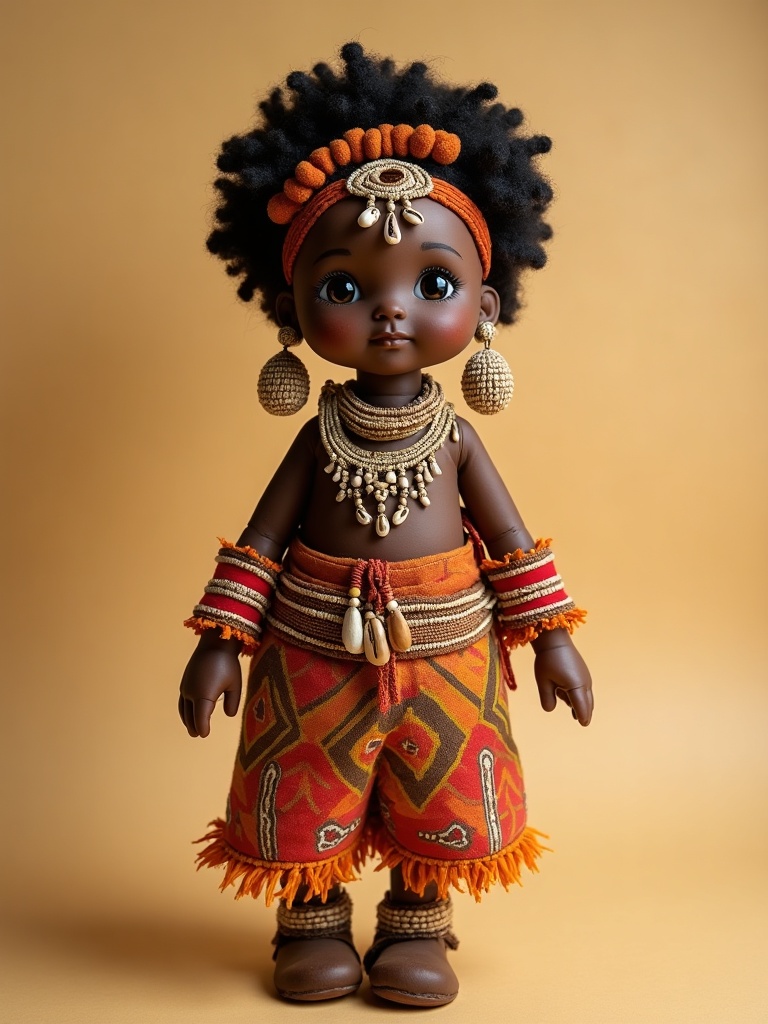
Art, Craft & Good Governance
Shyaam a-Mbul
According to Kuba oral tradition, Shyaam a-Mbul a Ngoong was the adopted son of a queen who, before he ruled, travelled to the Pende and Kongo kingdoms to study how good states are run. Around 1625 he returned and founded/unified the Kuba…
- People
- Kuba (Bushong)
- Country
- DR Congo
- Region
- Central Africa
- Era
- ≈1625 (founder)
- Theme
- Art, Craft & Good Governance
Make your own
Design your Shyaam a-Mbul
Pick a garment, a hairstyle and a scene, enter the PIN and generate a fresh image of Shyaam a-Mbul with AI.
Each image is generated live with fal.ai.
Generated images
No images generated yet — be the first.
Tradition & Origin
According to Kuba oral tradition, Shyaam a-Mbul a Ngoong was the adopted son of a queen who, before he ruled, travelled to the Pende and Kongo kingdoms to study how good states are run. Around 1625 he returned and founded/unified the Kuba Kingdom between the Sankuru and Kasai rivers in central DR Congo, with its capital at Nsheng (Mushenge).
★ Good rule, woven into cloth
Shyaam is remembered as the architect of Kuba political, social and artistic life. He wove 17+ peoples into one matrilineal kingdom governed by councils, and made aristocratic titles a matter of merit, not birth — so families competed by sponsoring art and excellence. The result was a golden age of Kuba craft: world-famous raffia textiles ("Kasai velvet," admired centuries later by Matisse), carved ndop royal portrait statues (Shyaam’s own bears a mancala board, his symbol of strategic wisdom), and masterful masks. Among the Kuba, men weave the raffia and women embroider it — craft as the very root of identity, exactly the spirit of the Maker Circles.
Honesty: Shyaam is a founder known through oral tradition; some popular accounts romanticise the kingdom’s "elections/juries," so we describe its councils and merit-titles accurately. The Kuba nyim (king) still reigns today — living heritage.
First he learned how others ruled. Then he made rule itself an art. His crown was a length of woven cloth.
Values & Capabilities
Capabilities
◆◆◆◆◆ shows how central a gift is — five diamonds mark a signature strength, fewer mark a supporting one.
He travelled to other kingdoms to learn good governance before he ever ruled.
He made aristocratic titles a reward for excellence, not an accident of birth.
He united 17+ groups into one matrilineal kingdom of councils.
Under him Kuba cloth and sculpture reached world-class refinement.
His royal symbol was the mancala board — patient, calculating wisdom.
Development
1 of 3 stages unlocked
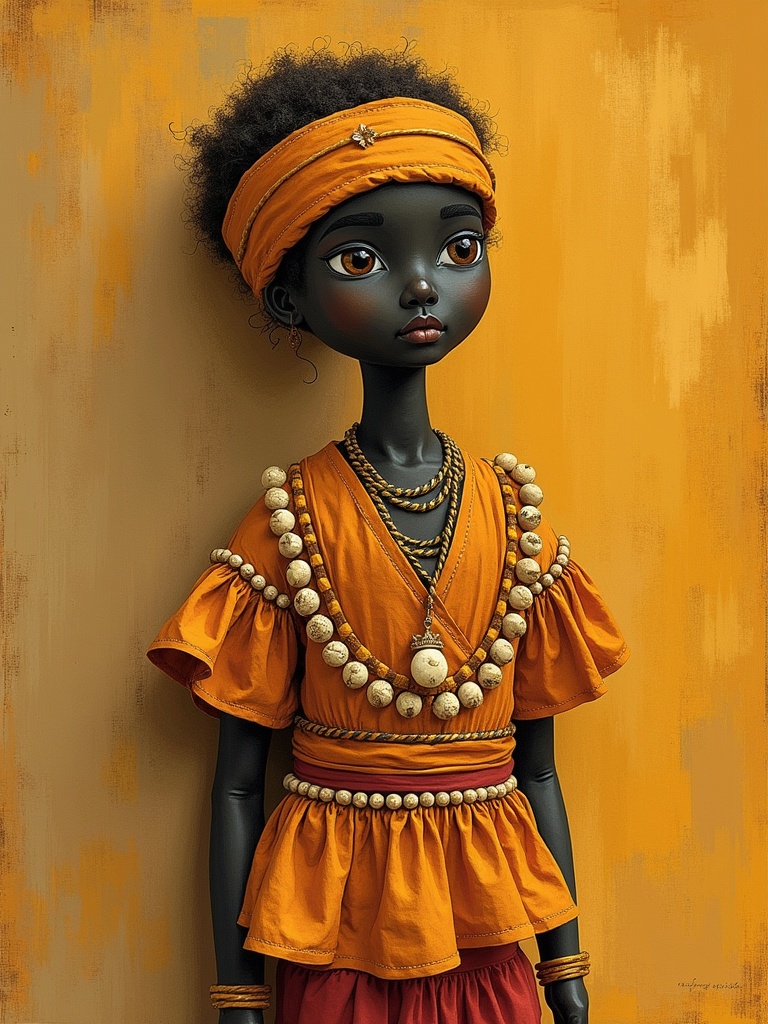
Young Shyaam journeying to learn from the Pende and Kongo kingdoms.
Answer all three to unlock this stage.
Unlock the previous stage first.
Make & Learn
Garment: real raffia-style cloth with Kuba geometric patterns (cut-pile/embroidered look), cowrie shells & beads (child-safe). Signature attribute: a small mancala board and a folded Kuba cloth. Education card: explains Kuba good governance (merit titles, councils) and that men weave, women embroider — craft as identity, mirroring the Maker Circles. Sizes as standard. Proceeds → Kuba weaving cooperatives (DRC). Kuba patterns & royal regalia are living cultural property — render with Kuba authorities’ approval.
How it's made
Every doll is sewn by hand from natural materials — built to last a lifetime and to be repaired, not replaced. Here is the shopping list and the work steps. Sizes: Classic 32 cm (heirloom) · Kidogo 18–20 cm (toddlers, no small parts) · Shule 28 cm (school edition).
Shopping list
- Natural cotton or linen for the body (skin tone), ~0.5 m
- Wool or cotton stuffing — no plastic
- Cotton thread and embroidery floss in matching colours
- Garment fabric in this doll's colours (see the fabrics above)
- Yarn for the hairstyle
- Beads, cowrie shells and trims as shown
- Sharps and embroidery needles, pins, fabric scissors, fabric marker
Work instructions
- Trace and cut the body pattern at your chosen size (Classic 32 cm / Kidogo 18–20 cm / Shule 28 cm).
- Sew the body pieces right sides together, leave an opening, turn and stuff firmly with natural fibre, then close by hand.
- Embroider the face gently and with dignity — no plastic parts for the toddler line.
- Make the hair from yarn following the chosen hairstyle and attach it securely.
- Cut and sew the garment from this doll's fabric, then dress the doll.
- Add the beadwork, shells, trims and any attribute by hand.
- Check every seam and reinforce it — the doll should be lifelong and repairable, with no loose small parts for small children.
Origin & Ethics
How we know this
Founder via oral tradition (★★★★☆); the kingdom & its art are well documented (museum collections worldwide). Describe councils/merit-titles accurately rather than over-romanticising; Kuba patterns/regalia are sacred living property → consent.
Committee: the Kuba royal court (nyim) & DRC cultural bodies, Kuba weavers’ cooperatives, art historians. Living dynasty → real veto.