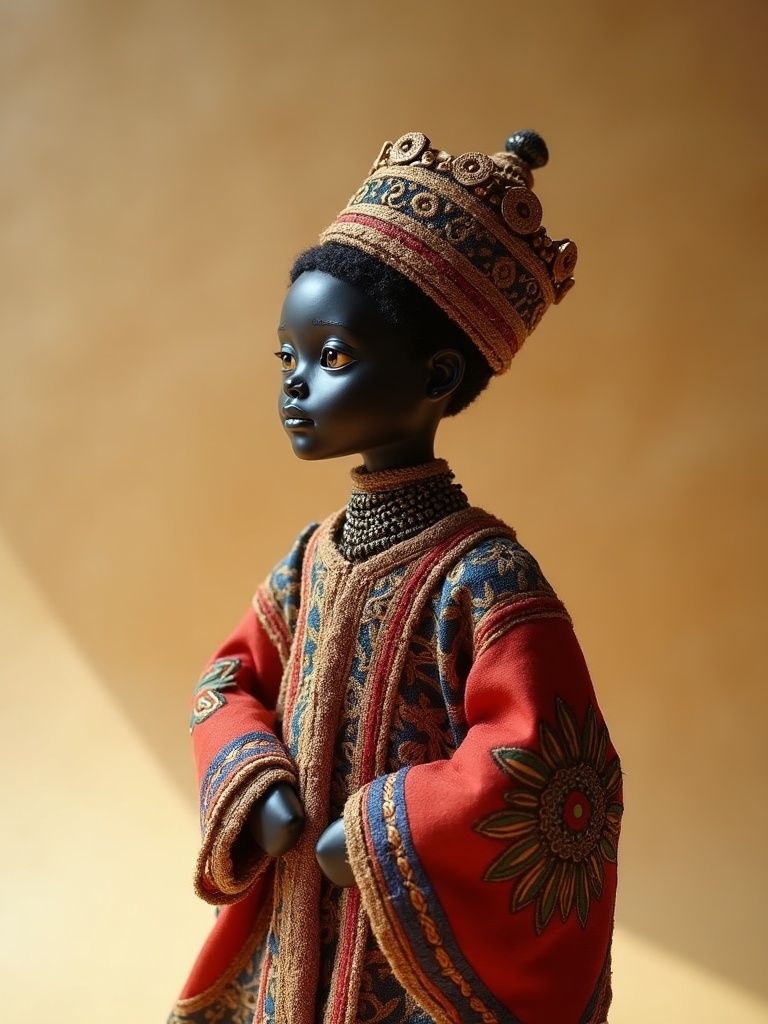
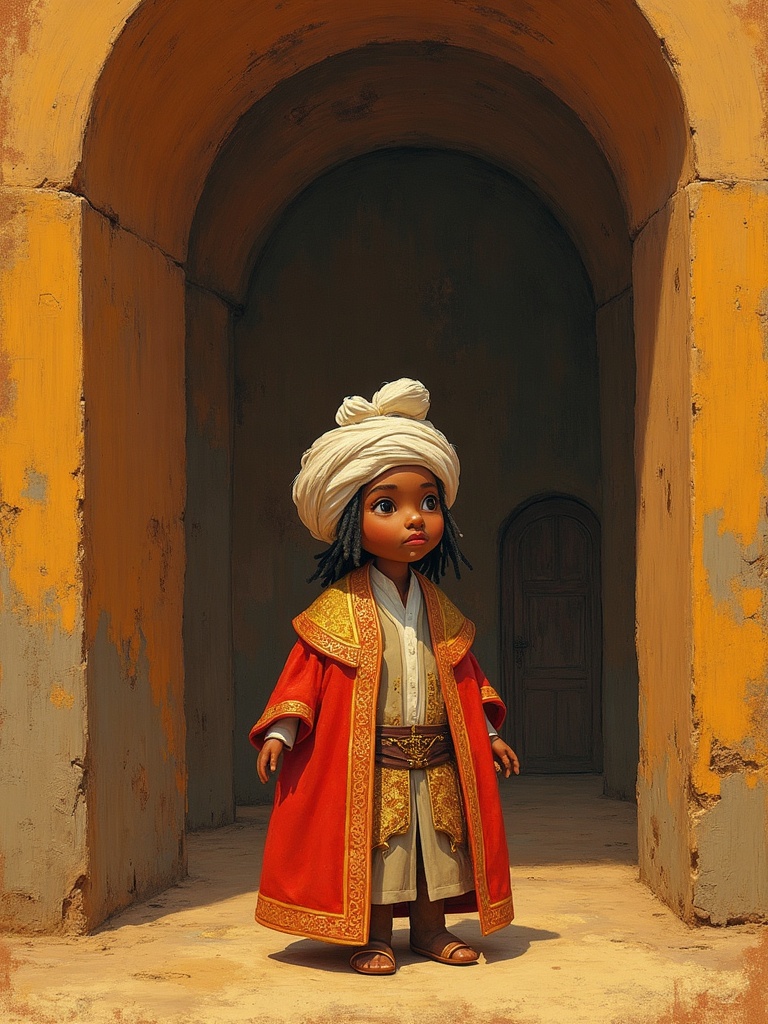
AI design preview — not a photo of the finished handmade doll
Invention & Writing
Njoya of Bamum
A king who dreamed of "a book that speaks without being heard" — and then invented an entire writing system to make it real.
- People
- Bamum (Bamoun)
- Country
- Cameroon
- Region
- Central Africa
- Era
- ≈1876–1933
- Theme
- Invention & Writing
Make your own
Design your Njoya of Bamum
Pick a garment, a hairstyle and a scene, enter the PIN and generate a fresh image of Njoya of Bamum with AI.
Each image is generated live with fal.ai.
Generated images
AI design preview — not a photo of the finished handmade doll
No images generated yet — be the first.
Tradition & Origin
A king who dreamed of "a book that speaks without being heard" — and then invented an entire writing system to make it real.
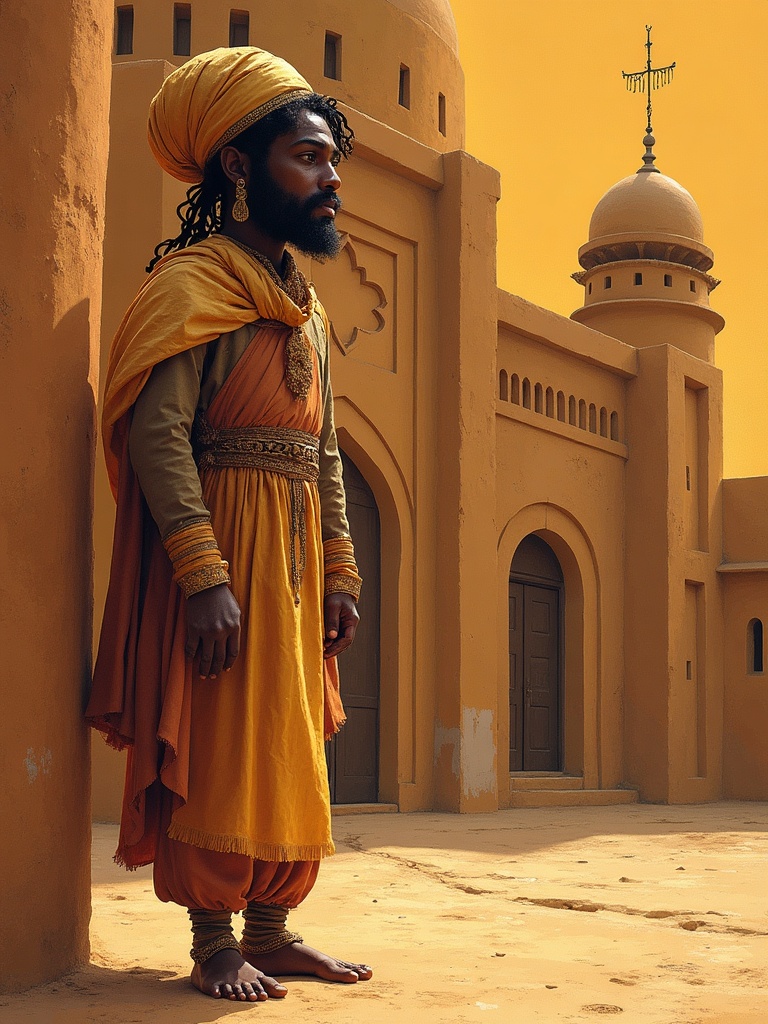
Refined over ~14 years from hundreds of pictures into a clean ~80-sign syllabary, A-ka-u-ku — with no alphabet copied.
DetailsENIbrahim Njoya ruled the Bamum Kingdom from his capital at Foumban, in the grasslands of what is now western Cameroon — a dynasty founded centuries earlier by the warrior-prince Nchare. Around 1896, with no model to copy, he set out to give his people their own script. As the story is told, a dream told him to gather his court and have them draw many different things and name them; from those drawings he would build writing.
Over roughly fourteen years the system evolved through several stages — from hundreds of pictures down to a streamlined syllabary of about 80 characters, named A-ka-u-ku after its first signs. Njoya used it to write his people into history: Libonar Oska, a 548-page chronicle of Bamum laws and customs (1912), a book of medical remedies (1908), and works on religion and dream-interpretation. He founded a palace school in 1898 that grew into a network of schools, commissioned a printing press, and rebuilt the great Foumban palace as an archive of his kingdom's knowledge.
Then colonialism closed in. The French administration carved up the kingdom, stripped the palace of its craft-guilds, and pulled children into colonial schools until — as an official noted by 1930 — the script "was no longer used except by the sultan and his courtiers." In 1931 Njoya was forced into exile in Yaoundé, where he died on 30 May 1933. But the manuscripts survived: today thousands of Bamum documents have been digitized, and A-ka-u-ku is being taught and revived in Foumban.
Timeline
- ≈1876born in Foumban; mother rules as regent
- ≈1895ascends the throne
- 1895–96invents the Lewa script; refines it to A-ka-u-ku
- 1917builds the Foumban palace; writes books, maps his kingdom
- 1931French exile him; the script is suppressed
- 1933dies in Yaoundé · today the script is revived in Foumban
Did you know?
- Bamum is one of the very few scripts in history whose entire invention by a single named ruler is documented — Njoya devised it, then taught it across his kingdom.DetailsEN
- Among his books was a treatise of medical remedies (1908) — a king who set out to record not only his people's laws but their pharmacopoeia.DetailsEN
- The British Library's Endangered Archives Programme helped save the royal palace archive at Foumban — correspondence, calendars, maps and medical papers reaching back to the 1870s.DetailsEN
- French colonial officials so eroded the script's use that by 1930 it survived mainly inside the palace — yet today it is being taught again in Foumban.DetailsEN
They exiled the king, but the letters he dreamed are being read again.
Values & Capabilities
Capabilities
◆◆◆◆◆ shows how central a gift is — five diamonds mark a signature strength, fewer mark a supporting one.
He created a whole script so his people could write their own history.
~15 books, a history, a medical encyclopedia, a map of his realm.
His great palace still stands as a museum.
He even built a corn-grinding mill.
Colonisers banned his script; children learn it again today.
Development
1 of 3 stages unlocked
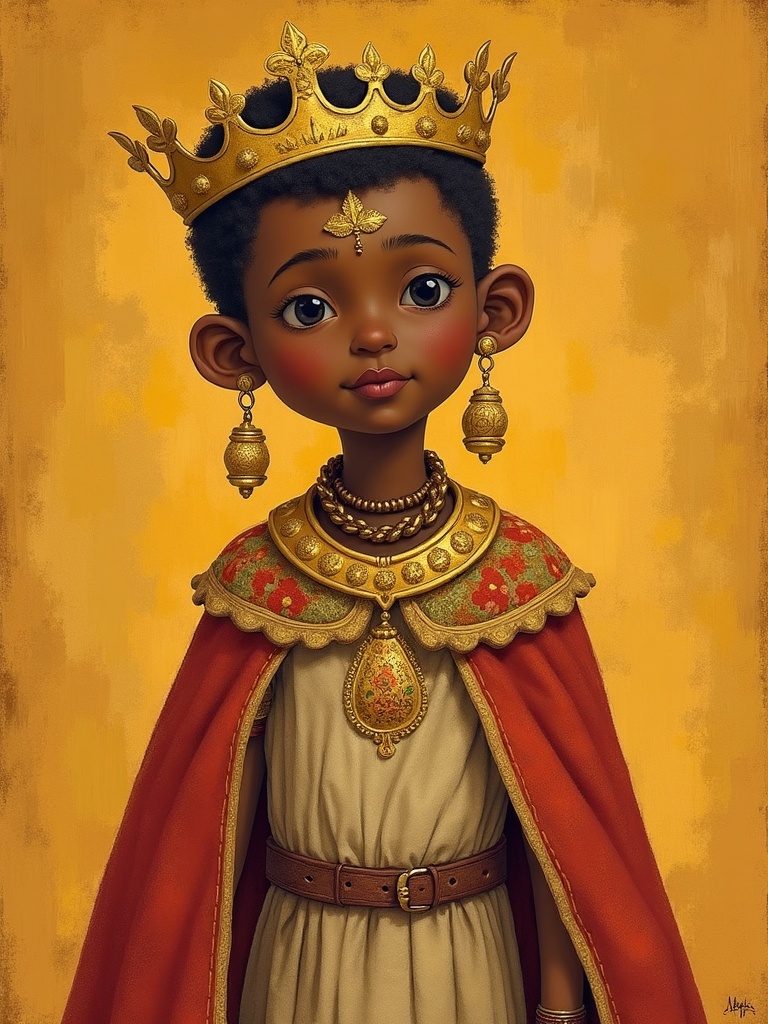
The young Njoya in Foumban, curious, becoming king after a regency.
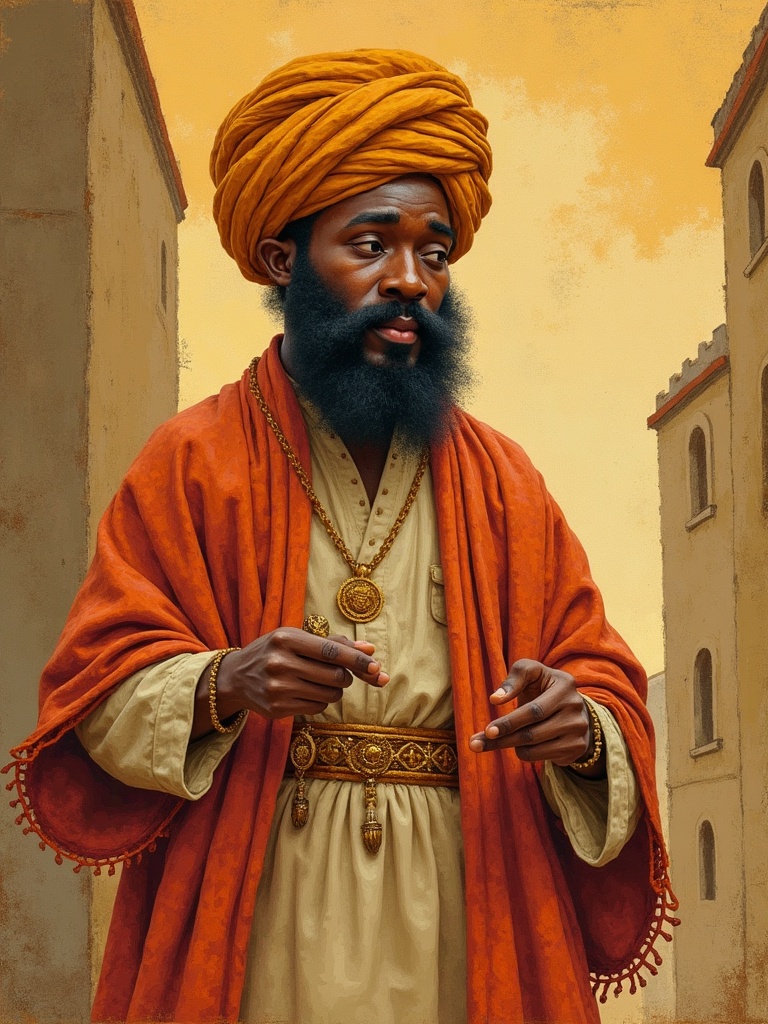
Answer all three to unlock this stage.
Unlock the previous stage first.
Crafting the doll
Garment: 100% cotton in Bamum indigo & royal red with embroidery, a beaded cap and brass-tone ornaments (child-safe). Signature attribute: a little book covered in A-ka-u-ku script (felt, embroidered signs). Education card: explains that Africa invented its own writing systems, names the French suppression honestly, and points to the revival project. Sizes Classic 32 / Kidogo 18–20 / Shule 28. Proceeds → the Bamum Scripts and Archives Project, Foumban.
How this doll is made
Sultan Ibrahim Njoya's look is rooted in the prestige material culture of the Bamum court at Foumban, where royal authority was displayed through deep-indigo Ndop cloth, lavish glass-bead and cowrie-covered regalia built over carved wood, cast-brass ornaments, and Njoya's own invented A-ka-u-ku script. Every garment and object signalled rank, wealth, and the inventiveness of a reforming king.
- Garments 2
- Accessories 3
- Materials 1
- Techniques 4
Garments
- Ndop indigo prestige clothA large prestige wrapper of handspun cotton, woven in narrow strips sewn together, then resist-dyed deep indigo blue with white stitched-resist geometric and figurative royal motifs; worn as a body wrapper to assert royal status and used as a backdrop for the throne and court ceremonies.DetailsEN
- Ndop body wrapper as royal court dressBeyond display backdrops, the deep-indigo Ndop cloth was worn directly by the king as a body wrapper and ceremonial garment to assert royal status at court appearances and festivals — the principal woven prestige dress of the Bamum sovereign.DetailsEN
Accessories
- Beaded prestige cap / headdressA titled Bamum ruler's cap or headdress woven from a vegetable-fibre base and densely worked with knotted yarn tufts and glass beads; both shape and materials signalled the wearer's rank, with the most elaborate beaded caps reserved for the fon.DetailsEN
- Beaded and cowrie-covered throne (Mandu Yenu style)A two-part royal seat with footstool carved from solid timber, then completely covered with European glass beads and Indian-Ocean cowrie shells; figures of protective twins, a two-headed snake and the earth-spider (wisdom) proclaim royal power. Njoya's famous beaded throne is the model for this prestige object.DetailsDE
- Beaded elephant mask (Kuosi society)An extravagant masquerade element of cloth panels (a hood with long front and back trunk-panels and large disk ears) entirely sewn with colourful glass beads on a fibre/raffia ground; worn by the elite Kuosi society that serves and protects the king, with beadwork marking noble rank.DetailsEN
Materials
- Indigo cotton, glass beads, cowrie shells, brass, raffiaThe core palette of Bamum royal material culture: handspun indigo-dyed cotton for Ndop cloth; imported European glass seed beads and Indian-Ocean cowrie shells (both rare, costly, and rank-restricted) for regalia; cast brass/bronze for pipes and ornaments; and raffia fibre used both as resist-stitching thread and as the cloth ground over carved-wood armatures.DetailsEN
Techniques
- Ndop stitch-resist indigo dyeingHow it is made: the desired pattern is tightly hand-stitched into the woven cotton cloth with raffia-fibre thread; the whole cloth is then immersed in an indigo vat so only the unstitched ground turns blue; once dyed and dried, the raffia stitches are pulled out, revealing crisp white resist motifs on a deep-blue field. King Njoya encouraged local production of this cloth at Foumban from about 1910.DetailsEN
- Grassfields beadwork over a cloth-and-armature formHow it is made: a wooden sculpture (throne, mask, figure) or a gourd is wrapped in raffia/cotton cloth to form a stitchable skin, then thousands of glass seed beads are sewn one section at a time into dense geometric and figurative patterns directly onto that cloth surface, fully covering the object.DetailsEN
- Lost-wax (cire perdue) brass castingHow it is made: a clay core is modelled and coated in beeswax carved with fine detail; a clay mould is built over the wax with pouring and venting ducts; the mould is heated so the wax melts and runs out, leaving a cavity; molten brass/bronze is poured in, and after cooling the clay mould is broken away to free the cast pipe or ornament. Practised across the Grassfields for prestige objects.DetailsEN
- Bamum A-ka-u-ku scriptNjoya's own invention: a writing system he devised from about 1896, evolving from a 500-600 character pictographic system to an 80-character syllabary by 1910 (named after its first four signs). It can be shown on the doll as inscribed tablets, manuscripts, or motifs, marking Njoya as a king-inventor.DetailsEN
How it's made
Every doll is sewn by hand from natural materials — built to last a lifetime and to be repaired, not replaced. Here is the shopping list and the work steps. Sizes: Classic 32 cm (heirloom) · Kidogo 18–20 cm (toddlers, no small parts) · Shule 28 cm (school edition).
Shopping list
- Natural cotton or linen for the body (skin tone), ~0.5 m
- Wool or cotton stuffing — no plastic
- Cotton thread and embroidery floss in matching colours
- Garment fabric in this doll's colours (see the fabrics above)
- Yarn for the hairstyle
- Beads, cowrie shells and trims as shown
- Sharps and embroidery needles, pins, fabric scissors, fabric marker
Work instructions
- Trace and cut the body pattern at your chosen size (Classic 32 cm / Kidogo 18–20 cm / Shule 28 cm).
- Sew the body pieces right sides together, leave an opening, turn and stuff firmly with natural fibre, then close by hand.
- Embroider the face gently and with dignity — no plastic parts for the toddler line.
- Make the hair from yarn following the chosen hairstyle and attach it securely.
- Cut and sew the garment from this doll's fabric, then dress the doll.
- Add the beadwork, shells, trims and any attribute by hand.
- Check every seam and reinforce it — the doll should be lifelong and repairable, with no loose small parts for small children.
Origin & Ethics
How we know this
On honesty: very well documented (the palace museum; Library of Congress research guide). We celebrate the invention (uncontested) while naming colonial suppression honestly and noting he was a king of a hierarchical society making pragmatic colonial-era choices.
Committee: the Bamum palace & current Sultan, the Bamum Scripts and Archives Project, Cameroonian cultural bodies, historians. Living dynasty → binding veto. The A-ka-u-ku script is used decoratively only with Bamum palace approval.
Sources
- Wikipedia — Ibrahim Njoya
- Wikipedia — Bamum script
- Library of Congress — Sultan Ibrahim Njoya
- ASC Leiden — Ibrahim Njoya
- Wikipedia — Bamum Scripts and Archives Project
- Textile Museum of Canada, Royal Display Cloth (Ndop) T94.3021 — handspun cotton, raffia stitch-resist, indigo, Grassfields royal use
- Explore-VC, The Case of Ndop Royal Fabric — Bamum Ndop production, raffia resist stitching, indigo vat dyeing
- The Metropolitan Museum of Art, Royal Display Cloth (Ndop), Cameroon Grassfields
- Ethnologisches Museum (Staatliche Museen zu Berlin), "Mandu Yenu": The Royal Throne of Bamum — beaded, cowrie-covered carved-wood throne gifted by Njoya in 1908
- The Conversation, Museum of the Bamoun Kings (Foumban) — beaded stools, headdresses, royal pipes, Njoya's manuscripts, indigo cloth
- Wikipedia, Foumban Royal Palace — Bamum kingdom seat built by Njoya (1917), palace museum of the dynasty
- Smarthistory, Elephant Mask (Kuosi Society), Cameroon Grassfields — cloth, glass beads, raffia; royal/fon association
- The Metropolitan Museum of Art, Beadwork in the Arts of Africa and Beyond — glass beads sewn over raffia-covered wood armatures
- The Metropolitan Museum of Art, Ashetu prestige cap, Cameroon Grassfields — beaded/fibre rank cap
- Pitt Rivers Museum, Oxford, Casting a brass head (cire perdue) — step-by-step lost-wax brass casting
- The Metropolitan Museum of Art, African Lost-Wax Casting — wax model, clay mould, molten brass technique
- Library of Congress, About Bamum Script — Njoya's a-ka-u-ku writing system
- Isaac Samuel, African History Extra, The invention of writing in an African kingdom: the Bamum script (1897-1931) — palace school, library, printing press