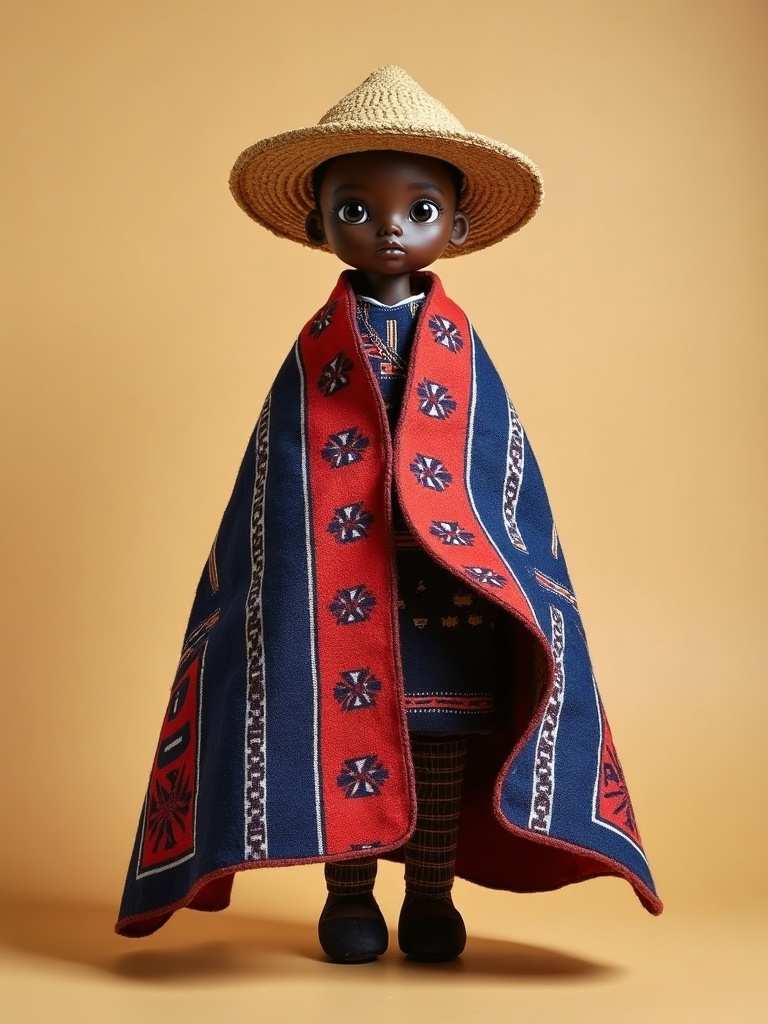
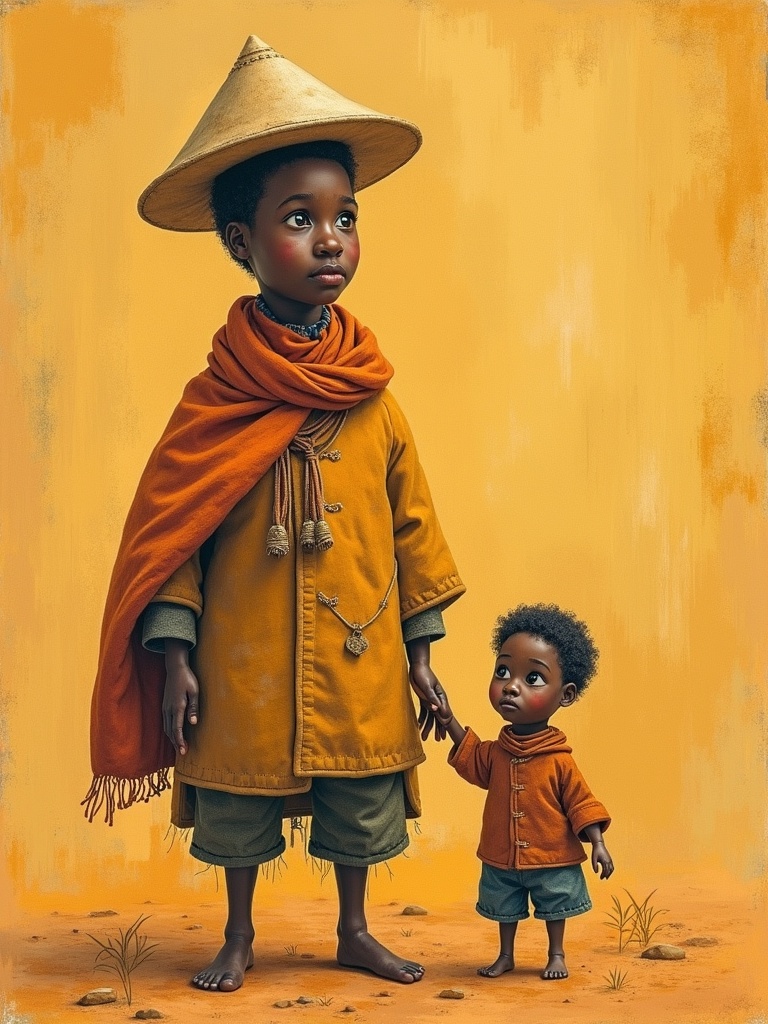
AI design preview — not a photo of the finished handmade doll
Diplomacy & Shelter
Moshoeshoe I
He built a nation not by conquering his neighbours, but by sheltering them — on a mountain that was never taken.
- People
- Basotho
- Country
- Lesotho
- Region
- Southern Africa
- Era
- ≈1786–1870
- Theme
- Diplomacy & Shelter
Make your own
Design your Moshoeshoe I
Pick a garment, a hairstyle and a scene, enter the PIN and generate a fresh image of Moshoeshoe I with AI.
Each image is generated live with fal.ai.
Generated images
AI design preview — not a photo of the finished handmade doll
No images generated yet — be the first.
Tradition & Origin
He built a nation not by conquering his neighbours, but by sheltering them — on a mountain that was never taken.
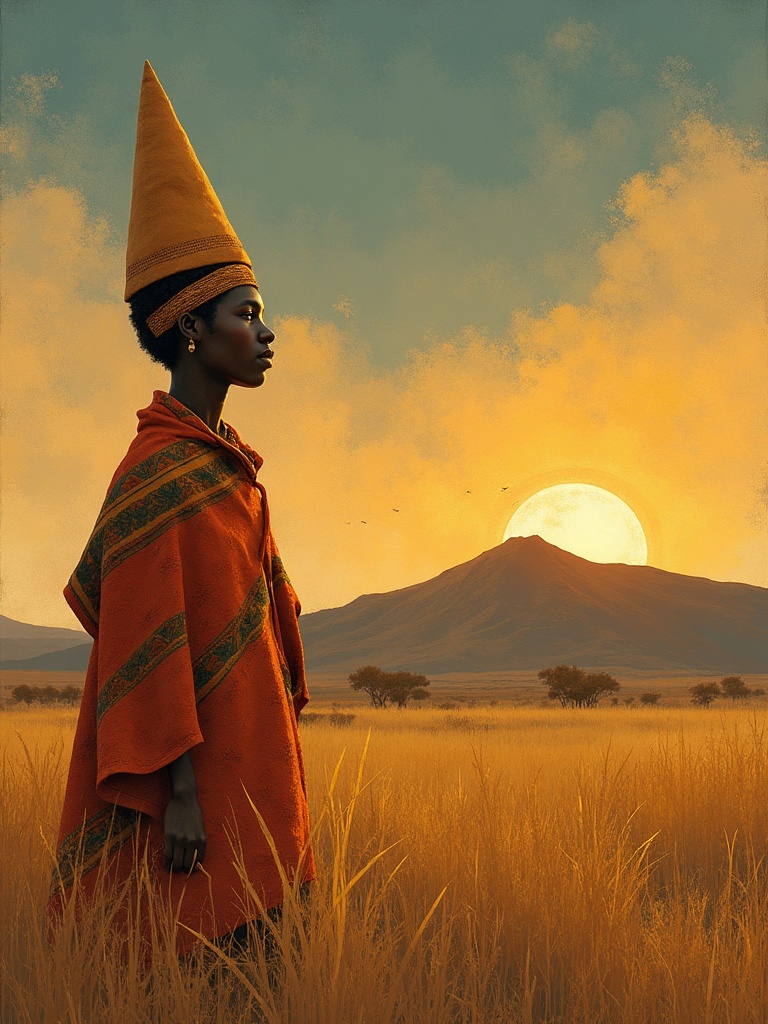
By 1839 he had lent out an estimated 20,000 head of cattle in trust — building loyalty through generosity, not conquest.
DetailsENBorn around 1786 near the upper Caledon River, Moshoeshoe I came of age during the Difaqane ("the crushing") — the wave of war, famine and displacement that tore through southern Africa in the early 19th century. Where others raided and scattered, he gathered. In the early months of 1824 he led a small band onto Thaba Bosiu, a flat-topped sandstone plateau ringed by cliffs and rising some 120 metres above the plain, and made it his capital. Refugees from shattered clans streamed to him, and from them he forged the Basotho nation.
His genius was diplomacy. Rather than rule by the spear, he bound followers to him through mafisa — a system of lending cattle in trust to those in need, in return for loyalty and service; by 1839 he had distributed most of an estimated 20,000 head this way. He negotiated with the Zulu, the Ndebele of Mzilikazi, the Boer trekkers and the Cape, sent cattle to enemies as gestures of peace, and in 1833 welcomed French Protestant missionaries who helped him deal with the wider world. Thaba Bosiu, meanwhile, repelled every assault — by AmaNgwane, by Ndebele, by Boer commando and British regulars alike — and was never once taken.
Yet shelter could not hold back the colonial tide forever. As Boers of the Orange Free State overran Basotho land in the 1860s wars, Moshoeshoe made a final diplomatic move: he appealed to the British, and on 12 March 1868 his country became a protectorate — a decision that preserved a Basotho homeland and is the reason Lesotho exists as an independent country today, encircled by South Africa rather than absorbed into it. He died in 1870 and lies buried on the summit of his unconquered mountain.
Timeline
- ≈1786born at Menkhoaneng
- early 1820sleads his people to Thaba Bosiu; unites Mfecane refugees
- 1833welcomes missionaries (first Sesotho books printed)
- 1868secures British protection, saving the land from the Boers
- 1870dies at Thaba Bosiu
Did you know?
- He often sent cattle to defeated enemies as a gesture of peace — diplomacy, not destruction, was how he grew his nation.DetailsEN
- His mountain stronghold Thaba Bosiu was besieged for decades by Zulu, Ndebele, Boer and British forces — and never once captured.DetailsEN
- By appealing for British protection in 1868, Moshoeshoe preserved the homeland that survives today as independent Lesotho, surrounded entirely by South Africa.DetailsEN
A king is measured by who he conquers — unless, like Moshoeshoe, he is measured by who he saved.
Values & Capabilities
Capabilities
◆◆◆◆◆ shows how central a gift is — five diamonds mark a signature strength, fewer mark a supporting one.
He turned a mountain into a refuge and refugees into a nation.
He out-talked empires and saved his land without being conquered.
He forgave defeated enemies and lent them cattle (mafisa).
From Thaba Bosiu he repelled the strongest armies of the region.
He wove many peoples into one Basotho nation.
Development
1 of 3 stages unlocked
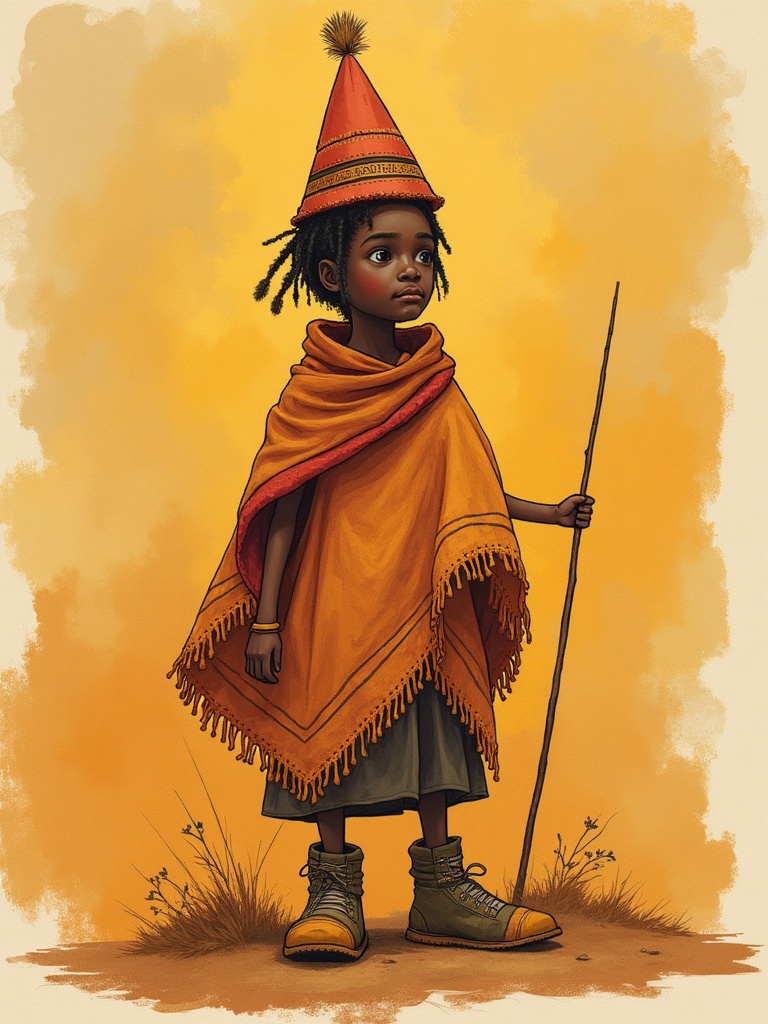
The young Moshoeshoe at Menkhoaneng, earning a name for daring and leadership.
Answer all three to unlock this stage.
Unlock the previous stage first.
Crafting the doll
Garment: a miniature Basotho blanket (wool, blue/red with motifs) and a woven straw mokorotlo. Signature attribute: a small Basotho pony or an ox (mafisa). Education card: explains diplomacy over conquest, the Mfecane, and honestly notes the blanket's 19th-century trade origin. Sizes Classic 32 / Kidogo 18–20 / Shule 28. Proceeds → Basotho weaving / heritage in Lesotho.
How this doll is made
Moshoeshoe I, founder of the Basotho nation from his mountain stronghold Thaba Bosiu, is most readily pictured in the wool Basotho blanket worn pinned at the shoulder and the conical mokorotlo straw hat. Both are honest products of 19th-century Basotho material culture: the blanket is an industrially woven wool textile, first secured by Moshoeshoe himself from English mills around the 1860s-1870s to replace scarce animal-skin karosses, that the Basotho adopted, named and made wholly their own as a national emblem, while the mokorotlo, grass-weaving, mohair and beadwork represent older indigenous craft skills still practised in Lesotho today.
- Garments 2
- Accessories 3
- Materials 2
- Techniques 3
Garments
- Basotho wool blanket (worn as a cloak)A thick rectangular wool blanket worn as a body-cloak, pinned at the shoulder in imitation of the older animal-skin kaross. It is not hand-spun in the village: Moshoeshoe I secured specially designed durable blankets from English textile maker Donald Fraser around 1876, after skins for karosses grew scarce by 1860; the Basotho adopted the imported wool textile and made it a national dress.DetailsEN
- Seanamarena blanket (chief's pattern)The most prestigious named blanket type; the name means roughly to swear by / honour the chiefs. Two classic patterns: the poone (mealie/corncob) motif symbolising fertility and wealth, and the chromatic design with a honeycomb ground and ace-of-spades motif designed by Charles Hendry Robertson. A characteristic pinstripe, originally a weaving fault, must run vertically to symbolise growth and dictates how the blanket is worn.DetailsEN
Accessories
- Mokorotlo conical straw hatThe national emblem of Lesotho (it appears on the flag and licence plates), a tall pointed grass hat with a distinctive looped or knotted topknot. Its conical form is said to be inspired by Mount Qiloane, the cone-shaped hill near Thaba Bosiu. Historically worn by chiefs at the pitso (public assembly); there is no firm evidence of it before the mid-19th century, the era of Moshoeshoe.DetailsEN
- Blanket pin / fasteningThe blanket is held closed by a single large pin at the shoulder. Men wear the darker side out with the opening to the right, pinned at the right shoulder and the pin kept hidden; women wear the lighter side out with a large folded collar, pinned at the front, often with a visible large metal safety pin. A married woman wraps the blanket at the waist rather than the shoulders.DetailsEN
- Kharetsa / emblem-bearing blanket motifsSome blanket designs carry national symbols useful for doll detailing: the Kharetsa pattern (named for Lesotho's endemic spiral aloe) shows a shield, spear, knobkerrie and the mokorotlo hat; Victoria England designs include heraldic badges; the leopard, crown and playing-card motifs recur. These printed/woven emblems, not added beadwork, are what give the cloak its character.DetailsEN
Materials
- Wool and mohairThe core fibres of Basotho dress. Blankets were originally pure wool (modern ones often blend merino wool with dralon/acrylic); Lesotho is one of the world's leading mohair (Angora goat) producers, and women weave mohair into rugs, tapestries and wall hangings. For an authentic doll the cloak should read as heavy woven wool, not printed cotton.DetailsEN
- Highland grass (mosea / leholi)The mokorotlo is made from indigenous highland grass called mosea or leholi that grows in the mountains of Lesotho and is brought to hat-weaving workshops (many in the Botha-Bothe district). The grass is selected, harvested and soaked before weaving, giving the hat its pale straw colour.DetailsEN
Techniques
- Mokorotlo straw-plaiting and coilingMade by skilled weavers (traditionally trained through apprenticeship) who interlace and coil thin strands of softened grass: plaiting interlaces strips over-and-under, twining twists strands for strong seams, and coiling winds strands into spirals to build up the cone. The complexity of the weave and grade of straw distinguish a fine chief's hat from an everyday one.DetailsEN
- Pinning and folding the blanketWearing the blanket is itself a learned technique with rules: the pinstripe runs vertically (horizontal is considered unlucky), the darker/lighter face and the side of the opening signal the wearer's gender, and the fold and pin position change with age and marital status. Getting the drape and pin right is what makes a doll's blanket read as authentically Basotho.DetailsEN
- Mohair tapestry and grass-basket weavingBeyond the hat, Basotho women weave grass baskets and bowls (sturdy local grasses wrapped with cotton twine using coiling) and weave mohair/Angora wool into rugs and wall hangings. These crafts supply props and texture references and use the same coiling and plaiting families of technique as the hat.DetailsEN
How it's made
Every doll is sewn by hand from natural materials — built to last a lifetime and to be repaired, not replaced. Here is the shopping list and the work steps. Sizes: Classic 32 cm (heirloom) · Kidogo 18–20 cm (toddlers, no small parts) · Shule 28 cm (school edition).
Shopping list
- Natural cotton or linen for the body (skin tone), ~0.5 m
- Wool or cotton stuffing — no plastic
- Cotton thread and embroidery floss in matching colours
- Garment fabric in this doll's colours (see the fabrics above)
- Yarn for the hairstyle
- Beads, cowrie shells and trims as shown
- Sharps and embroidery needles, pins, fabric scissors, fabric marker
Work instructions
- Trace and cut the body pattern at your chosen size (Classic 32 cm / Kidogo 18–20 cm / Shule 28 cm).
- Sew the body pieces right sides together, leave an opening, turn and stuff firmly with natural fibre, then close by hand.
- Embroider the face gently and with dignity — no plastic parts for the toddler line.
- Make the hair from yarn following the chosen hairstyle and attach it securely.
- Cut and sew the garment from this doll's fabric, then dress the doll.
- Add the beadwork, shells, trims and any attribute by hand.
- Check every seam and reinforce it — the doll should be lifelong and repairable, with no loose small parts for small children.
Origin & Ethics
How we know this
On honesty: very well documented. We celebrate diplomacy and mercy without making him a flawless saint (youthful raids; guns and horses for defence). The Basotho blanket is a 19th-century adoption; the mokorotlo is the older form.
Committee: the Lesotho royal house & government cultural bodies, Basotho elders, historians, UNESCO (Thaba Bosiu). Living monarchy & nation → binding veto.
Sources
- Britannica — Moshoeshoe
- UNESCO — Thaba Bosiu
- SA History — King Moshoeshoe I
- The Collector — Lesotho history
- Wikipedia — Moshoeshoe I
- Wikipedia, Basotho blanket — industrial wool origin, Moshoeshoe and Donald Fraser c.1876, replacing the kaross, worn pinned at the shoulder
- Wikipedia, Mokorotlo — grass species (mosea/leholi), conical form, national emblem, mid-19th-century emergence
- Wikipedia, Qiloane — conical mountain near Thaba Bosiu that inspired the mokorotlo shape
- TRC Leiden (Textile Research Centre), A straw hat on the Lesotho flag — ethnographic detail on mokorotlo grass, workshops and history
- UNESCO Intangible Cultural Heritage, The knowledge, craft techniques and skill of making the Basotho hat / Moliea-Nyeoe (Lesotho) — grass selection, soaking, weaving and transmission
- Thula Tula, History of the Basotho Heritage Blanket — Seanamarena meaning, poone and chromatic/ace-of-spades patterns, pinstripe, colour sides
- Thula Tula, The Ultimate Guide to the Basotho Blanket — patterns, colours and wearing conventions
- Thula Tula, Tips on How and When to Wear Your Basotho Blanket — men vs women pinning, fold, vertical stripe, life-stage rules
- SAFrea Chronicle, Basotho Blankets: Lesotho Stories and Emblems — named designs (Victoria England, Spitfire, Kharetsa, Seanamarena) and their emblems
- Aranda Textile Mills, Basotho Heritage Blankets — modern jacquard manufacture, wool blends, named ranges
- EveryCulture, Culture of Lesotho — mohair/wool industry, tapestry, pottery, beadwork and grass crafts