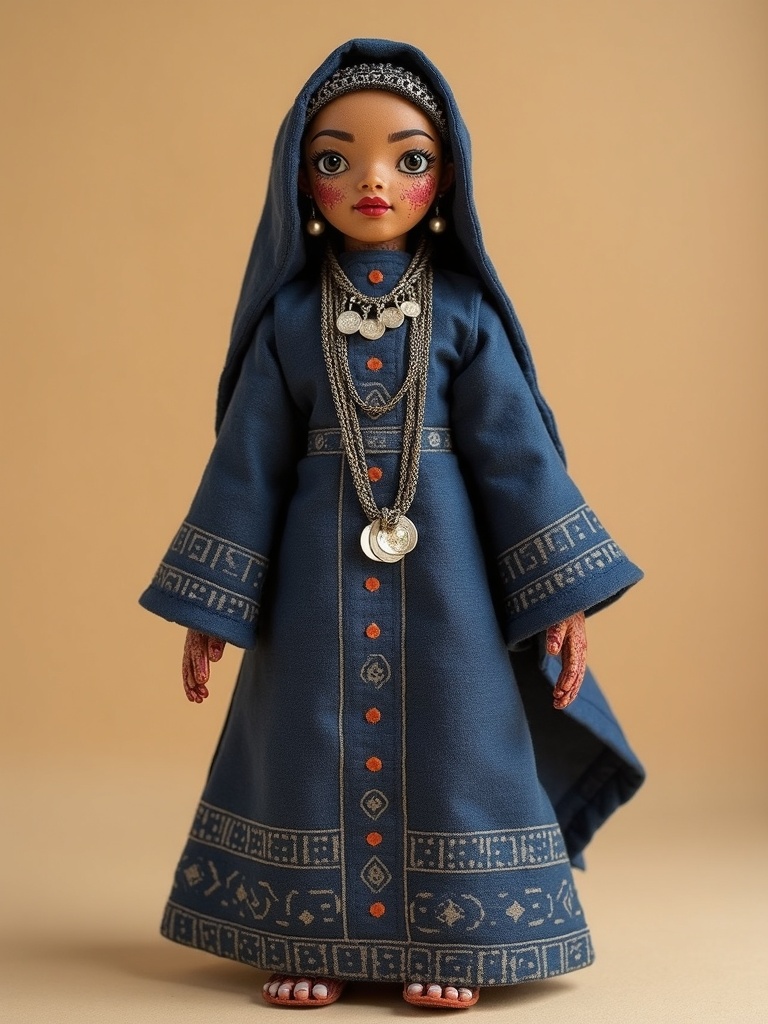
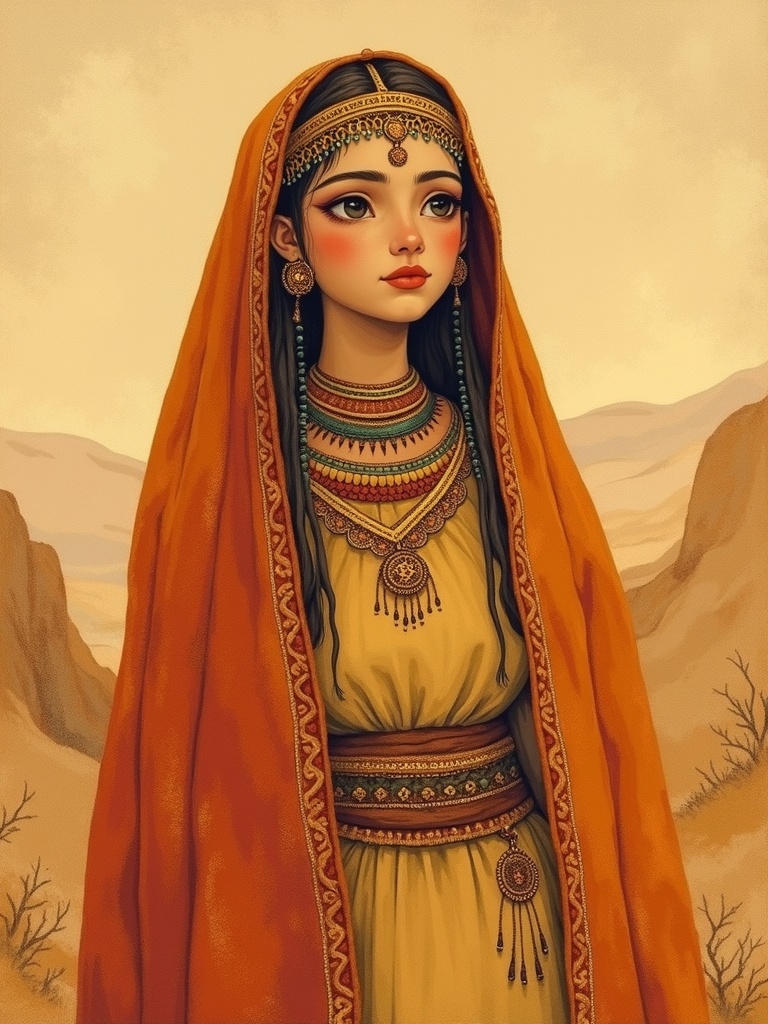
AI design preview — not a photo of the finished handmade doll
Freedom & Resistance
Dihya (al-Kahina)
A 7th-century Amazigh warrior-queen who routed an empire — remembered, ironically, by the name her enemies gave her.
- People
- Amazigh (Berber), Jarawa/Zenata
- Country
- Algeria
- Region
- North Africa
- Era
- 7th century (d. ≈703)
- Theme
- Freedom & Resistance
Make your own
Design your Dihya (al-Kahina)
Pick a garment, a hairstyle and a scene, enter the PIN and generate a fresh image of Dihya (al-Kahina) with AI.
Each image is generated live with fal.ai.
Generated images
AI design preview — not a photo of the finished handmade doll
No images generated yet — be the first.
Tradition & Origin
A 7th-century Amazigh warrior-queen who routed an empire — remembered, ironically, by the name her enemies gave her.
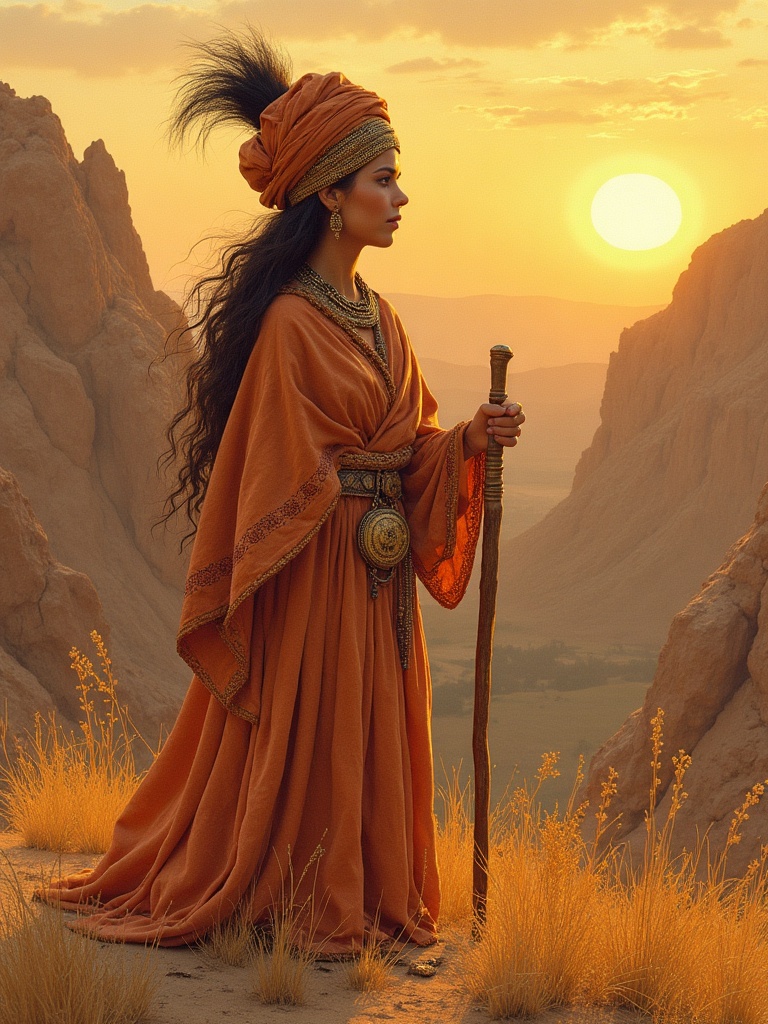
Her own people knew her as Dihya (recorded also as Dahya, Damya or Damiya). The name history mostly remembers her by — al-Kahina, "the soothsayer" or "the priestess" — was an exonym coined by her Arab opponents, who believed she possessed powers of prophecy. From the rugged Aurès Mountains of what is now north-eastern Algeria, she united Amazigh (Berber) tribes to resist the Umayyad conquest of the Maghreb in the late 7th century.
Around 696–698 her coalition crushed the Umayyad general Hassan ibn al-Nu'mān — a defeat (often placed at the Meskiana river) so complete that Arab forces retreated all the way back to Cyrenaica, in modern Libya, and waited for years before daring to return. For a time she was the most powerful ruler in North Africa. The chronicles describe a scorched-earth resistance and, eventually, her defeat and death around 701–703, near a well in the Aurès still said to bear her name.
Almost everything we "know" is semi-legendary: the main source, Ibn Khaldun, wrote in the 14th century, centuries after the events, and his account is steeped in myth — he even claims she lived to 127. Her very faith is genuinely debated: she has been called a Jewish queen, a Christian queen, and a follower of traditional Berber religion, and honest historians do not settle it. What endures is the figure: an indigenous woman who, however we read the legend, stood against an empire — claimed today by Amazigh and Algerian memory alike.
Timeline
- early 7th c.born to chief Tabat (Jarawa)
- ~680sleads the resistance after Kusayla's death
- ≈698victory at Meskiana over Hassan ibn al-Nu'man
- 698–703rules a Berber state from the Aurès to the oases
- 703final defeat & death near El Jem
Did you know?
- "Al-Kahina" — "the soothsayer" or "priestess" — was a name given by her Arab enemies; her own name is recorded as Dihya.DetailsEN
- Historians genuinely disagree about her religion — Jewish, Christian, or traditional Berber faith have all been argued from the sparse, legend-laden sources.DetailsEN
- Ibn Khaldun, her main chronicler, claimed she died at the age of 127 — a figure most scholars treat as part of her legend rather than fact.DetailsEN
History buried her real name — but never her defiance.
Values & Capabilities
Capabilities
◆◆◆◆◆ shows how central a gift is — five diamonds mark a signature strength, fewer mark a supporting one.
She united fractious tribes to defend their homeland and way of life.
Her victory at Meskiana stopped an empire for five years.
A symbol of the indigenous, non-Arab North Africa and of Amazigh pride.
Hero to some, “sorceress” to others; a lesson in who writes history.
In an age of kings, a woman led the last great stand.
Development
1 of 3 stages unlocked
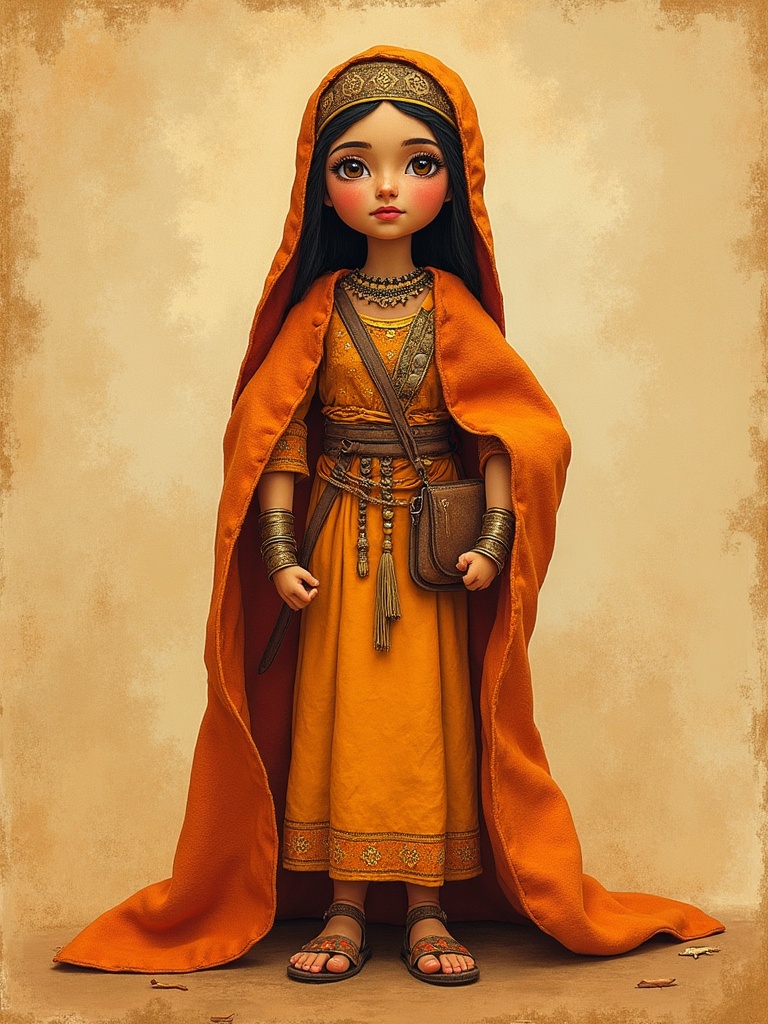
Young Dihya learning the ways of her people, riding the high country.
Answer all three to unlock this stage.
Unlock the previous stage first.
Crafting the doll
Garment: 100% cotton/wool in indigo with woven Amazigh geometric patterns, real silver-tone Berber jewellery (child-safe, firmly sewn). Signature attribute: silver fibulae & a small Barb horse. Education card: explains Amazigh (Berber) heritage, that “al-Kahina” was her enemies' name, and that her story is part history, part legend. Sizes Classic 32 / Kidogo 18–20 / Shule 28. Proceeds → Amazigh craft cooperatives (silver / weaving).
How this doll is made
Dihya al-Kahina's look is grounded in the material culture of the Imazighen (Amazigh) of the Aurès mountains: a draped, pin-fastened wrap of handspun wool worn over a tunic, anchored by heavy silver fibulae and adorned with the coral, amber and Kabyle enamel jewellery that signalled rank, protection and wealth. Every element is handmade by women weavers and village silversmiths, so the doll honours real craft traditions rather than costume invention.
- Garments 2
- Accessories 4
- Materials 2
- Techniques 3
Garments
- Draped wool wrap (haik)A large rectangle of handwoven wool draped over the body like a Roman toga and held closed at the shoulders rather than tailored; the everyday outer garment of Amazigh women across North Africa, sometimes finished with fringes and fine embroidery.DetailsEN
- Woven wool tunic and beltBeneath and over the wrap, women wore an ankle-length wool tunic gathered at the waist by a woven wool belt; colours and patterns signalled age, region, marital status and standing within the community.DetailsEN
Accessories
- Paired silver fibulae (tabzimt/afzim)Two large triangular silver brooches, each with a long pin, used to fasten the unsewn wrap at the shoulders and joined across the chest by a chain — the defining fastener of Amazigh women's dress and an ancient North African form.DetailsEN
- Kabyle enamel and coral jewellerySilver brooches, pendants and rings decorated with cloisonné enamel in blue, green and yellow and bezel-set with red coral; coral was believed to carry baraka (blessing) and to protect against the evil eye.DetailsEN
- Coral, amber and silver necklace / headdressHeavy strands and a brow ornament combining silver beads, red coral and amber (or copal) beads with coins and pendants; worn at the chest and across the forehead, doubling as portable family wealth and dowry.DetailsEN
- Silver pectoral ornamentA large hinged chest ornament of worked silver, sometimes set with enamel and coral, hung from the shoulders and resting over the chest — an emblem of status seen across Amazigh costume of Morocco and Algeria.DetailsEN
Materials
- Handspun woolCoarse, lanolin-rich fleece from Atlas/Aurès mountain sheep, hand-washed, combed, spun on a spindle and woven into the wraps, tunics and belts; the foundational fibre of all Amazigh dress.DetailsEN
- Silver, coral and amberVillage smiths worked silver (often melted coins) into fibulae and pendants, set with Mediterranean red coral and warm amber/copal beads — the prized materials of Kabyle and wider Amazigh jewellery.DetailsEN
Techniques
- Berber flatweave on the vertical loomWomen weave on a vertically mounted wooden loom, passing weft threads through warps separated by a heddle rod and shed stick to make reversible flatweave (kilim) cloth with geometric, protective motifs.DetailsEN
- Kabyle cloisonné enamelling and silver smithingSilversmiths solder thin twisted-wire cells onto a silver base, fill them with powdered glass enamel in blue, green and yellow, fire it, then bezel-set coral cabochons and add granulated silver beads — the signature Kabyle decorative method.DetailsEN
- Natural wool dyeingBefore synthetic dyes, weavers coloured handspun wool with plant and mineral sources — indigo for blue, henna and madder for reds, saffron and turmeric for yellows — producing the earthy palette of Amazigh textiles.DetailsEN
How it's made
Every doll is sewn by hand from natural materials — built to last a lifetime and to be repaired, not replaced. Here is the shopping list and the work steps. Sizes: Classic 32 cm (heirloom) · Kidogo 18–20 cm (toddlers, no small parts) · Shule 28 cm (school edition).
Shopping list
- Natural cotton or linen for the body (skin tone), ~0.5 m
- Wool or cotton stuffing — no plastic
- Cotton thread and embroidery floss in matching colours
- Garment fabric in this doll's colours (see the fabrics above)
- Yarn for the hairstyle
- Beads, cowrie shells and trims as shown
- Sharps and embroidery needles, pins, fabric scissors, fabric marker
Work instructions
- Trace and cut the body pattern at your chosen size (Classic 32 cm / Kidogo 18–20 cm / Shule 28 cm).
- Sew the body pieces right sides together, leave an opening, turn and stuff firmly with natural fibre, then close by hand.
- Embroider the face gently and with dignity — no plastic parts for the toddler line.
- Make the hair from yarn following the chosen hairstyle and attach it securely.
- Cut and sew the garment from this doll's fabric, then dress the doll.
- Add the beadwork, shells, trims and any attribute by hand.
- Check every seam and reinforce it — the doll should be lifelong and repairable, with no loose small parts for small children.
Origin & Ethics
How we know this
On honesty: semi-legendary (★★★★☆). A real resistance leader whose story survives mainly through later, often hostile or romanticised sources; her religion is genuinely unknown/debated and must not be fixed; “al-Kahina” is an exonym; she is a contested symbol claimed by many causes — presented with care, not as settled fact.
Committee: Amazigh cultural associations (Algeria/Morocco/Tunisia/diaspora), historians of the Maghreb, North-African heritage bodies. Tifinagh script used decoratively only with Amazigh cultural approval; her religion must never be presented as settled fact.
Sources
- Wikipedia — Kahina
- World History Encyclopedia — Kahina
- Carthage Magazine — Al-Kahina Dihya
- Medievalists — Berber Queen al-Kahina
- Arab America — Al-Kahina
- Wikipedia — Battle of El Jem
- beYOUteous — Berber Queen Dihya: An Imazighen from the Aurès Mountains
- Wikipedia — Amazigh fibula (form, function, Kabyle abzim)
- Smarthistory — Amazigh (Kabyle) brooches (fibulae): enamel, coral, silver
- The Metropolitan Museum of Art — Remarkable Berber Jewelry at The Met (Morocco & Algeria)
- The Metropolitan Museum of Art — Pair of Fibulae (North Africa, silver and enamel)
- The Metropolitan Museum of Art — Pectoral Ornament (North Africa)
- The Met, Heilbrunn Timeline of Art History — The Magic of Signs and Patterns in North African Art (Salwa Mikdadi)
- Smithsonian National Museum of African Art — Kabyle Fibula, silver/coral/enamel, Algeria
- Smithsonian National Museum of African Art — Kabyle Bracelet, silver/coral, Algeria
- Harvard Peabody Museum — Imazighen: Amazigh Aesthetics & Symbology gallery
- Encyclopedia.com (Fashion, Costume & Culture) — Berber Dress: the haik wrap and women's costume
- Morocco World News — The Disappearing Tradition of Amazigh Facial and Body Tattoos (siyala, protection, identity)