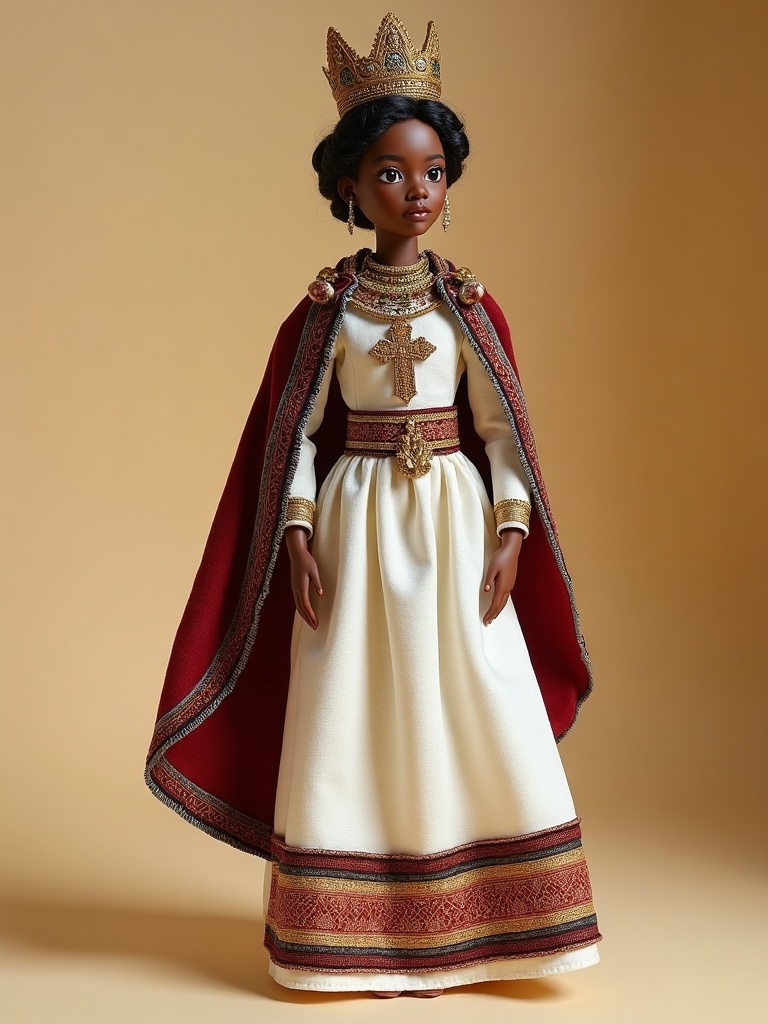
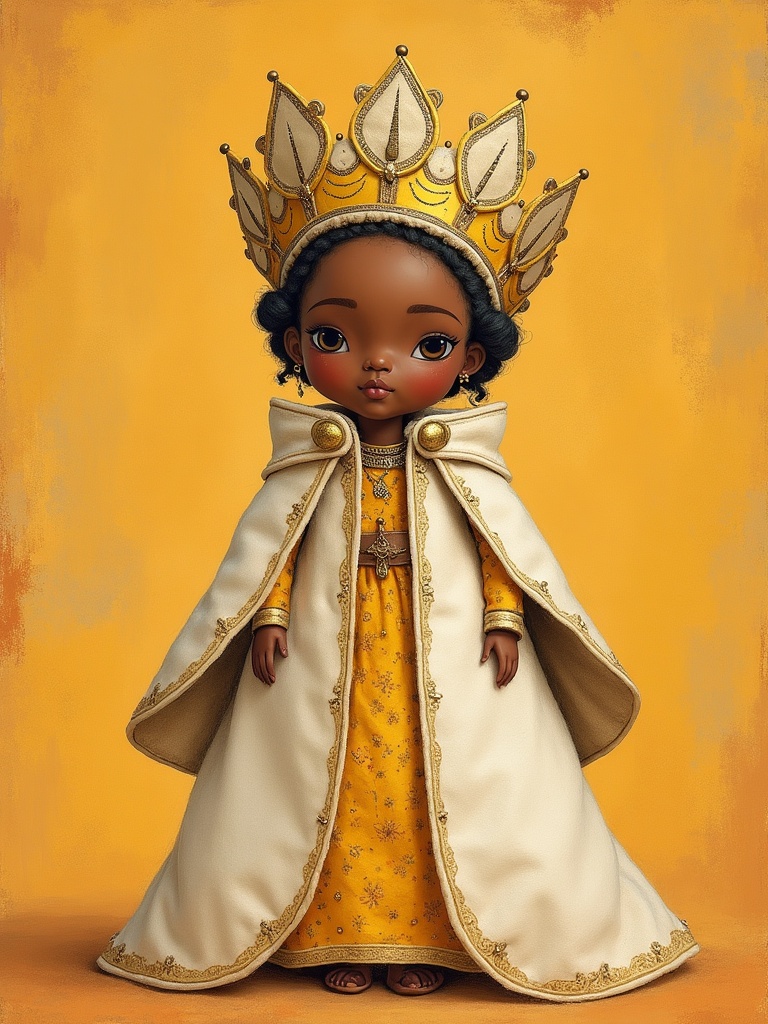
AI design preview — not a photo of the finished handmade doll
Strategy & Defiance
Taytu Betul
She named a capital after a flower and helped break an empire in the field. Empress Taytu Betul co-founded Addis Ababa and stood at the heart of Ethiopia's strategy at Adwa in 1896 — one of the only times an African power decisively defeated a European army of conquest.
- People
- Amhara (Ethiopian Empire)
- Country
- Ethiopia
- Region
- Horn of Africa
- Era
- ≈1851–1918
- Theme
- Strategy & Defiance
Make your own
Design your Taytu Betul
Pick a garment, a hairstyle and a scene, enter the PIN and generate a fresh image of Taytu Betul with AI.
Each image is generated live with fal.ai.
Generated images
AI design preview — not a photo of the finished handmade doll
No images generated yet — be the first.
Tradition & Origin
She named a capital after a flower and helped break an empire in the field. Empress Taytu Betul co-founded Addis Ababa and stood at the heart of Ethiopia's strategy at Adwa in 1896 — one of the only times an African power decisively defeated a European army of conquest.
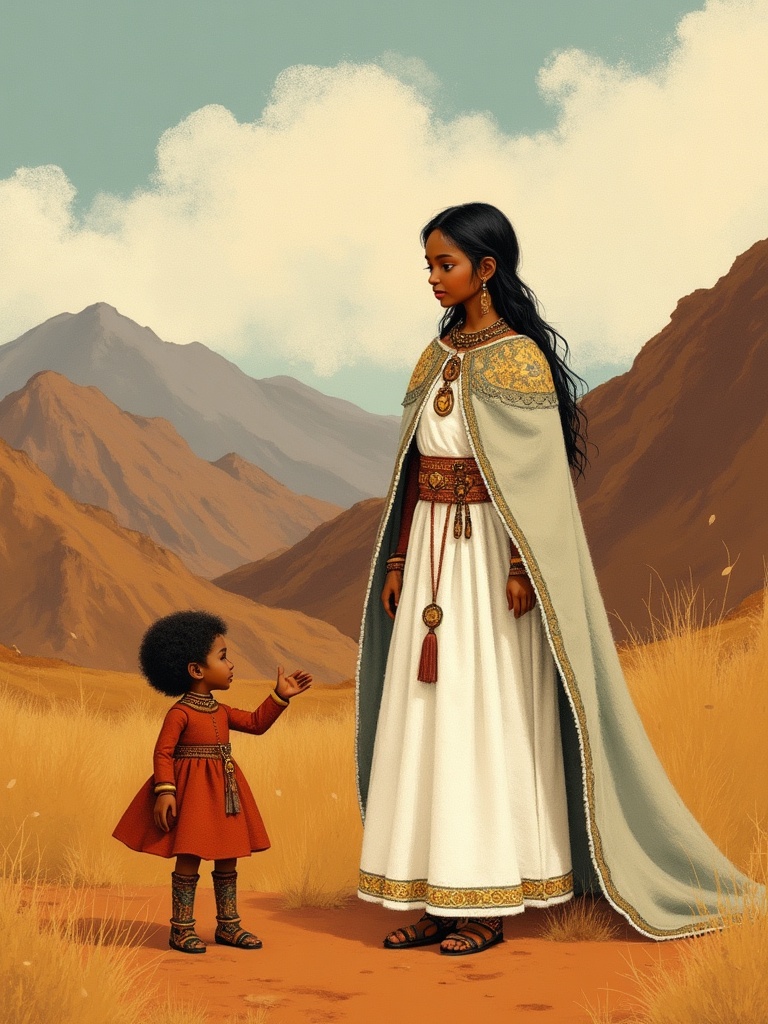
Taytu was born around 1851 in the highlands of Semien, into an aristocratic family linked to Ethiopia's ancient Solomonic line. In April 1883 she married Sahle Maryam, the king who would become Emperor Menelik II, and was crowned Itege — empress — on 4 November 1889. She was no ornamental consort: contemporaries record that Menelik consulted her before important decisions, and she sat at the centre of court politics and military counsel.
Around 1886 she and Menelik founded a new capital on the warm plain below the Entoto hills, near the Filwoha hot springs the Oromo called Finfinne. Taytu gave the city its name — Addis Abeba, "new flower" — and built a house for herself near the springs. It grew into the city that is today the seat of the African Union, a fitting legacy for an empress whose name still flowers over the continent's diplomacy.
The reckoning with Italy came over the Treaty of Wuchale of 1889. Its Amharic and Italian texts differed: where the Amharic let Ethiopia choose to use Italy as a diplomatic channel, the Italian version made Ethiopia an Italian protectorate. Taytu was among the fiercest opponents of this colonial sleight of hand. When pressed to accept Italy's terms, she is widely quoted as refusing to let her country be made anyone's protégé — and the treaty was repudiated, leading to war. During the campaign she is credited with the tactic that forced the Italian garrison from the fort on Enda Iyesus hill at Mekelle in January 1896: cutting off its water supply until thirst compelled surrender.
On 1 March 1896, at the Battle of Adwa, Taytu marched north with the imperial army — sources describe her commanding her own force of thousands and directing cannoneers and the care of the wounded. Ethiopia routed the invading Italians, capturing thousands of prisoners and securing its independence in an age when nearly all of Africa was being colonised. Adwa became a beacon for anti-colonial movements worldwide. Taytu remained a power at court until Menelik's health failed, and she died on 11 February 1918 in the city she had named.
Timeline
- ≈1851born in Semien, of a noble Solomonic-linked family; educated in Amharic & Ge’ez
- 1883marries Menelik II
- 1886/87founds & names Addis Ababa
- 1889sees through the Treaty of Wuchale, urges resistance
- 1 Mar 1896Battle of Adwa — leads troops, commands artillery, the Mekelle water strategy; Ethiopia wins
- 1913 / 1918Menelik dies; she is sidelined; dies in 1918
Did you know?
- The Treaty of Wuchale had two texts: the Amharic let Ethiopia choose to deal with Europe through Italy, while the Italian version claimed Ethiopia as an Italian protectorate — and Taytu was a leading voice in rejecting it.DetailsEN
- At the siege of Mekelle the Ethiopians seized the fort's well and fought off desperate Italian attempts to retake it, forcing the garrison's surrender through thirst.DetailsEN
- Taytu named the new capital 'Addis Abeba' — 'new flower' — and first settled by the Filwoha hot springs the Oromo knew as Finfinne.DetailsEN
- The victory at Adwa is one of the few times an African nation decisively defeated a European colonial power, and it inspired anti-colonial movements far beyond Ethiopia.DetailsEN
She refused to let her country be called anyone's protégé — and made a new flower bloom where an empire tried to plant its flag.
Values & Capabilities
Capabilities
◆◆◆◆◆ shows how central a gift is — five diamonds mark a signature strength, fewer mark a supporting one.
She caught the trap hidden in the fine print and refused it.
She shaped the battle and commanded artillery in Africa’s great victory.
She won a siege by cutting the enemy’s water supply.
She founded and named Ethiopia’s capital, “New Flower”.
Literate when few women were, she ruled with her mind.
Development
1 of 3 stages unlocked
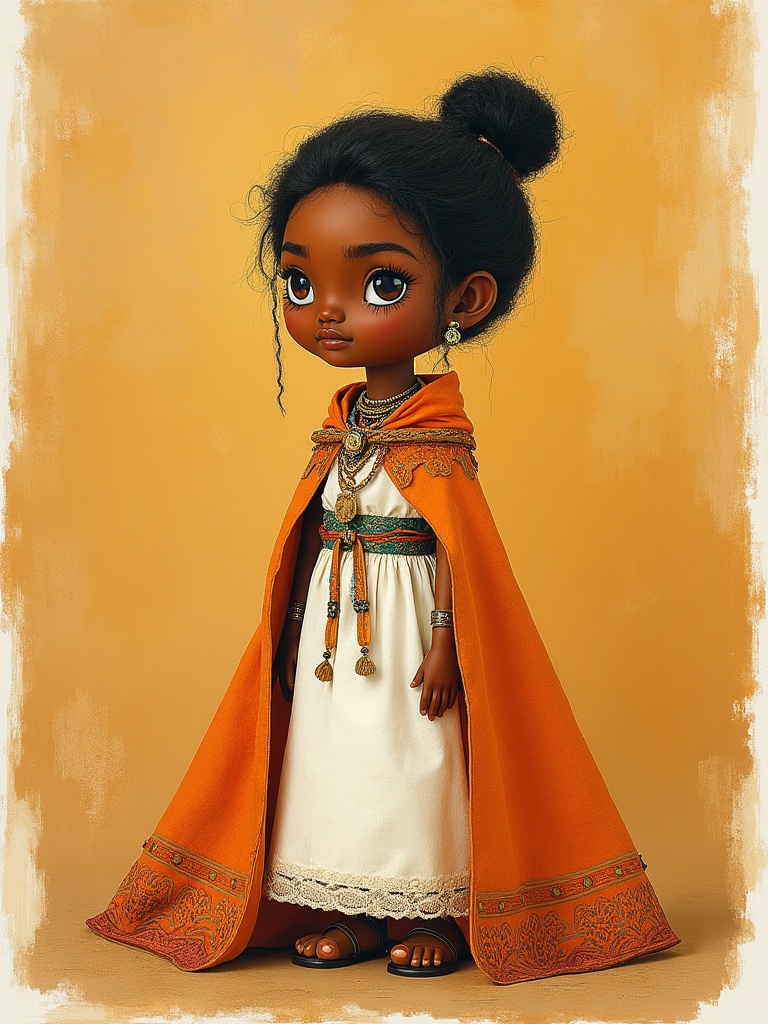
Young Taytu learning to read Amharic and Ge’ez.
Answer all three to unlock this stage.
Unlock the previous stage first.
Crafting the doll
Garment: a white shamma/netela (cotton with woven coloured borders), an embroidered cape, a gold-tone crown, an Ethiopian cross (child-safe). Signature attribute: a small red royal parasol and the “torn treaty.” Education card: explains Adwa (the great anti-colonial victory that kept Ethiopia free), the Treaty of Wuchale, and the founding of Addis Ababa — and that she was a learned woman who said no to colonisation. Sizes as standard. Proceeds → Ethiopian heritage & girls’ education.
How this doll is made
Empress Taytu Betul's look belongs to the high material culture of the Ethiopian Solomonic court: handspun highland-cotton garments edged in shimmering woven tibeb, layered over royal velvet, and crowned with gold filigree regalia made in imperial goldsmith workshops. Every element — the white kemis, the netela shawl, the gold cross and diadem, the shuruba braids — signals Orthodox faith, aristocratic rank and sovereign authority.
- Garments 3
- Accessories 2
- Materials 2
- Techniques 3
Garments
- Habesha kemis (imperial white dress)Ankle-length gown of shemma — handspun, handwoven white highland cotton finished by skilled weavers (shemane). Woven as long narrow loom strips that are stitched side by side into the full silhouette; premium high-thread-count 'saba' cloth historically marked aristocratic and royal rank.DetailsEN
- Netela (shawl / mantle)Handmade cotton shawl worn draped over the shoulders and head with the kemis. White ground with colourful woven tibeb borders; for church or formal occasions the bordered edges are opened over both shoulders, framing the wearer with dignity.DetailsEN
- Royal velvet cape (kaba / lemd)Imperial outer cape of rich velvet worn as Solomonic regalia; the kabba/lemd, paired with crown and royal umbrella, was the mark of sovereign authority worn by the court of Menelik II and Taytu in the Adwa era.DetailsEN
Accessories
- Gold crown / diademRoyal crown of worked gold set with gemstones (Ethiopian opals, emeralds, rubies, diamonds), produced in imperial goldsmith workshops that Menelik II patronised — a confident synthesis of indigenous craft and cosmopolitan materials.DetailsEN
- Ethiopian Orthodox cross necklacePersonal pendant cross strung on the matab (christening neck-cord), worn by Orthodox Tewahedo Christians. Cast and chased in gold or silver with intricate filigree latticework; regional forms include Lalibela (oval), Gondar (round) and Axum types.DetailsEN
Materials
- Handspun highland cottonRaw highland cotton hand-carded and spun on a drop spindle into a uniquely soft thread, the foundation of all shemma cloth; the skill is passed mother to daughter and spun in the home.DetailsEN
- Gold, gemstones, silk & velvetAlluvial gold from the western lowlands and opal from Wollo and Shewa fed imperial jewellery; silk and velvet, with silver/gold metallic thread, supplied royal capes and the metallic 'melgom' bead accents on fine kemis borders.DetailsEN
Techniques
- Handloom tibeb weavingMulticoloured geometric tibeb borders are woven directly into the cloth edges on the narrow loom using supplementary weft (often silver or gold metallic thread) — a visual language encoding region, rank and the weaver's skill.DetailsEN
- Gold filigree & granulationGoldsmithing by hammering, filigree (delicate lace-like patterns of fine wire) and granulation (tiny fused metal balls for textured surfaces), with enamelwork — the techniques behind crowns, crosses and layered court jewellery.DetailsEN
- Shuruba (albaso) hair braidingTraditional Habesha braiding: five to seven thick cornrows alternating with thin cornrows along the front (the dirib/albaso layered technique), with voluminous hair at the back — a noble style historically worn at the imperial court.DetailsFR
How it's made
Every doll is sewn by hand from natural materials — built to last a lifetime and to be repaired, not replaced. Here is the shopping list and the work steps. Sizes: Classic 32 cm (heirloom) · Kidogo 18–20 cm (toddlers, no small parts) · Shule 28 cm (school edition).
Shopping list
- Natural cotton or linen for the body (skin tone), ~0.5 m
- Wool or cotton stuffing — no plastic
- Cotton thread and embroidery floss in matching colours
- Garment fabric in this doll's colours (see the fabrics above)
- Yarn for the hairstyle
- Beads, cowrie shells and trims as shown
- Sharps and embroidery needles, pins, fabric scissors, fabric marker
Work instructions
- Trace and cut the body pattern at your chosen size (Classic 32 cm / Kidogo 18–20 cm / Shule 28 cm).
- Sew the body pieces right sides together, leave an opening, turn and stuff firmly with natural fibre, then close by hand.
- Embroider the face gently and with dignity — no plastic parts for the toddler line.
- Make the hair from yarn following the chosen hairstyle and attach it securely.
- Cut and sew the garment from this doll's fabric, then dress the doll.
- Add the beadwork, shells, trims and any attribute by hand.
- Check every seam and reinforce it — the doll should be lifelong and repairable, with no loose small parts for small children.
Origin & Ethics
How we know this
Very well documented (★★★★★); imperial-court context and her distrust of Europeans named honestly within the colonial setting; omit sensitive personal asides not suitable for children; focus on Adwa, the treaty, Addis Ababa and her learning.
Committee: Ethiopian cultural & Orthodox heritage bodies, historians (e.g. Prouty’s biography), Addis Ababa custodians. 5-step protocol.
Sources
- Wikipedia — Taytu Betul
- Lugha Yangu — Taytu Betul
- Kentake Page — Empress Taytu
- Wikipedia — Battle of Adwa
- Wikipedia — Habesha kemis (shemma cotton, narrow-loom strips, tibeb borders, saba royal cloth)
- Wikipedia — Netela (handmade cotton shawl with woven tibeb borders, how worn)
- Wikipedia — Clothing in Ethiopia (shemma, netela, gabi, royal velvet cape kaba/lemd)
- Yego — Handspun: The Culture of Ethiopian Cotton (hand-carding, drop-spindle spinning)
- The Bead Traders — The Beauty and Richness of Ethiopian Jewelry (filigree, granulation, enamel, hammering)
- Timeless Ethiopia — Ethiopian Crosses (matab neck cord, gold/silver crosses, regional forms, filigree)
- Sky Jems — Ethiopian Imperial Jewels: Regalia of the Solomonic Dynasty (crowns, gold filigree, opals/gems, Beta Israel goldsmiths, Menelik II workshops)
- Afroculture — Ethiopian braids: Beauty of Ethiopia (shuruba/albaso cornrow technique, cultural meaning)
- UNDP Ethiopia — Shuruba: braids and cornrows providing healing and sanctuary for women
- Wikipedia — Menelik II (reign 1889–1913, Adwa, imperial regalia: crown, velvet cape, sceptre)