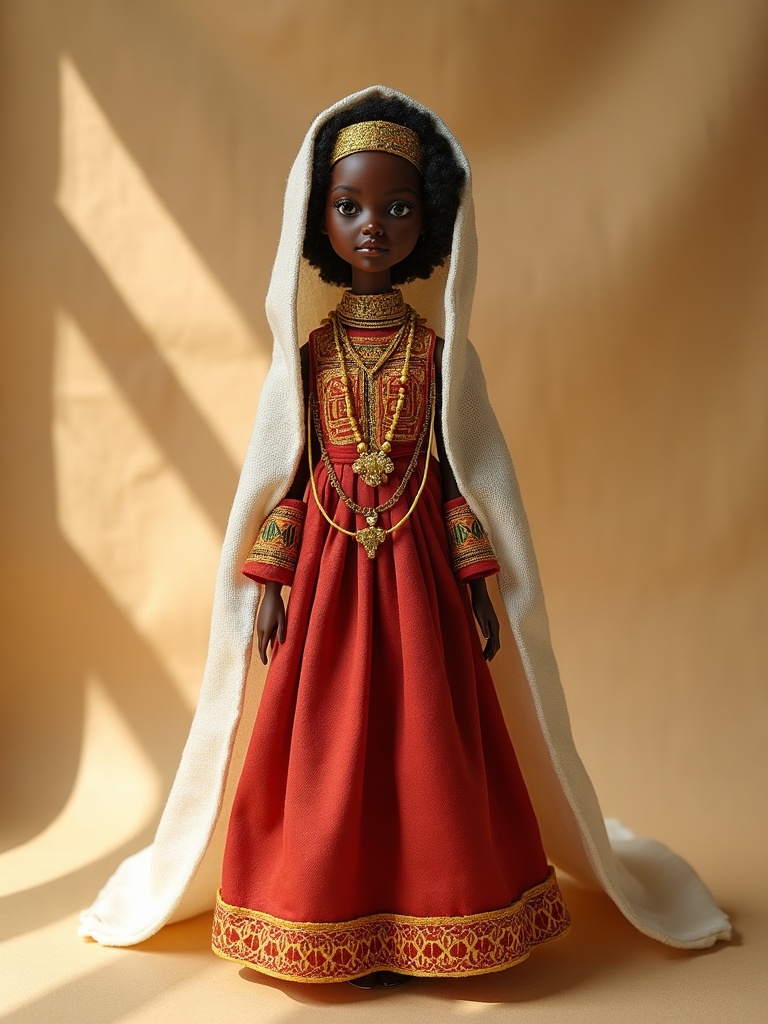
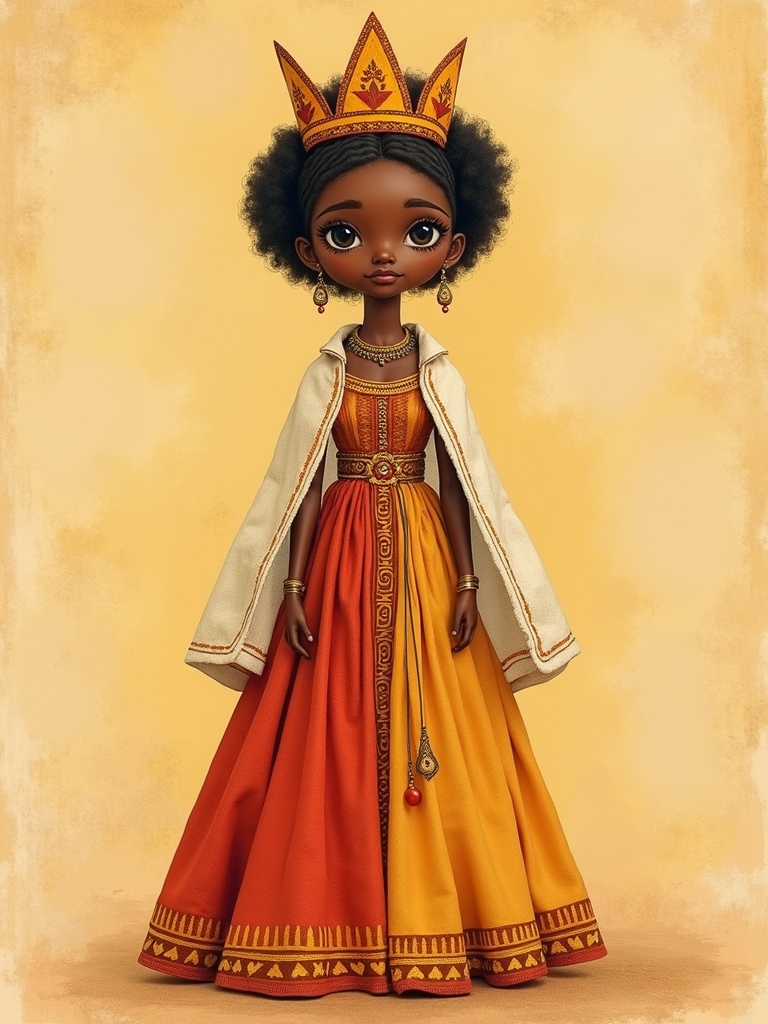
AI design preview — not a photo of the finished handmade doll
Sabiduría
Makeda (Reina de Saba)
According to legend, a queen of the south crossed deserts to test the wisdom of King Solomon — and from that meeting an entire dynasty, and a nation's sacred identity, was said to be born.
- People
- Saba/Aksum
- Country
- Etiopía
- Region
- Horn of Africa
- Era
- Leyenda
- Theme
- Sabiduría
Make your own
Design your Makeda (Reina de Saba)
Pick a garment, a hairstyle and a scene, enter the PIN and generate a fresh image of Makeda (Reina de Saba) with AI.
Each image is generated live with fal.ai.
Generated images
AI design preview — not a photo of the finished handmade doll
No images generated yet — be the first.
Tradition & Origin
According to legend, a queen of the south crossed deserts to test the wisdom of King Solomon — and from that meeting an entire dynasty, and a nation's sacred identity, was said to be born.
Her name in Ethiopian tradition is Makeda, the Queen of Sheba. The fullest telling of her story comes not from a chronicle but from the Kebra Nagast ("The Glory of Kings"), Ethiopia's national epic, written in the sacred Ge'ez language and dated by scholars to the 14th century AD. According to this legend, Makeda travelled from her kingdom to Jerusalem to witness Solomon's wisdom for herself; moved by what she found, she turned from worshipping sun and moon to the God of Israel. From their encounter, the epic says, came a son — Menelik I — who is traditionally placed in the 10th century BC.
It is vital to keep the legendary apart from the documented. The Kebra Nagast tells how the grown Menelik travelled to meet his father in Jerusalem and returned to Ethiopia bearing the Ark of the Covenant, founding the Solomonic dynasty. That claim — that Ethiopia's rulers descended directly from Solomon and the Queen of Sheba — became the central legitimising myth of the imperial throne. The line is said in tradition to have run for 225 generations, ending only with the deposition of Emperor Haile Selassie in 1974. Historically, the dynasty was re-asserted in 1270 AD when Yekuno Amlak claimed Solomonic descent.
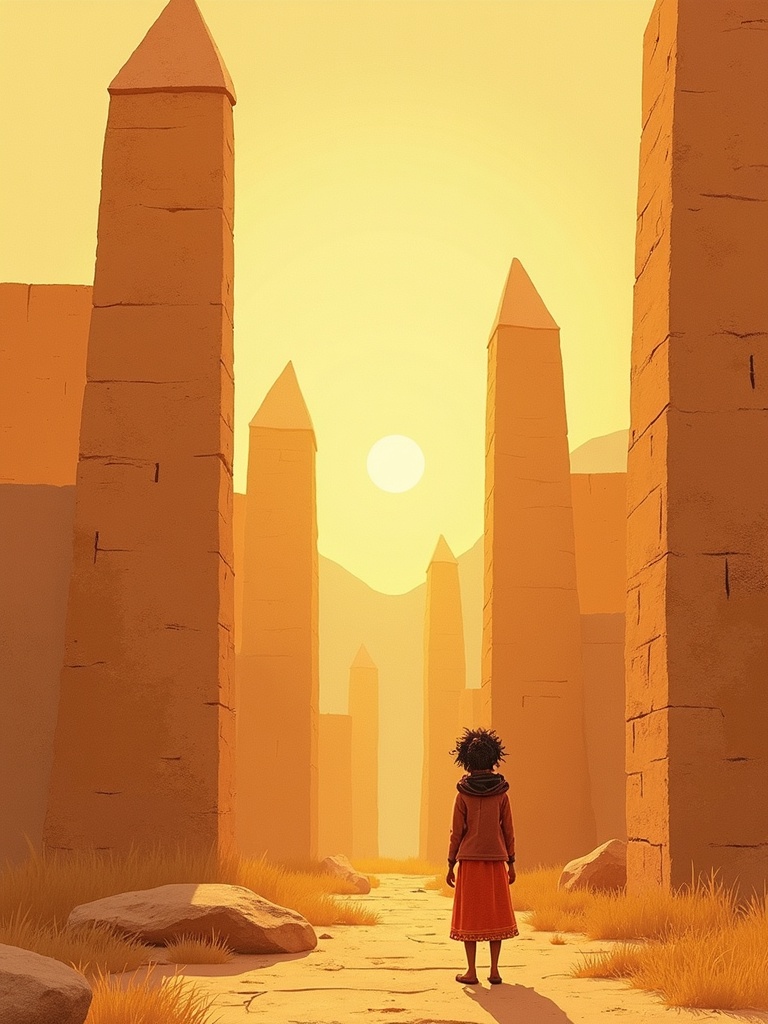
Behind the legend lies real, documented ground. Northern Ethiopia was home to the great Aksumite (Axumite) kingdom, which flourished from roughly the 1st to the 8th century AD at the crossroads of Africa, Arabia and the Greco-Roman world — one of the most powerful states of its age. Its capital, Aksum, is a UNESCO World Heritage Site, famed for towering carved stelae, including a 24-metre granite obelisk weighing some 160 tonnes that Fascist Italy looted in 1937 and only returned in 2005.
And was there a real Sheba? Indigenous South Arabian inscriptions record a kingdom of Saba', centred on Marib in modern Yemen, that grew rich controlling the trade in frankincense, myrrh and gold along the incense routes from roughly the 8th century BC. Scholars remain divided: most place biblical Sheba in South Arabia, but a long tradition — and the Kebra Nagast itself — locates her in Ethiopia. The truth may lie in the deep cultural ties that long linked both shores of the Red Sea.
Timeline
- LegendeEine Königin von Saba hört vom weisesten König der Welt und beschließt, ihn zu prüfen.
- die ReiseSie zieht mit einer Karawane voller Gold, Gewürze & Weihrauch nach Jerusalem — um zu lernen.
- die RätselSie stellt schwere Fragen; beide tauschen Weisheit; sie ist tief beeindruckt.
- die HeimkehrSie kehrt heim & wird (im Kebra Nagast) zur Stammmutter Äthiopiens; ihr Sohn Menelik gründet eine Dynastie.
- ~1.–7. Jh. n. Chr.Die reale Welt: Aksum blüht als eine der größten Handelsmächte (Gold, Weihrauch, Stelen, Münzen).
- 14. Jh.Das Kebra Nagast schreibt Makedas Geschichte nieder & macht sie zum Nationalepos.
Did you know?
- According to the Kebra Nagast, the Queen of Sheba's son Menelik I brought the Ark of the Covenant from Jerusalem to Ethiopia — a claim still central to Ethiopian Orthodox tradition.DetailsEN
- Scholars still dispute whether the historical Sheba lay in Yemen or in Ethiopia — and note that the Sabaean kingdom only flourished centuries after Solomon was said to have lived.DetailsEN
- The frankincense and myrrh that made Sheba wealthy grow almost nowhere else on Earth — only in southern Arabia and the Horn of Africa — making both shores of the Red Sea heirs to her trade.DetailsEN
- Aksum's largest stele was carved to resemble a nine-storey building, complete with false doors and windows — among the tallest single stones ever raised in the ancient world.DetailsEN
Legend or history, Makeda reminds us that wisdom was worth crossing a desert for.
Values & Capabilities
Capabilities
◆◆◆◆◆ shows how central a gift is — five diamonds mark a signature strength, fewer mark a supporting one.
Su mayor "hazaña": emprender todo un viaje solo para volverse más sabia. En el juego: Quien sostiene a Makeda puede hacer una pregunta difícil — y gana por ingenio, no por fuerza.
Planteó los acertijos más difíciles de su tiempo. Enseña: Una buena pregunta a veces es más poderosa que un ejército — y el ingenio no tiene género.
Su reino de Saba/Aksum vivía del comercio de oro, incienso y mirra en el Mar Rojo. Representa a una potencia africana que conectó el mundo antiguo.
De ella — según la leyenda — surgió toda una dinastía imperial. Enseña: Una sola mujer sabia puede ser el comienzo de algo grande. (Un puente hacia las abuelas.)
She came not with empty hands, but with rich gifts, and met the wisest as an equal. She teaches dignity, respect, and magnanimity in dealing with others.
Development
1 of 3 stages unlocked
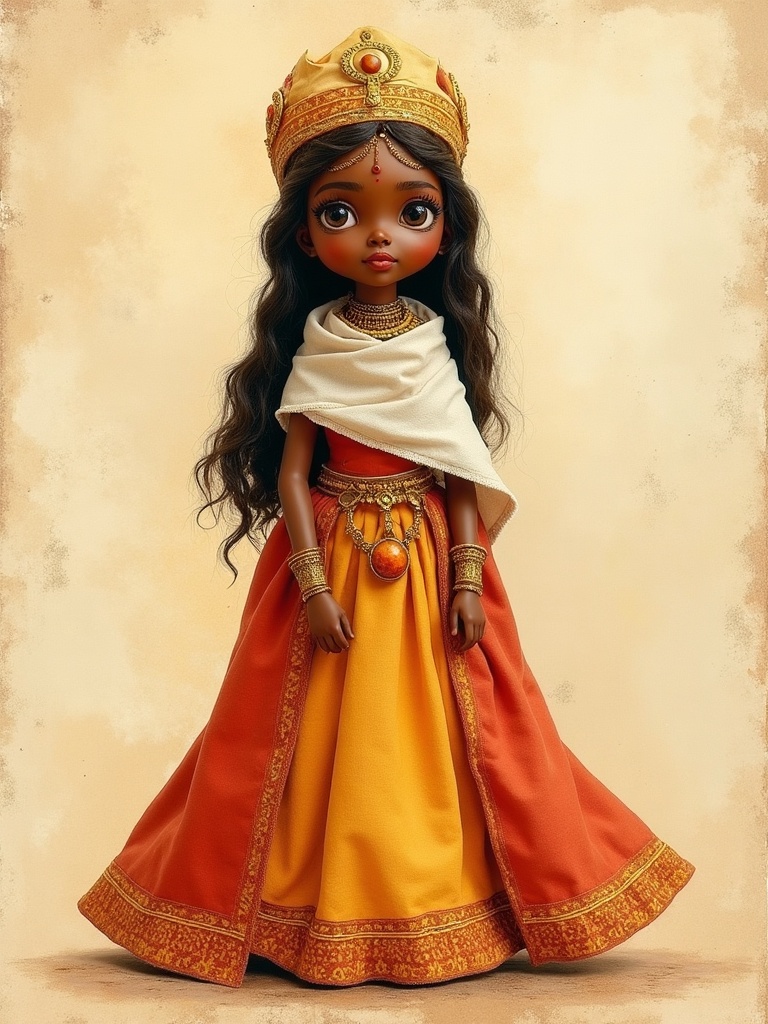
Makeda as a young ruler, curious and thirsty for knowledge, who hears of a wise king far away. A dignified robe, a first golden diadem. Gift: The clever riddle-poser (in the making).[5]
Answer all three to unlock this stage.
Unlock the previous stage first.
Crafting the doll
Fabrics & Manufacturing notes
Real natural fibers, honest craftsmanship, lifelong repairability — and with Makeda a fragrant detail: a touch of real frankincense.
The materials list
The robe: Crimson, gold & white Shamma
Makeda wears a royal robe of 100% cotton in Crimson red and gold, plus — as a bridge to Selam — a fine white Shamma cloth with red-and-gold Tilet border pattern and a gold band/diadem. Jewelry of amber and gold-toned beads (an echo of the frankincense & gold trade), child-safely sewn. Ideal from Ethiopian weaving cooperatives.
Signature attributes: Scroll & frankincense
Her hallmark is the Scroll of Riddles (fabric/felt, with an embroidered Ge'ez pattern) — and, especially lovely, a tiny frankincense pouch or a gold-toned casket with real frankincense grains (in the collector's variant), so that the doll faintly of frankincense is fragrant — the scent of ancient Saba. Optionally a felt camel. No small parts that can be swallowed in the school/toddler line.
Signature & Educational Card
Embroidered into the hem: „Makeda" and the name of the seamstress. Enclosed is an Educational Cardwhich — as a teaching piece for the whole series — explains the difference between legend and documented history , plus three of the famous „hard questions" to puzzle over yourself. Optional QR thread to the history page.
Production stages & effort
Crimson-gold robe, Shamma, diadem, scroll, incense casket, educational card. The collector's and wisdom figure.
Simplified robe, small scroll. Affordable entry point.
Washable, reinforced seams, sturdy attributes (without loose incense). With a legend-vs-history card for the classroom.
How this doll is made
Makeda, Queen of Sheba, is a legendary figure of the Ethiopian Kebra Nagast and Sabaean tradition, so her doll is grounded not in a single surviving wardrobe but in the real material cultures the legend draws on: the handwoven cotton dress of the living Habesha highland tradition, the gold regalia and filigree of Aksumite/Solomonic Ethiopia, and the frankincense-and-gold wealth of the ancient South Arabian kingdom of Saba. Each element below is documented from museum and ethnographic sources, presented to honour rather than invent.
- Garments 2
- Accessories 3
- Materials 2
- Techniques 3
Garments
- Habesha kemis (white cotton dress)A long, flowing ankle-length dress handwoven from shemma cloth made of hand-spun cotton, typically white, beige or light grey; narrow loom-woven strips are stitched side by side to build the full silhouette. This is the living Habesha tradition the Makeda legend feeds into.DetailsEN
- Netela shawl with tibeb borderA light two-layered rectangular shawl of handwoven white cotton muslin draped over the shoulders and head, edged with the same colourful tibeb border as the dress; a museum example pairs a kemis and netela in handwoven, embroidered cotton.DetailsEN
Accessories
- Aksumite/Solomonic gold crownA high, domed gold crown in the Ethiopian imperial tradition, worked in gold filigree with coloured stones (Ethiopian opal, emerald, ruby), fusing indigenous Aksumite and Amhara forms with Coptic Christian iconography; key historic pieces are held at the National Museum in Addis Ababa.DetailsEN
- Sabaean broad collar pendantAn elaborate broad ornamental collar with small round pendants and a large central medallion attached to a crescent-shaped pendant, modelled on South Arabian limestone female statues from the kingdom of Saba (Sheba), c. 1st century BCE.DetailsEN
- Frankincense and myrrh adornmentSmall carved beads or a vial of frankincense and myrrh resin worn or carried, evoking the aromatic incense exclusive to South Arabia that made the kingdom of Saba fabulously wealthy through the caravan trade (c. 800 BCE-600 CE).DetailsEN
Materials
- Hand-spun highland cotton (shemma)The base cloth: raw cotton cleaned and spun by hand by women, then woven by male shemane weavers into the soft white shemma fabric used for the kemis and netela; Ethiopia has an ancient indigenous cotton-weaving tradition.DetailsEN
- GoldGold for the crown and jewellery, the defining royal material of Aksumite and Sabaean wealth; Aksum minted the first native African gold coinage and the Sheba legend describes gifts of gold 'in great quantity' carried by camel.DetailsEN
Techniques
- Narrow-loom tibeb weavingHow the borders are made: weavers on a simple pit/ground loom weave multicoloured geometric tibeb and tilet patterns directly into the cloth edges during production using supplementary weft, the family-owned motifs passed from father to son.DetailsEN
- Gold granulationHow the gold ornament is decorated: hundreds of microscopic gold spheres (granules) are fused onto a smooth gold surface to outline patterns and add relief, an ancient goldsmithing technique used in Ethiopian and Near Eastern jewellery.DetailsEN
- Gold filigreeHow the lace-like gold is made: fine drawn gold wire is twisted and soldered into delicate openwork patterns, the signature of Ethiopian imperial goldsmiths (many from the Beta Israel community) for crowns, crosses and necklaces.DetailsEN
How it's made
Every doll is sewn by hand from natural materials — built to last a lifetime and to be repaired, not replaced. Here is the shopping list and the work steps. Sizes: Classic 32 cm (heirloom) · Kidogo 18–20 cm (toddlers, no small parts) · Shule 28 cm (school edition).
Shopping list
- Natural cotton or linen for the body (skin tone), ~0.5 m
- Wool or cotton stuffing — no plastic
- Cotton thread and embroidery floss in matching colours
- Garment fabric in this doll's colours (see the fabrics above)
- Yarn for the hairstyle
- Beads, cowrie shells and trims as shown
- Sharps and embroidery needles, pins, fabric scissors, fabric marker
Work instructions
- Trace and cut the body pattern at your chosen size (Classic 32 cm / Kidogo 18–20 cm / Shule 28 cm).
- Sew the body pieces right sides together, leave an opening, turn and stuff firmly with natural fibre, then close by hand.
- Embroider the face gently and with dignity — no plastic parts for the toddler line.
- Make the hair from yarn following the chosen hairstyle and attach it securely.
- Cut and sew the garment from this doll's fabric, then dress the doll.
- Add the beadwork, shells, trims and any attribute by hand.
- Check every seam and reinforce it — the doll should be lifelong and repairable, with no loose small parts for small children.
Ten Name suggestions
The legendary name is preserved. These ten names — Ethiopian/Aksumite & from the Saba tradition — are suitable for Companion figures, daughters or the series around Makeda. To be confirmed by Ethiopian authorities before use.
Beautiful connection: „Selam" links Makeda to the Ethiopian flagship doll — and the name „Bilqīs" opens up the Islamic tradition. One queen, three worlds, one name per door.
Origin & Ethics
How we know this
Sobre la honestidad: Makeda es la figura con menos respaldo histórico de toda la serie — marcada deliberadamente como "Leyenda" (★★☆☆☆). No está documentado si la Reina de Saba existió como persona real; su historia perdura en la Biblia, el Corán y la epopeya nacional etíope Kebra Nagast (siglo XIV), no en hallazgos arqueológicos. Aksum, en cambio, es una cultura elevada plenamente documentada y magnífica — aquí la leyenda y el mundo real se mantienen claramente separados. Varias tradiciones la reclaman (etíope-cristiana, islámica como Bilqīs; Yemen también reclama a Saba) — esto se reconoce, no se apropia. Los adornos adultos y en parte estereotipados de los textos antiguos (como la leyenda de Bilqīs y los Jinn) se omiten deliberadamente para una figura infantil; la representación evita el viejo cliché de la "seductora" y muestra a una reina sabia y digna. Las "habilidades" y las "etapas de la vida" trasladan la tradición al formato de carta coleccionable. Como Makeda pertenece a la identidad nacional y religiosa de Etiopía (y Aksum es Patrimonio de la Humanidad de la UNESCO), la aprobación final corresponde a las autoridades culturales, eclesiásticas y de investigación etíopes.
Elder Approval & Sources to Observe
In a legendary and at the same time sacred figure, approval is especially delicate: Makeda belongs to Ethiopia's national and religious identity (Orthodox Church, Kebra Nagast), is venerated in the Islamic world as Bilqīs and is dear to the Rastafari. Several communities must be heard — and the boundary between history, faith and legend must be preserved respectfully and honestly.
The Approval Panel
The five-step protocol
Contact via official channels (Ethiopian cultural authorities, UNESCO World Heritage Site Aksum, Orthodox Church, Aksum research). Presentation of the vision, 42% rule, veto right.
Hand over this compendium as a draft — especially the "legend-instead-of-history" framing, the dignified (non-eroticized) portrayal & the omission of adult embellishments.
Cultural agencies for the figure, the Church for the sacred dimension, craft for material, research for the honest source classification.
Written approval for each element. Sacred content (Kebra Nagast, Ark of the Covenant reference) is touched only with ecclesiastical consent & never disrespectfully.
Habesha craftspeople & community funds receive a share; part of the proceeds supports the preservation of the Aksum World Heritage Site.
Most sensitive areas: the honest separation of legend, faith & history (never sell legend as documented fact), the dignified, non-eroticized depiction (against the old „seductress“ cliché), the respectful handling of sacred content (Kebra Nagast, Ark of the Covenant) and the fair acknowledgment that Yemen claims Saba for itself.
Sources to observe
Sources
- Ethiopian tradition (Kebra Nagast, ~1314) calls her Makeda, matriarch of the Solomonic dynasty; historicity unconfirmed; in the Quran she is called Bilqīs. madainproject.com: Queen of Sheba.
- Makeda & Solomon conceive (in the Kebra Nagast) Menelik I, who grows up in Aksum & founds the Solomonic line; connection to the Ark of the Covenant in Aksum. feelnubia.org.uk: Queens and Mothers — Makeda; en.wikipedia.org: Menelik I.
- The Kebra Nagast — 14th-century national epic in Ge'ez; legitimizes the Solomonic dynasty; described by Ullendorff as a "conflation of legendary cycles." en.wikipedia.org: Kebra Nagast.
- First mention in 1 Kings 10 / 2 Chronicles 9: She comes with camels, gold, spices & precious stones, "to test Solomon with hard questions"; echoed in the Quran (Surah 27, Saba). madainproject.com; britannica.com: Queen of Sheba.
- Kebra Nagast as the "fullest" version; she as a "seeker of truth & knowledge"; Menelik brings (according to legend) the Ark of the Covenant to Aksum; dynasty down to Haile Selassie. ebsco.com: The Queen of Sheba.
- Bible: 120 talents of gold & great quantities of spices as gifts; "there was no more spirit in her" before Solomon's wisdom. allaboutethio.com; feelnubia.org.uk.
- Aksum as one of the "four greatest powers" (with Rome, Persia, China); wealth from frankincense, myrrh, gold; its own gold coins; Ge'ez from Sabaean. world-archaeology.com; sciencenewstoday.org: Kingdom of Aksum; education.nationalgeographic.org.
- Saba/Sheba located between Ethiopia & South Arabia (Yemen) — a dispute of traditions; Aksum at times extended into South Arabia. britannica.com: Queen of Sheba; graphsearch.epfl.ch: Kingdom of Aksum.
- Aksum: Adulis as the main port, coins in Greek/Ge'ez, stelae as funerary monuments; Christianization under King Ezana (4th c.). archaeology.org: Africa's Merchant Kings; courses.lumenlearning.com.
- Aksum as a UNESCO World Heritage Site: monolithic obelisks/stelae (up to >20 m), royal tombs, the Church of Our Lady Mary of Zion (said to hold the Ark of the Covenant); the Ezana Stone trilingual. whc.unesco.org: Aksum; dawan.africa.
- Wikipedia, Habesha kemis — shemma cotton dress, tilet/tibeb loom borders, netela shawl
- Powerhouse Collection, embroidered Habesha kemis and netela from Ethiopia, 1960s — handwoven cotton, tibeb supplementary-weft borders
- Wikipedia, Clothing in Ethiopia — shemma weaving, pit looms, Dorze/Konso weavers, tibeb motifs
- allaboutETHIO, Weaving in Ethiopia — hand-spun cotton, shemane weavers, traditional looms
- Leila Atelier, Ethiopia's Ancient Cotton Tradition — indigenous handloom cotton heritage
- Biblical Archaeology Society, The Legend of Solomon and Sheba — Kebra Nagast, Makeda, Solomonic dynasty
- SkyJems, Ethiopian Imperial Jewels: Regalia of the Solomonic Dynasty — gold filigree, granulation, crowns, National Museum Addis Ababa
- The Bead Traders, The Beauty and Richness of Ethiopian Jewelry — gold filigree and granulation, Aksum heritage
- Wikipedia, Granulation (jewellery) — fusing gold granules onto a surface
- Smarthistory, Aksumite coins — first native African gold coinage, royal regalia and headcloth on coin portraits
- The Archaeologist, Daily Life in the Kingdom of Saba (Sheba) — South Arabian dress, broad collar with crescent pendant, linen/cotton robes
- Smithsonian National Museum of Asian Art, Caravan Kingdoms: Yemen and the Ancient Incense Trade — frankincense and myrrh wealth of Saba
- Wikipedia, Dorze people — renowned southern Ethiopian handloom weavers