The Ten
Makeda (Königin von Saba)
The story first appears in the Hebrew Bible (1 Kings 10): The Queen of Sheba comes to Jerusalem with camels laden with gold, precious stones and spices, “to test Solomon with hard questions”. [4][6] In the Quran she bears the name Bilqīs…
- People
- Saba/Aksum
- Country
- Ethiopia
- Region
- Northeast Africa
- Era
- Legend
- Theme
- Wisdom
Make your own
Design your Makeda (Königin von Saba)
Pick a garment, a hairstyle and a scene, enter the PIN and generate a fresh image of Makeda (Königin von Saba) with AI.
Each image is generated live with fal.ai.
Generated images
No images generated yet — be the first.
History & Meaning
①Tradition, Legend & the Journey to Knowledge
The story first appears in the Hebrew Bible (1 Kings 10): The Queen of Sheba comes to Jerusalem with camels laden with gold, precious stones and spices, “to test Solomon with hard questions”.[4][6] In the Quran she bears the name Bilqīs and rules over a mighty kingdom.[1] And in the Ethiopian national epic Kebra Nagast — „The Glory of the Kings" — she becomes Queen Makeda of Sheba, who seeks knowledge and becomes the mother of the Ethiopian nation.[2][3]
👑 „She came to test him with hard questions"
This is the heart of her story, and for this project the most beautiful thing of all: Makeda did not go to war, but set out on the search for wisdom. Her intention was „intellectual and spiritual inquiry" — she wanted to challenge the wisest person in the world with riddles of her own and test whether his reputation was true.[5] A powerful queen who travels right across the ancient world simply to learn and to measure her mind — there is no better role model for the value this project places above all else: Curiosity and knowledge.
The real world behind the legend: Sheba & Aksum
Even though Makeda herself is legend — the world she comes from is very real. "Saba" refers to an ancient trading empire that shaped both shores of the Red Sea. In Africa, from this rose the Kingdom of Aksum (in present-day northern Ethiopia/Eritrea) — once counted by contemporaries among the four greatest powers on Earth , alongside Rome, Persia and China.[7] Aksum grew rich through trade in frankincense, myrrh, gold and ivory on the Red Sea, minted its own gold coins and wrote in the Ge'ez script.[7][9] Its famous Stelae — obelisks up to over 20 m tall, carved from a single block of granite — still stand today (UNESCO World Heritage Site).[10]
The ancestral mother — told for children
In the Kebra Nagast Makeda's son Menelik I. becomes the founder of the Solomonic dynasty of Ethiopia — an imperial house that, according to tradition, reached as far as Haile Selassie (1974).[2][5] For children we tell it simply and with dignity: Makeda became the founding mother of a great people — an ancestress whom Ethiopia still invokes to this day. (The adult embellishments of the old texts do not belong in a children's figure and are left out.)
Makeda traveled to learn.
Which of the two is the true queen?
⑤Transfer to the Present
How does Makeda's legend become a lesson for a child in 2050?
The Search for Wisdom
A journey, simply to learn.
Curiosity, education, lifelong learning. The heart of the project: wanting to become wiser is the noblest adventure. Travel (even in your mind) in order to understand.
The Clever Riddler
She tested with questions.
Critical thinking, asking good questions. Don't believe everything — check for yourself, the most important skill in a world full of quick answers.
Legend vs. History
Documented? Or just told?
Source literacy, media literacy. Makeda teaches you to ask: „How do I know this? Is it documented or handed down?“ — a key skill of the 21st century.
The Ancestral Mother
Beginning of a great people.
Identity, pride, female ancestral lineage. A woman as the origin of a nation — a powerful self-image for girls, a bridge to the grandmothers.
Makeda's promise to a child: "Travel far to become wiser — and always ask: Is that really true? The best queen is the one who never stops learning."
Abilities & Development
Abilities
Her greatest "deed": to undertake an entire journey just to grow wiser. In play: Whoever holds Makeda may ask a hard question — and wins through cleverness, not through strength.
She posed the hardest riddles of her time. She teaches: A good question is sometimes mightier than an army — and cleverness knows no gender.
Her kingdom of Saba/Aksum lived on trade in gold, frankincense and myrrh on the Red Sea. She stands for an African power that connected the ancient world.
From her — according to legend — an entire imperial dynasty arose. She teaches: A single wise woman can be the beginning of something great. (A bridge to the grandmothers.)
She came not with empty hands, but with rich gifts, and met the wisest as an equal. She teaches dignity, respect, and magnanimity in dealing with others.
Through the years
③Life Stages (of the legend)
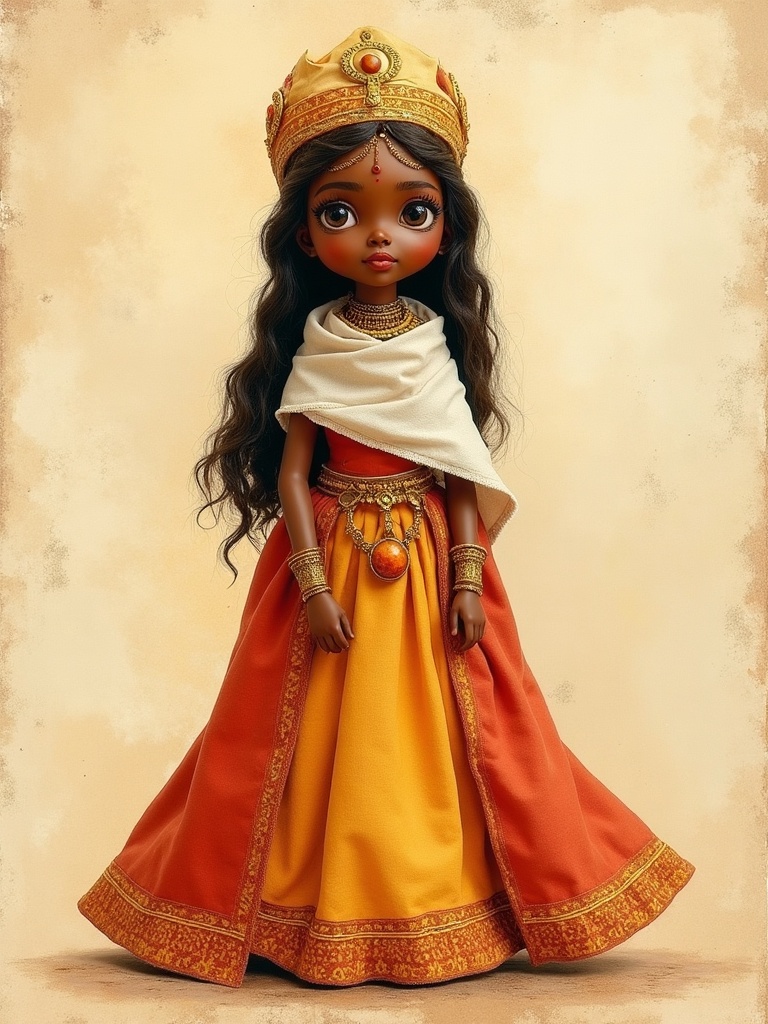
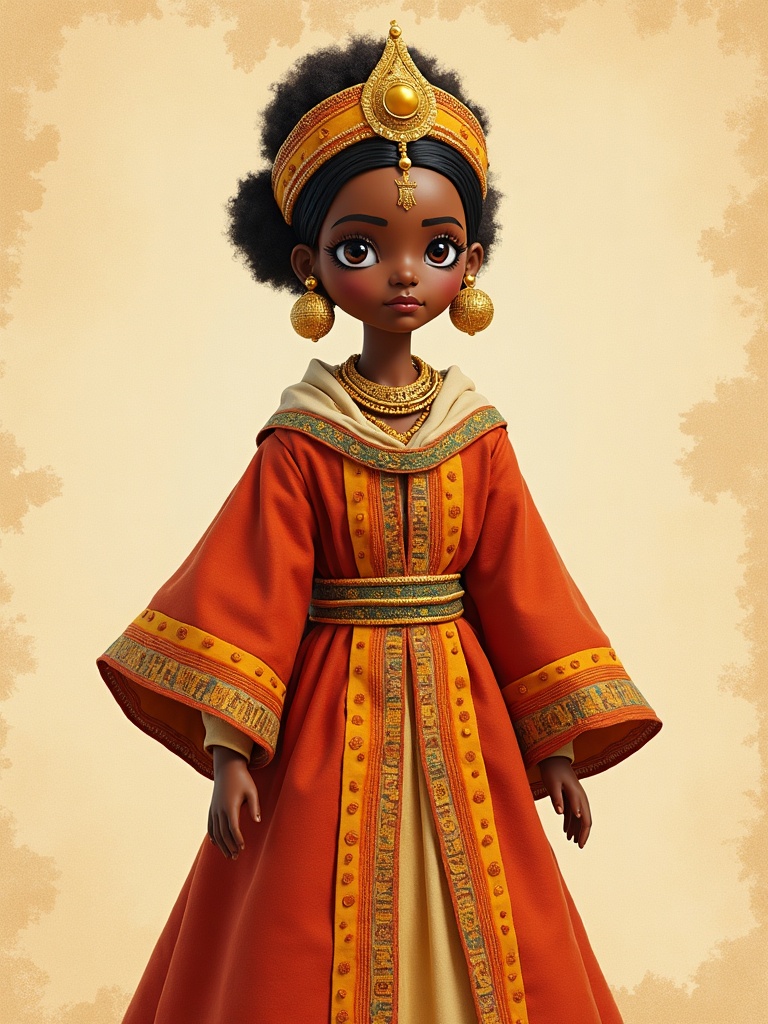
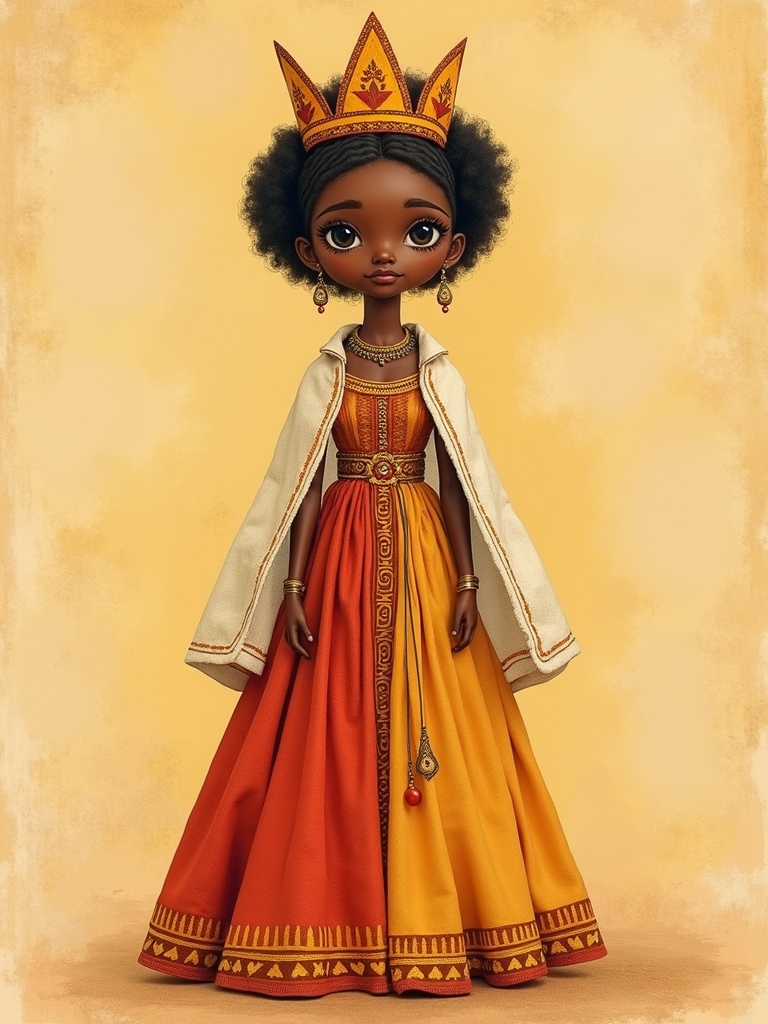
The three stages follow her story — from the young queen, through the traveling riddle-poser, to the wise matriarch.
Makeda as a young ruler, curious and thirsty for knowledge, who hears of a wise king far away. A dignified robe, a first golden diadem. Gift: The clever riddle-poser (in the making).[5]
Makeda at the head of her caravan, gold & frankincense in her baggage, a scroll full of riddles in her hand. The moment of her glory. Signature gift: The Search for Wisdom.[4]
Makeda as a mature, revered queen, returned wiser — before an Aksum stele, surrounded by her people. Gift united with The Matriarch.[2]
Lovely for children: Makeda's journey shows that a journey need not exist for conquering — the greatest conquest is to return home wiser than you set out.
Make & Learn
⑦Fabrics & Manufacturing notes
Real natural fibers, honest craftsmanship, lifelong repairability — and with Makeda a fragrant detail: a touch of real frankincense.
The materials list
The robe: Crimson, gold & white Shamma
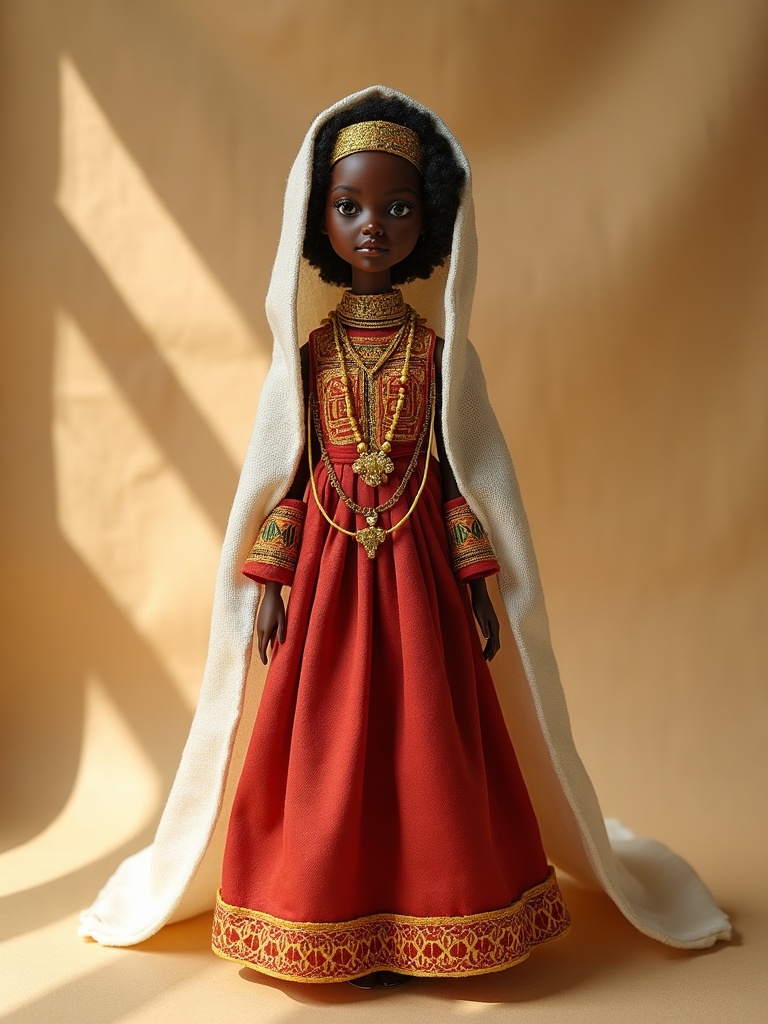
Makeda wears a royal robe of 100% cotton in Crimson red and gold, plus — as a bridge to Selam — a fine white Shamma cloth with red-and-gold Tilet border pattern and a gold band/diadem. Jewelry of amber and gold-toned beads (an echo of the frankincense & gold trade), child-safely sewn. Ideal from Ethiopian weaving cooperatives.
Signature attributes: Scroll & frankincense
Her hallmark is the Scroll of Riddles (fabric/felt, with an embroidered Ge'ez pattern) — and, especially lovely, a tiny frankincense pouch or a gold-toned casket with real frankincense grains (in the collector's variant), so that the doll faintly of frankincense is fragrant — the scent of ancient Saba. Optionally a felt camel. No small parts that can be swallowed in the school/toddler line.
Signature & Educational Card
Embroidered into the hem: „Makeda" and the name of the seamstress. Enclosed is an Educational Cardwhich — as a teaching piece for the whole series — explains the difference between legend and documented history , plus three of the famous „hard questions" to puzzle over yourself. Optional QR thread to the history page.
Production stages & effort
Crimson-gold robe, Shamma, diadem, scroll, incense casket, educational card. The collector's and wisdom figure.
Simplified robe, small scroll. Affordable entry point.
Washable, reinforced seams, sturdy attributes (without loose incense). With a legend-vs-history card for the classroom.
How it's made
Every doll is sewn by hand from natural materials — built to last a lifetime and to be repaired, not replaced. Here is the shopping list and the work steps. Sizes: Classic 32 cm (heirloom) · Kidogo 18–20 cm (toddlers, no small parts) · Shule 28 cm (school edition).
Shopping list
- Natural cotton or linen for the body (skin tone), ~0.5 m
- Wool or cotton stuffing — no plastic
- Cotton thread and embroidery floss in matching colours
- Garment fabric in this doll's colours (see the fabrics above)
- Yarn for the hairstyle
- Beads, cowrie shells and trims as shown
- Sharps and embroidery needles, pins, fabric scissors, fabric marker
Work instructions
- Trace and cut the body pattern at your chosen size (Classic 32 cm / Kidogo 18–20 cm / Shule 28 cm).
- Sew the body pieces right sides together, leave an opening, turn and stuff firmly with natural fibre, then close by hand.
- Embroider the face gently and with dignity — no plastic parts for the toddler line.
- Make the hair from yarn following the chosen hairstyle and attach it securely.
- Cut and sew the garment from this doll's fabric, then dress the doll.
- Add the beadwork, shells, trims and any attribute by hand.
- Check every seam and reinforce it — the doll should be lifelong and repairable, with no loose small parts for small children.
⑥Ten Name suggestions
The legendary name is preserved. These ten names — Ethiopian/Aksumite & from the Saba tradition — are suitable for Companion figures, daughters or the series around Makeda. To be confirmed by Ethiopian authorities before use.
Beautiful connection: „Selam" links Makeda to the Ethiopian flagship doll — and the name „Bilqīs" opens up the Islamic tradition. One queen, three worlds, one name per door.
⑧Curriculum Mapping & Subjects
Makeda is a pedagogical stroke of luck: through her one can teach source literacy like no other figure — the difference between legend, belief and documented history. At the same time she makes Aksum visible, one of the great forgotten civilizations.
Legend vs. History
Documented? Handed down? Believed?
History / Media Literacy. What is a source? How do I distinguish evidence, tradition & belief? Source criticism with the finest example.
A forgotten great power
Gold, frankincense, stelae, coins.
History / Geography. Aksum as one of the „four great powers"; Red Sea trade, its own script & coinage — African antiquity on a par with Rome.
Testing with questions
Wisdom through curiosity.
Logic / Language / Values. Solving & posing riddles; formulating good questions; practicing critical thinking.
Bible, Quran, Kebra Nagast
One figure, many traditions.
Religion / Values. How the same story lives in three cultures — building a bridge between worlds of faith, gently & respectfully.
Children sort statements into "proven / handed down / believed" — including about Makeda herself. Learning goal: source literacy, critical thinking, honest handling of knowledge.
The class solves old riddles & invents their own to "test" others. Learning goal: logical thinking, formulating questions, joy in puzzling.
Children discover Aksum's stelae, coins & trade and compare it with Rome. Learning goal: African antiquity, correcting the cliché of a "history-less" Africa.
Origin & Ethics
How we know this
On honesty: Makeda is the least historically substantiated figure in the entire series — deliberately marked as a "Legend" (★★☆☆☆). Whether the Queen of Sheba existed as a real person is not documented; her story lives on in the Bible, the Quran and the Ethiopian national epic Kebra Nagast (14th c.), not in archaeological finds. Aksum, by contrast, is a fully documented, magnificent high culture — legend and the real world are kept cleanly separate here. Several traditions lay claim to her (Ethiopian-Christian, Islamic as Bilqīs; Yemen also claims Sheba) — this is acknowledged, not appropriated. The adult & partly clichéd embellishments of the ancient texts (such as the Bilqīs-Jinn legend) are deliberately left out for a children's figure; the depiction avoids the old "seductress" cliché and shows a wise, dignified queen. The "abilities" and "life stages" translate the tradition into the collectible-card format. Since Makeda belongs to Ethiopia's national & religious identity (and Aksum is a UNESCO World Heritage Site), final approval rests with the Ethiopian cultural, church & research authorities.
⑨Elder Approval & Sources to Observe
In a legendary and at the same time sacred figure, approval is especially delicate: Makeda belongs to Ethiopia's national and religious identity (Orthodox Church, Kebra Nagast), is venerated in the Islamic world as Bilqīs and is dear to the Rastafari. Several communities must be heard — and the boundary between history, faith and legend must be preserved respectfully and honestly.
The Approval Panel
The five-step protocol
Contact via official channels (Ethiopian cultural authorities, UNESCO World Heritage Site Aksum, Orthodox Church, Aksum research). Presentation of the vision, 42% rule, veto right.
Hand over this compendium as a draft — especially the "legend-instead-of-history" framing, the dignified (non-eroticized) portrayal & the omission of adult embellishments.
Cultural agencies for the figure, the Church for the sacred dimension, craft for material, research for the honest source classification.
Written approval for each element. Sacred content (Kebra Nagast, Ark of the Covenant reference) is touched only with ecclesiastical consent & never disrespectfully.
Habesha craftspeople & community funds receive a share; part of the proceeds supports the preservation of the Aksum World Heritage Site.
Most sensitive areas: the honest separation of legend, faith & history (never sell legend as documented fact), the dignified, non-eroticized depiction (against the old „seductress“ cliché), the respectful handling of sacred content (Kebra Nagast, Ark of the Covenant) and the fair acknowledgment that Yemen claims Saba for itself.
Sources to observe
Sources
- Ethiopian tradition (Kebra Nagast, ~1314) calls her Makeda, matriarch of the Solomonic dynasty; historicity unconfirmed; in the Quran she is called Bilqīs. madainproject.com: Queen of Sheba.
- Makeda & Solomon conceive (in the Kebra Nagast) Menelik I, who grows up in Aksum & founds the Solomonic line; connection to the Ark of the Covenant in Aksum. feelnubia.org.uk: Queens and Mothers — Makeda; en.wikipedia.org: Menelik I.
- The Kebra Nagast — 14th-century national epic in Ge'ez; legitimizes the Solomonic dynasty; described by Ullendorff as a "conflation of legendary cycles." en.wikipedia.org: Kebra Nagast.
- First mention in 1 Kings 10 / 2 Chronicles 9: She comes with camels, gold, spices & precious stones, "to test Solomon with hard questions"; echoed in the Quran (Surah 27, Saba). madainproject.com; britannica.com: Queen of Sheba.
- Kebra Nagast as the "fullest" version; she as a "seeker of truth & knowledge"; Menelik brings (according to legend) the Ark of the Covenant to Aksum; dynasty down to Haile Selassie. ebsco.com: The Queen of Sheba.
- Bible: 120 talents of gold & great quantities of spices as gifts; "there was no more spirit in her" before Solomon's wisdom. allaboutethio.com; feelnubia.org.uk.
- Aksum as one of the "four greatest powers" (with Rome, Persia, China); wealth from frankincense, myrrh, gold; its own gold coins; Ge'ez from Sabaean. world-archaeology.com; sciencenewstoday.org: Kingdom of Aksum; education.nationalgeographic.org.
- Saba/Sheba located between Ethiopia & South Arabia (Yemen) — a dispute of traditions; Aksum at times extended into South Arabia. britannica.com: Queen of Sheba; graphsearch.epfl.ch: Kingdom of Aksum.
- Aksum: Adulis as the main port, coins in Greek/Ge'ez, stelae as funerary monuments; Christianization under King Ezana (4th c.). archaeology.org: Africa's Merchant Kings; courses.lumenlearning.com.
- Aksum as a UNESCO World Heritage Site: monolithic obelisks/stelae (up to >20 m), royal tombs, the Church of Our Lady Mary of Zion (said to hold the Ark of the Covenant); the Ezana Stone trilingual. whc.unesco.org: Aksum; dawan.africa.