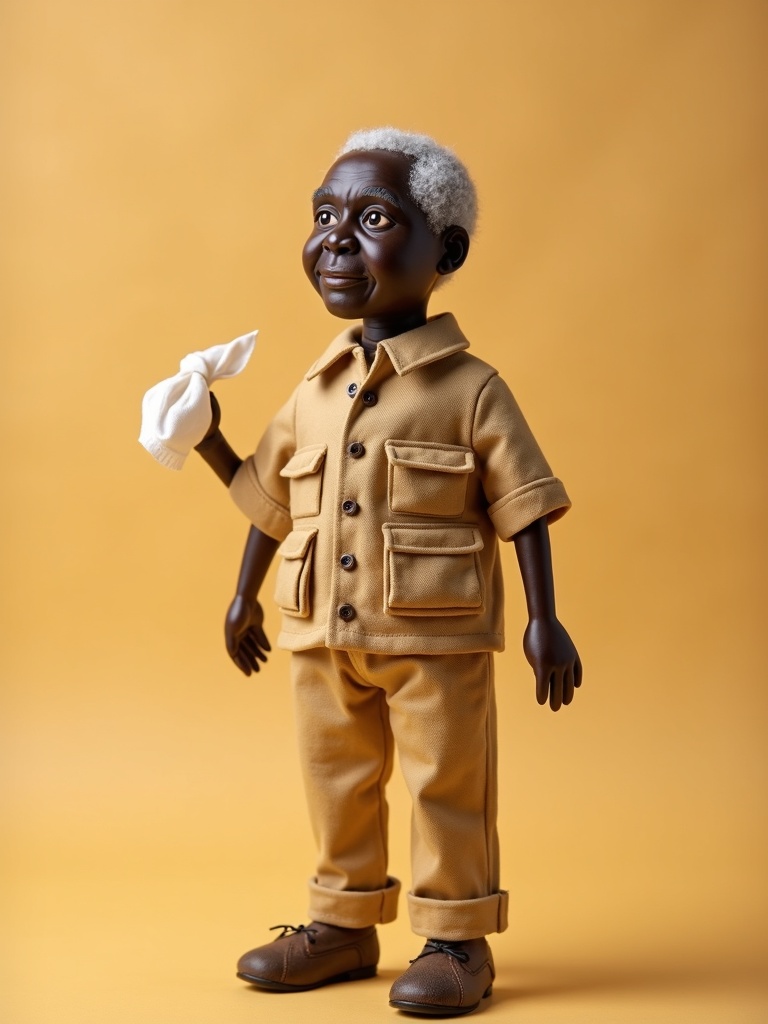
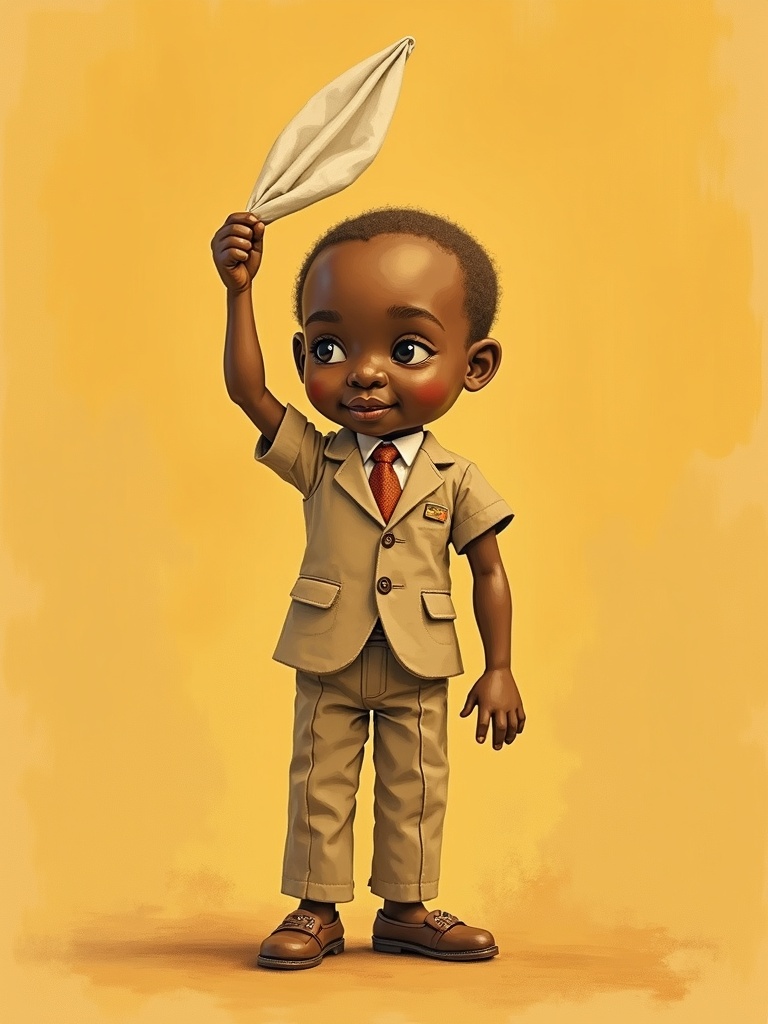
AI design preview — not a photo of the finished handmade doll
Independence & Humanism
Kenneth Kaunda
He rode to freedom meetings with a guitar on his shoulder and a white handkerchief in his hand — and when Zambia became free in 1964, that gentle man became its first president.
- People
- Bemba
- Country
- Zambia
- Region
- Central Africa
- Era
- 1924–2021
- Theme
- Independence & Humanism
⚖ A respectful concept
Kenneth Kaunda (1924–2021) was a real Zambian leader; this doll is a respectful homage, not an exact likeness, and uses only documented quotes with sources. His dignity is honoured throughout, including an honest naming of the one-party state he built in 1972–1973 alongside his genuine work for independence, peace and AIDS awareness. The consent of his family and of the Zambian national institutions that commemorate him (the Kenneth Kaunda Foundation, his state funeral and national memorials) is respectfully implied. This is a draft tribute for an educational children's project, not a finished or endorsed product.
Make your own
Design your Kenneth Kaunda
Pick a garment, a hairstyle and a scene, enter the PIN and generate a fresh image of Kenneth Kaunda with AI.
⚖ AI homage concept — not a likeness of the real person.
Each image is generated live with fal.ai.
Generated images
AI design preview — not a photo of the finished handmade doll
No images generated yet — be the first.
Tradition & Origin
He rode to freedom meetings with a guitar on his shoulder and a white handkerchief in his hand — and when Zambia became free in 1964, that gentle man became its first president.
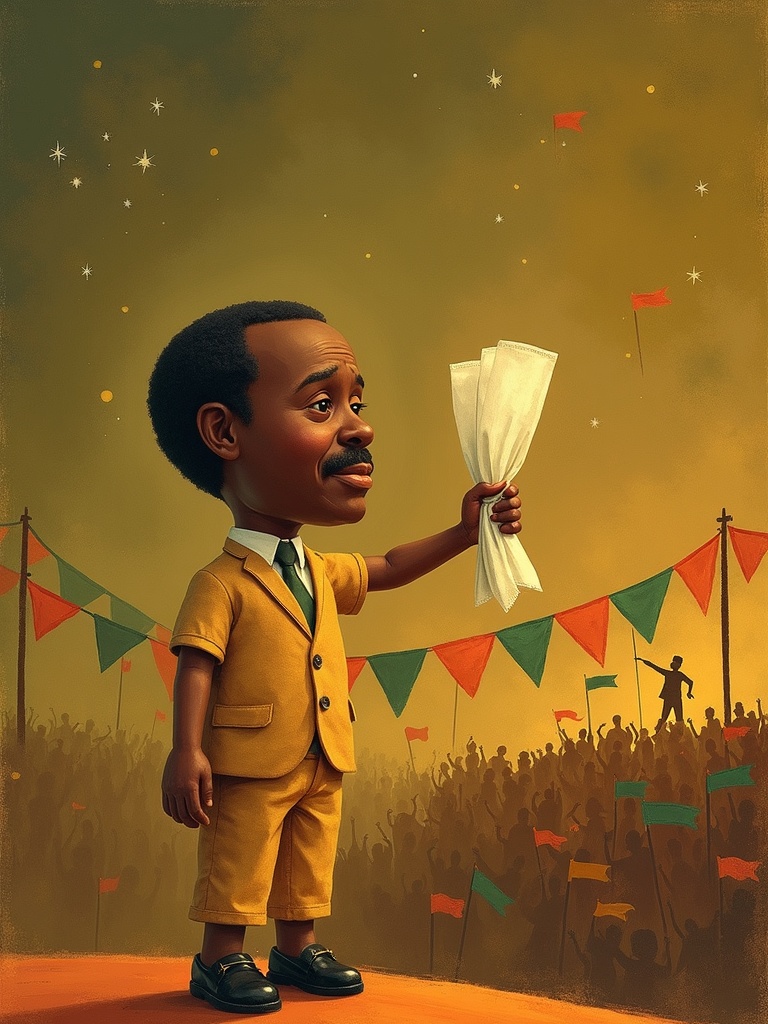
Kenneth David Kaunda was born on 28 April 1924 at Lubwa Mission in Chinsali, in the far north of what was then Northern Rhodesia, the youngest of eight children among the Bemba people. His father was a Church of Scotland minister and teacher; his mother was the first African woman to teach in the colony. Kenneth followed them into the classroom — but the injustice of colonial rule pulled him out of it and into politics, where he founded the United National Independence Party (UNIP) and led a patient campaign of civil disobedience modelled on Gandhi and Martin Luther King Jr.
On 24 October 1964 the Union Jack came down and Kaunda became the first president of Zambia. He preached a philosophy he called Zambian Humanism — that a nation should put its people first and care for them like family — and he nationalised the great copper mines that were the country's lifeblood. Beyond his borders he turned Zambia into a frontline sanctuary: the ANC, ZAPU, ZANU and SWAPO all worked from Zambian soil, and the ANC's Radio Freedom broadcast from Lusaka while Zambia absorbed the cross-border raids that this courage invited.
The story is not all light, and an honest record says so. In 1972–1973 Kaunda banned every party but his own and ruled a one-party state for nearly two decades, while a copper-dependent economy slid into debt as world prices fell. Yet his decency kept showing through. He sang his song of unity, 'Tiyende Pamodzi' ('let us go together'); in 1987 he told his shocked nation that his own son had died of AIDS — the first African head of state to speak so openly — and campaigned ever after against the disease and its stigma.
And when the people finally voted him out in 1991, he did the rarest thing of all in the Africa of his time: he accepted defeat and handed over power peacefully. He lived on as a beloved elder, 'KK', until his death in Lusaka in 2021 at the age of 97, mourned across a continent with a forest of raised white handkerchiefs.
Timeline
- 1924Born 28 April at Lubwa Mission, Chinsali, among the Bemba.
- 1960Becomes leader of the new United National Independence Party (UNIP).
- 1964Becomes the first president of an independent Zambia on 24 October.
- 1972Declares a one-party state; UNIP becomes the only legal party (formalised 1973).
- 1987Announces publicly that his son has died of AIDS, urging openness against the disease.
- 1991Loses the multi-party election and hands over power peacefully; dies in Lusaka in 2021, aged 97.
Did you know?
- Kaunda was almost never seen without a white handkerchief, his lifelong sign of love and peace — at his 2021 funeral, mourners raised handkerchiefs in salute.DetailsEN
- He composed his own songs and once strummed his guitar and sang 'Tiyende Pamodzi' in Bemba at a White House dinner.DetailsEN
- The short-sleeved 'Kaunda suit' he popularised became a symbol of independent African dignity, copied by leaders and officials across the continent.DetailsEN
- His commitment to non-violence, inspired by Gandhi and Martin Luther King Jr., earned him the nickname 'Africa's Gandhi'.DetailsEN
A whole nation said goodbye not with weapons raised, but with white handkerchiefs lifted to the sky.
Values & Capabilities
Capabilities
◆◆◆◆◆ shows how central a gift is — five diamonds mark a signature strength, fewer mark a supporting one.
He was almost never seen without a white handkerchief in his hand — his lifelong sign of love and peace.
He led Northern Rhodesia to freedom and became the first president of Zambia on 24 October 1964.
He taught a philosophy he called Zambian Humanism — that a country should put people first and care for them like family.
He turned Zambia into a frontline sanctuary for fighters against apartheid and colonial rule across southern Africa.
When his own son died of AIDS, he told the truth in public and spent his later life fighting the disease and its stigma.
Development
1 of 6 stages unlocked
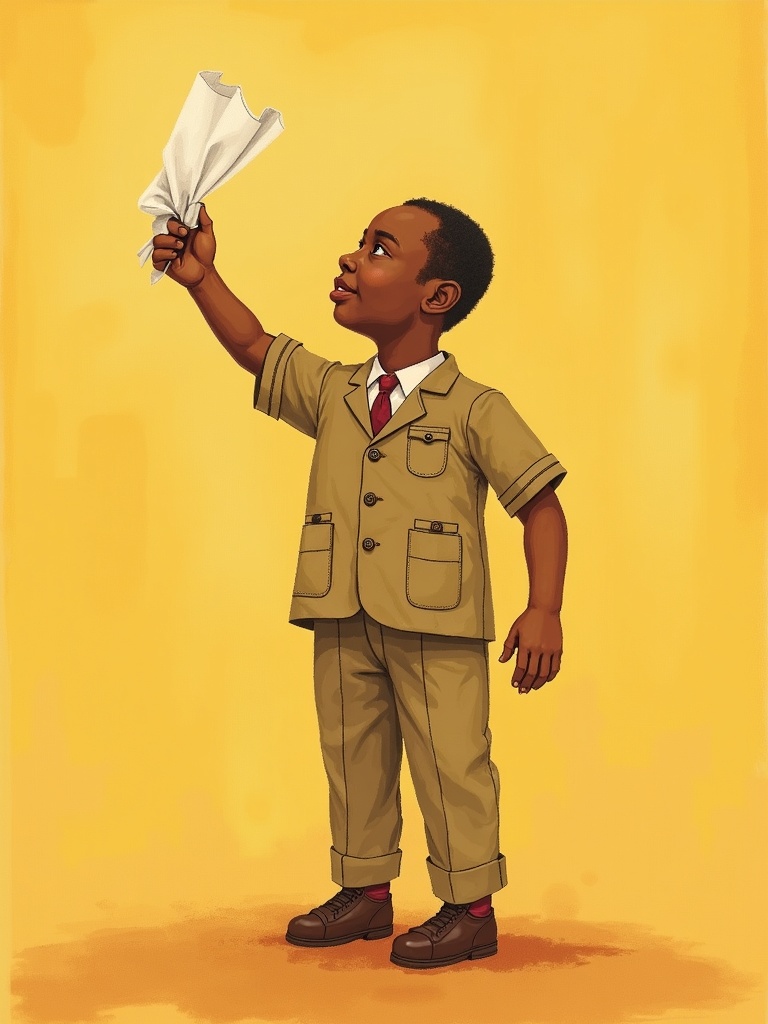
Born in 1924 at Lubwa Mission in Chinsali, the teacher-son of a missionary and a pioneering teacher-mother.
Answer all three to unlock this stage.
Unlock the previous stage first.
Unlock the previous stage first.
Unlock the previous stage first.
Unlock the previous stage first.
Crafting the doll
The doll is built around real Zambian and Bemba material culture. Its signature outfit is the Kaunda suit — the short-sleeved safari jacket in light khaki cotton drill with four bellows pockets, a self-belt and matching trousers, worn without a tie, which Kaunda made a symbol of post-colonial African dignity. As an alternative it carries the bright chitenge, Zambia's universal printed cotton wrap cloth, as a sash or pocket trim. The defining attribute is a small white handkerchief, his lifelong sign of peace, paired with a simple acoustic guitar for his song 'Tiyende Pamodzi'. An education card carries his honest story — the freedom and AIDS-awareness courage and the one-party years named side by side. Sizes: Classic 32 / Kidogo 18–20 / Shule 28. A share of proceeds supports children's literacy and HIV-awareness education projects in Zambia.
How this doll is made
His look is built from the post-independence statesman's wardrobe he made famous — the short-sleeved khaki 'Kaunda suit' — together with Zambia's bright chitenge wrap cloth, his white peace-handkerchief and the acoustic guitar of his unity songs.
- Garments 2
- Accessories 3
- Materials 2
- Techniques 3
Garments
- Kaunda suit (safari jacket)A short-sleeved khaki cotton-drill jacket with four bellows pockets, a self-belt and matching trousers, worn without a tie; Kaunda made it a symbol of independent African dignity.DetailsEN
- Chitenge wrap clothZambia's universal printed cotton wrap (kitenge), worn as skirt, sash, headscarf or baby sling and the only cultural element shared across Zambian peoples.DetailsEN
Accessories
- White handkerchiefKaunda's lifelong hand-held symbol of love and peace, adopted in the independence struggle and raised by mourners at his funeral.DetailsEN
- Acoustic guitarHe rode to meetings with a guitar on his shoulder and sang his own songs, most famously 'Tiyende Pamodzi'.DetailsEN
- Self-belt & bellows pocketsThe Kaunda suit's defining details: a cloth self-belt at the waist and four expandable bellows pockets on the jacket front.DetailsEN
Materials
- Cotton drill / poplin (khaki)The Kaunda suit is sewn from lightweight khaki cotton drill or poplin, cool and hard-wearing in the tropical climate.DetailsEN
- Wax-print cotton (chitenge)Chitenge is printed cotton made with an industrialised batik/wax-print technique, giving bright two-sided patterns.DetailsEN
Techniques
- Wax-resist printingChitenge patterns are made by an industrial version of batik wax-resist dyeing, so the design appears clearly on both faces of the cloth.DetailsEN
- Jacket tailoringThe Kaunda suit is cut as a structured short-sleeved jacket with set-in pockets, belt loops and matching trousers — formal yet tieless.DetailsEN
- Cloth wrapping & tyingThe chitenge is not tailored but folded and tied around the body or head, a skill passed down among Zambian women and men alike.DetailsEN
How it's made
Every doll is sewn by hand from natural materials — built to last a lifetime and to be repaired, not replaced. Here is the shopping list and the work steps. Sizes: Classic 32 cm (heirloom) · Kidogo 18–20 cm (toddlers, no small parts) · Shule 28 cm (school edition).
Shopping list
- Natural cotton or linen for the body (skin tone), ~0.5 m
- Wool or cotton stuffing — no plastic
- Cotton thread and embroidery floss in matching colours
- Garment fabric in this doll's colours (see the fabrics above)
- Yarn for the hairstyle
- Beads, cowrie shells and trims as shown
- Sharps and embroidery needles, pins, fabric scissors, fabric marker
Work instructions
- Trace and cut the body pattern at your chosen size (Classic 32 cm / Kidogo 18–20 cm / Shule 28 cm).
- Sew the body pieces right sides together, leave an opening, turn and stuff firmly with natural fibre, then close by hand.
- Embroider the face gently and with dignity — no plastic parts for the toddler line.
- Make the hair from yarn following the chosen hairstyle and attach it securely.
- Cut and sew the garment from this doll's fabric, then dress the doll.
- Add the beadwork, shells, trims and any attribute by hand.
- Check every seam and reinforce it — the doll should be lifelong and repairable, with no loose small parts for small children.
Origin & Ethics
How we know this
The documented core of this record — his 1924 birth at Lubwa Mission among the Bemba, his teaching, the founding and leadership of UNIP, the 1964 presidency, Zambian Humanism, support for the Frontline States and the ANC/ZAPU/ZANU/SWAPO, the 1972–1973 one-party state, the white handkerchief and the song 'Tiyende Pamodzi', his 1987 AIDS disclosure and later HIV advocacy, and his peaceful exit after losing the 1991 election — is well attested across multiple independent sources. The exact year his son died is given variously as 1986–1988 in different reports; his public AIDS announcement is dated to 1987. This is a respectful homage, not an exact likeness, using documented quotes only.
This figure is offered as a homage drawn entirely from public historical record — Wikipedia, Britannica, UNAIDS, the Chatham House and Christian Science Monitor reporting, and Zambian and South African news archives. As Kaunda is a recently deceased real leader given a state funeral, the doll honours the consent of his family and of the Zambian national institutions that commemorate him (the Kenneth Kaunda Foundation and the national memorials in his name). Only documented quotes are used, the likeness is deliberately non-exact, and the record names the one-party era and economic decline honestly and with dignity.
Sources
- Kenneth Kaunda — Wikipedia
- Kenneth Kaunda — Encyclopaedia Britannica
- Kenneth Kaunda: the man behind the statesman — Chatham House
- Battling AIDS in Africa: Kaunda sets an example — The Christian Science Monitor
- UNAIDS is deeply saddened by the death of the former President of Zambia, Kenneth Kaunda — UNAIDS
- Zambians give handkerchief salute to fallen statesman Kaunda — VOA News
- Humanism in Zambia — Schumacher Center for a New Economics
- Kaunda soldiers on in anti-AIDS campaign — The New Humanitarian
- Zambia: Kenneth Kaunda — Father of the Zambian Song — allAfrica.com
- Safari jacket — Wikipedia
- Kitenge (chitenge) — Wikipedia
- For the love of the stylish Kaunda suit — Daily Nation