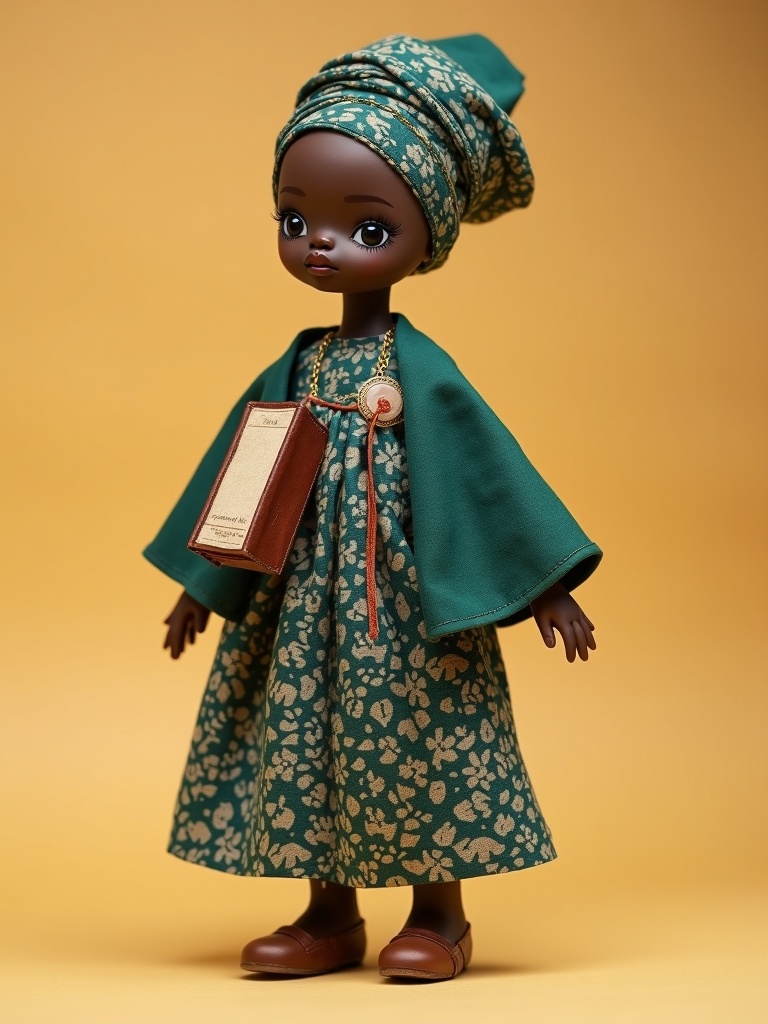
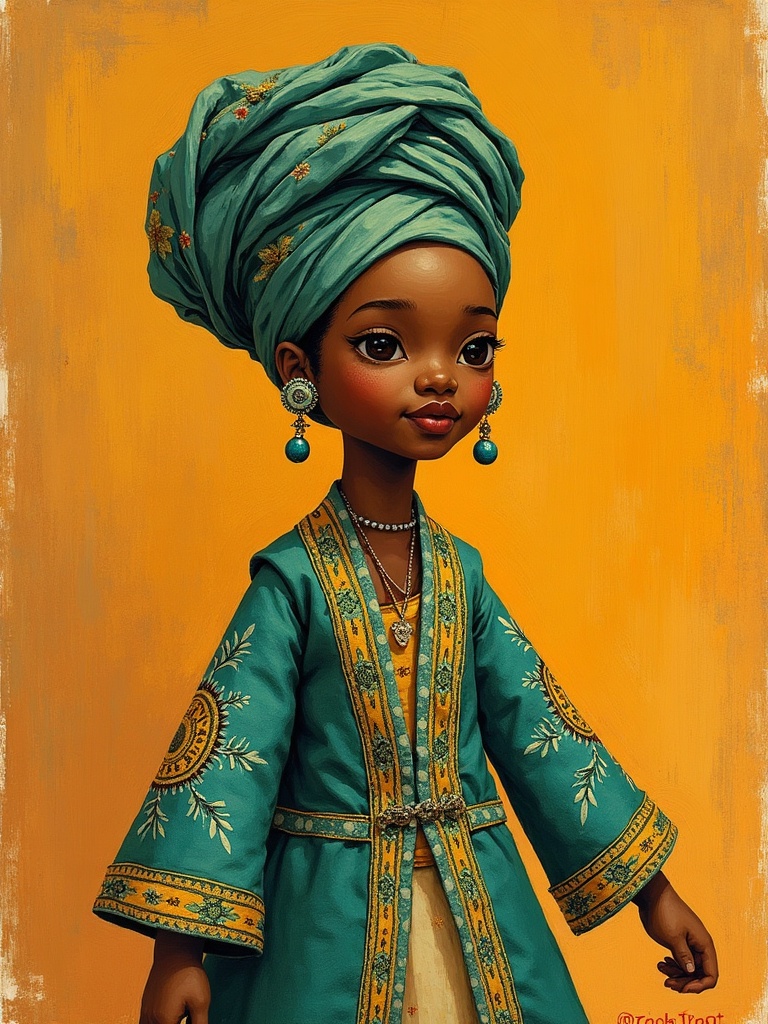
AI design preview — not a photo of the finished handmade doll
Reform, Justice & Diplomacy
Idris Alooma
When Mai Idris Alooma rode out from the walled city of Ngazargamu, he brought something no rival around Lake Chad had seen: muskets, camel cavalry, and judges who answered to the law instead of the sword.
- People
- Kanuri (Sayfawa dynasty)
- Country
- Chad
- Region
- Central Africa
- Era
- ≈1564–1596
- Theme
- Reform, Justice & Diplomacy
Make your own
Design your Idris Alooma
Pick a garment, a hairstyle and a scene, enter the PIN and generate a fresh image of Idris Alooma with AI.
Each image is generated live with fal.ai.
Generated images
AI design preview — not a photo of the finished handmade doll
No images generated yet — be the first.
Tradition & Origin
When Mai Idris Alooma rode out from the walled city of Ngazargamu, he brought something no rival around Lake Chad had seen: muskets, camel cavalry, and judges who answered to the law instead of the sword.
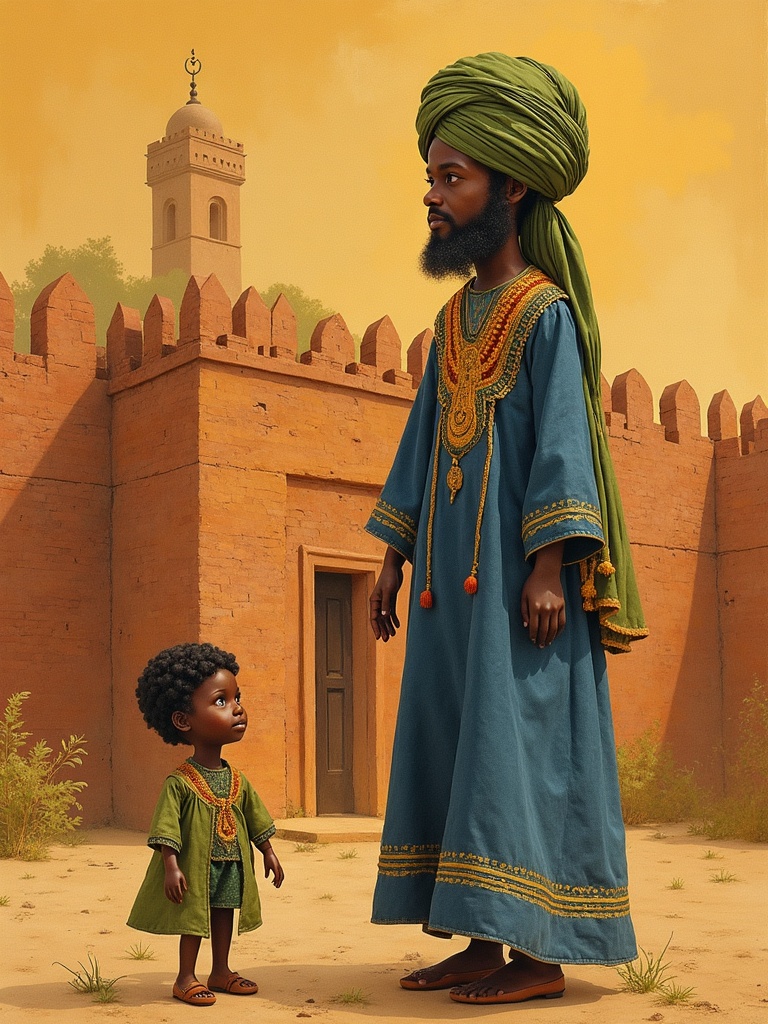
The Ottoman Empire once sent a 200-member ambassadorial party across the desert to his court at Ngazargamu.
DetailsENIdris Alooma (also written Idris Alauma or Idris Aloma) was a Kanuri Mai — king — of the Kanem-Bornu Empire, the great Sahelian state that stretched across what is now Chad, Nigeria, Niger and Cameroon. He belonged to the Sayfawa (Sefuwa) dynasty, one of the longest-ruling royal lines in world history: it held the throne for roughly 800 years, from about 1085 until 1846. By Idris's day the dynasty had already governed for some five centuries from its fortified capital, Ngazargamu, west of Lake Chad. Historians disagree on his exact dates — different king-lists give him 32, 33, 36 or even 51 years — but his reign is usually placed in the last third of the 16th century (commonly given as c. 1564–1596, with some sources extending it to about 1603).
Almost everything we know of him comes from a single remarkable voice: his chief imam and chronicler Ahmad ibn Furtu (Ahmad bin Fartuwa), who set down a detailed account of the first twelve years of the reign — one of the earliest surviving works of indigenous African history-writing. Through Furtu we see a ruler who modernised his army with startling speed. Idris imported firearms and hired Turkish (Ottoman) musketeers and military advisers to train a corps of iron-helmeted gunmen. He clad his cavalry in chain mail and quilted armour, introduced camel cavalry to the Lake Chad region, used Kotoko boatmen on the rivers, and fought with walled war-camps, prolonged sieges and scorched-earth campaigns. One epic poem credits him with victories in 330 wars and more than 1,000 battles.
Yet Idris is remembered as much for justice as for war. A devout Muslim, he reformed his courts along Islamic law (sharia), established qadi (judge) courts and a court of appeals, and deliberately separated the judiciary from the rest of the government — a striking idea for any state of his era. He sponsored the building of mosques, and on pilgrimage to Mecca he founded a hostel to shelter pilgrims travelling from Bornu. His diplomacy reached far beyond the Sahara: he exchanged embassies with Tripoli, Egypt and the Ottoman Empire, which once sent a 200-member ambassadorial party across the desert to his court, while his own envoys travelled north to Istanbul. Under his hand, Kanem-Bornu reached the height of its power and influence.
Timeline
- ≈1564becomes Mai after Queen Aissa Koli
- reignends the Kanem civil wars; reunites the heartland
- reignreforms the courts, appoints qadis, builds brick mosques
- reignopens diplomacy with the Ottomans, Tripoli, Egypt, Morocco; receives a 200-member embassy
- 1576his imam Ibn Furtu writes the chronicles
- ≈1596dies; the Sayfawa dynasty endures until 1893
Did you know?
- Idris Alooma hired Turkish (Ottoman) gunmen to train his soldiers in the use of muskets — making Bornu one of the first powers south of the Sahara to field a firearm corps.DetailsEN
- He is credited with introducing camel cavalry to the Lake Chad region, turning the desert ship into a weapon of mobile war.DetailsEN
- He separated the judges from the government, setting up Islamic qadi courts and a court of appeals — an early division of judicial power in 16th-century Bornu.DetailsEN
- On pilgrimage to Mecca he built a hostel so that travellers from his empire would always have a place to rest on the long road to the holy city.DetailsEN
A king who counted his strength not only in muskets, but in fair courts and shelter for the weary.
Values & Capabilities
Capabilities
◆◆◆◆◆ shows how central a gift is — five diamonds mark a signature strength, fewer mark a supporting one.
He put the law on a firm footing, appointing trained judges (qadis) to settle disputes fairly across the empire — so an ordinary person could seek justice, not just the powerful.
He exchanged embassies with the Ottoman sultan and the rulers of Tripoli, Egypt and Morocco, securing safe passage for his people abroad; an Ottoman delegation of 200 crossed the Sahara to his court.
He ended the civil wars that had torn Kanem–Bornu apart and reunited it under one strong, stable rule.
He built brick mosques, invited scholars, and encouraged literacy and pilgrimage; his own court produced written chronicles.
He learned from everywhere — adopting firearms and trainers from the Ottomans, walled camps, armoured horsemen, and boat-troops on Lake Chad — to defend his people.
Development
1 of 3 stages unlocked
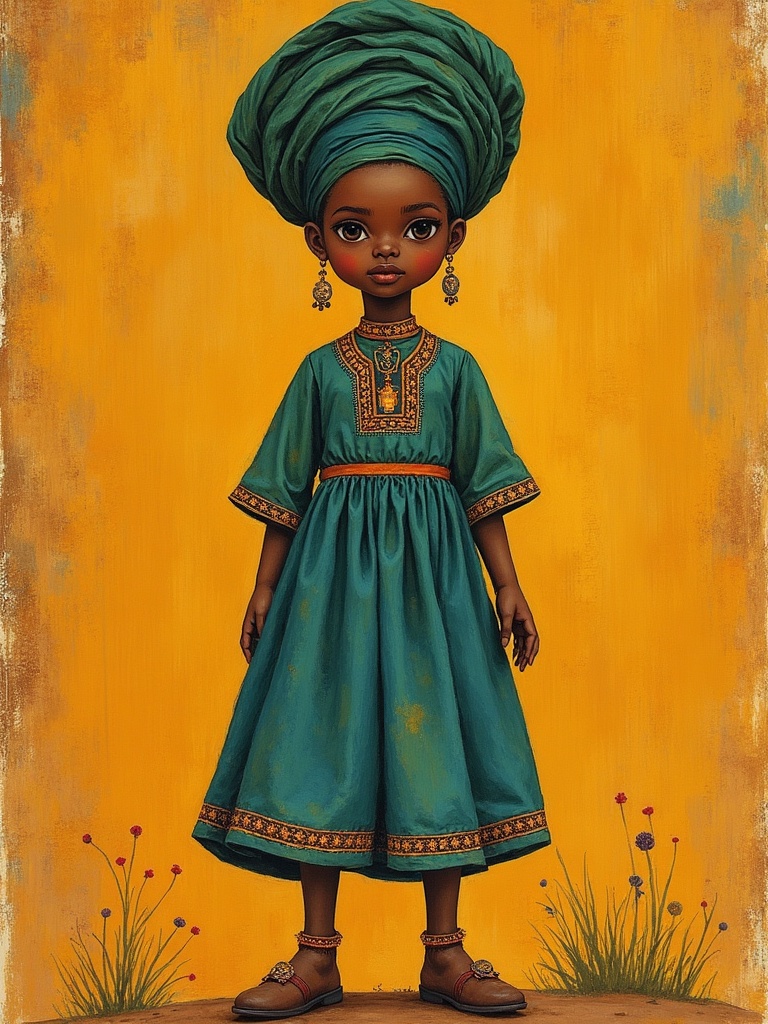
The young ruler taking a kingdom worn by war.
Answer all three to unlock this stage.
Unlock the previous stage first.
Crafting the doll
Garment: an indigo-and-green embroidered boubou and a layered turban, leather amulet-pouches (child-safe). Signature attribute: a small law-book and a sealed envoy’s letter. Education card: Kanem–Bornu and Lake Chad, fair courts, the trans-Saharan world that linked Bornu to the Ottomans — and honestly the era’s slave trade. Sizes as standard. Proceeds → Lake Chad / Kanuri heritage.
How this doll is made
Mai Idris Alooma's image is grounded in the cavalry court culture of the Kanem-Bornu Empire around Lake Chad, where Kanuri royal dress combined the great wrapped turban and flowing embroidered gown of trans-Saharan Islamic fashion with the kingdom's famous quilted-cotton and iron armour for horse and rider. Handspun cotton, kapok padding, vegetable-tanned leather and traded iron mail were the working materials of this Sudanic equestrian world.
- Garments 2
- Accessories 4
- Materials 1
- Techniques 3
Garments
- Babban riga (great gown)A very wide, flowing robe sewn from joined cotton panels, worn by male aristocracy as a sign of rank, piety and authority. The neckline carries dense hand embroidery of geometric motifs (such as the 'aska biyu' two-knives triangle and spiral forms); aristocrats sometimes layered several robes to enhance prestige.DetailsEN
- Quilted cotton armour (lifidi)A thick padded war-garment for the rider, made of several layers of locally woven cotton stuffed with kapok (silk-cotton tree floss) and quilted through to hold the filling. Named components covered different parts of the body — e.g. the bantan lifidi over loins and abdomen, the safa over the upper torso, and the kumakumi corselet — and could be worn alone or over chain mail.DetailsEN
Accessories
- Large wrapped turban and lithamA long strip of cotton wound into a very large turban, the prestige headdress of Sahelian court and cavalry men; among trans-Saharan groups including the Kanuri it could be drawn across the lower face as a litham (mouth/face veil) against sun and dust, leaving only the eyes visible.DetailsEN
- Quilted horse armour (barding)A matching set of brightly coloured quilted cotton coverings for the war-horse, made of cloth panels sewn together and stuffed with kapok, often decorated in a diamond patchwork pattern. It protected the horse from arrows in battle and was also worn for grand military parades; a war-horse could additionally be fitted with a quilted breastplate (dan gaba).DetailsEN
- Tooled leather horse regalia and saddlerySaddles, reins, ornamental straps, saddlebags and scabbards (the cavalry's 'kayan doki', horse gear) made by Sahelian leatherworkers from vegetable-tanned, vividly dyed hides, decorated with geometric cut-outs and tooling that echo Islamic abstract design. Such richly tooled tack is still displayed by mounted men at northern Nigerian Durbar/Sallah festivals.DetailsEN
- Iron chain mail shirt and cuirassThe Mai/Shehu of Bornu's elite guards wore iron mail shirts and, in some cases, riveted iron plate cuirasses (six horizontal torso plates fastened with iron rivets and leather trim, opening at one side). Mail was traded in from Islamic polities across the Sahel rather than made locally, and was worn over a quilted garment for cushioning.DetailsEN
Materials
- Handspun cotton and kapokCotton was hand-spun and woven into long narrow strips on the Chadic/narrow-strip loom used by the Kanuri and neighbouring groups, then joined into broad cloth for gowns and armour. Kapok — the wool-like floss from the silk-cotton tree — supplied the soft, springy padding stuffed inside quilted armour for horse and rider.DetailsEN
Techniques
- Quilted-armour makingSeveral layers of woven cotton are stacked and stitched together through their full thickness around a packing of kapok or raw cotton fibre; the quilting lines are often worked in decorative patterns and combined with applied patches of coloured cloth (e.g. diamond patchwork). The result is a thick, padded textile stiff enough to turn arrows yet light enough for man and horse to wear in the field or on parade.DetailsEN
- Riveted iron mail makingMail shirts (sulke) were built from small iron rings, each individually closed with a rivet rather than simply butted, giving far greater strength; the garment was finished with a leather collar and thongs. Because the rings had to turn an arrow or sword, riveted construction was prized over quicker butted work.DetailsEN
- Vegetable tanning and leather dyeingLeatherworkers (majema) turned raw hides into supple leather using plant tannins such as the pods of the bagaruwa (Egyptian mimosa) tree, soaking, then whitening or colouring the skins with dyes made from indigo, bark, pomegranate skins and mineral pigments. The dyed leather was then cut, layered and tooled into saddlery, scabbards and ornamental horse trappings.DetailsEN
How it's made
Every doll is sewn by hand from natural materials — built to last a lifetime and to be repaired, not replaced. Here is the shopping list and the work steps. Sizes: Classic 32 cm (heirloom) · Kidogo 18–20 cm (toddlers, no small parts) · Shule 28 cm (school edition).
Shopping list
- Natural cotton or linen for the body (skin tone), ~0.5 m
- Wool or cotton stuffing — no plastic
- Cotton thread and embroidery floss in matching colours
- Garment fabric in this doll's colours (see the fabrics above)
- Yarn for the hairstyle
- Beads, cowrie shells and trims as shown
- Sharps and embroidery needles, pins, fabric scissors, fabric marker
Work instructions
- Trace and cut the body pattern at your chosen size (Classic 32 cm / Kidogo 18–20 cm / Shule 28 cm).
- Sew the body pieces right sides together, leave an opening, turn and stuff firmly with natural fibre, then close by hand.
- Embroider the face gently and with dignity — no plastic parts for the toddler line.
- Make the hair from yarn following the chosen hairstyle and attach it securely.
- Cut and sew the garment from this doll's fabric, then dress the doll.
- Add the beadwork, shells, trims and any attribute by hand.
- Check every seam and reinforce it — the doll should be lifelong and repairable, with no loose small parts for small children.
Origin & Ethics
How we know this
Very well documented via Ibn Furtu’s chronicles (a rare contemporary African record); celebrate justice, diplomacy and learning while naming the warfare and the trans-Saharan slave trade of the era honestly.
Committee: Kanuri & Lake Chad (Chad/Nigeria/Niger) heritage bodies, historians of the Sahel, Islamic-heritage scholars. 5-step protocol.
Sources
- Encyclopedia.com — Mai Idris Alooma
- Wikipedia — Idris Alooma
- Wikipedia — Kanem–Bornu Empire
- PanAfroCore — Idris Alooma
- Wikipedia — Ibn Furtu
- British Museum quilted cotton horse armour (Af1899,1213.2), via Google Arts & Culture
- TRC Leiden, African Quilted Armour (materials, kapok/cotton, quilting and patchwork construction)
- Pitt Rivers Museum, mail armour (sulke) from Kano, Nigeria, riveted iron links with leather collar
- HAMA Association, Heavy Armour in the Sahel: An Iron Cuirass from Northern Nigeria (Bornu guards' mail/cuirass over quilted lifida)
- The Metropolitan Museum of Art, Horse Armor in Europe essay (note on Sudanic African quilted horse armor in active use into the 20th century)
- Bowers Museum, Robe (Babban Riga) — cotton panels, silk geometric embroidery, aska biyu and spiral motifs
- Smithsonian National Museum of African Art (Eliot Elisofon Archives), Hausa armed horsemen in quilted armour, Niamey, Niger
- Black History Month UK / Fitzwilliam Museum, Bound Together: Northern Nigeria's leather heritage (tanning, dyeing, tooled saddlery)
- Native Tribe Info, Hausa Leatherwork: Craftsmanship in Nigeria and Niger (majema tanners, bagaruwa tannin, kayan doki horse gear)
- Adire African Textiles, Loom Types in Sub-Saharan Africa (Kanuri/Chadic narrow-strip loom, handspun cotton)
- Wikipedia, Litham (mouth/face veil worn with the turban by trans-Saharan groups including the Kanuri)