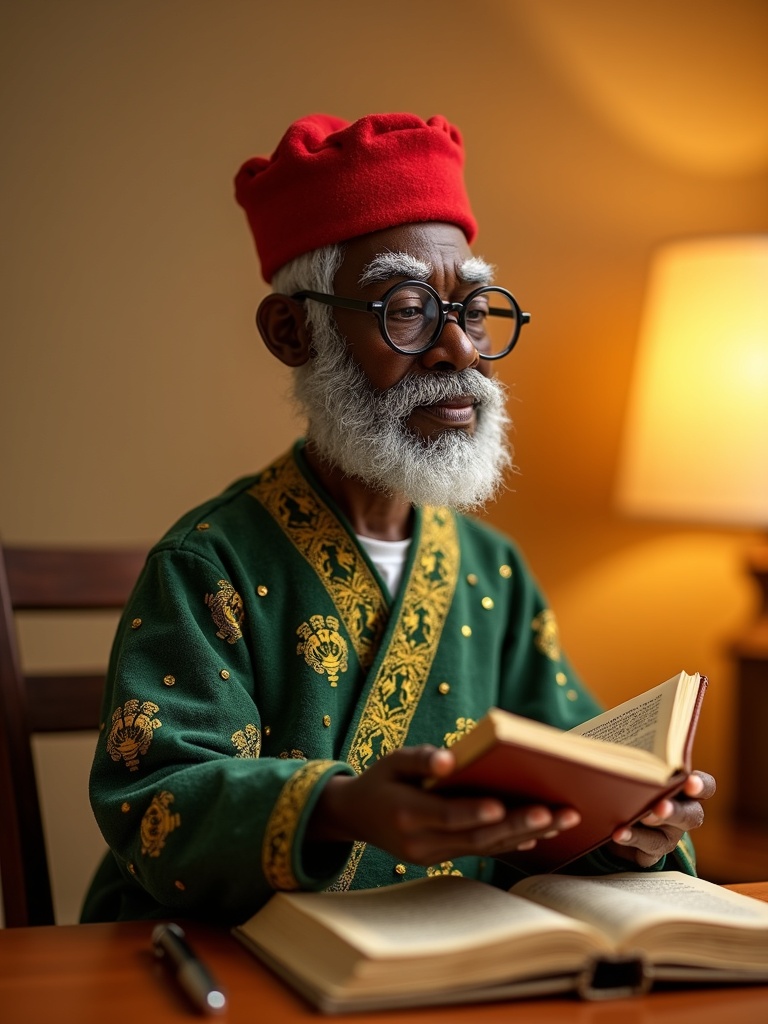
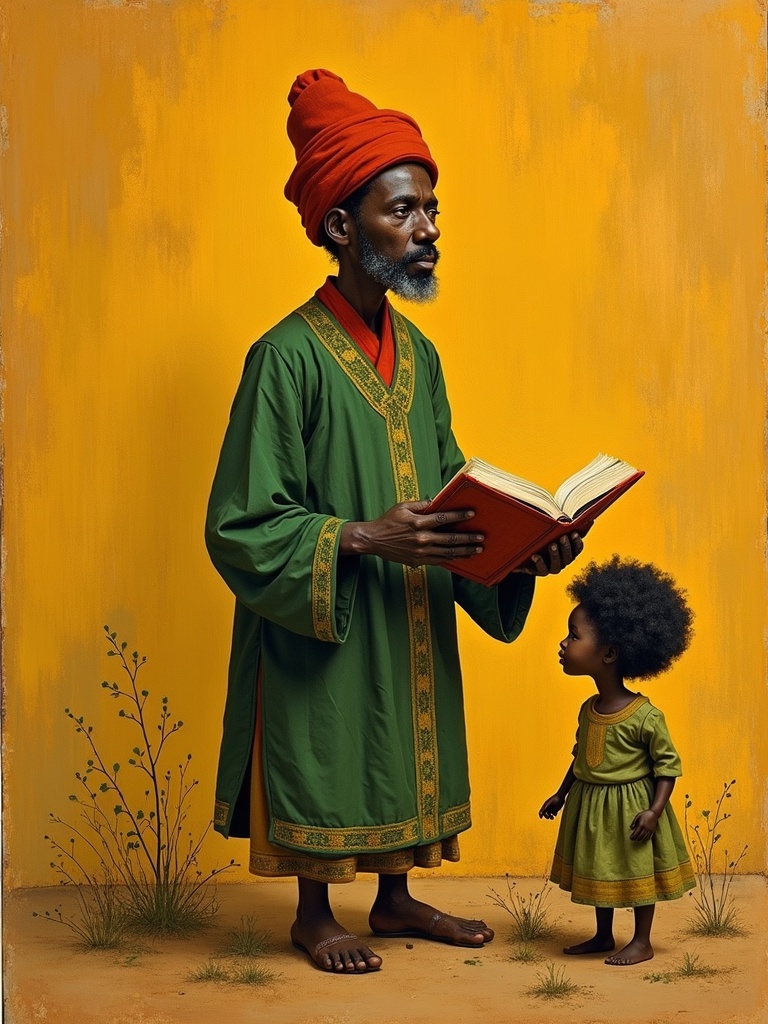
AI design preview — not a photo of the finished handmade doll
Father of African Literature
Chinua Achebe
In 1958, a young Nigerian radio producer answered a lifetime of books that had painted his people as voiceless savages — and reclaimed the African story in an African voice.
- People
- Igbo
- Country
- Nigeria
- Region
- West Africa
- Era
- 1930–2013
- Theme
- Father of African Literature
⚖ A respectful concept
Chinua Achebe was a real person who died in 2013. This doll is a respectful homage, not a likeness of his face or body, and would only ever be produced with the consent of the Achebe family and estate. Every quotation used here is documented from his published books, essays and lectures with a source; nothing is invented or put in his mouth. The image prompts deliberately specify 'respectful homage, no exact likeness', and the figure shown is a draft idea, not a finished product.
Make your own
Design your Chinua Achebe
Pick a garment, a hairstyle and a scene, enter the PIN and generate a fresh image of Chinua Achebe with AI.
⚖ AI homage concept — not a likeness of the real person.
Each image is generated live with fal.ai.
Generated images
AI design preview — not a photo of the finished handmade doll
No images generated yet — be the first.
Tradition & Origin
In 1958, a young Nigerian radio producer answered a lifetime of books that had painted his people as voiceless savages — and reclaimed the African story in an African voice.
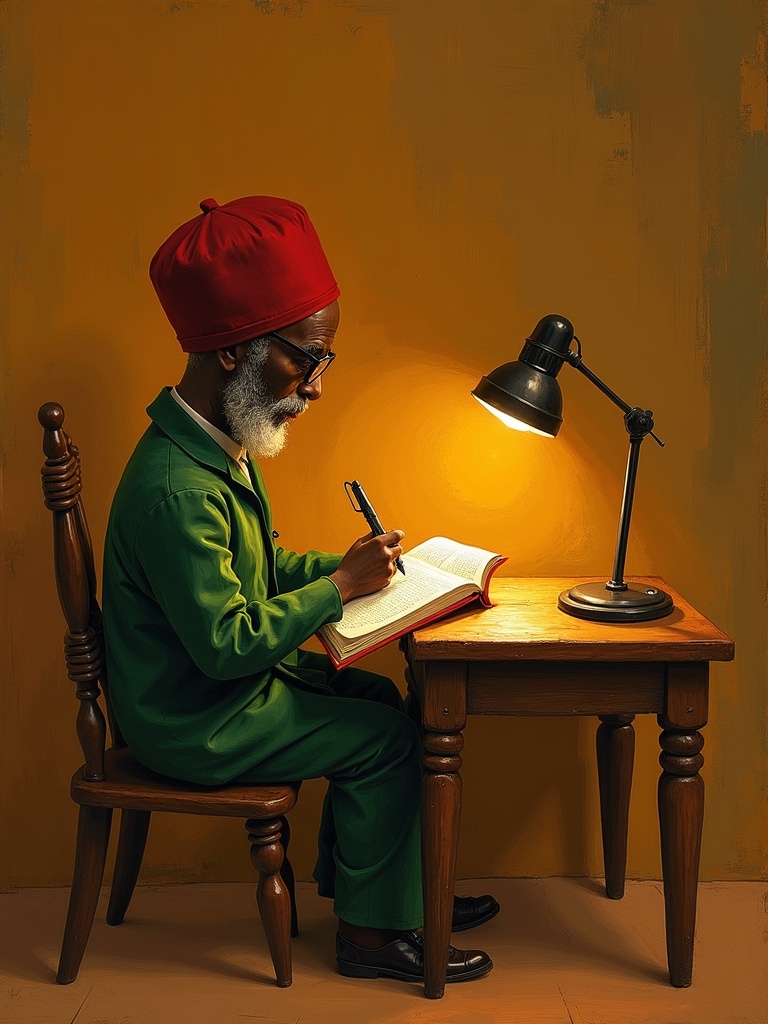
Albert Chinụalụmọgụ Achebe was born on 16 November 1930 in the Igbo town of Ogidi in eastern Nigeria, the son of Isaiah Okafo Achebe, a teacher and Christian evangelist, and Janet Iloegbunam, a blacksmith's daughter. He grew up at a crossroads — Sunday hymns in the mission house, masquerades and proverbs in the village — and it was this double inheritance, neither denied, that would feed all his work. At University College, Ibadan he abandoned medicine for literature, and after graduating in 1953 he joined the Nigerian Broadcasting Corporation.
Reading European novels set in Africa, Achebe was wounded to find his own people cast as a faceless, savage backdrop. His answer was Things Fall Apart (1958), the story of the proud wrestler Okonkwo and the clan of Umuofia as British missionaries and colonial officers arrive. He told it entirely from inside the village, with its laws, festivals and proverbs intact — and he wrote in English bent to the rhythm of Igbo speech, refusing to smooth away either the dignity of his culture or its hard edges. The novel's title came from W. B. Yeats's poem 'The Second Coming'.
The book grew into the most widely read work of African literature ever written — over 20 million copies in 57 languages — and earned Achebe the title 'father of modern African literature'. He never used that fame to flatter. In a 1975 lecture, An Image of Africa, he called Joseph Conrad, author of a celebrated classic, 'a thoroughgoing racist'. During the Nigeria–Biafra war of 1967–70 he served as a roving ambassador for breakaway Biafra and bore witness to its famine and grief.
A car accident in 1990 left him paralysed from the waist down, but it did not stop him: he taught for decades in the United States, became a professor at Brown University, won the Man Booker International Prize in 2007, and in 2012 published his last book, the memoir There Was a Country, before his death in Boston on 21 March 2013. He had said that until lions have their own historians, the history of the hunt will always glorify the hunter — and he had spent his life being a historian for the lions.
Timeline
- 1930Born Albert Chinụalụmọgụ Achebe in the Igbo town of Ogidi, eastern Nigeria.
- 1953Graduates from University College, Ibadan; later joins the Nigerian Broadcasting Corporation.
- 1958Heinemann publishes Things Fall Apart, the founding novel of modern African literature.
- 1975Delivers 'An Image of Africa', naming the racism in Conrad's Heart of Darkness.
- 2007Wins the Man Booker International Prize for his body of work.
- 2012Publishes There Was a Country, a personal history of the Biafran war, a year before his death.
Did you know?
- Achebe took the title Things Fall Apart from a line in W. B. Yeats's poem 'The Second Coming' — an Irish poem framing an Igbo story.DetailsEN
- In a 1975 lecture he publicly branded Joseph Conrad 'a thoroughgoing racist', forcing the West to re-read one of its most admired novels.DetailsEN
- A 1990 car accident left him paralysed from the waist down, yet he went on teaching, writing and publishing for more than twenty more years.DetailsEN
- He wrote that 'proverbs are the palm-oil with which words are eaten' — and built his English prose around the music of Igbo speech.DetailsEN
Until the lions have their own historians, he said, the hunt will always glorify the hunter — so he wrote for the lions.
Values & Capabilities
Capabilities
◆◆◆◆◆ shows how central a gift is — five diamonds mark a signature strength, fewer mark a supporting one.
He took the pen back from the colonisers and told the story of Africa from the inside, in his own people's voice.
His first novel crossed the whole world, carrying an African village into more than fifty languages.
He wove the proverbs and music of Igbo speech into English, so the language itself carried his culture.
He stood up and named the racism hidden inside a book the whole West admired.
Through war and lifelong injury he kept writing, refusing to let hard history be forgotten.
Development
1 of 5 stages unlocked
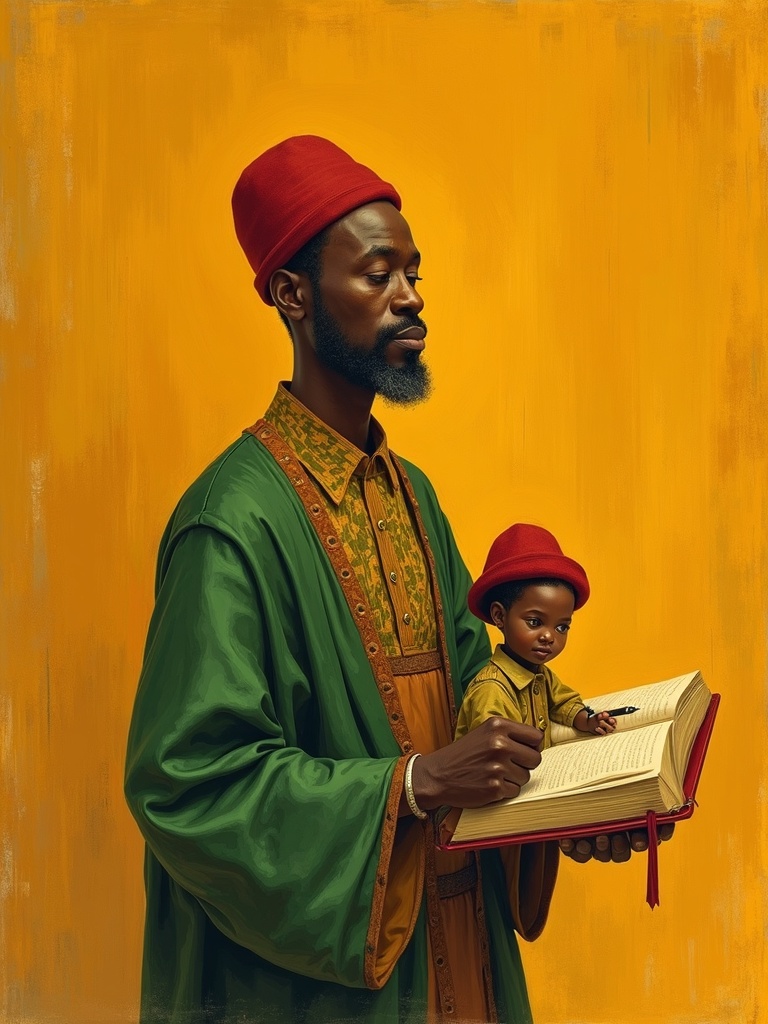
The son of a mission teacher in Igbo Ogidi, he grew up between village proverbs and colonial schoolbooks.
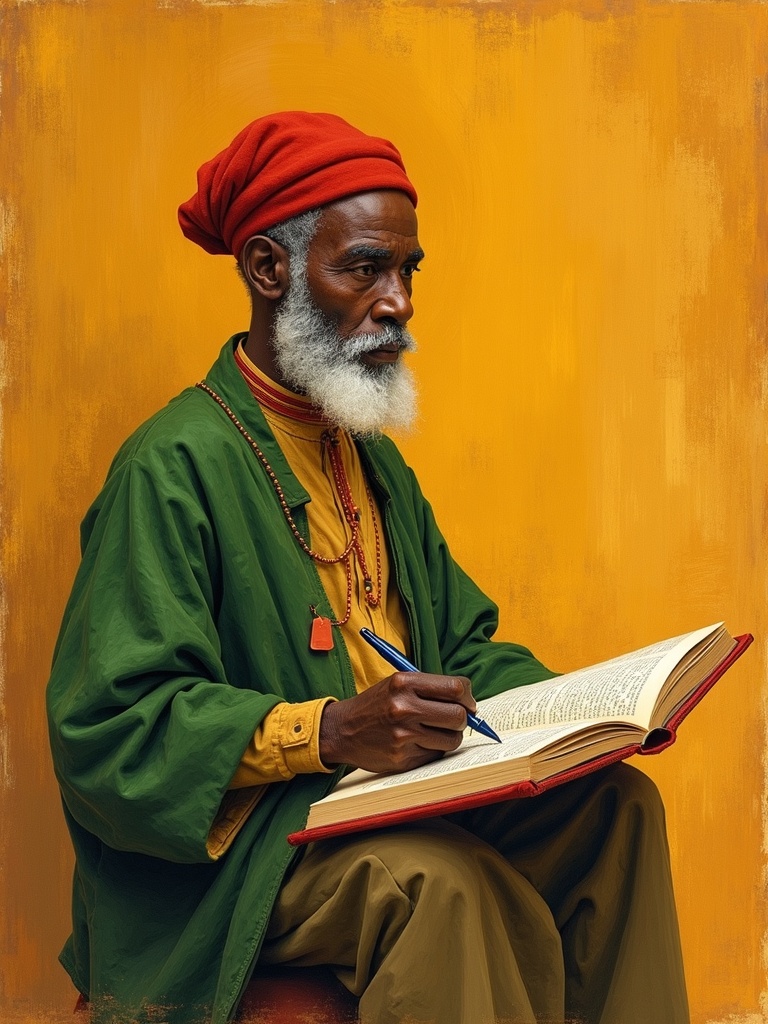
Answer all three to unlock this stage.
Unlock the previous stage first.
Unlock the previous stage first.
Unlock the previous stage first.
Crafting the doll
The doll is sewn from deep green velvet for the isiagu tunic with appliquéd golden lion-heads, worn over a woven wrapper and crowned with a red felt ozo title cap (or a striped okpu agu cap); a quieter scholar's version uses a plain dark cotton shirt and stitched reading glasses. His signature attribute is a small stitched open book with a fountain pen, alongside a carved wooden walking stick. An education card explains Igbo chieftaincy dress and the meaning of the red cap, and tells the story of Things Fall Apart. Sizes: Classic 32 / Kidogo 18–20 / Shule 28. A share of proceeds supports children's libraries and reading programmes in Nigeria.
How this doll is made
This homage grounds the doll in the prestige dress of an Igbo elder and titled man — a velvet isiagu tunic patterned with lion-heads, a red ozo title cap (or woven okpu agu cap), a wrapper and a carved walking stick — together with the open book and fountain pen that are the writer's own working accessories. Respectful homage, no exact likeness.
- Garments 2
- Accessories 4
- Materials 2
- Techniques 2
Garments
- Isiagu tunicA pullover tunic-shirt, long or short-sleeved, of velvet, silk or cotton patterned with lion- or leopard-heads, traditionally given to an Igbo man on receiving a chieftaincy title.DetailsEN
- Wrapper (akwa) & agbada optionThe isiagu is worn over a wrapper tied at the waist; for grand occasions an embroidered agbada robe and matching cap form a stately alternative.DetailsEN
Accessories
- Red ozo title cap (okpu mme)A red fez-style cap, the okpu mme, worn by titled Nze/Ozo men of high moral standing and community achievement — a spiritually significant marker of rank.DetailsEN
- Okpu agu (leopard) capA cap woven with white and red stripes, the 'leopard hat', historically a sign of bravery and warrior status, an alternative crown for the isiagu.DetailsEN
- Carved walking stickA polished carved wooden staff carried as a prestige marker by titled Igbo elders, completing the figure of authority.DetailsEN
- Open book & fountain penA small stitched open cloth book and a slim fountain pen, the working tools of a novelist — the writer's own most fitting accessories.DetailsEN
Materials
- Velvet for the isiaguThe richly embroidered isiagu is most often cut from high-quality velvet (also silk or cotton), giving the lion-head pattern its deep, regal sheen.DetailsEN
- Red felt & woven cap fibreThe ozo cap is a soft red felt fez, while the okpu agu is woven from striped red and white fibre — the two materials that crown a titled Igbo man.DetailsEN
Techniques
- Lion-head appliqué & embroideryThe isiagu's signature lion- or leopard-heads are embroidered or appliquéd in repeating motifs across the cloth, often with gold buttons linked by small chains.DetailsEN
- Cap weaving & shapingThe okpu agu cap is hand-woven in red-and-white stripes and shaped to the head, while the red ozo fez is blocked and finished as a smart fitted cap.DetailsEN
How it's made
Every doll is sewn by hand from natural materials — built to last a lifetime and to be repaired, not replaced. Here is the shopping list and the work steps. Sizes: Classic 32 cm (heirloom) · Kidogo 18–20 cm (toddlers, no small parts) · Shule 28 cm (school edition).
Shopping list
- Natural cotton or linen for the body (skin tone), ~0.5 m
- Wool or cotton stuffing — no plastic
- Cotton thread and embroidery floss in matching colours
- Garment fabric in this doll's colours (see the fabrics above)
- Yarn for the hairstyle
- Beads, cowrie shells and trims as shown
- Sharps and embroidery needles, pins, fabric scissors, fabric marker
Work instructions
- Trace and cut the body pattern at your chosen size (Classic 32 cm / Kidogo 18–20 cm / Shule 28 cm).
- Sew the body pieces right sides together, leave an opening, turn and stuff firmly with natural fibre, then close by hand.
- Embroider the face gently and with dignity — no plastic parts for the toddler line.
- Make the hair from yarn following the chosen hairstyle and attach it securely.
- Cut and sew the garment from this doll's fabric, then dress the doll.
- Add the beadwork, shells, trims and any attribute by hand.
- Check every seam and reinforce it — the doll should be lifelong and repairable, with no loose small parts for small children.
Origin & Ethics
How we know this
This record is highly reliable: Achebe's life, novels, prizes, the 1975 Conrad lecture and the Biafra memoir are all well documented, and every quotation is taken verbatim from his published work with a source. There is no legend here. The only sensitivity is the rights issue of depicting a recently deceased real person, addressed above — the look is homage, not likeness, and the doll is a draft concept, not an authorised product.
Because Chinua Achebe was a real person who died in 2013, this figure is presented strictly as a respectful homage and would only be manufactured and sold with the documented consent of the Achebe family and estate; his likeness is not reproduced. The cultural dress and adornment were checked against Igbo sources on isiagu chieftaincy attire, the ozo red cap and okpu agu cap, and elder's regalia, so the heritage is honoured rather than caricatured.
Sources
- Wikipedia — Chinua Achebe (born 1930 Ogidi, died 2013 Boston; full name Albert Chinụalụmọgụ Achebe; Things Fall Apart 1958; Man Booker International 2007; 1975 Conrad lecture; 1990 accident; There Was a Country 2012)
- Wikipedia — Things Fall Apart (1958, Heinemann; title from Yeats; Okonkwo and Umuofia; 20 million copies, 57 languages; foundational African novel)
- Encyclopaedia Britannica — Chinua Achebe (biography, books and facts; 'father of modern African literature')
- Biography.com — Chinua Achebe: Things Fall Apart, Books & Quotes (life, works and legacy)
- Brown University News — Famed African writer Chinua Achebe joins the Brown faculty (professor of Africana Studies, 2009)
- Wikipedia — Isiagu (Igbo men's chieftaincy tunic with lion/leopard-head pattern, velvet, worn with red ozo cap or okpu agu cap)
- Umuigbo — Igbo Traditional Attire (isiagu, okpu agu cap, red ozo cap, walking stick, wrapper)
- Afriklens — Igbo Cultural Attire: What the Red Cap Represents (ozo/nze title cap meaning and use)