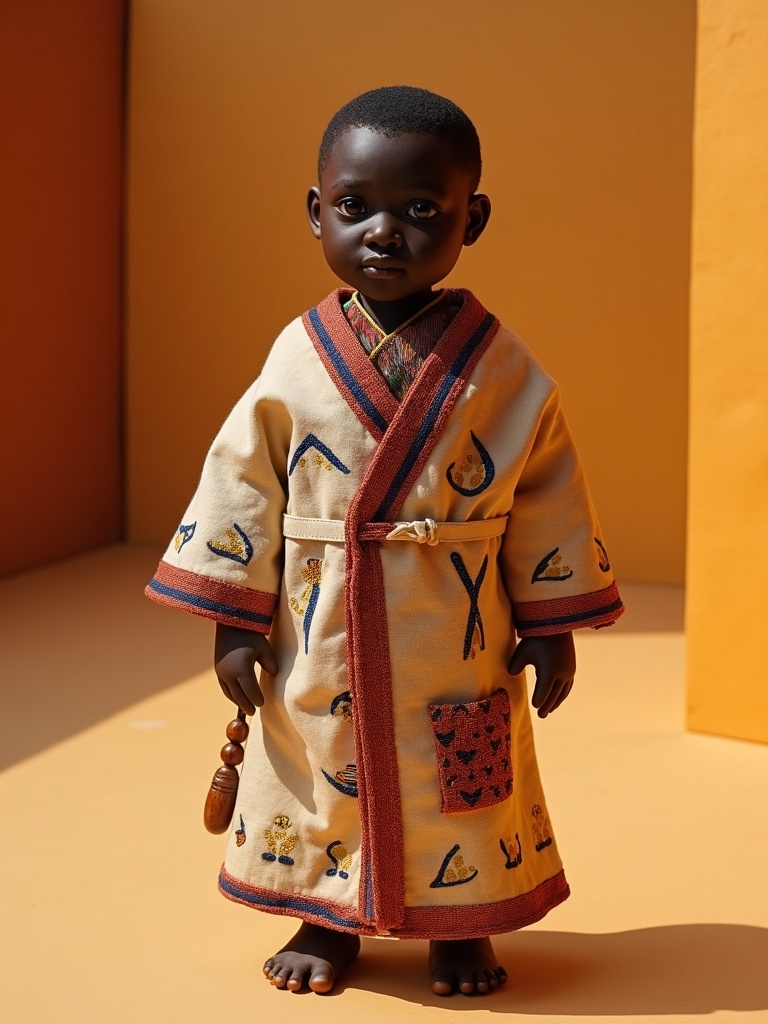
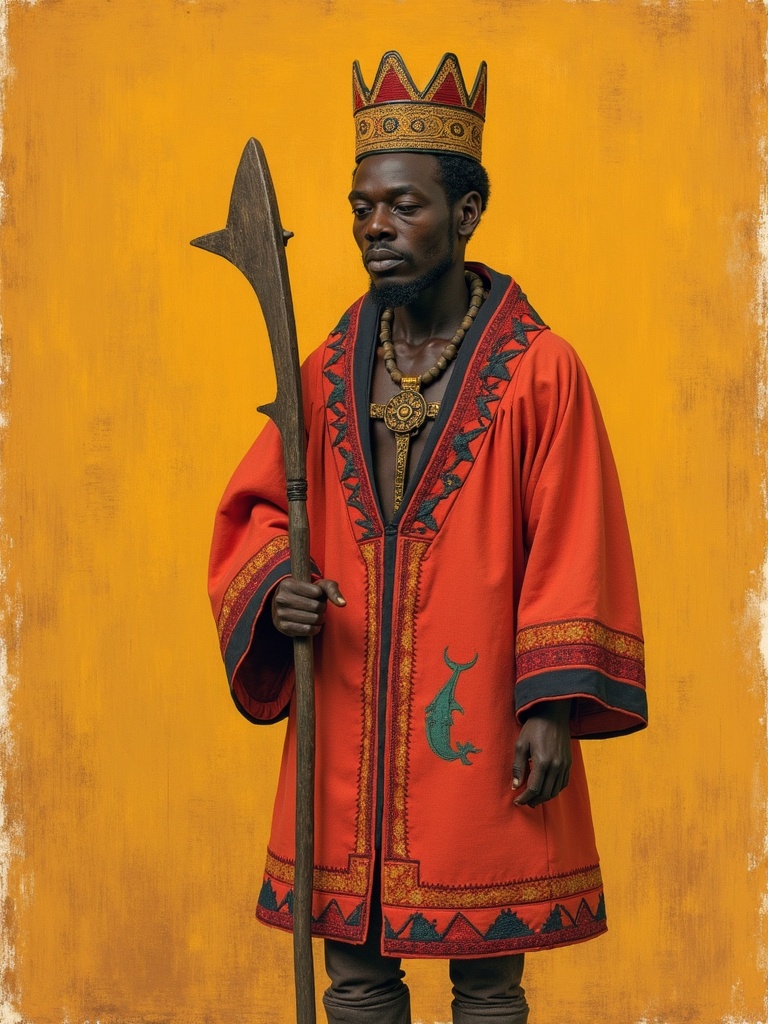
AI design preview — not a photo of the finished handmade doll
Last King of Dahomey
Béhanzin
He chose a shark for his emblem — for as the shark guards the coast, so the king guards the kingdom. Béhanzin was the last man to rule a free Dahomey, and he fought an empire twice rather than sign his country away.
- People
- Fon (Dahomey)
- Country
- Benin
- Region
- West Africa
- Era
- ≈1845–1906
- Theme
- Last King of Dahomey
Make your own
Design your Béhanzin
Pick a garment, a hairstyle and a scene, enter the PIN and generate a fresh image of Béhanzin with AI.
Each image is generated live with fal.ai.
Generated images
AI design preview — not a photo of the finished handmade doll
No images generated yet — be the first.
Tradition & Origin
He chose a shark for his emblem — for as the shark guards the coast, so the king guards the kingdom. Béhanzin was the last man to rule a free Dahomey, and he fought an empire twice rather than sign his country away.
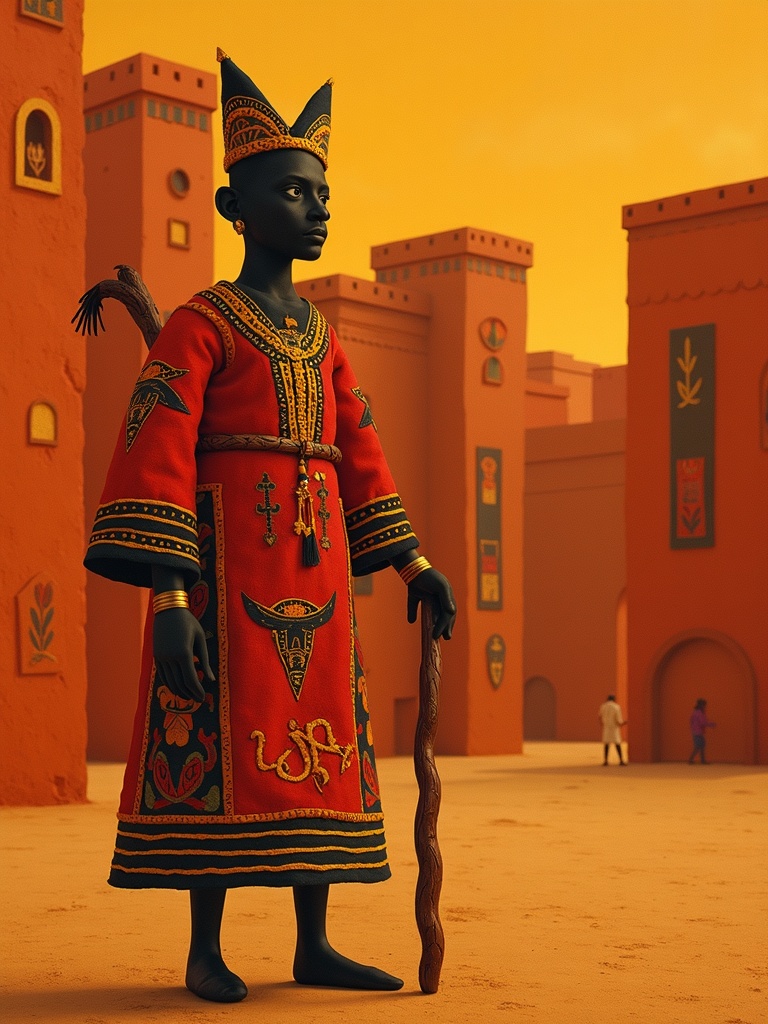
Born Kondo around 1845, he was a prince of Dahomey, a powerful Fon kingdom whose walled capital, Abomey, lay in what is now Benin. When he became king in 1890 he took the throne name Béhanzin and the shark as his royal totem. By then France already held footholds on the coast and wanted the whole kingdom; Béhanzin refused the agreements his predecessors had been pressed into, and prepared instead to fight.
Twice the kingdom went to war with France. In the First Franco-Dahomean War of 1890 the Dahomeans withdrew after the battle of Atchoukpa. The far larger Second War (1892–94) pitted Béhanzin's army — among them the Mino (also called the Agojie or 'Amazons'), the only all-female combat regiment in modern history — against General Alfred Dodds and his repeating rifles and artillery. The Dahomeans fought with extraordinary courage but were outgunned; thousands fell. When Abomey was about to be taken, Béhanzin had its royal palaces burned rather than surrender them whole, and fled north to organise more resistance.
On 15 January 1894 he gave himself up to spare his people further suffering. France deported him with his family to the island of Martinique, and later to Blida in Algeria, where he died on 10 December 1906, far from the coast he had vowed to guard. Years later his remains were brought home to Abomey.
When the French took Abomey they also looted its royal treasures — thrones, palace doors and sacred statues, including a striking figure of Béhanzin carved as half-man, half-shark. These were displayed in Paris for more than a century. In 2021, after a law passed by the French parliament, France returned 26 of the Abomey treasures to Benin, where crowds lined the streets, drumming and weeping, to welcome them home.
Timeline
- c. 1845Born Kondo, a prince of the Fon kingdom of Dahomey, in the royal city of Abomey.
- 1890Becomes king, takes the name Béhanzin and the shark as his emblem; the First Franco-Dahomean War breaks out.
- 1892The Second Franco-Dahomean War rages; Abomey falls on 17 November and Béhanzin has the palaces burned.
- 15 Jan 1894Béhanzin surrenders to spare his people and is deported with his family to Martinique.
- 10 Dec 1906After being moved to Blida in Algeria, he dies in exile, far from Dahomey.
- 2021France returns 26 looted royal treasures of Abomey — among them Béhanzin's half-man, half-shark statue — to Benin.
Did you know?
- Béhanzin's army included the Mino — the only all-female fighting regiment in modern history, sworn to defend the king and feared by their enemies.DetailsEN
- Rather than hand his capital to the French intact, Béhanzin ordered the royal palaces of Abomey set on fire before he withdrew north.DetailsEN
- Among the looted treasures returned to Benin in 2021 was a wooden statue showing Béhanzin himself as half-man, half-shark — his royal emblem made flesh.DetailsEN
The shark could not hold back the tide of empire — but a kingdom that remembers its king is never truly conquered.
Values & Capabilities
Capabilities
◆◆◆◆◆ shows how central a gift is — five diamonds mark a signature strength, fewer mark a supporting one.
When France pressed in from the coast, he took the throne of Dahomey vowing to defend its land rather than sign it away.
He fought France not once but twice, refusing to accept that his kingdom's fate had already been decided in Paris.
His army included the famed all-women regiment of Dahomey — disciplined warriors sworn to defend the king.
Rather than hand his royal city intact to the invaders, he set Abomey alight and fled north to keep resisting.
He surrendered to spare his people and was shipped across the sea, yet he carried himself as a king to the end.
Development
1 of 6 stages unlocked
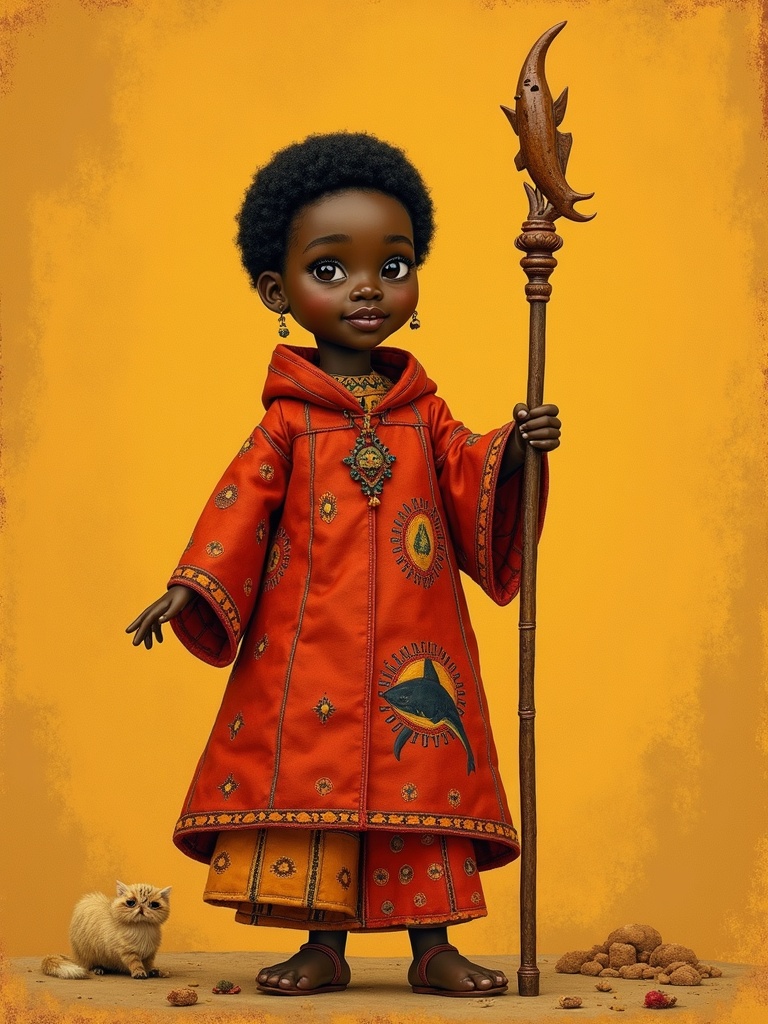
Born around 1845 in Abomey, he grew up a prince of the Fon kingdom of Dahomey, heir to a long line of kings.
Answer all three to unlock this stage.
Unlock the previous stage first.
Unlock the previous stage first.
Unlock the previous stage first.
Unlock the previous stage first.
Crafting the doll
The doll is built around real Fon court material culture of Abomey: cream and unbleached cotton wrappers covered in bright appliqué — small cut shapes of red, indigo, gold and black cloth hand-sewn into pictures of the king's emblems, the shark and the egg cradled in a hand. His signature attribute is a carved wooden recade, the royal staff of office, with a small appliqué shark banner at his side and a long ceremonial pipe. An education card tucked in the box tells the honest story of Dahomey's two wars with France, the women warriors of the Mino, and the looted treasures returned in 2021. Sizes: Classic 32 / Kidogo 18–20 / Shule 28. A share of proceeds supports children's education and heritage projects in Benin.
How this doll is made
His doll is grounded in the royal material culture of 19th-century Abomey: cream cotton cloth, bright appliqué picturing the king's totems, and the carved emblems of Fon kingship.
- Garments 2
- Accessories 3
- Materials 2
- Techniques 3
Garments
Accessories
- Recade royal staffA carved wooden recade with a curved blade — the staff of office that marked a Dahomean king's authority.DetailsEN
- Shark emblem bannerA small appliqué banner showing the stylised shark, Béhanzin's royal totem guarding the coast.DetailsEN
- Long ceremonial pipeA long slender smoking pipe, one of the symbols associated with Béhanzin in the royal imagery.DetailsEN
Materials
Techniques
- Abomey appliquéPictures are built by laying small coloured cloth shapes onto a background and hand-stitching them down, layer over layer.DetailsEN
- Guild transmissionThe appliqué craft is held by Fon family guilds in Abomey who pass the royal patterns from one generation to the next.DetailsEN
- Hand cloth-doll sewingThe figure itself is a hand-sewn, stuffed cloth doll, its garments cut and appliquéd to echo the Abomey royal banners.DetailsEN
How it's made
Every doll is sewn by hand from natural materials — built to last a lifetime and to be repaired, not replaced. Here is the shopping list and the work steps. Sizes: Classic 32 cm (heirloom) · Kidogo 18–20 cm (toddlers, no small parts) · Shule 28 cm (school edition).
Shopping list
- Natural cotton or linen for the body (skin tone), ~0.5 m
- Wool or cotton stuffing — no plastic
- Cotton thread and embroidery floss in matching colours
- Garment fabric in this doll's colours (see the fabrics above)
- Yarn for the hairstyle
- Beads, cowrie shells and trims as shown
- Sharps and embroidery needles, pins, fabric scissors, fabric marker
Work instructions
- Trace and cut the body pattern at your chosen size (Classic 32 cm / Kidogo 18–20 cm / Shule 28 cm).
- Sew the body pieces right sides together, leave an opening, turn and stuff firmly with natural fibre, then close by hand.
- Embroider the face gently and with dignity — no plastic parts for the toddler line.
- Make the hair from yarn following the chosen hairstyle and attach it securely.
- Cut and sew the garment from this doll's fabric, then dress the doll.
- Add the beadwork, shells, trims and any attribute by hand.
- Check every seam and reinforce it — the doll should be lifelong and repairable, with no loose small parts for small children.
Origin & Ethics
How we know this
The core record is well documented: French and Dahomean sources, museum collections and modern scholarship confirm Béhanzin's reign (1890–94), the two Franco-Dahomean wars, his shark emblem, his surrender on 15 January 1894, exile to Martinique and Algeria, death in 1906, and the 2021 restitution of 26 Abomey treasures. Some elements — exact birth year (c. 1845), proverbs, and the symbolic powers of the shark — come from royal tradition and oral history. As a 19th-century historical figure he carries no living-person rights restrictions; the doll is homage, not portrait.
Because Béhanzin lived and died over a century ago, no living person's consent is required — but the figure is offered as respectful homage, not exact likeness, shaped from the published historical and museum record on the kingdom of Dahomey, the Franco-Dahomean wars, the Agojie/Mino, and the Abomey appliqué tradition. It is made in the spirit of the restitution of the Abomey royal treasures to Benin, with care that the kingdom's history — including its hard chapters — is told honestly and its dignity honoured rather than turned into spectacle.
Sources
- Béhanzin — Wikipedia (birth name Kondo, reign, shark/egg emblems, wars, surrender 1894, exile, death 1906)
- The conquest of Dahomey (1890–1894) — Service historique de la Défense (French army record of the campaign)
- Dahomey Amazons — Wikipedia (Mino/Agojie all-female regiment, role under Béhanzin, 1892 losses)
- Dahomey women warriors — Britannica (Amazons, slave trade, French conquest)
- Royal Cloths and Totems of Benin — UNSEEN BENIN (Abomey appliqué, kings' totems, Béhanzin's shark and egg motto)
- Restitution of 26 works to the Republic of Benin — Musée du quai Branly – Jacques Chirac
- 129-year journey nears end as France returns Benin treasures — VOA News (2021 restitution, looted 1892)
- King Béhanzin: The Last Independent King of Dahomey — Ozi Ikòrò (overview of resistance and exile)
- Fon Appliqué Banners from Benin — Indigo Arts (Abomey guild appliqué technique and royal motifs)