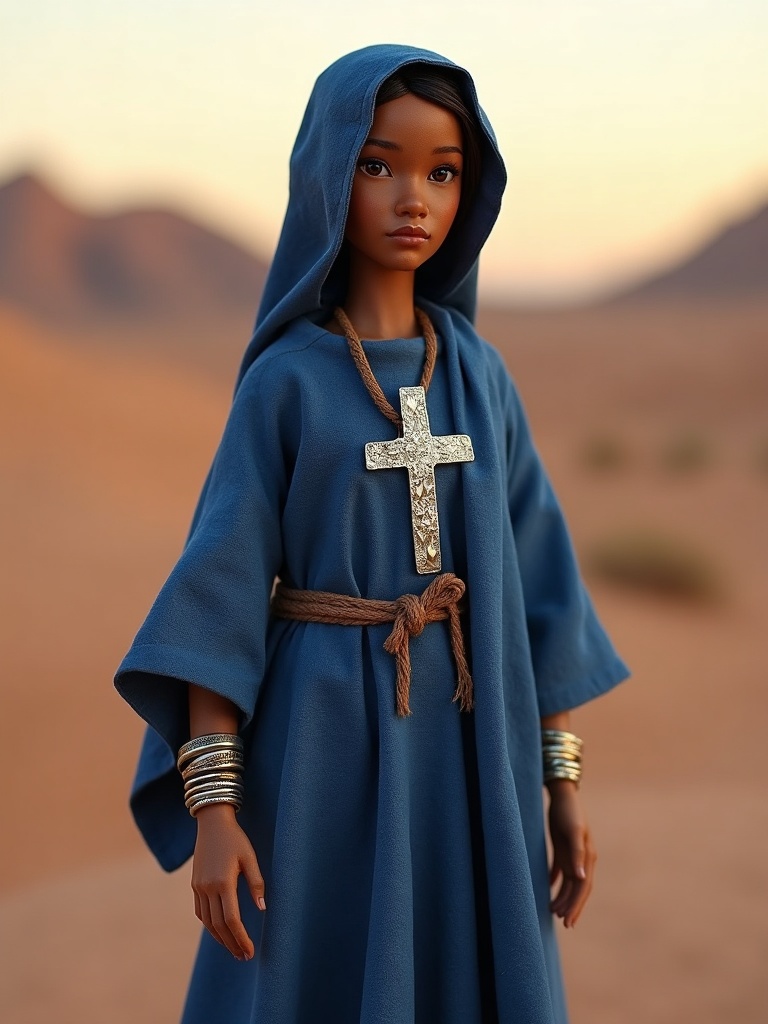
Mother Of The Desert
Tin Hinan
The Tuareg call her mother of us all — a queen who, legend says, crossed the Sahara on a white camel and gave a people their name. In 1925 a tomb in the deep desert seemed to answer the legend with bones.
- People
- Tuareg (Kel Ahaggar)
- Country
- Algeria
- Region
- North Africa
- Era
- ≈4th century CE
- Theme
- Mother Of The Desert
Make your own
Design your Tin Hinan
Pick a garment, a hairstyle and a scene, enter the PIN and generate a fresh image of Tin Hinan with AI.
Each image is generated live with fal.ai.
Generated images
No images generated yet — be the first.
Tradition & Origin
The Tuareg call her mother of us all — a queen who, legend says, crossed the Sahara on a white camel and gave a people their name. In 1925 a tomb in the deep desert seemed to answer the legend with bones.
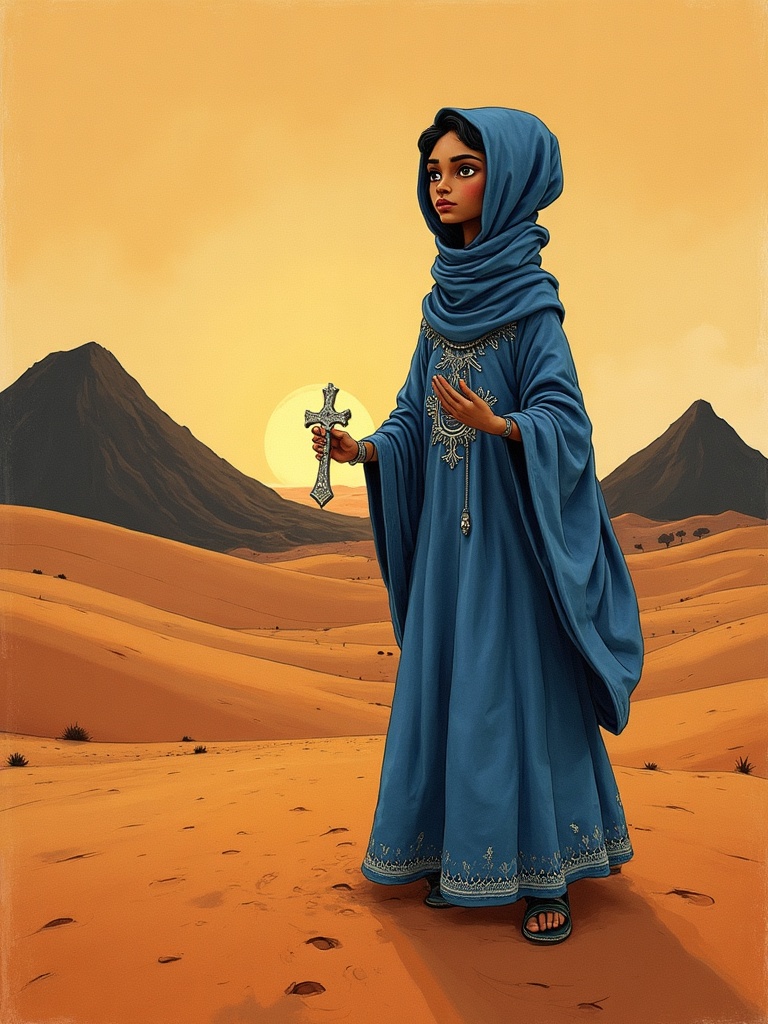
The woman of Abalessa wore seven silver bracelets on her right forearm and seven gold on her left — a deliberate, regal symmetry.
DetailsENTin Hinan is the semi-legendary ancestress and first queen of the Kel Ahaggar — the Tuareg of the Hoggar (Ahaggar) mountains of southern Algeria, around the 4th century CE. Her name means literally "woman of the tents," but the Tuareg render it more tenderly as "mother of us all." In the oral tradition she is a fugitive princess who left the northern oases and, with her faithful servant Takama, led a caravan south into the Hoggar. The story says they nearly perished until they found grain hoarded in desert anthills — and that the warrior nobility of the Tuareg trace their descent from Tin Hinan herself, while the vassal classes trace theirs from Takama.
This matters because the Tuareg are notably matrilineal-leaning: lineage, and the right to rule, often pass through the mother's line, and the Tuareg preserve their own ancient script, Tifinagh. A foremother who is a queen is not a curiosity here — it is the keystone of how a whole society remembers itself. That is why "Mother of the Desert" still resonates from the Hoggar to the Aïr.
Then archaeology met the legend. On 18 October 1925, the controversial explorer Byron Khun de Prorok — working with French colonial support and, in later seasons, the archaeologist Maurice Reygasse — opened a monumental stone tomb at Abalessa, near Tamanrasset. Beneath the slabs lay the skeleton of a tall, broad-shouldered woman, lying on a wooden litter, wearing seven silver bracelets on her right arm and seven gold on her left, with beads of garnet, carnelian, amazonite and turquoise. A piece of gold foil bore the imprint of a Roman coin of Constantine I (struck 308–324 CE); radiocarbon dating of the wooden bed agreed on a 4th-century burial. The body now rests in the Bardo National Museum in Algiers.
But honesty demands a caution the legend does not. The rich woman of Abalessa has been traditionally identified with Tin Hinan — and that identification is uncertain and contested. The tomb proves that a powerful, lavishly adorned woman was buried in the Hoggar in late antiquity; it does not prove she is the queen of the stories. As one account puts it plainly: apart from local tradition, there is little to confirm the skeleton belonged to Tin Hinan. Legend and archaeology lie in the same grave — but they are not the same thing.
Timeline
- ≈4th c. CETuareg tradition places Tin Hinan as ancestress and first Tamenokalt of the Ahaggar.
- 308–324 CEReign of Constantine I, whose coin was stamped on gold foil found in the Abalessa tomb — anchoring its date.
- 4th–5th c. CECarbon dating of the tomb's wooden litter places the burial in this period.
- 1925Byron Khun de Prorok opens the monumental tomb at Abalessa with French military support.
- 1933Maurice Reygasse leads a more thorough scientific investigation of the tomb.
- todayThe remains and treasure are held at the Bardo National Museum in Algiers; the Tuareg still honour 'Mother of Us All'.
Did you know?
- Her name means literally "woman of the tents," but the Tuareg translate it metaphorically as "mother of us all" — and she is honored with the title Tamenokalt, "queen."DetailsEN
- Legend says she reached the Hoggar on a milk-white camel with her servant Takama; the Tuareg nobility claim descent from Tin Hinan, the vassal classes from Takama.DetailsEN
- The Abalessa skeleton was a tall woman with narrow pelvis, broad shoulders and slender legs, buried on a wooden litter with gold and silver jewellery — but apart from local tradition there is little to prove the remains are actually Tin Hinan's.DetailsEN
- A fourth-century date for the tomb is supported by Roman-coin gold foil, radiocarbon dating of the wooden bed, and the style of the pottery and grave goods.DetailsEN
The desert kept a queen's bones for sixteen centuries — but whether they are <em>her</em> bones, only the legend dares to say.
Values & Capabilities
Capabilities
◆◆◆◆◆ shows how central a gift is — five diamonds mark a signature strength, fewer mark a supporting one.
Tuareg oral tradition names Tin Hinan the founding ancestress from whom the noble Kel Ahaggar trace their line, and still call her 'Mother of Us All'.
Legend tells of a princess who fled the northern Sahara and survived a near-fatal desert crossing to reach the Hoggar mountains.
In Tuareg society property, the family tent and noble descent pass through women — a tradition rooted in ancestresses like Tin Hinan.
The tall woman in the Abalessa tomb wore seven silver bracelets on one arm and seven gold on the other — the splendour later tied to Tin Hinan.
As first Tamenokalt she is remembered as the unifier who gave the scattered desert clans of the Ahaggar a shared ancestor and order.
Development
1 of 5 stages unlocked
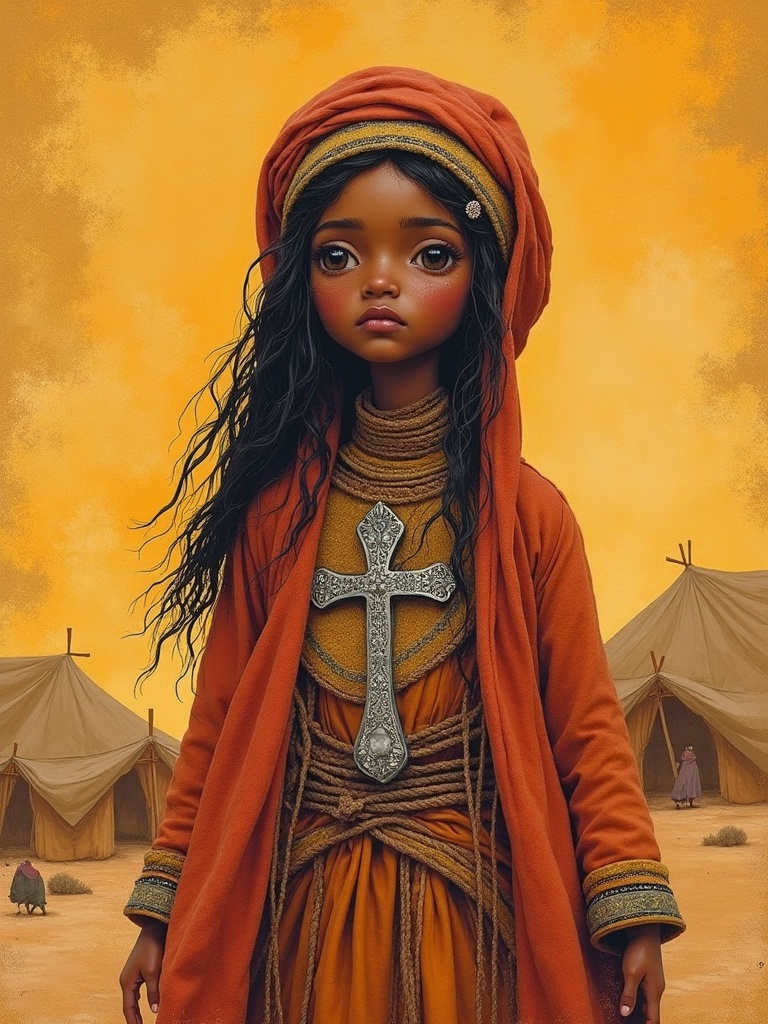
Tuareg families pass down the memory of an ancestress called 'she of the tents', the mother of their line.
Answer all three to unlock this stage.
Unlock the previous stage first.
Unlock the previous stage first.
Unlock the previous stage first.
Crafting the doll
The doll is built from real desert materials: indigo-dyed handspun cotton for the flowing robe and head-shawl (the deep blue of the Tuareg 'blue people'), undyed cream cotton beneath, and dyed goatskin leather for a small tooled bag. Her signature attribute is the silver Cross of Agadez (tanaghilt) with stacked silver-and-gold bracelets echoing the Abalessa tomb. A small education card explains legend-versus-tomb and the matrilineal Tuareg. Sizes Classic 32 / Kidogo 18–20 / Shule 28. A share of proceeds supports Saharan-heritage and girls' education programmes.
How this doll is made
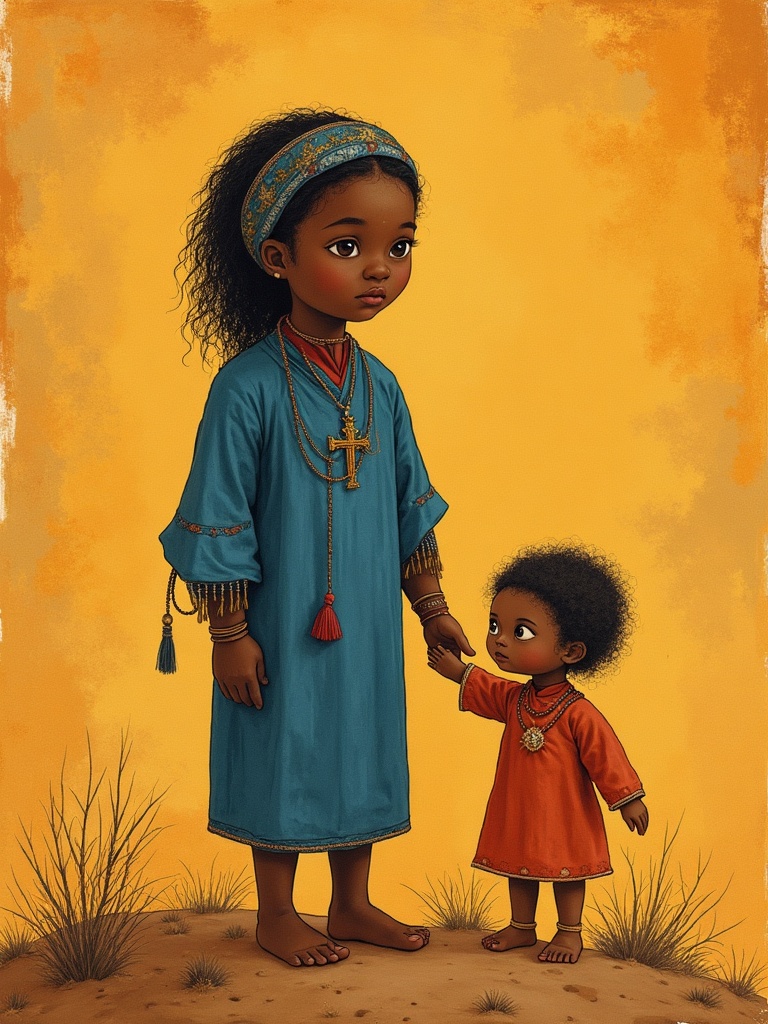
Tin Hinan's look is grounded in the material culture of the Tuareg (Kel Ahaggar) of the Sahara: flowing indigo-dyed cotton robes (the famed 'blue people', though it is men who veil), silver jewellery cast by the inadan smiths — above all the Cross of Agadez — and the tooled, dyed leatherwork that Tuareg women make for the migrating life of the tent.
- Garments 2
- Accessories 3
- Materials 2
- Techniques 3
Garments
- Indigo-dyed cotton robeA long, flowing robe of cotton dyed deep indigo; the lustrous blue can rub onto the skin, the source of the Tuareg nickname 'the blue people'. Worn loose for the desert climate.DetailsEN
- Draped head-shawl (uncovered face)A loosely draped cloth over the hair, leaving the face uncovered — because among the Tuareg it is the MEN who veil with the tagelmust, while women like Tin Hinan keep their faces open.DetailsEN
Accessories
- Cross of Agadez (tanaghilt)The iconic Tuareg silver pendant, also called tasagalt ('cast in a mold'); a symbol of identity and protection given from father to child to point out 'the four directions of the world'.DetailsEN
- Talhakimt pendant & silver braceletsA flat shield-shaped silver talhakimt pendant and heavy silver bangles; the Abalessa tomb held seven silver bracelets on one forearm and seven gold on the other.DetailsEN
- Tooled leather travel bag (taghrek)A goatskin bag worked by Tuareg women with impressed, stitched and excised geometric motifs, fringe and tassels that shake with the camel's stride.DetailsEN
Materials
- Indigo and cottonHandspun cotton cloth dyed with natural indigo to the saturated blue-black of Tuareg formal dress; the dye is pounded into the cloth rather than washed in, so it stays brilliant.DetailsEN
- Silver, gold and goatskinThe inadan smiths work silver (and, for the grandest pieces, gold) into crosses and bracelets, while women dye and tool goatskin leather; the Abalessa burial mixed both gold and silver.DetailsEN
Techniques
- Lost-wax silver castingThe inadan smith carves the cross in wax, encases it in clay, melts the wax out and pours in molten silver — 'cast in a mold' (tasagalt) — then files and engraves the surface, never hammering it.DetailsEN
- Leather tooling and dyeingWomen decorate goatskin by impressing, stitching and cutting (excising) motifs, colouring it with dyes from indigo, pomegranate, sorghum and minerals, then adding fringe and tassels.DetailsEN
- Indigo dyeingCotton is repeatedly dipped in fermented indigo and beaten so the pigment sits on the surface and burnishes to a metallic sheen — the deep blue that defines Tuareg ceremonial cloth.DetailsEN
How it's made
Every doll is sewn by hand from natural materials — built to last a lifetime and to be repaired, not replaced. Here is the shopping list and the work steps. Sizes: Classic 32 cm (heirloom) · Kidogo 18–20 cm (toddlers, no small parts) · Shule 28 cm (school edition).
Shopping list
- Natural cotton or linen for the body (skin tone), ~0.5 m
- Wool or cotton stuffing — no plastic
- Cotton thread and embroidery floss in matching colours
- Garment fabric in this doll's colours (see the fabrics above)
- Yarn for the hairstyle
- Beads, cowrie shells and trims as shown
- Sharps and embroidery needles, pins, fabric scissors, fabric marker
Work instructions
- Trace and cut the body pattern at your chosen size (Classic 32 cm / Kidogo 18–20 cm / Shule 28 cm).
- Sew the body pieces right sides together, leave an opening, turn and stuff firmly with natural fibre, then close by hand.
- Embroider the face gently and with dignity — no plastic parts for the toddler line.
- Make the hair from yarn following the chosen hairstyle and attach it securely.
- Cut and sew the garment from this doll's fabric, then dress the doll.
- Add the beadwork, shells, trims and any attribute by hand.
- Check every seam and reinforce it — the doll should be lifelong and repairable, with no loose small parts for small children.
Origin & Ethics
How we know this
The Tuareg ancestress Tin Hinan sits between documented archaeology and oral legend. The monumental tomb at Abalessa and its rich gold-and-silver burial are real and were excavated in 1925/1933, but its identification with Tin Hinan is traditional and uncertain, and her life-story is legend that varies by teller. Her dress and jewellery are reconstructed from well-documented Tuareg material culture, not from the tomb's exact contents.
Because Tin Hinan is an ancient, semi-legendary figure, no living family or royal house holds rights to her image. The record is built only from public museum and scholarly sources (Wikipedia, the Bardo / Algerian national collections, the Met, the Smithsonian and the Fowler Museum's 'Art of Being Tuareg'), and the craft draws on documented Tuareg material culture rather than any sacred or restricted object. We invite correction from Tuareg communities and Amazigh cultural bodies.
Sources
- Wikipedia — Tin Hinan (legendary 4th-century Tuareg queen, 'mother of us all', matrilineal descent)
- Wikipedia — Tin Hinan Tomb (Abalessa, de Prorok 1925 / Reygasse 1933, 7 silver + 7 gold bracelets, Constantine coin, Bardo Museum)
- Ancient Origins — The Monumental Tomb of Queen Tin Hinan, Ancient Ancestress of the Tuaregs
- New World Encyclopedia — Tuareg (matrilineal society, women own the tent, inadan smiths, dress)
- Afropop Worldwide — Susan Rasmussen on the Tuareg (anthropology of Tuareg society and gender)
- Wikipedia — Agadez Cross (tanaghilt/tasagalt, lost-wax silver casting, Tuareg of Niger)
- The Metropolitan Museum of Art — Saddle Bag, Tuareg peoples (dyed goatskin leatherwork)
- Annenberg Learner, Art Through Time — Bag (taghrek), Tuareg leatherwork by women
- Fowler Museum at UCLA — Art of Being Tuareg: Sahara Nomads in a Modern World
- Smithsonian National Museum of African Art — Art of Being Tuareg: Sahara Nomads in a Modern World
- Wikipedia — Litham / tagelmust (indigo veil worn by Tuareg men, the 'blue people'; women unveiled)