The First Stories & the Roots of Humanity
The San Storyteller
The San Storyteller is not one person but a composite archetype — a figure woven to honour the San (ǀXam and other Khoisan) first peoples of southern Africa and the narrators who, against all odds, carried humanity's oldest stories into our own time.
- People
- San (ǀXam / Khoisan)
- Country
- South Africa
- Region
- Southern Africa
- Era
- deep time / timeless
- Theme
- The First Stories & the Roots of Humanity
Make your own
Design your The San Storyteller
Pick a garment, a hairstyle and a scene, enter the PIN and generate a fresh image of The San Storyteller with AI.
Each image is generated live with fal.ai.
Generated images
No images generated yet — be the first.
Tradition & Origin
The San Storyteller is not one person but a composite archetype — a figure woven to honour the San (ǀXam and other Khoisan) first peoples of southern Africa and the narrators who, against all odds, carried humanity's oldest stories into our own time.
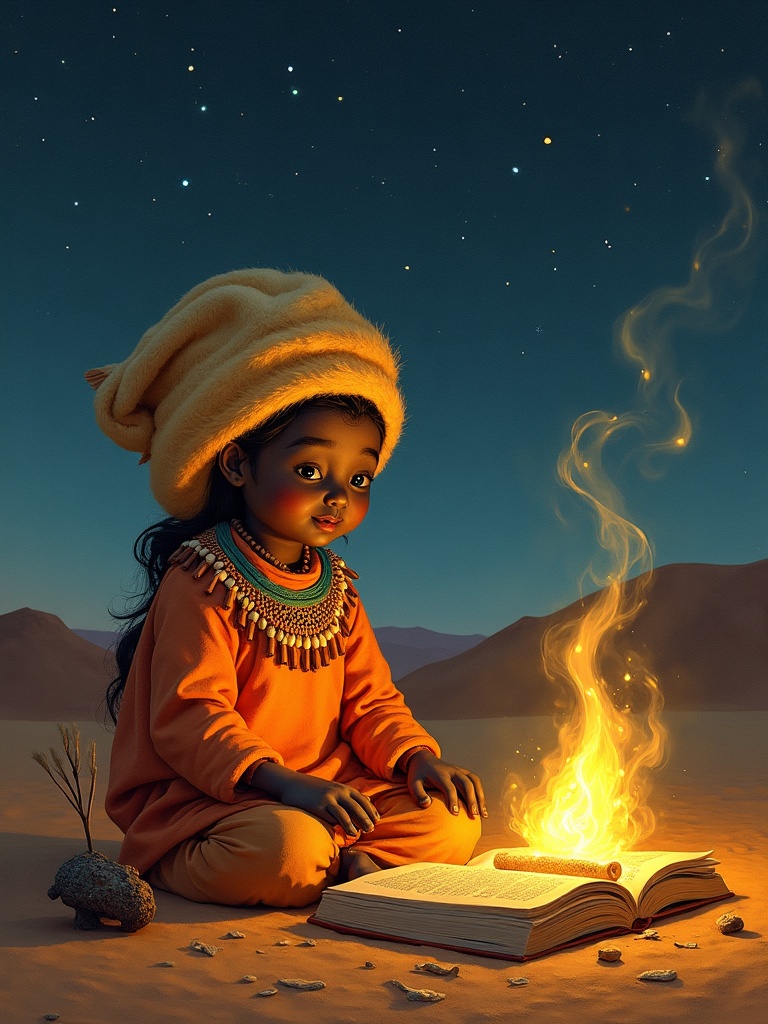
87 ǀXam stories were set down by Bleek & Lloyd in the 1870s — dictated by imprisoned ǀXam narrators at the Breakwater Convict Station, in a language now extinct.
DetailsENGenetic studies place Khoisan lineages among the deepest-branching in all of humanity: research on Khoe-San genomes confirms they sit on one side of the earliest population split in Homo sapiens, with every other living human on the other. By this reckoning the San are not merely an old people but kin near the very root of the human family tree — keepers of a continuity measured in tens of thousands of years, from ostrich-eggshell beads worn 50,000 years ago to the click consonants (ǀ, ǁ, ǂ, !) still spoken in Khoisan tongues today.
The Storyteller stands in for real, named narrators. In the 1870s, the philologist Wilhelm Bleek and his sister-in-law Lucy Lloyd recorded thousands of pages of ǀXam and !Kun texts — myths, dreams, weather-lore and personal memory. Their teachers were not free informants but ǀXam convicts from the Breakwater Convict Station in Cape Town, men serving sentences under colonial law: ǁKabbo, Dia!kwain, ǀhanǂkass'o, ǀaǃkúnta and others. From a prison the colony built, these elders dictated a world — including ǀKaggen, the trickster-creator who takes the form of a praying mantis and who, in their telling, brought forth the eland that fills the rock-shelter walls.
That painted world survives at the uKhahlamba / Drakensberg, part of the Maloti-Drakensberg Park inscribed by UNESCO in 2000 — hundreds of sites holding tens of thousands of San images, a four-millennia tradition of belief rendered in ochre and white. And the words themselves outlasted the people who spoke them: South Africa's national coat of arms, adopted on Freedom Day 2000, carries the ǀXam motto !ke e꞉ ǀxarra ǁke — "diverse people unite" — in a language that is now extinct. The Storyteller is how we keep faith with that silence: a composite voice for narrators whose names we know and whose tongue we lost.
Timeline
- deep timeSan ancestors live as hunter-gatherers across Southern Africa, one of humanity's oldest continuous lineages.
- ≈73,000 BCEAt Blombos Cave, people grind ochre and cut tiny patterns into ostrich eggshell, among the earliest known art.
- deep time–todaySan paint tens of thousands of rock images, eland and trance dancers, across the Maloti-Drakensberg.
- 1870sǁKabbo and other ǀXam dictate their stories and language to Bleek and Lloyd in Cape Town.
- 2000The uKhahlamba / Maloti-Drakensberg San rock art is inscribed as a UNESCO World Heritage site.
- 2017The South African San publish their own Code of Research Ethics, the first by an Indigenous people in Africa.
Did you know?
- The ǀXam narrators who dictated the Bleek and Lloyd archive in 1870s Cape Town were convicts from the Breakwater Convict Station — among them ǁKabbo, Bleek and Lloyd's first true teacher.DetailsEN
- In ǀXam cosmology ǀKaggen (Cagn) is a trickster-creator who shape-shifts into a praying mantis and who created the eland, the animal painted most often on southern African rock walls.DetailsEN
- South Africa's coat of arms, unveiled on Freedom Day 2000, bears the motto !ke e꞉ ǀxarra ǁke — "diverse people unite" — written in the now-extinct ǀXam language.DetailsEN
A nation speaks its motto in a tongue no living mouth still holds — proof that a story, well kept, can outlive even the people who first told it.
Values & Capabilities
Capabilities
◆◆◆◆◆ shows how central a gift is — five diamonds mark a signature strength, fewer mark a supporting one.
She carries the world's oldest spoken library, told by firelight long before any book was written.
Her language sings with clicks no alphabet had ever written down.
From a broken ostrich egg she grinds tiny white discs into beads older than any city.
With ochre and a steady hand she paints the great eland onto the rock where the spirit world begins.
She knows the trickster-maker ǀKaggen, who once made the eland from honey and a strip of shoe-leather.
Development
1 of 5 stages unlocked
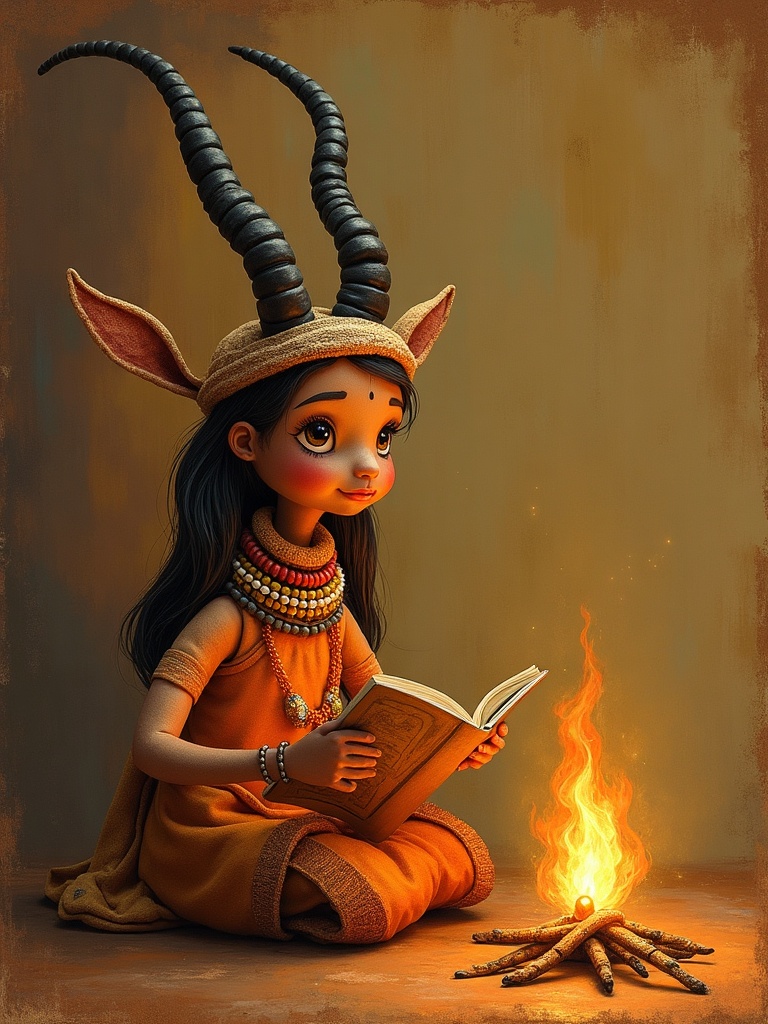
A San child grows up inside a small, sharing band where everyone is fed and no one is a chief above the others.
Answer all three to unlock this stage.
Unlock the previous stage first.
Unlock the previous stage first.
Unlock the previous stage first.
Crafting the doll
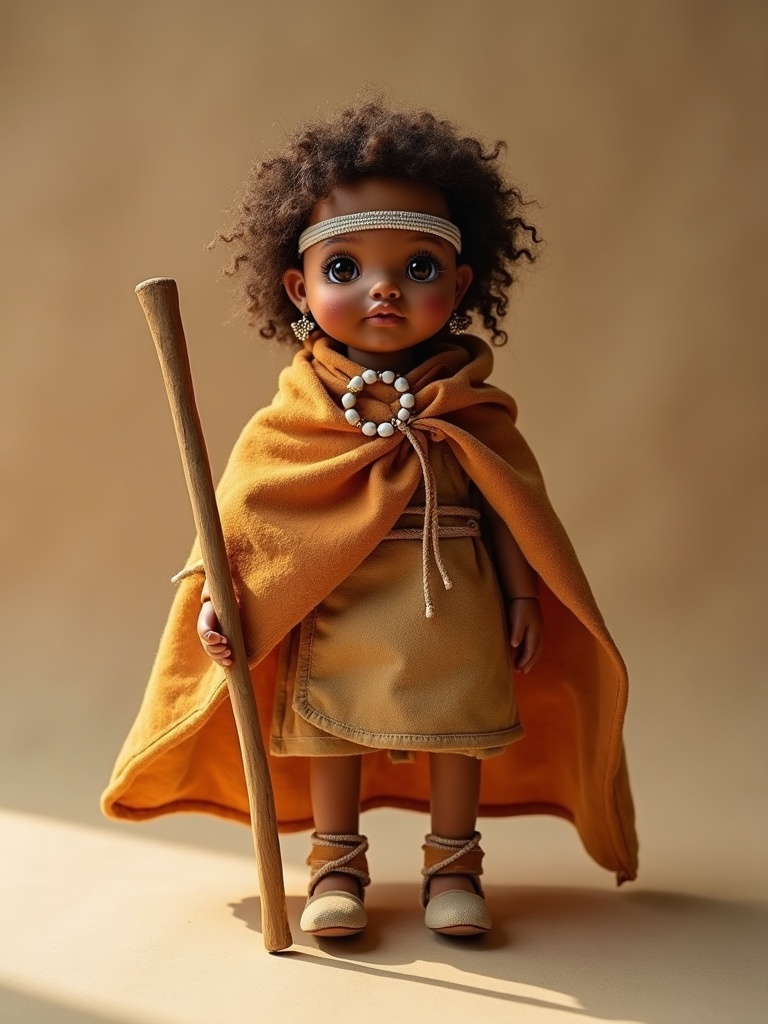
Her body is honest hand-tanned hide and soft cloth: a springbok-skin kaross cloak and small antelope-hide apron, with skin and hair lightly touched with red ochre. Her signature attribute is strands of tiny white ostrich-eggshell disc beads at neck and brow, among the oldest beads on Earth, with a smooth wooden digging stick and a peacefully carried bow and reed quiver. A little education card explains the clicks of the ǀXam language, the ostrich-eggshell beads, and the eland rock paintings. Sizes Classic 32 / Kidogo 18–20 / Shule 28. A share of proceeds supports San community heritage and language projects.
How this doll is made
The San Storyteller's look is grounded in real San material culture: soft hide karosses and antelope-skin aprons, the world's oldest ostrich-eggshell bead jewellery, red-ochre adornment, a digging stick and a peacefully carried bow and quiver, and the ochre, haematite and charcoal palette of the rock paintings.
- Garments 2
- Accessories 3
- Materials 2
- Techniques 3
Garments
- Springbok-skin kaross (cloak)A sleeveless hide cloak, traditionally of springbok or other antelope skin with the hair left on, worn draped over the shoulders. For San women it doubles as a carrier for firewood, food and even a baby, the classic foraging garment.DetailsEN
- Antelope-hide apronSmall front and back aprons of supple tanned springbok, duiker or steenbok skin form the customary everyday dress of San women, worn with or beneath the kaross.DetailsEN
Accessories
- Ostrich-eggshell bead necklace & headbandStrands of tiny white disc beads ground from ostrich eggshell, strung as necklaces, girdles and head-ornaments. Among the oldest ornaments humans have made (over 50,000 years) and still produced by San women in the Kalahari.DetailsEN
- Digging stick & gathering bagA smooth fire-hardened wooden digging stick, sometimes weighted with a bored stone, used with a small hide bag to gather roots, tubers, melons, berries and nuts, the toolkit of San gathering.DetailsEN
- Hunting bow & reed quiverA light wooden bow and a reed quiver of poison-tipped arrows, the San hunter's tools, shown here peacefully carried across the back rather than drawn.DetailsEN
Materials
- Red ochre & rock-art pigmentsIron-rich ochre and haematite (red and brown), specularite or manganese (black), and silica or china clay (white) are ground to powder. Ochre is also rubbed on skin and hair as adornment and protection. Ochre use at Blombos Cave is among the earliest signs of human symbolism.DetailsEN
- Hide, sinew & reedTanned antelope hide for clothing and bags, sinew for thread and bowstrings, and reed for arrow shafts and quivers, the everyday materials of San life, worked entirely by hand.DetailsEN
Techniques
- Ostrich-eggshell bead-making (drilling & grinding discs)A broken eggshell is chipped into small blanks; a hole is drilled in each with a hand-drill and awl; the rough blanks are strung, then ground together against stone (kept wet) until they become smooth, even, luminous white discs. Labour-intensive work done mainly by women.DetailsEN
- Rock painting (pigment + binder)Ground ochre and mineral pigments are mixed with a binder, egg white, animal blood, fat or beeswax, and applied to rock with fingers, feathers, reeds or brushes to make the eland and trance figures of San rock art.DetailsEN
- Hide tanning & bow/quiver makingAnimal skins are scraped, softened and worked into supple leather for karosses, aprons and bags; bows are shaped from springy wood and strung with twisted sinew, with reeds bound into quivers, the practical crafts behind the San's tools and dress.DetailsEN
How it's made
Every doll is sewn by hand from natural materials — built to last a lifetime and to be repaired, not replaced. Here is the shopping list and the work steps. Sizes: Classic 32 cm (heirloom) · Kidogo 18–20 cm (toddlers, no small parts) · Shule 28 cm (school edition).
Shopping list
- Natural cotton or linen for the body (skin tone), ~0.5 m
- Wool or cotton stuffing — no plastic
- Cotton thread and embroidery floss in matching colours
- Garment fabric in this doll's colours (see the fabrics above)
- Yarn for the hairstyle
- Beads, cowrie shells and trims as shown
- Sharps and embroidery needles, pins, fabric scissors, fabric marker
Work instructions
- Trace and cut the body pattern at your chosen size (Classic 32 cm / Kidogo 18–20 cm / Shule 28 cm).
- Sew the body pieces right sides together, leave an opening, turn and stuff firmly with natural fibre, then close by hand.
- Embroider the face gently and with dignity — no plastic parts for the toddler line.
- Make the hair from yarn following the chosen hairstyle and attach it securely.
- Cut and sew the garment from this doll's fabric, then dress the doll.
- Add the beadwork, shells, trims and any attribute by hand.
- Check every seam and reinforce it — the doll should be lifelong and repairable, with no loose small parts for small children.
Origin & Ethics
How we know this
This is a respectful composite archetype, not a documented individual: there was never one 'San Storyteller'. The material culture (kaross, ostrich-eggshell beads, ochre, bow, digging stick) and the ǀKaggen/eland stories are well documented, but the ǀXam tales survive almost entirely through the colonial-era Bleek and Lloyd archive and should be treated as precious yet mediated. Living San communities and their councils, not this card, are the true authorities.
Because the San are living peoples, this archetype should be made and shared with the guidance of San representative bodies, the South African San Council and the South African San Institute (SASI), following the San Code of Research Ethics (fairness, respect, care and honesty). No sacred trance or shamanic imagery is used as caricature, and the figure is presented as a respectful homage to a whole people rather than any named individual or sacred ritual.
Sources
- The Digital Bleek and Lloyd, University of Cape Town (ǀXam & !kun notebooks, ~12,000 pages, ǁKabbo, Diäǃkwain, ǀhanǂkassʼo, ǀKaggen the Mantis)
- University of Cape Town, The digital Bleek and Lloyd (project overview, Centre for Curating the Archive, dispersed across four institutions)
- Wikipedia, Specimens of Bushman Folklore (Bleek & Lloyd, 87 ǀXam legends and myths, click script, cornerstone of San study)
- Wikipedia, Ostrich eggshell beads (among the oldest ornaments, ~50,000+ years, making process, San hxaro exchange)
- The Conversation, The tiny ostrich eggshell beads that tell the story of Africa's past (age, manufacture, San and Kalahari context)
- UNESCO World Heritage Centre, Maloti-Drakensberg Park (largest concentration of rock art in sub-Saharan Africa, San paintings)
- Smarthistory, uKhahlamba-Drakensberg rock paintings (San) (eland, trance/shamanism, ochre pigments, sites)
- Crazy Alchemist Bestiary, ǀKaggen: San Mantis Trickster-Creator (shapeshifting maker of the eland, ǀXam mythology)
- British Museum, necklace of ostrich-eggshell beads, southern Africa (object Af-6027)
- Wikipedia, Kaross (hide cloak of the Khoikhoi and San, foraging dress, digging stick)
- Origins Centre, University of the Witwatersrand (San first nations, rock art, world's oldest art / Blombos ochre)
- South African San Institute, San Code of Research Ethics 2017 (fairness, respect, care, honesty; San Council approval)