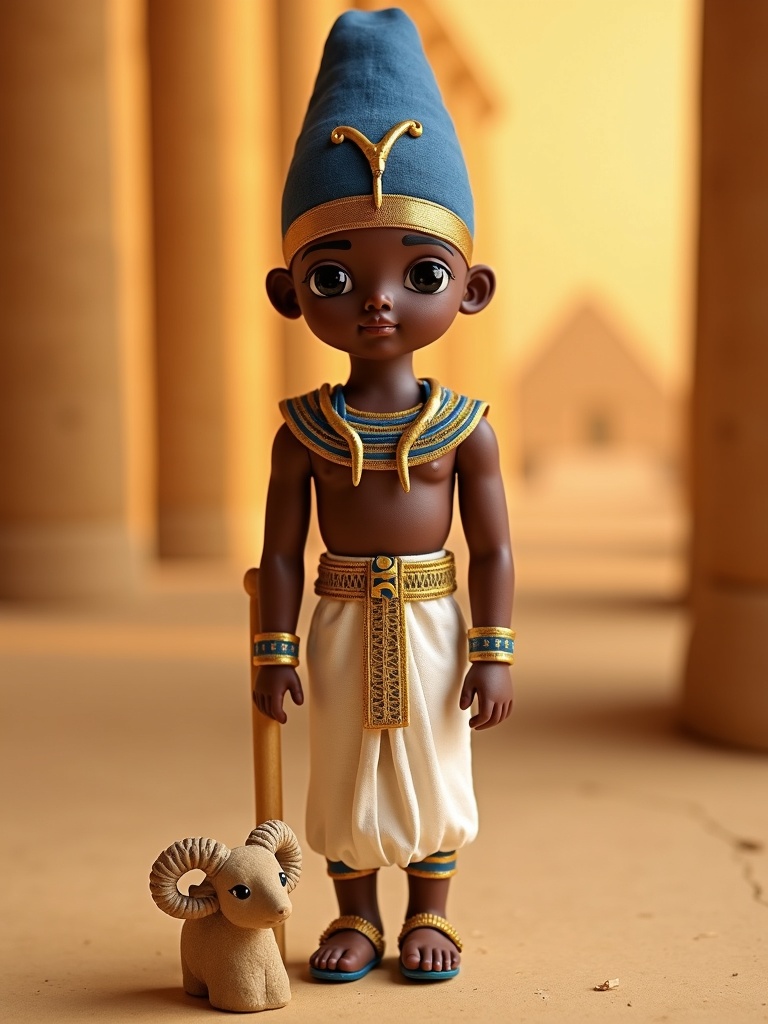
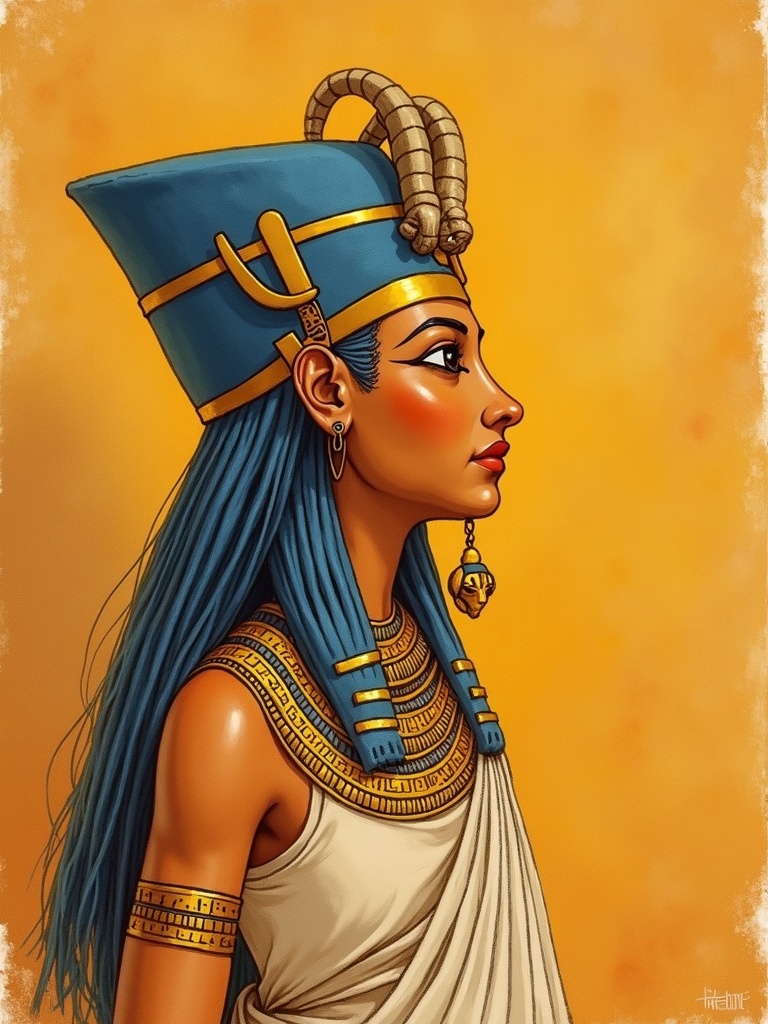
AI design preview — not a photo of the finished handmade doll
The Black Pharaoh of Kush
Taharqa
Three thousand years ago a king from the African south wore the double crown of Egypt and Nubia at once — and the Bible still remembers him by name.
- People
- Kushite (Nubia), 25th Dynasty
- Country
- Sudan
- Region
- North Africa
- Era
- ≈710–664 BCE (reigned ≈690–664 BCE)
- Theme
- The Black Pharaoh of Kush
Make your own
Design your Taharqa
Pick a garment, a hairstyle and a scene, enter the PIN and generate a fresh image of Taharqa with AI.
Each image is generated live with fal.ai.
Generated images
AI design preview — not a photo of the finished handmade doll
No images generated yet — be the first.
Tradition & Origin
Three thousand years ago a king from the African south wore the double crown of Egypt and Nubia at once — and the Bible still remembers him by name.
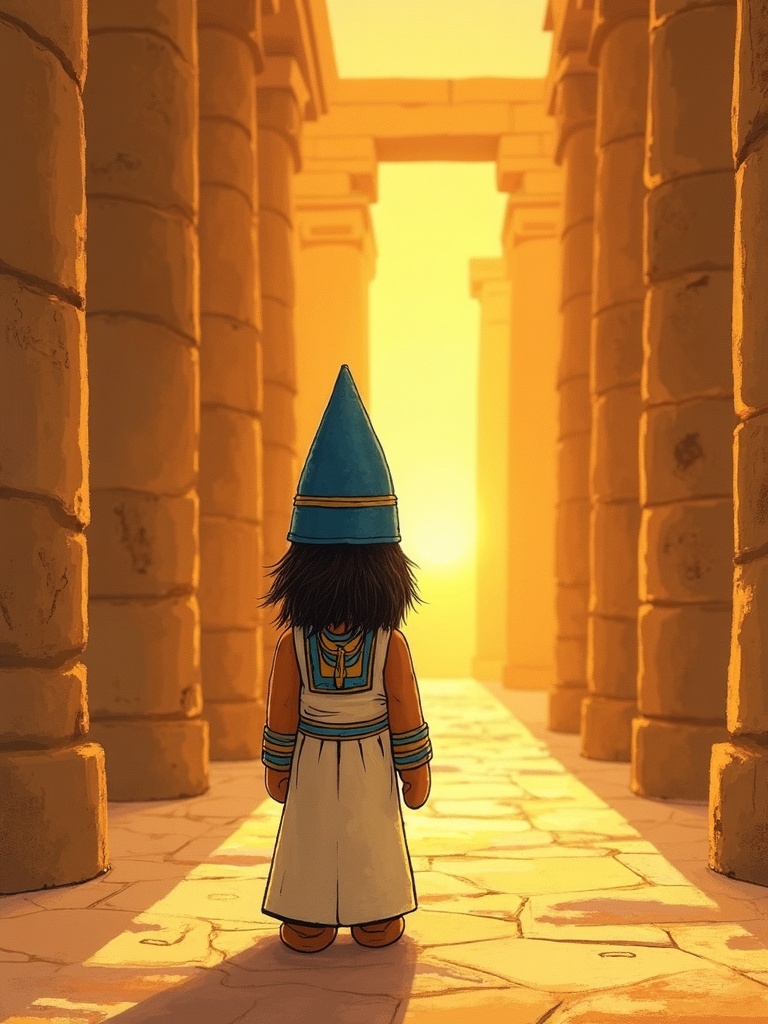
Taharqa was born around 710 BCE into the royal house of Kush, the powerful Nubian kingdom of the upper Nile in what is now Sudan. His father, King Piye, and his uncle had marched north and conquered Egypt, so that the kings of Kush became the pharaohs of Egypt's 25th Dynasty — the line history remembers as the 'Black Pharaohs'. When Taharqa took the throne around 690 BCE, he ruled a single empire stretching from the Mediterranean delta all the way to Napata, governing from the ancient capital of Memphis while keeping his heart in the Nubian homeland beneath the sacred mountain of Jebel Barkal.
His reign became a golden age. A great Nile flood and good harvests filled the granaries, and Taharqa poured that wealth into stone: he raised the towering colonnade at Karnak in Thebes, and built or restored temples across Nubia — at Kawa, where granite rams of the god Amun stood guard before his shrine, and at Sanam and Jebel Barkal. Historians count him among the most prolific builders of the entire ancient world; travellers on the Nile in his day passed temple after temple bearing his name.
But to the north loomed the empire of Assyria, the most fearsome military power of the age. The Hebrew Bible names him 'Tirhakah king of Cush' (2 Kings 19:9) as Egyptian forces moved against the Assyrian king Sennacherib. Later the Assyrian kings Esarhaddon and Ashurbanipal invaded outright — in 671 BCE they captured Memphis and even Taharqa's own family, and drove him south. This is honest history: a brilliant, prosperous reign that ended in retreat to his homeland.
Taharqa died in 664 BCE and was laid to rest at Nuri, beneath a steep pyramid about 51.75 metres square at its base — the largest pyramid ever built in ancient Sudan. It was set so that, seen from Jebel Barkal, the New Year sun would rise directly over its peak. With him went over 1,070 small shabti figures of granite, alabaster and green ankerite. Even his enemies could not erase his mark on the Nile valley.
Timeline
- ≈710 BCEBorn into the royal house of Kush, son of King Piye and queen Abar, at Napata.
- 701 BCEAs a young commander he is linked to Egyptian forces facing Sennacherib of Assyria — remembered in the Bible as 'Tirhakah'.
- ≈690 BCECrowned pharaoh of Egypt and Kush, taking the double-uraeus crown of the 25th Dynasty.
- ≈680 BCEBuilds the Amun temple and stone shrine at Kawa and the great colonnade at Karnak.
- 671 BCEThe Assyrian king Esarhaddon captures Memphis and the royal family; Taharqa fights on from the south.
- 664 BCEDies in Nubia and is buried beneath the largest pyramid in ancient Sudan, at Nuri.
Did you know?
- Taharqa is the only African pharaoh named in the Hebrew Bible, where he appears as 'Tirhakah king of Cush' marching against Assyria.DetailsEN
- His double-uraeus cap-crown carried two cobra emblems instead of one, signalling that he ruled over both Egypt and Nubia at the same time.DetailsEN
- Granite ram statues of the god Amun protecting Taharqa once guarded his temple at Kawa and now stand in the British Museum and the Ashmolean.DetailsEN
- The kingdom of Kush that he ruled left behind more pyramids than Egypt itself, scattered across the deserts of modern Sudan.DetailsEN
A boy from the Nubian desert wore the crown of two lands — proof that the centre of the world has always had room to move.
Values & Capabilities
Capabilities
◆◆◆◆◆ shows how central a gift is — five diamonds mark a signature strength, fewer mark a supporting one.
Taharqa wore the double-uraeus cap-crown to rule Egypt and Nubia together as one realm from Memphis to Napata.
He raised and restored temples from Karnak in Egypt to Kawa, Sanam and Jebel Barkal in Nubia — a renaissance in stone.
As prince and king he marched north against the mighty Assyrian empire — and the Bible remembers him by name.
He honoured Amun of Napata — the ram-headed god of the sacred mountain Jebel Barkal — above all.
He rests under the largest pyramid ever built in ancient Sudan, aligned so the New Year sun rises over its peak.
Development
1 of 5 stages unlocked
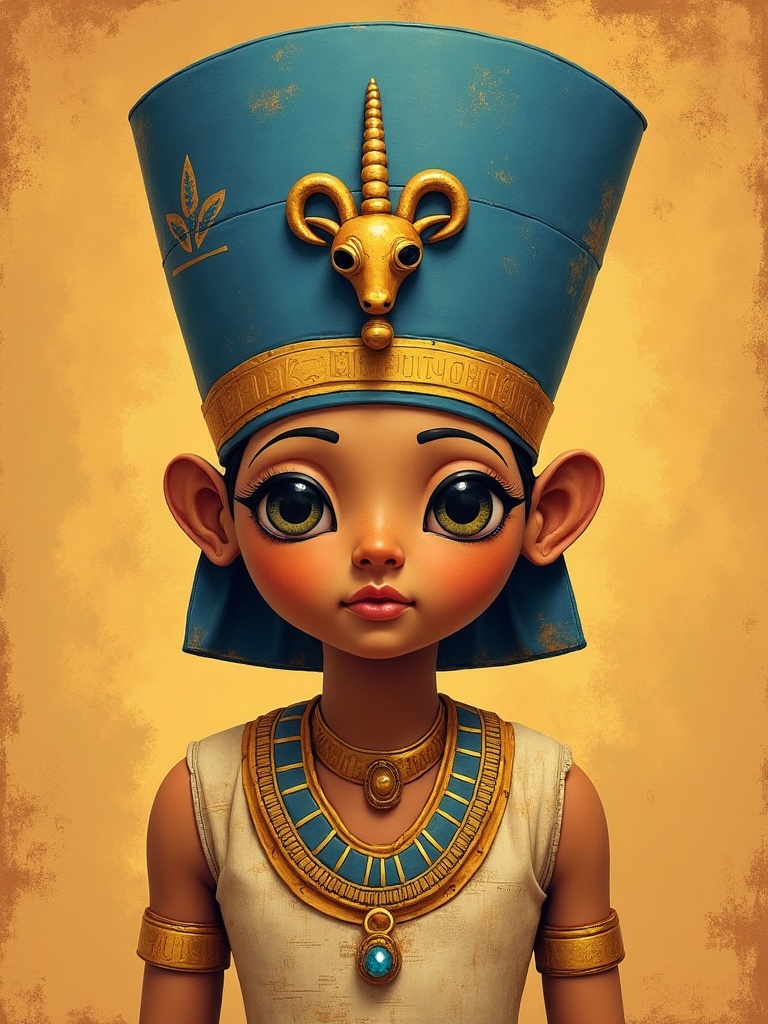
Born into the royal house of Kush, son of King Piye and queen Abar, raised beneath the sacred mountain Jebel Barkal.
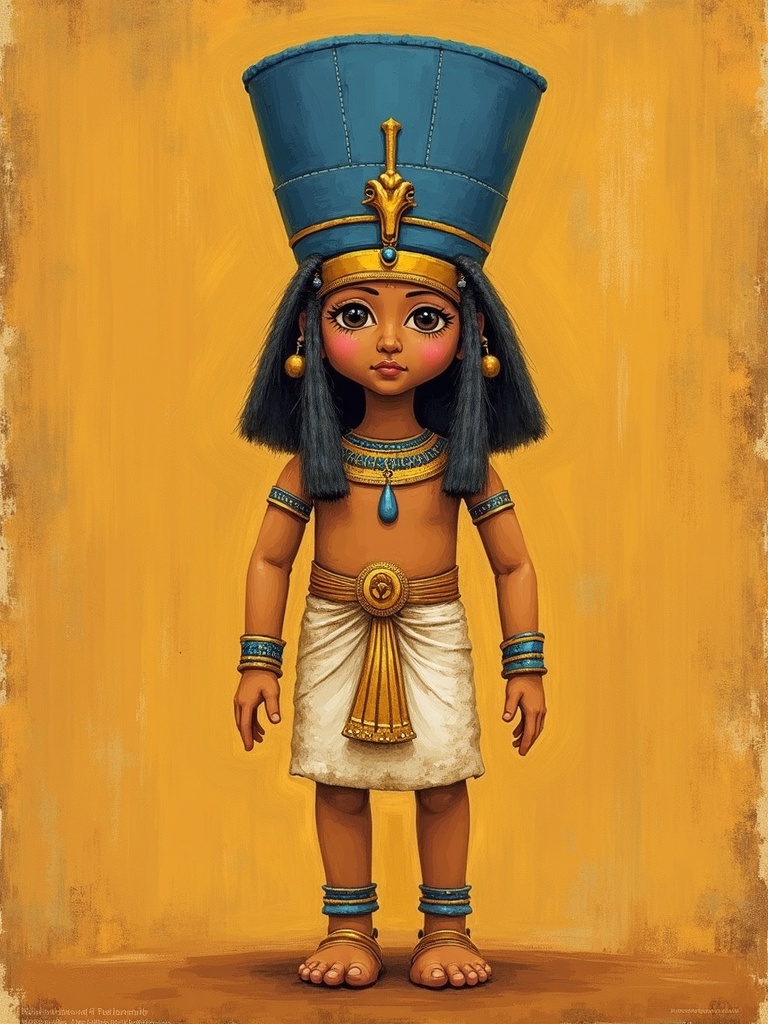
Answer all three to unlock this stage.
Unlock the previous stage first.
Unlock the previous stage first.
Unlock the previous stage first.
Crafting the doll
The doll is sewn from undyed linen-look cotton for the royal kilt, deep indigo cloth for the cap-crown, and a soft suede-look felt for the leopard mantle, with gold metallic thread for the double uraeus, the broad usekh collar and the twin ram's-head pendants on a braided cord — its signature attribute. A small carved-look granite ram of Amun and a golden crook-and-flail complete the set. Each doll ships with an education card naming Kush, the 25th Dynasty and the pyramids of Nuri. Sizes Classic 32 / Kidogo 18–20 / Shule 28. A share of proceeds supports heritage education and the protection of Sudan's Napatan archaeological sites.
How this doll is made
Taharqa's look is built from securely dated Kushite royal art: the cap-crown with two cobras, the ram's-head pendants of Amun, the leopard mantle of a priest-king, and the granite rams that guarded his temple at Kawa.
- Garments 3
- Accessories 3
- Materials 2
- Techniques 2
Garments
- Cap-crown (skullcap)A close-fitting blue royal cap worn by Kushite kings, marked at the brow by the uraeus — distinct from the tall Egyptian crowns.DetailsEN
- Pleated kilt (shendyt)A white linen royal kilt with a broad belt — the Egyptian element of the king's dress, worn with distinctly Nubian regalia.DetailsEN
- Leopard-skin mantleThe spotted skin worn across one shoulder, the ritual dress of a priest-king honouring the gods.DetailsEN
Accessories
- Double uraeusTwo rearing cobra emblems on the forehead, signifying rule over both Egypt and Nubia — a hallmark of the Kushite 25th Dynasty.DetailsEN
- Ram's-head pendantsTwin gold ram's-head amulets of the god Amun, strung on a thick cord around the neck, ends falling forward over the shoulders.DetailsEN
- Crook & flailThe crossed crook and flail of gold and blue, the ancient insignia of kingship over the Two Lands.DetailsEN
Materials
- Granite & gneissHard granitic gneiss was carved into the ram-of-Amun statues that protected Taharqa at Kawa, now in the British Museum, Ashmolean and National Museum of Sudan.DetailsEN
- Alabaster & ankerite shabtisOver 1,070 servant figures of granite, green ankerite and alabaster were buried with him at Nuri — the materials of Kushite royal craft.DetailsEN
Techniques
- Sandstone relief carvingHis Kawa shrine was built of 236 carved sandstone blocks showing the king offering to ram-headed Amun-Re — later moved stone-by-stone to Oxford.DetailsEN
- Pyramid masonryThe steep Nubian pyramid at Nuri, ≈51.75 m square at its base, was the largest ever built in ancient Sudan, aligned to the New Year sunrise.DetailsEN
How it's made
Every doll is sewn by hand from natural materials — built to last a lifetime and to be repaired, not replaced. Here is the shopping list and the work steps. Sizes: Classic 32 cm (heirloom) · Kidogo 18–20 cm (toddlers, no small parts) · Shule 28 cm (school edition).
Shopping list
- Natural cotton or linen for the body (skin tone), ~0.5 m
- Wool or cotton stuffing — no plastic
- Cotton thread and embroidery floss in matching colours
- Garment fabric in this doll's colours (see the fabrics above)
- Yarn for the hairstyle
- Beads, cowrie shells and trims as shown
- Sharps and embroidery needles, pins, fabric scissors, fabric marker
Work instructions
- Trace and cut the body pattern at your chosen size (Classic 32 cm / Kidogo 18–20 cm / Shule 28 cm).
- Sew the body pieces right sides together, leave an opening, turn and stuff firmly with natural fibre, then close by hand.
- Embroider the face gently and with dignity — no plastic parts for the toddler line.
- Make the hair from yarn following the chosen hairstyle and attach it securely.
- Cut and sew the garment from this doll's fabric, then dress the doll.
- Add the beadwork, shells, trims and any attribute by hand.
- Check every seam and reinforce it — the doll should be lifelong and repairable, with no loose small parts for small children.
Origin & Ethics
How we know this
Taharqa is a thoroughly documented historical king: his reign dates, monuments, the Assyrian wars and his Nuri pyramid are attested in inscriptions, the Bible, Assyrian annals and excavated remains. Specific regalia (cap-crown with double uraeus, ram's-head pendants, leopard mantle) reflect securely dated Kushite art, not invention; exact birth year and some campaign details remain debated among scholars.
As an ancient historical figure with no living descendants or royal house, Taharqa carries no individual-consent requirement. The portrayal was guided by published Egyptological and Nubiological scholarship (British Museum, Ashmolean, the Metropolitan Museum of Art, the University of Chicago's Institute for the Study of Ancient Cultures, and UNESCO's Gebel Barkal World Heritage documentation) and aims to present Kushite material culture with dignity and accuracy, naming the hard end of his reign honestly rather than glossing it.
Sources
- Taharqa — Wikipedia
- Taharqa, Nubian Pharaoh — Encyclopaedia Britannica
- King Taharqa of the Kingdom of Cush — Biblical Archaeology Society
- 2 Kings 19:9 (Tirhakah king of Cush) — Bible Hub
- Statues of Amun in the form of a ram protecting King Taharqa — Wikipedia
- Nuri (Kushite royal necropolis) — Wikipedia
- Shrine of Taharqa (Kawa, now Ashmolean) — Egypt Museum
- Kushite Kingdom (regalia: cap crown, double uraeus, ram amulet) — Institute for the Study of Ancient Cultures, University of Chicago
- Ram's-head Amulet, Kushite Period — The Metropolitan Museum of Art
- Gebel Barkal and the Sites of the Napatan Region — UNESCO World Heritage Centre
- Nubian pyramids — Wikipedia