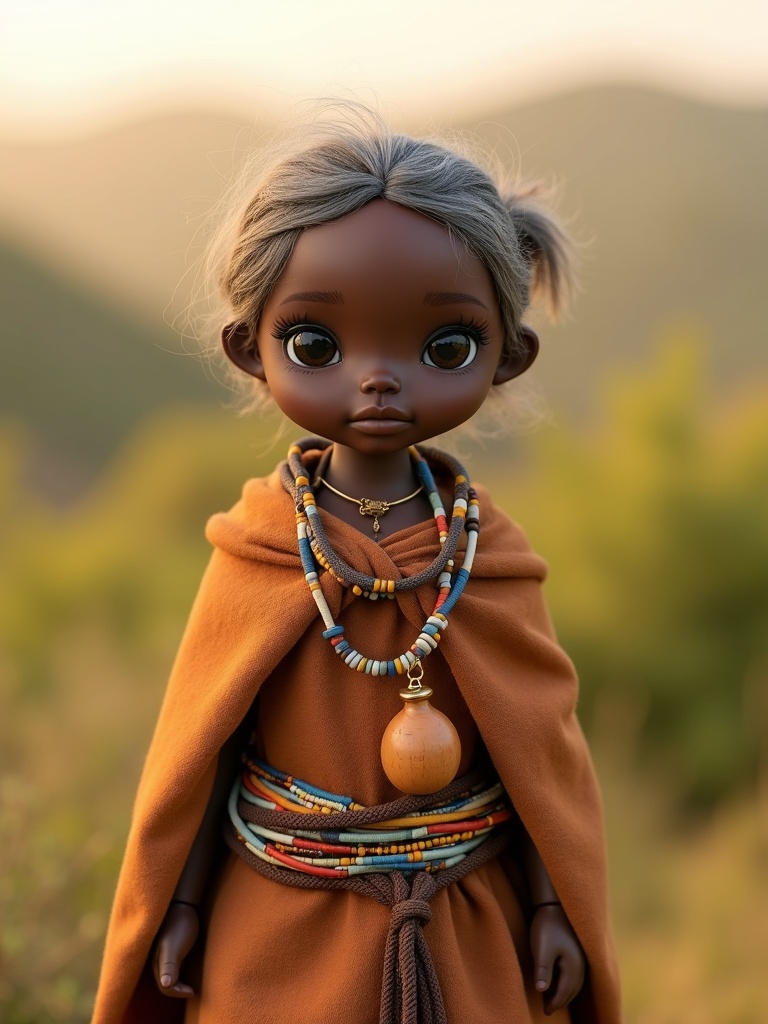
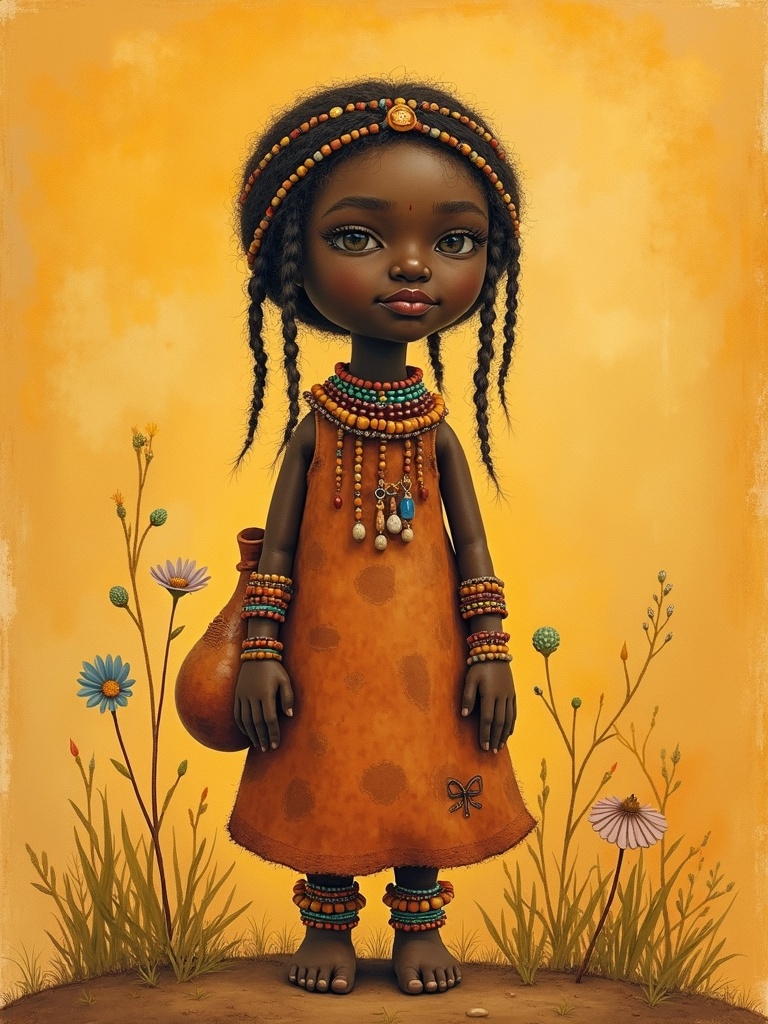
AI design preview — not a photo of the finished handmade doll
Courage & Resistance
Moraa Ngiti
In the green hills of western Kenya, a woman who was told to stay silent warned her whole people of what was coming — and when the soldiers came for the cattle, it was her counsel that helped light the spark of resistance.
- People
- Gusii (Abagusii)
- Country
- Kenya
- Region
- East Africa
- Era
- ≈1850s–1910s (fl. 1908)
- Theme
- Courage & Resistance
Make your own
Design your Moraa Ngiti
Pick a garment, a hairstyle and a scene, enter the PIN and generate a fresh image of Moraa Ngiti with AI.
Each image is generated live with fal.ai.
Generated images
AI design preview — not a photo of the finished handmade doll
No images generated yet — be the first.
Tradition & Origin
In the green hills of western Kenya, a woman who was told to stay silent warned her whole people of what was coming — and when the soldiers came for the cattle, it was her counsel that helped light the spark of resistance.
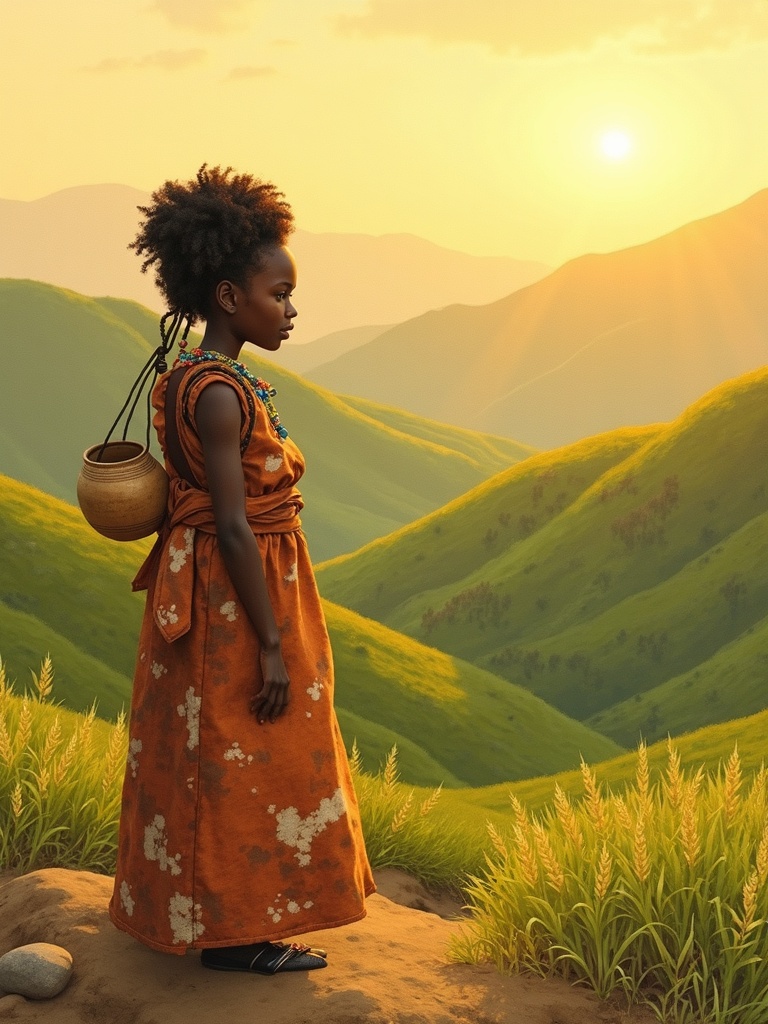
Moraa wa Ng'iti was born around the middle of the 1800s into the Bogeka sub-clan of Getutu (Kitutu), among the Abagusii — the Gusii people of the Kisii highlands in south-western Kenya. The Gusii are a Bantu-speaking, cattle-keeping people who, by their own oral tradition, migrated over generations from the Mount Elgon region down through Nyanza before settling these cool, fertile ridges between roughly the 17th and 18th centuries. Wealth was measured in cattle, defended by young warriors from the cattle camps known as the ebisarate, and Moraa grew up in a world where a woman speaking out in public broke a deep custom.
She married a healer named Ng'iti — which is why she is remembered as Moraa wa Ng'iti, 'Moraa of Ng'iti' — and trained as a medicine woman and seer (an omoragori), drawing on the herbal knowledge of the highlands and the prophetic current that ran through Nyanza in those years. Gusii memory says she foresaw the arrival of Europeans and the loss of land, cattle and freedom, and that she even named the elder Ombati as the man who would side with the British. While many elders began to collaborate with the new colonial administration, Moraa refused.
The reckoning came in January 1908. British forces raided the Kitutu cattle camps and drove off thousands of head of cattle — striking at the very heart of Gusii wealth and pride. Moraa urged the warriors to resist, blessing them and handing out protective charms, and on 18 January 1908 her kinsman Otenyo Nyamaterere ambushed and speared the young colonial officer G. A. S. Northcote. Northcote survived, but the attack triggered a wider uprising. The British answered with overwhelming force: many Gusii were killed, Otenyo was eventually captured, publicly tried and executed, and his head was carried off to a museum in Britain — a wrong his descendants are still trying to put right.
Moraa herself was arrested and tortured at the Kisii police station, yet she refused to recant. The harsh truth is that the resistance did not save the cattle camps or stop colonial rule — and yet Moraa was not broken. She lived on quietly as a healer in Kitutu and is remembered as dying peacefully around 1929. Today she survives in Gusii songs and stories, and in calls to honour the Abagusii role in Kenya's long struggle for freedom.
Timeline
- ≈1850sMoraa wa Ng'iti is born into the Bogeka sub-clan of Getutu (Kitutu) among the Abagusii
- ≈1900by tradition she warns the Gusii of European arrival and names the elder Ombati as a future collaborator
- 1905–1907British expeditions push into Gusii country with punitive cattle raids and burnings
- Jan 1908British forces raid the Kitutu cattle camps (ebisarate), seizing thousands of head of cattle
- 18 Jan 1908her kinsman Otenyo Nyamaterere ambushes and spears the colonial officer Northcote, who survives; harsh reprisals follow
- ≈1929after arrest and torture she lives on as a healer in Kitutu and dies peacefully
Did you know?
- Moraa broke a deep custom of her time simply by speaking out in public — a woman openly counselling warriors when most Gusii elders had already made peace with the colonisers.DetailsEN
- Gusii oral history says she even named the elder Ombati in advance as the man who would side with the British — a prophecy people later said came true.DetailsEN
- After Otenyo's execution the British took his skull to a museum in Britain; in 2015 Gusii elders formally asked for it to be returned home.DetailsEN
- The Gusii cattle-camp world Moraa fought for, the ebisarate, was deliberately abolished by the British around 1913 — ending a whole pastoral-warrior way of life.DetailsEN
They could seize the cattle and silence the camps — but they could not take the courage of a woman who saw it all coming and refused to kneel.
Values & Capabilities
Capabilities
◆◆◆◆◆ shows how central a gift is — five diamonds mark a signature strength, fewer mark a supporting one.
She warned her people that strangers would come and take the land and the cattle — and she was right.
She spoke out in public against the colonisers at a time when women were rarely meant to.
She was a respected medicine woman who knew the plants and remedies of the Kisii highlands.
When the British seized thousands of cattle, her counsel helped spark the Gusii resistance.
Arrested and tortured by the colonial police, she refused to break — and lived on as a healer.
Development
1 of 4 stages unlocked
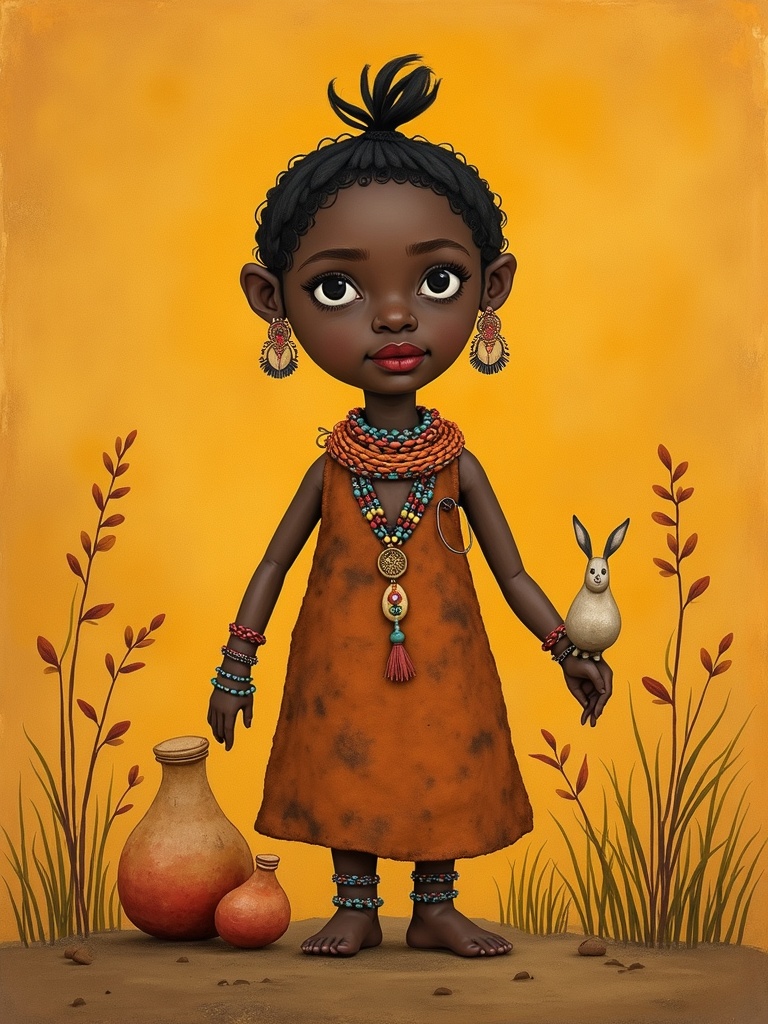
A young woman trained in healing and second sight grows into a respected prophetess of the Bogeka people.
Answer all three to unlock this stage.
Unlock the previous stage first.
Unlock the previous stage first.
Crafting the doll
Garment: softened cowhide skin wrap (egesarra) over a plain woven base, layered with coloured glass trade-bead strands, a beaded waist string and beaded chains (egetinti) in Gusii red, white and green; an East-African printed cotton kanga/leso variant and a cowrie-ringed ceremonial headdress (ekiore) are offered. Signature attribute: a seer's carved divining gourd with a healer's herb bundle and a small Tabaka soapstone (kisii stone) carving. Education card: explains that Moraa was a real Gusii prophetess and medicine woman whose counsel helped spark the 1908 resistance, and that her story is preserved partly in oral tradition and partly in colonial records — honest about what is documented versus remembered. Sizes Classic 32 / Kidogo 18–20 / Shule 28. Proceeds → Kisii soapstone (Tabaka) carving and Gusii beadwork cooperatives, and Gusii oral-history projects.
How this doll is made
Moraa's look is grounded in real Gusii (Abagusii) material culture of the Kisii highlands: softened cowhide dress and bright trade-bead strands, the cowrie-ringed ceremonial ekiore headdress, and the carved divining gourd and herb bundle of a seer-healer — finished with a small carving in the famous pink-and-cream Tabaka soapstone. Every element is hand-made, so the doll honours living Gusii craft rather than inventing costume.
- Garments 2
- Accessories 3
- Materials 2
- Techniques 3
Garments
- Cowhide wrap (egesarra)A softened cattle-hide skin worn over the shoulder and body — pre-textile Gusii dress for a cattle-keeping highland people, before printed cloth became common.DetailsEN
- Ceremonial ekiore headdressA conical Gusii ceremonial headdress ringed with cowrie shells over a cowhide base, worn for special occasions and dances in the highlands.DetailsEN
Accessories
- Beaded chains (egetinti)Strung beaded chains worn by Gusii girls and women at initiation and ceremonies, in bright red, white and green glass trade beads.DetailsEN
- Seer's divining gourd & charmsThe carved gourd and pouch of protective charms (ebirago) of a Gusii seer (omoragori) and medicine woman — Moraa's documented calling.DetailsEN
- Kisii soapstone carvingA small carving in pink-to-cream Tabaka soapstone (kisii stone), the highland craft for which the Gusii are world-known.DetailsEN
Materials
- Cowhide & glass trade beadsTanned cattle hide and imported glass beads — the everyday materials of pre-colonial and early-colonial Gusii dress and adornment for a pastoral people.DetailsEN
- Tabaka soapstone (kisii stone)A soft metamorphic rock from the Tabaka Hills of Kisii County, ranging from light pink to creamy white and grey, soft enough to carve by hand.DetailsEN
Techniques
- Soapstone hand-carving (Tabaka)Men dig the stone from shallow pits with picks and shovels, then carve it with axes, knives and chisels; women sand and wash the forms smooth before they are engraved, polished, waxed and dyed.DetailsEN
- Gusii beadwork stringingGlass beads are strung and patterned by hand into neck strands, waist strings and the egetinti chains, with colour combinations marking age, status and occasion.DetailsEN
- Soapstone engraving & finishingAfter carving, artisans etch geometric and freehand savannah motifs into the soft stone, then polish, wax and dye it — or leave it in its natural pink-cream colour.DetailsEN
How it's made
Every doll is sewn by hand from natural materials — built to last a lifetime and to be repaired, not replaced. Here is the shopping list and the work steps. Sizes: Classic 32 cm (heirloom) · Kidogo 18–20 cm (toddlers, no small parts) · Shule 28 cm (school edition).
Shopping list
- Natural cotton or linen for the body (skin tone), ~0.5 m
- Wool or cotton stuffing — no plastic
- Cotton thread and embroidery floss in matching colours
- Garment fabric in this doll's colours (see the fabrics above)
- Yarn for the hairstyle
- Beads, cowrie shells and trims as shown
- Sharps and embroidery needles, pins, fabric scissors, fabric marker
Work instructions
- Trace and cut the body pattern at your chosen size (Classic 32 cm / Kidogo 18–20 cm / Shule 28 cm).
- Sew the body pieces right sides together, leave an opening, turn and stuff firmly with natural fibre, then close by hand.
- Embroider the face gently and with dignity — no plastic parts for the toddler line.
- Make the hair from yarn following the chosen hairstyle and attach it securely.
- Cut and sew the garment from this doll's fabric, then dress the doll.
- Add the beadwork, shells, trims and any attribute by hand.
- Check every seam and reinforce it — the doll should be lifelong and repairable, with no loose small parts for small children.
Origin & Ethics
How we know this
On honesty: semi-documented (★★★★☆). Moraa wa Ng'iti was a real Gusii prophetess and healer; the 1908 Gusii resistance and the spearing of the colonial officer Northcote on 18 January 1908 are recorded events. Her exact birth/death dates (≈1850s; died ≈1929), the wording of her prophecies, and the fine detail of her role come down partly through Gusii oral tradition and later retellings, which differ on points. The Gusii material culture shown (cowhide dress, beadwork, cowrie ekiore, Tabaka soapstone) is real and documented.
Made in respectful homage with the guidance of Gusii (Abagusii) cultural authorities — the spirit of Kisii and Nyamira county heritage bodies, Gusii elders and oral historians, the National Museums of Kenya, and Tabaka soapstone and beadwork artisan cooperatives. The hard colonial history (the 1908 killings, Otenyo's execution, Moraa's torture) is named honestly but shown with dignity and never as spectacle; the figure is presented as honoured history and memory.
Sources
- Wikipedia — Warrior Otenyo (Otenyo Nyamaterere, Moraa Ng'iti, 1908 Gusii resistance, spearing of Northcote, aftermath)
- Paukwa (Shujaa Stories, Kenya) — Moraa wa Ng'iti: The Magical Warrior
- Ukombozi Review — Moraa Ng'iti: Heroine of Abagusii anti-colonial resistance
- Victor Mmulah (Medium) — Moraa wa Ng'iti: Gusii Prophetess and Anti-Colonial Heroine
- Wikipedia — Gusii people (Abagusii: Kisii highlands, Ekegusii, migration, ebisarate cattle camps, soapstone, obokano)
- Wikipedia — Mumboism (Nyanza anti-colonial prophetic movement among Luo and Gusii)
- Wikipedia — Soapstone mining in Tabaka, Kenya (kisii stone quarrying and hand-carving by Gusii artisans)
- Google Arts & Culture / National Museums of Kenya — The Kisii Community of Kenya (ekiore headdress, egetinti beaded chains, obokano, soapstone)
- Missouri State University Art History — Hand-Carved Kisii Soapstone Objects (Tabaka quarrying, carving, sanding, colours)