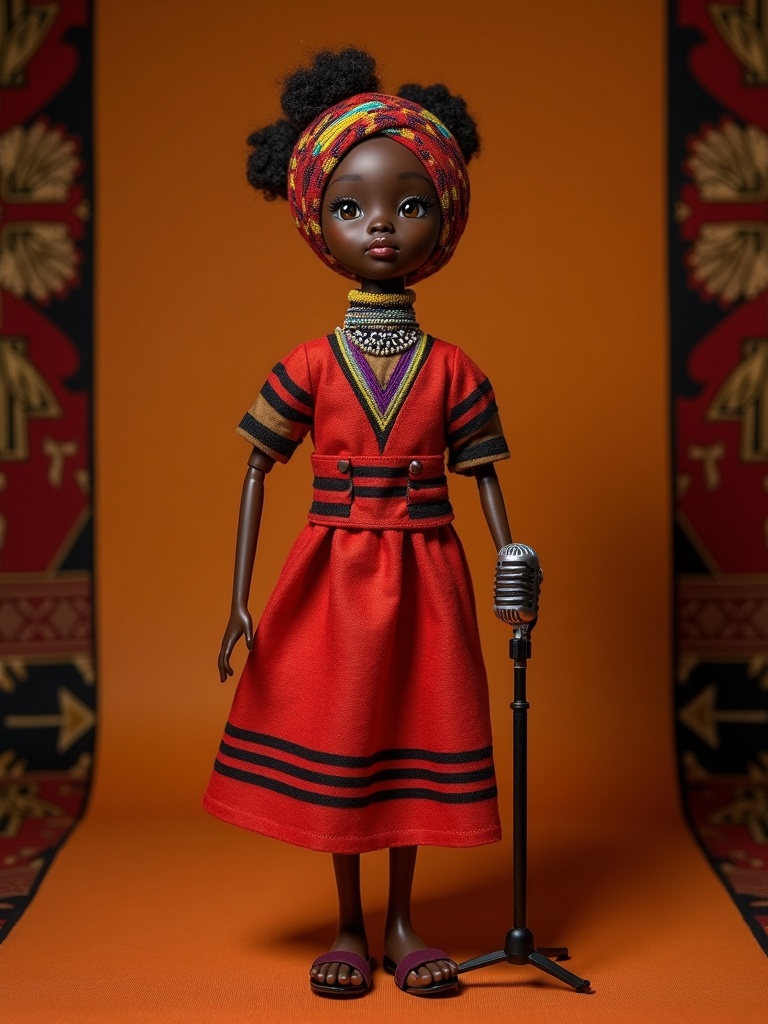
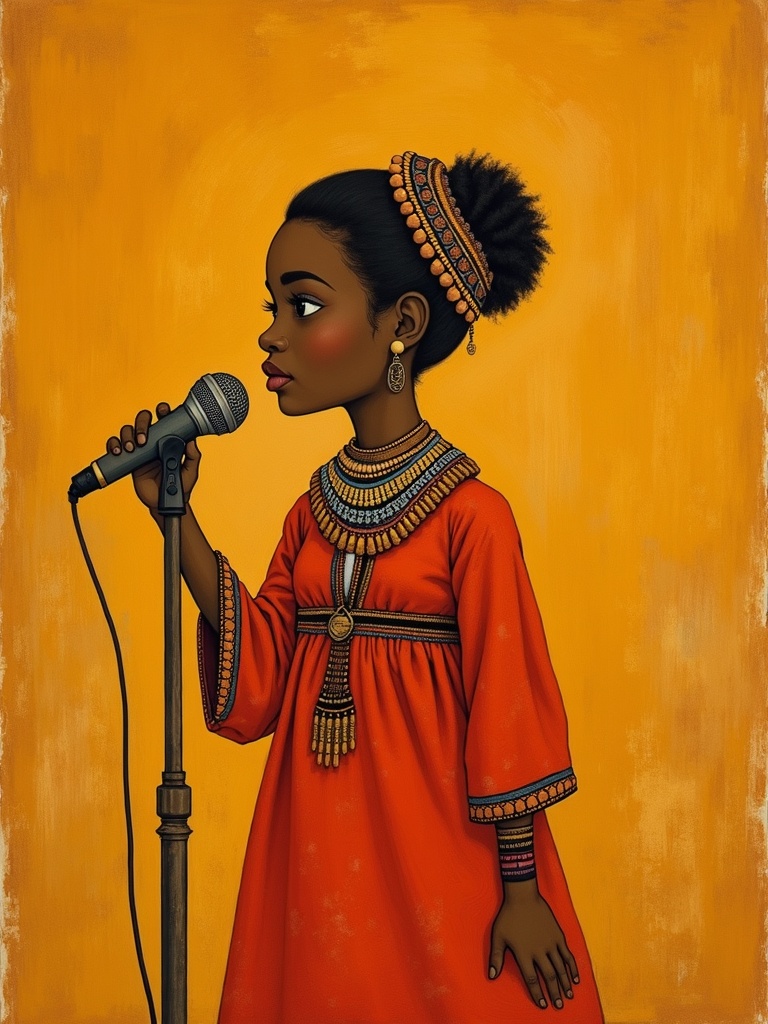
AI design preview — not a photo of the finished handmade doll
Mama Africa — Voice of a Continent
Miriam Makeba
She was a township girl from Johannesburg who became the voice of a whole continent — and when she told the world the truth about apartheid, her own country tried to erase her. It could not.
- People
- Xhosa, South Africa
- Country
- South Africa
- Region
- Southern Africa
- Era
- 1932–2008
- Theme
- Mama Africa — Voice of a Continent
⚖ A respectful concept
Miriam Makeba (1932–2008) was a real person who died within living memory; this doll is a respectful homage, not an exact likeness, and is never meant to be sold as her endorsed image. Only her documented, publicly attributed quotes are used here, each with a source, and her exile and resilience are shown with dignity — never her suffering. The figure honours her music and anti-apartheid courage in the spirit of consent of her family and estate, and is offered as a respectful educational draft, not a finished or licensed product.
Make your own
Design your Miriam Makeba
Pick a garment, a hairstyle and a scene, enter the PIN and generate a fresh image of Miriam Makeba with AI.
⚖ AI homage concept — not a likeness of the real person.
Each image is generated live with fal.ai.
Generated images
AI design preview — not a photo of the finished handmade doll
No images generated yet — be the first.
Tradition & Origin
She was a township girl from Johannesburg who became the voice of a whole continent — and when she told the world the truth about apartheid, her own country tried to erase her. It could not.
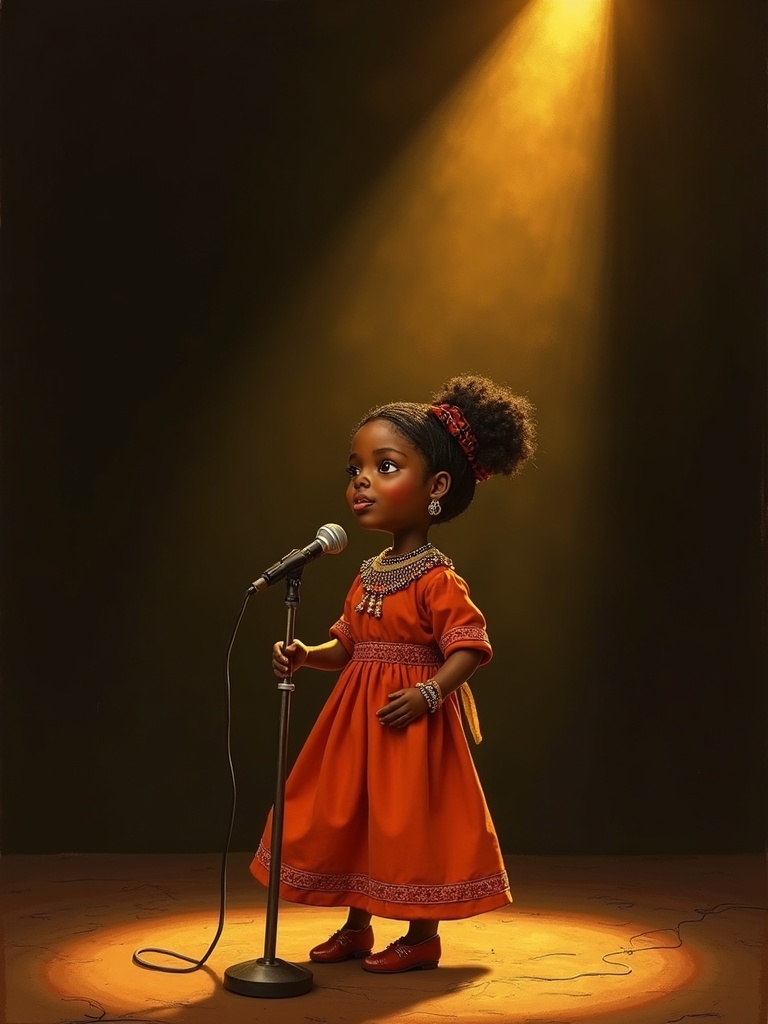
Zenzile Miriam Makeba was born on 4 March 1932 in a township near Johannesburg, South Africa, to a Xhosa teacher father, Caswell, and a Swazi mother, Christina, who worked as a domestic. Her father died when she was very young, and as a child she sang in church and choirs before joining township groups like the Manhattan Brothers and the all-woman Skylarks. By the late 1950s her voice — jazz, township songs, and traditional Xhosa music — had made her famous across South Africa.
A brief appearance in the anti-apartheid film Come Back, Africa (1959) carried her name overseas and won her the support of American star Harry Belafonte. Soon the world knew her songs: 'Pata Pata' became a worldwide hit, and 'Qongqothwane' — nicknamed the 'Click Song' by Westerners who could not pronounce its Xhosa name — let audiences everywhere hear the click consonants of her language. In 1966 she and Belafonte won a Grammy Award for an album that spoke openly about the suffering of Black South Africans.
But Makeba did not only sing. She testified before the United Nations against apartheid and called for the world to act. In return, the apartheid government banned her music, revoked her South African citizenship and refused to let her come home — she could not even attend her own mother's funeral. Stateless, she was given passports and honorary citizenship by other nations and lived in exile for about thirty-one years, in the United States, in Guinea, and beyond, singing for a free South Africa wherever she went.
When apartheid finally began to fall, Nelson Mandela invited her home in 1990, and Mama Africa stepped onto free South African soil once more. She kept singing and serving as a goodwill ambassador until 9 November 2008, when she suffered a heart attack after a concert in Castel Volturno, Italy — a concert held to support a writer standing up to organised crime. She had just finished singing 'Pata Pata'. To the end, her last act was a song against injustice.
Timeline
- 1932Born on 4 March near Johannesburg, South Africa, to a Xhosa father and Swazi mother.
- 1959Appears in the anti-apartheid film 'Come Back, Africa', drawing international attention and the support of Harry Belafonte.
- 1963Testifies against apartheid at the United Nations; South Africa revokes her citizenship and bans her music.
- 1966Wins the Grammy Award with Harry Belafonte for 'An Evening with Belafonte/Makeba'.
- 1990Invited home by Nelson Mandela, she returns to South Africa after about 31 years in exile.
- 2008Dies on 9 November after a concert in Castel Volturno, Italy, having just sung 'Pata Pata'.
Did you know?
- The 'Click Song' is really 'Qongqothwane', a traditional Xhosa wedding song whose name means 'knocking beetle' — Westerners simply nicknamed it for the click consonants they could not pronounce.DetailsEN
- Makeba was stateless for years, but other countries gave her travel papers — so a woman with no nation became a citizen of many, and a voice for all of Africa.DetailsEN
- She died in Italy in 2008 right after singing 'Pata Pata' at a concert held to support a writer standing up against an organised-crime network — singing against injustice to her very last breath.DetailsEN
They took her country, but they could never take her song.
Values & Capabilities
Capabilities
◆◆◆◆◆ shows how central a gift is — five diamonds mark a signature strength, fewer mark a supporting one.
Her songs carried the languages and feelings of Africa to every corner of the world, earning her the name 'Mama Africa'.
She stood before the United Nations and told the world the plain truth about apartheid, asking for it to end.
When her country banned her music and took away her citizenship, she kept singing — for thirty-one long years away from home.
Together with Harry Belafonte she won a Grammy — one of the first African artists honoured on the world's biggest music stage.
When apartheid began to fall, Nelson Mandela invited her home, and she sang on free South African soil at last.
Development
1 of 6 stages unlocked
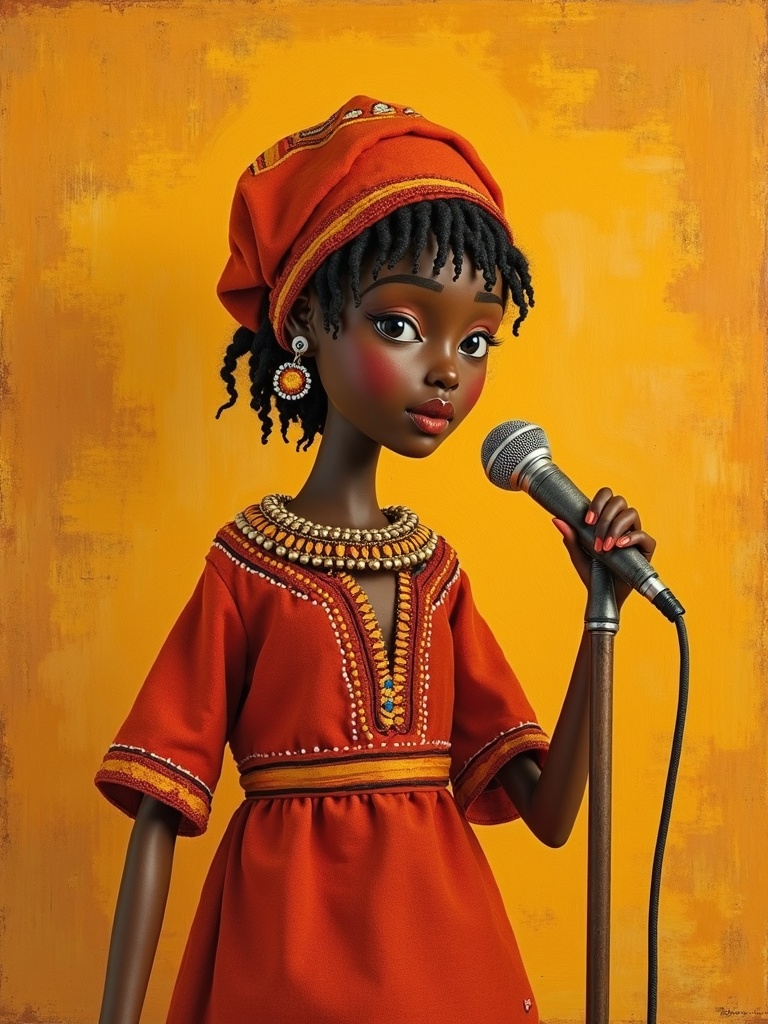
Born near Johannesburg to a Xhosa father and Swazi mother, she lost her father young and grew up singing in church and choirs.
Answer all three to unlock this stage.
Unlock the previous stage first.
Unlock the previous stage first.
Unlock the previous stage first.
Unlock the previous stage first.
Crafting the doll
The doll is dressed in the real materials of Xhosa heritage and the concert stage: a traditional umbhaco ensemble of white cotton cloth dyed warm red-ochre and trimmed with bands of black bias tape, layered with a wide beaded collar and a beaded iqhiya head-tie of coloured glass beads. For her stage looks she wears printed shweshwe cotton and elegant gowns, and she carries a slim vintage microphone as her signature attribute. The education card explains apartheid, exile, her UN testimony, her Grammy and the meaning of the Click Song. Sizes: Classic 32 / Kidogo 18–20 / Shule 28. A share of proceeds supports music education and human-rights programmes for young people.
How this doll is made
A respectful homage to Miriam Makeba's two worlds — the Xhosa heritage of her birth and the concert stages of her exile. The doll's look is grounded in real Xhosa umbhaco dress, glass-bead collars and head-ties, and the printed shweshwe cottons of Southern Africa, paired with the singer's signature microphone and short natural hair.
- Garments 2
- Accessories 3
- Materials 2
- Techniques 3
Garments
- Umbhaco wrap skirtA Xhosa wrap skirt of white cotton blanket cloth dyed warm red-ochre and decorated with bands of black bias tape — a traditional ceremonial garment of the Xhosa and Mfengu peoples of South Africa.DetailsEN
- Shweshwe printed-cotton dressA simple day dress of shweshwe — the distinctive indigo (or red/brown) discharge-printed cotton with small geometric motifs, a beloved everyday cloth of Southern Africa.DetailsEN
Accessories
- Beaded Xhosa collarA wide collar of white, black, red and green glass seed-beads worked in geometric bands; Xhosa beadwork communicates age, status and life-stage and is worn at the throat for ceremony.DetailsEN
- Beaded iqhiya head-tieA cloth head-tie (iqhiya) fitted to the head and festooned with colourful beads, worn by Xhosa women for ceremonial and everyday occasions.DetailsEN
- Vintage stage microphoneA slim silver vintage microphone on a stand — the emblem of a singer whose voice reached the whole world from the concert stage.DetailsEN
Materials
- Red-ochre dyed cottonWhite cotton blanket cloth coloured with red ochre to a rich reddish-brown — the earthy material of Xhosa umbhaco dress, symbolising a tie to the earth and ancestors.DetailsEN
- Glass seed-beadsTiny coloured glass beads used across Xhosa collars, bands and head-ties; colours and geometric patterns carry meaning about identity and life-stage.DetailsEN
Techniques
- Xhosa bead-stringingThreading and weaving glass seed-beads into geometric bands and collars by hand — the Xhosa beadwork tradition in which colour and pattern form a visual language.DetailsEN
- Ochre dyeing & bias-tape trimColouring cotton cloth with red ochre and then cutting and sewing it with applied black bias-tape decoration — the construction method behind the Xhosa umbhaco skirt.DetailsEN
- Shweshwe discharge printingIndigo-dyed cotton is roller-printed with a weak acid that bleaches out tiny white geometric motifs, producing the crisp, slightly stiff shweshwe cloth.DetailsEN
How it's made
Every doll is sewn by hand from natural materials — built to last a lifetime and to be repaired, not replaced. Here is the shopping list and the work steps. Sizes: Classic 32 cm (heirloom) · Kidogo 18–20 cm (toddlers, no small parts) · Shule 28 cm (school edition).
Shopping list
- Natural cotton or linen for the body (skin tone), ~0.5 m
- Wool or cotton stuffing — no plastic
- Cotton thread and embroidery floss in matching colours
- Garment fabric in this doll's colours (see the fabrics above)
- Yarn for the hairstyle
- Beads, cowrie shells and trims as shown
- Sharps and embroidery needles, pins, fabric scissors, fabric marker
Work instructions
- Trace and cut the body pattern at your chosen size (Classic 32 cm / Kidogo 18–20 cm / Shule 28 cm).
- Sew the body pieces right sides together, leave an opening, turn and stuff firmly with natural fibre, then close by hand.
- Embroider the face gently and with dignity — no plastic parts for the toddler line.
- Make the hair from yarn following the chosen hairstyle and attach it securely.
- Cut and sew the garment from this doll's fabric, then dress the doll.
- Add the beadwork, shells, trims and any attribute by hand.
- Check every seam and reinforce it — the doll should be lifelong and repairable, with no loose small parts for small children.
Origin & Ethics
How we know this
Every biographical claim here is documented through reputable public sources (Britannica, Wikipedia, South African History Online and others), and the quotes are publicly attributed to Makeba. Sources differ slightly on exact years (for example whether her UN testimony and citizenship loss are dated 1962, 1963 or 1964, and whether her exile is described as about 30 or 31 years); these small differences are noted honestly. This is a homage to a real recent person, not an authorised or licensed product; her likeness is honoured, not copied, and only verifiable facts and quotes are used.
Because Miriam Makeba died within living memory, this figure is offered as a respectful educational homage rather than a licensed likeness, made in the spirit of consent of her family and estate. Cultural details were drawn from public museum and heritage sources on Xhosa umbhaco dress, beadwork and the Qongqothwane song; any production would seek the blessing of her family, the Makeba estate and relevant South African and Xhosa cultural voices before release.
Sources
- Encyclopaedia Britannica — Miriam Makeba biography (born 1932 Johannesburg; Mama Africa; Pata Pata; Grammy; exile; died 2008)
- Wikipedia — Miriam Makeba (Xhosa/Swazi parentage; UN testimony; statelessness; nine passports; exile in Guinea; return 1990; death at Castel Volturno 2008)
- South African History Online — Miriam Makeba (biography, UN testimony, citizenship revoked, exile, return, honours)
- Wikipedia — The Click Song / Qongqothwane (traditional Xhosa marriage song; 'knocking beetle'; click consonants; Makeba's interpretation)
- Europeana — Miriam Makeba, Mama Africa (life, music and anti-apartheid activism)
- South African History Online — Miriam Makeba: Activist on Two Fronts (music and politics)
- The Metropolitan Museum of Art — Umbhaco wrap skirt, Xhosa or Mfengu peoples, South Africa (ochre-dyed cotton blanket cloth)
- Music In Africa — Miriam Makeba (Mama Africa) directory profile
- Lowell Milken Center for Unsung Heroes — Miriam Makeba: 'Mama Africa'