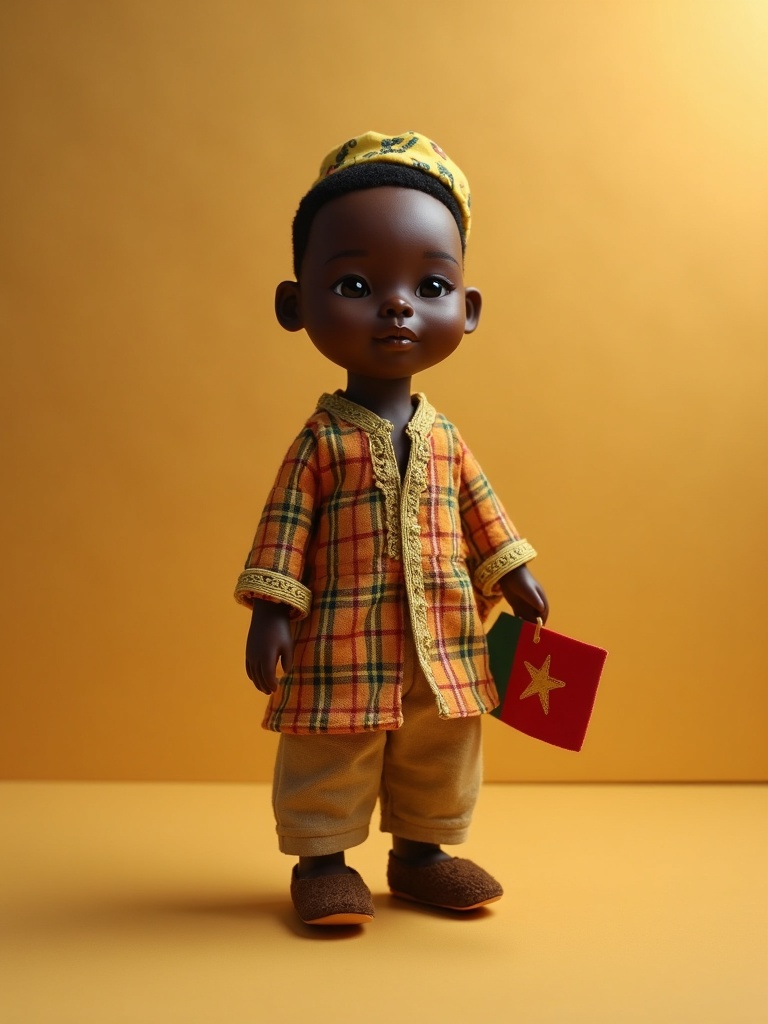
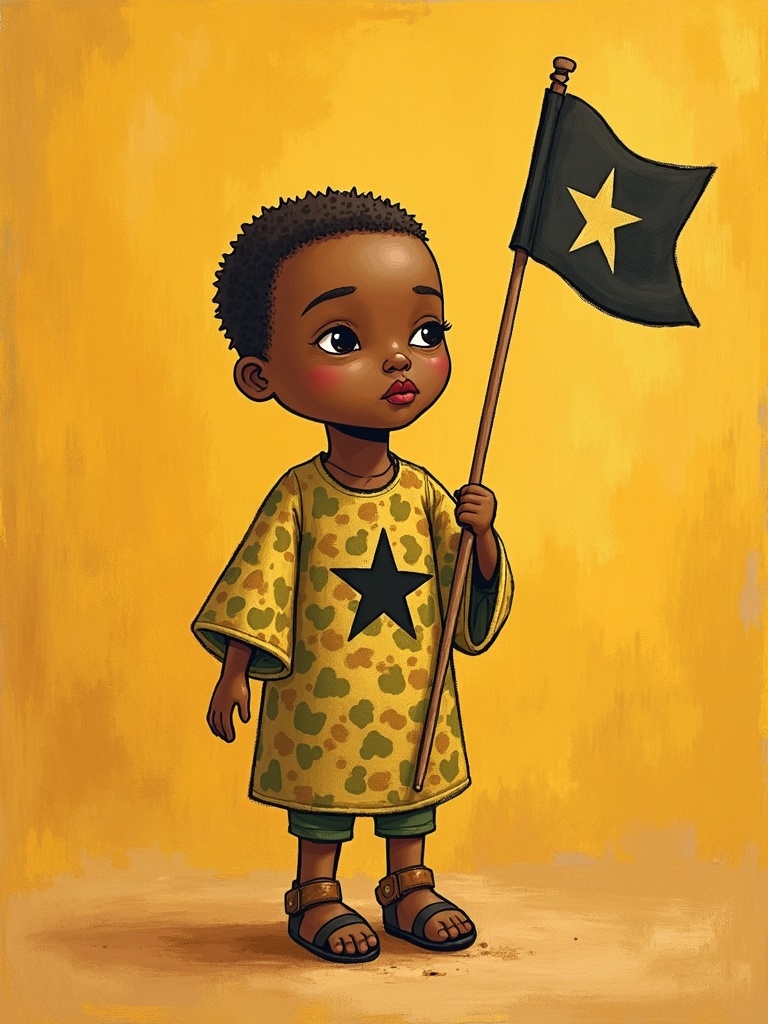
AI design preview — not a photo of the finished handmade doll
Pan-African Independence
Kwame Nkrumah
At midnight on 6 March 1957, a man in a northern Ghanaian smock stepped onto a podium in Accra and told the world, 'Ghana, your beloved country is free forever!' — and an entire continent began to believe it could be free too.
- People
- Akan (Nzima), Ghana
- Country
- Ghana
- Region
- West Africa
- Era
- 1909–1972
- Theme
- Pan-African Independence
⚖ A respectful concept
Kwame Nkrumah was a real 20th-century statesman who died in 1972; this doll is a respectful homage, never an exact likeness, made with dignity and educational intent. Only documented, sourced quotes are used — nothing is invented. The figure honours his role in Ghana's independence and the Pan-African movement; the consent of family and Ghanaian national institutions (which steward his memory at the Kwame Nkrumah Memorial Park) is respectfully assumed. This is a draft homage, not a finished commercial likeness.
Make your own
Design your Kwame Nkrumah
Pick a garment, a hairstyle and a scene, enter the PIN and generate a fresh image of Kwame Nkrumah with AI.
⚖ AI homage concept — not a likeness of the real person.
Each image is generated live with fal.ai.
Generated images
AI design preview — not a photo of the finished handmade doll
No images generated yet — be the first.
Tradition & Origin
At midnight on 6 March 1957, a man in a northern Ghanaian smock stepped onto a podium in Accra and told the world, 'Ghana, your beloved country is free forever!' — and an entire continent began to believe it could be free too.
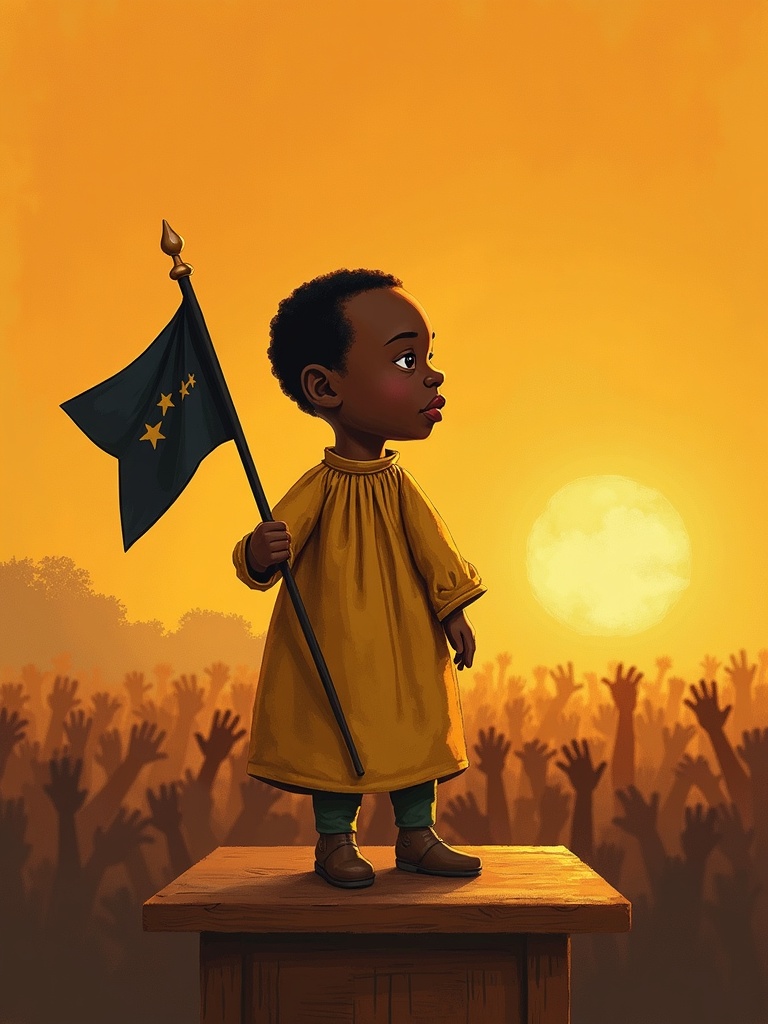
He was born Kofi Nkrumah on 21 September 1909 in the small fishing village of Nkroful, in Nzima land in the far southwest of the British Gold Coast colony. His father was a goldsmith; his mother, Elizabeth Nyanibah, was a market trader who lived to be over a hundred. A bright, restless boy raised Roman Catholic, he trained as a teacher, then in 1935 sailed for the United States, where he spent a decade studying economics, sociology and philosophy at Lincoln University and the University of Pennsylvania, scrubbing dishes and preaching on Sundays to pay his way while absorbing the ideas of Marcus Garvey and the Pan-African movement.
Back home in 1947, he turned mass frustration into a movement. He founded the Convention People's Party in 1949 and called for 'Positive Action' — strikes, boycotts and non-violent protest — which landed him in colonial prison and then, when his party swept the polls, carried him from a jail cell to the office of Prime Minister in 1952. On independence day in 1957 he and five comrades wore the handwoven northern fugu smock, making it forever a symbol of a self-governing Africa. He gave the new nation the ancient name Ghana and a flag bearing a Black Star borrowed from Garvey's shipping line — a beacon for Africans everywhere.
As leader he thought big. His government built the colossal Akosombo Dam on the Volta River (1961–1965), creating Lake Volta — the largest man-made lake on Earth by surface area — to power factories and homes, and it poured resources into free education. In 1963 he helped found the Organisation of African Unity and pressed, almost alone, for a single united Africa: 'We must unite now or perish.'
But the dream darkened. The Preventive Detention Act let his government imprison opponents without trial, and in 1964 Ghana became a one-party state with Nkrumah declared president for life — moves critics fairly call authoritarian. With the economy faltering, the army overthrew him on 24 February 1966 while he was abroad in China. He lived his final years in exile in Guinea, still writing of African unity, and died of cancer in Bucharest in 1972. Decades later, in a 2000 BBC poll, listeners across the continent voted him Africa's Man of the Millennium.
Timeline
- 1909Born Francis Kwame Kofi Nwiana Nkrumah in Nkroful, Nzima land, Gold Coast.
- 1935–1945Studies in the USA (Lincoln University, University of Pennsylvania), absorbing Pan-African ideas.
- 1949Founds the Convention People's Party and launches 'Positive Action' against colonial rule.
- 1957On 6 March, declares Ghana independent — the first sub-Saharan colony to break free.
- 1963Co-founds the Organisation of African Unity in Addis Ababa: 'We must unite now or perish.'
- 1966Overthrown by a military coup on 24 February while visiting China; goes into exile in Guinea.
Did you know?
- The Black Star on Ghana's flag was lifted from Marcus Garvey's Black Star Line shipping company — Nkrumah's tribute to Africans of the diaspora across the Atlantic.DetailsEN
- There is a kente cloth pattern named 'Fathia Fata Nkrumah' to honour his marriage to Fathia, an Egyptian woman — weaving the union of two corners of Africa into the cloth itself.DetailsEN
- He and his fellow leaders chose to declare independence in the handwoven northern smock (fugu) rather than European suits — and Ghanaians still wear it with pride today.DetailsEN
He could not unite a whole continent in his lifetime — but he taught it to dream of unity, and that dream is still being woven.
Values & Capabilities
Capabilities
◆◆◆◆◆ shows how central a gift is — five diamonds mark a signature strength, fewer mark a supporting one.
He led the Gold Coast to become Ghana, the first sub-Saharan African colony to win independence from European rule.
He dreamed of one united Africa and warned the continent it must come together or stay weak.
He insisted Ghana's freedom meant nothing until all of Africa was free, and helped other movements.
He built schools, roads and the great Akosombo Dam to power a young, hopeful country.
He placed a Black Star on Ghana's flag to link Africa with people of African descent everywhere.
Development
1 of 5 stages unlocked
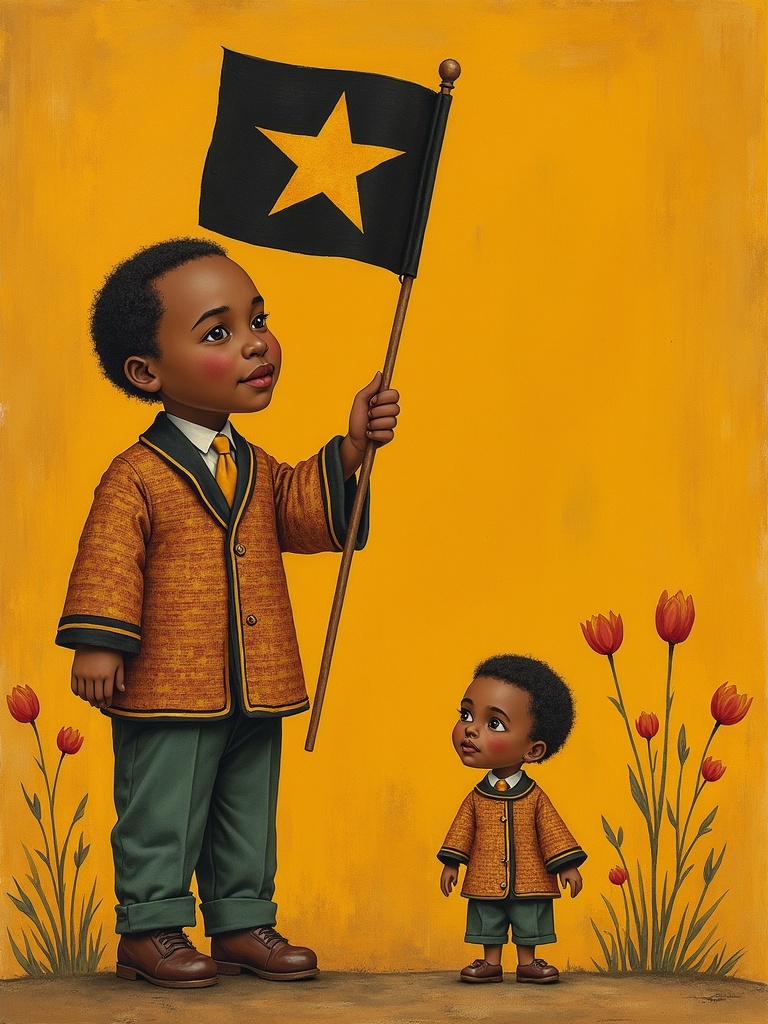
A boy from a small Nzima fishing village, raised by a fishmonger mother, who loved learning and questions.
Answer all three to unlock this stage.
Unlock the previous stage first.
Unlock the previous stage first.
Unlock the previous stage first.
Crafting the doll
The doll's signature look is built from real Ghanaian textiles: the hand-loomed fugu (batakari) smock of dyed and undyed cotton strips in a plaid weave, and a draped kente robe of woven gold, green and red silk-and-cotton strips made on narrow looms in weaving towns like Bonwire. The signature attribute is a small red-gold-green flag bearing the black star, the Lodestar of African Freedom, paired with an embroidered kufi cap. Each comes with an education card naming the independence date (6 March 1957) and the OAU. Available in Sizes Classic 32 / Kidogo 18–20 / Shule 28. A share of proceeds supports African heritage education and craft cooperatives.
How this doll is made
Nkrumah's doll is dressed in the very textiles that announced Ghana's freedom — the northern fugu smock he and his comrades wore on independence day, and the symbolic kente and Black Star that became national emblems.
- Garments 2
- Accessories 3
- Materials 2
- Techniques 3
Garments
- Fugu / batakari smockA flowing smock of hand-loomed dyed and undyed cotton strips in a plaid weave, worn over trousers — the garment Nkrumah wore to declare independence in 1957.DetailsEN
- Kente robeToga-draped Asante cloth of hand-woven silk and cotton strips; gold/yellow signals royalty and high status; the 'Fathia Fata Nkrumah' pattern honoured his marriage.DetailsEN
Accessories
- Kufi capA small round embroidered skull-cap commonly worn with the Ghanaian smock; here in gold and black.DetailsEN
- Black Star flagRed-gold-green flag with a central black five-pointed star — the 'Lodestar of African Freedom', designed by Theodosia Okoh in 1957.DetailsEN
- Okyeame linguist staffA gold-leafed Akan staff topped with a carved proverb figure, a West African symbol of authority and measured speech.DetailsEN
Materials
- Cotton & silk yarnsNorthern smock cloth uses hand-spun cotton in dyed and undyed strips; kente blends silk and cotton on narrow looms.DetailsEN
- Gold leaf accentsAkan regalia and linguist staffs are finished in gold — the metal that gave the 'Gold Coast' its colonial name and Ghana its flag's gold stripe.DetailsEN
Techniques
- Strip weaving on a narrow loomBoth fugu and kente are woven as long narrow strips on a wooden loom, then hand-sewn edge-to-edge into a wide cloth.DetailsEN
- Symbolic pattern namingKente patterns carry names from proverbs, chiefs and events; choosing the right named pattern is itself an act of meaning, as with 'Fathia Fata Nkrumah'.DetailsEN
- Neckline embroideryGhanaian smocks are finished with hand-stitched decorative embroidery around the neckline, a mark of the maker's craft.DetailsEN
How it's made
Every doll is sewn by hand from natural materials — built to last a lifetime and to be repaired, not replaced. Here is the shopping list and the work steps. Sizes: Classic 32 cm (heirloom) · Kidogo 18–20 cm (toddlers, no small parts) · Shule 28 cm (school edition).
Shopping list
- Natural cotton or linen for the body (skin tone), ~0.5 m
- Wool or cotton stuffing — no plastic
- Cotton thread and embroidery floss in matching colours
- Garment fabric in this doll's colours (see the fabrics above)
- Yarn for the hairstyle
- Beads, cowrie shells and trims as shown
- Sharps and embroidery needles, pins, fabric scissors, fabric marker
Work instructions
- Trace and cut the body pattern at your chosen size (Classic 32 cm / Kidogo 18–20 cm / Shule 28 cm).
- Sew the body pieces right sides together, leave an opening, turn and stuff firmly with natural fibre, then close by hand.
- Embroider the face gently and with dignity — no plastic parts for the toddler line.
- Make the hair from yarn following the chosen hairstyle and attach it securely.
- Cut and sew the garment from this doll's fabric, then dress the doll.
- Add the beadwork, shells, trims and any attribute by hand.
- Check every seam and reinforce it — the doll should be lifelong and repairable, with no loose small parts for small children.
Origin & Ethics
How we know this
Nkrumah's life is exceptionally well documented through his own writings, speeches and state records; the dates, projects and quotes here are sourced and verifiable. The doll is a respectful homage, not a portrait, and the colours and attire are grounded in real Ghanaian dress rather than a single photograph. His legacy is genuinely contested in Ghana, and we name both the achievements and the authoritarian acts honestly.
This homage is offered for educational use with respect for the memory stewarded by Nkrumah's family and Ghanaian national institutions, including the Kwame Nkrumah Memorial Park & Mausoleum in Accra. Textile elements (kente, fugu) are presented in consultation with the understanding of Ghanaian craft traditions and their weaving communities, who hold the cultural authorship of these cloths; kente received Geographical Indication protection in 2025. No claim is made to represent the official position of any Ghanaian state body.
Sources
- Kwame Nkrumah — Wikipedia
- Kwame Nkrumah, 'At long last, the battle has ended!' Independence Day 1957 — Speakola
- 'We must unite now or perish' — President Kwame Nkrumah (OAU 1963) — New African Magazine
- 1966 Ghanaian coup d'état — Wikipedia
- Akosombo Dam — Wikipedia
- Kwame Nkrumah's iconic 1963 speech on African unity — Face2Face Africa
- The 'Fugu' Nkrumah Gave The World — Modern Ghana
- Ghanaian smock — Wikipedia
- Flag of Ghana (Black Star, Theodosia Okoh, Garvey's Black Star Line) — Wikipedia
- Kente cloth — Wikipedia