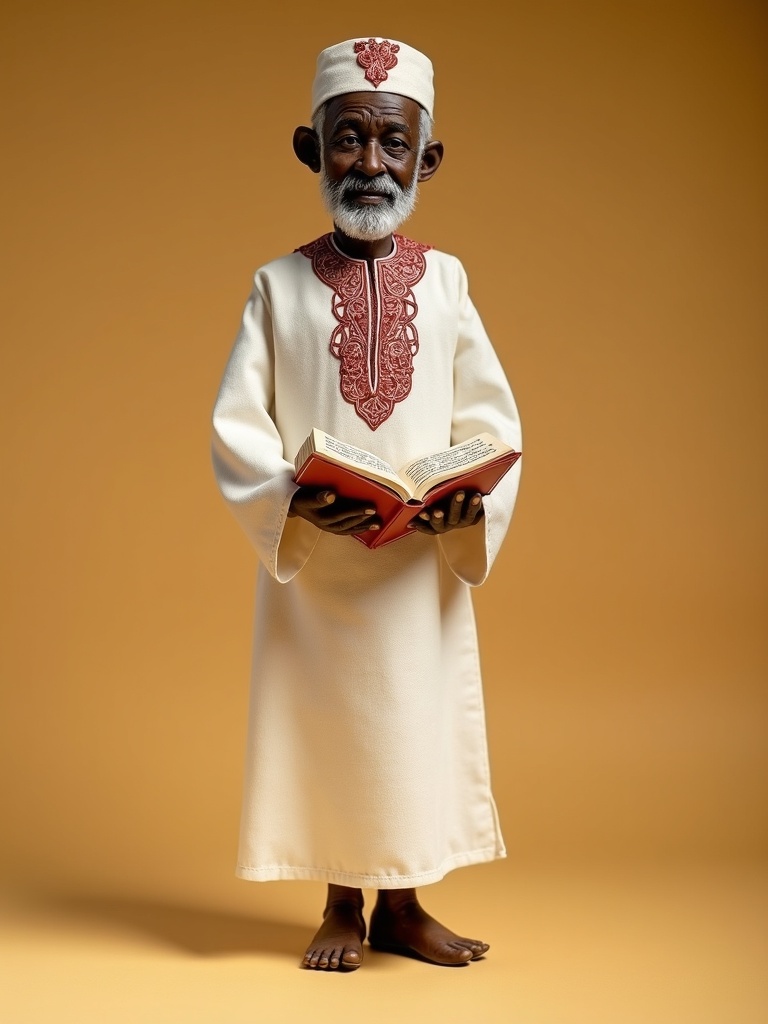
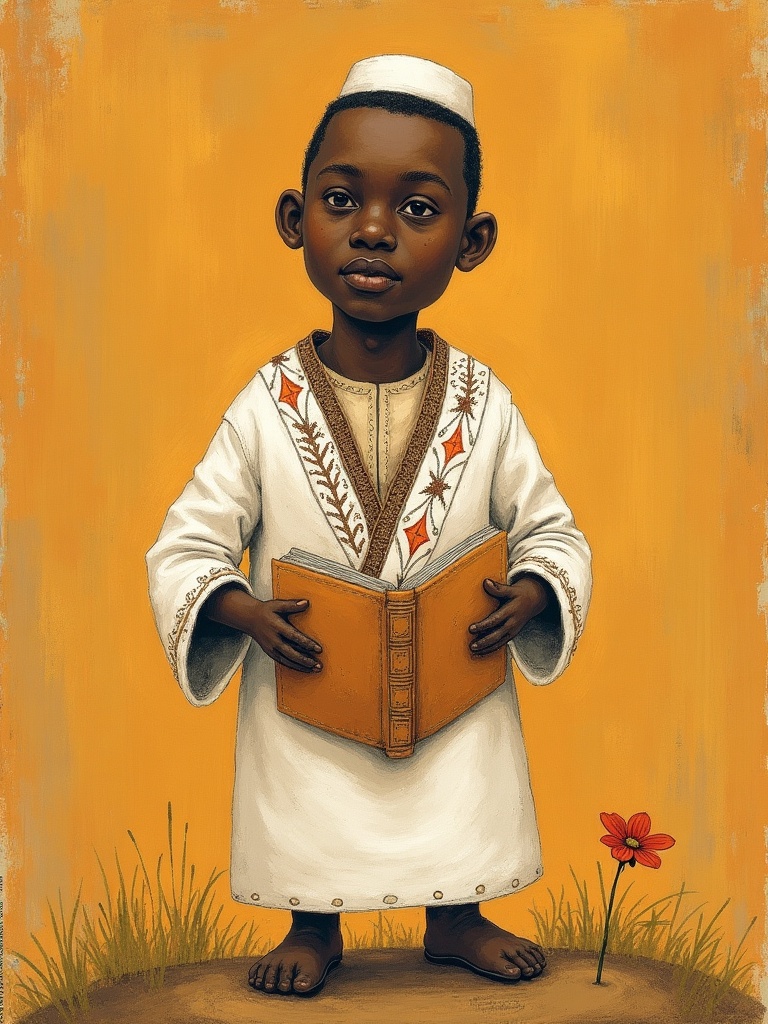
AI design preview — not a photo of the finished handmade doll
Mwalimu — Teacher & Nation-Builder
Julius Nyerere
He could have kept any title in the world, yet the one he loved was the smallest: Mwalimu — Swahili for teacher. Julius Nyerere taught a young country to read, to share a language, and to call itself a family.
- People
- Zanaki, Tanzania
- Country
- Tanzania
- Region
- East Africa
- Era
- 1922–1999
- Theme
- Mwalimu — Teacher & Nation-Builder
⚖ A respectful concept
Julius Nyerere was a real Tanzanian leader (1922–1999); this doll is a respectful homage, not an exact likeness, and uses only documented quotes with sources. His dignity is honoured throughout — including an honest naming of the mixed economic record of Ujamaa and forced villagisation alongside his genuine gains in literacy, education and Pan-African solidarity. Consent of his family and of the Tanzanian national institutions that commemorate him (Mwalimu Nyerere Day, the Mwalimu Julius K. Nyerere Foundation, the international airport and the Catholic 'Servant of God' cause) is respectfully implied. This is a draft tribute for an educational children's project, not a finished or endorsed product.
Make your own
Design your Julius Nyerere
Pick a garment, a hairstyle and a scene, enter the PIN and generate a fresh image of Julius Nyerere with AI.
⚖ AI homage concept — not a likeness of the real person.
Each image is generated live with fal.ai.
Generated images
AI design preview — not a photo of the finished handmade doll
No images generated yet — be the first.
Tradition & Origin
He could have kept any title in the world, yet the one he loved was the smallest: Mwalimu — Swahili for teacher. Julius Nyerere taught a young country to read, to share a language, and to call itself a family.
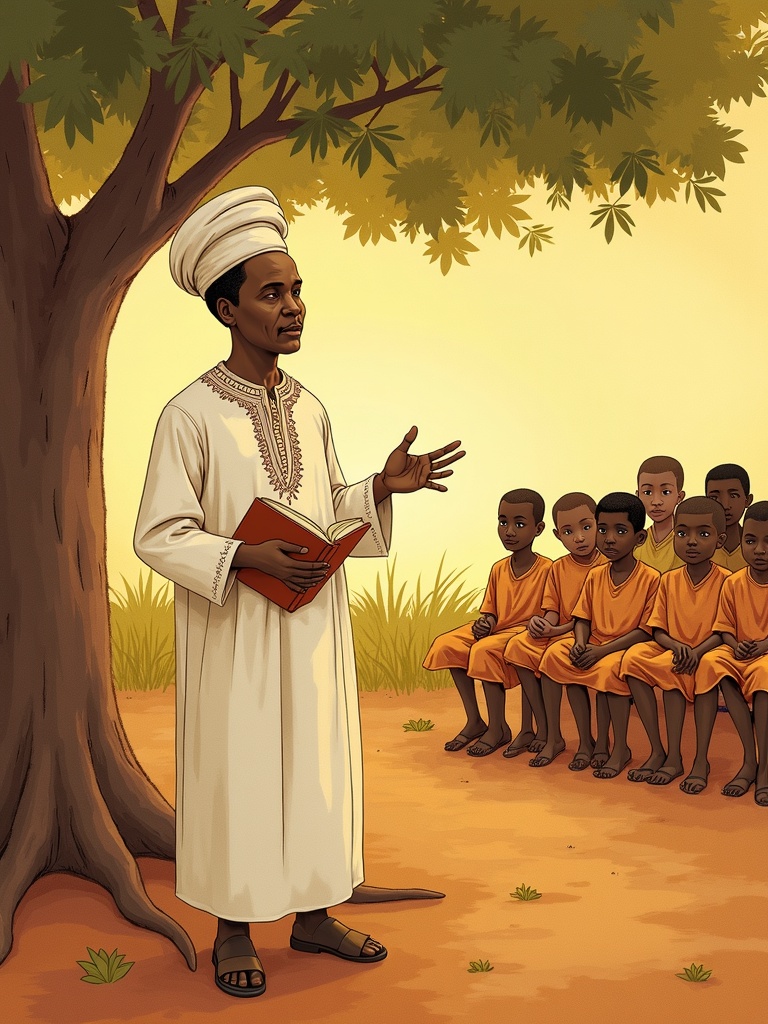
Julius Kambarage Nyerere was born on 13 April 1922 in Butiama, a village by Lake Victoria in what was then the British colony of Tanganyika. He was a son of a chief of the small Zanaki people, and his middle name, Kambarage, was drawn from a rain spirit of Zanaki tradition. He finished a four-year primary course in three years, went on to Tabora and to Makerere College in Uganda, and then to the University of Edinburgh — the first Tanganyikan ever to study at a British university. He came home not to rule but to teach biology and English, and the name stuck for life: everyone called him Mwalimu.
In 1954 he helped found TANU, and through patient, peaceful organising he led Tanganyika to independence in 1961, becoming first its prime minister and, after union with Zanzibar, the first president of Tanzania in 1964. His great idea was Ujamaa — Swahili for 'familyhood' — set out in the 1967 Arusha Declaration: an African socialism built on cooperation and self-reliance, in which a nation would care for its people the way a family cares for its own. He nationalised key industries, asked his ministers to live simply, and poured the country's energy into schools and clinics.
The honest record is mixed, and Nyerere himself came to admit it. His education and literacy campaign was a genuine triumph, admired across Africa — but the forced villagisation of the 1970s, which moved roughly eleven to thirteen million people into planned ujamaa villages, disrupted farming, productivity fell, and by the time he left office Tanzania was poor and dependent on foreign aid. What never wavered was his character: a devout, frugal man who shared a home in Tanzania with liberation movements fighting apartheid, who helped found the Organisation of African Unity, and who — to prove that an African language could carry the world's literature — sat down and translated Shakespeare into Kiswahili.
In 1985 he did the rarest thing of all: he stepped down willingly, the first African head of state to retire voluntarily, and went back to his childhood village of Butiama to garden and write. He died in London in 1999. The Catholic Church has since opened a cause for his sainthood, naming him a Servant of God — but for millions of children across East Africa he is, and always will be, simply the Teacher.
Timeline
- 1922Born 13 April in Butiama, Tanganyika, son of a Zanaki chief.
- 1954Helps found TANU, the Tanganyika African National Union.
- 1961Leads Tanganyika to independence; becomes its first prime minister.
- 1964Becomes first president of the united Republic of Tanzania.
- 1967Issues the Arusha Declaration, setting out Ujamaa and self-reliance.
- 1985Retires voluntarily — the first African head of state to do so; dies in London in 1999.
Did you know?
- Before he was president, Nyerere taught biology and English at a secondary school in Tabora — which is exactly why his people named him 'Mwalimu', the teacher.DetailsEN
- He translated Shakespeare's 'Julius Caesar' and 'The Merchant of Venice' into Kiswahili to prove that an African language could hold the world's greatest literature — and to help make Swahili Tanzania's unifying tongue.DetailsEN
- A committed Pan-Africanist, he gave a home in Tanzania to freedom movements like the ANC and FRELIMO and led the 'Front Line States' against white-minority rule in southern Africa.DetailsEN
- Once 'Ujamaa' faltered, Nyerere was honest about it — a leader who could admit failure is rare, and it is part of why he is still so respected.DetailsEN
He asked to be called not 'President' but 'Teacher' — and the best teachers are the ones brave enough to say what did not work.
Values & Capabilities
Capabilities
◆◆◆◆◆ shows how central a gift is — five diamonds mark a signature strength, fewer mark a supporting one.
A schoolteacher before he was a president, he was known all his life by the Swahili word Mwalimu — 'teacher'.
He built his idea of Tanzania on Ujamaa — Swahili for 'familyhood' — where a country looks after its people like an extended family.
In 1985 he stepped down on his own — the first African head of state to retire from power voluntarily.
He gave a home in Tanzania to freedom movements fighting apartheid and colonial rule across southern Africa.
He translated Shakespeare's plays into Kiswahili to prove that an African language could carry the world's greatest literature.
Development
1 of 6 stages unlocked
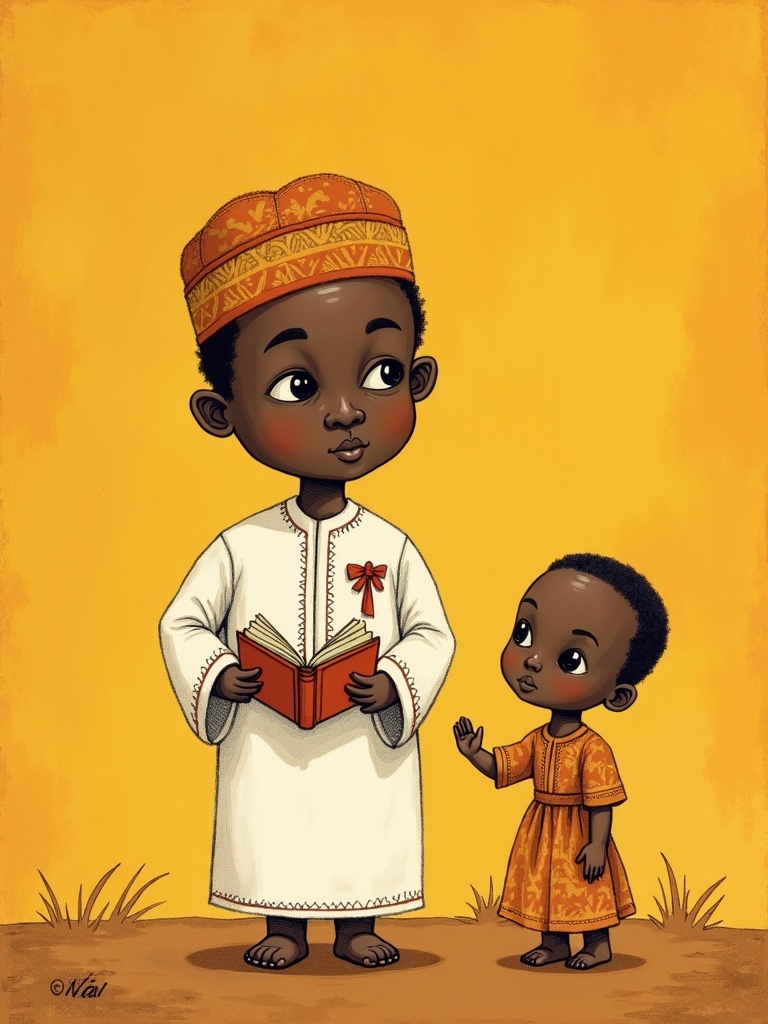
Born in 1922, a chief's son in Butiama who finished a four-year primary course in three.
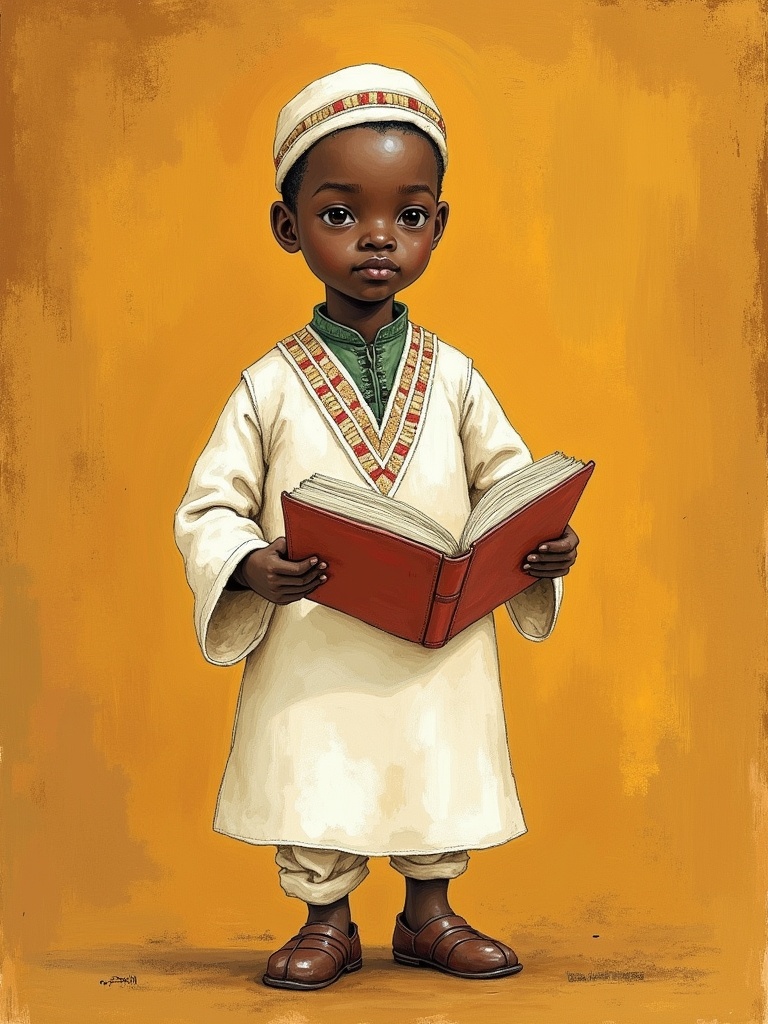
Answer all three to unlock this stage.
Unlock the previous stage first.
Unlock the previous stage first.
Unlock the previous stage first.
Unlock the previous stage first.
Crafting the doll
The doll is built around real Swahili coastal material culture: the kanzu, a long white or cream cotton robe worn by men across the East African Great Lakes coast, finished with fine maroon embroidery at the collar, chest and cuffs, and topped by the kofia — a small embroidered cap with a flat crown. As an alternative he wears the plain, unshowy presidential suit of a teacher who disliked display. His signature attribute is an open book of Kiswahili text, recalling both his profession and his Shakespeare translations, paired with a simple wooden walking stick (fimbo). An education card carries his honest story — the literacy triumph and the Ujamaa shortfalls named side by side. Sizes: Classic 32 / Kidogo 18–20 / Shule 28. A share of proceeds supports children's literacy and Kiswahili-language reading projects in Tanzania.
How this doll is made
His look is built from Swahili coastal men's dress — the long white embroidered kanzu and the kofia cap — together with the plain teacher's suit and the open Kiswahili book of his life's work.
- Garments 2
- Accessories 3
- Materials 2
- Techniques 3
Garments
Accessories
- Maroon embroidery (collar & chest)The fine maroon embroidered band around the kanzu's collar, abdomen and sleeves — the garment's signature decoration.DetailsEN
- Open Kiswahili bookA small open book of Kiswahili text, recalling Mwalimu the teacher and his Shakespeare translations into Swahili.DetailsEN
- Walking stick (fimbo)A plain wooden staff often carried by East African elders and leaders as a mark of standing.DetailsEN
Materials
Techniques
- Hand embroideryThe collar band and the kofia are worked by hand in fine stitched patterns — the slow, skilled decoration that marks formal dress.DetailsEN
- Robe tailoringThe kanzu is cut and sewn as a loose floor-length tunic with set sleeves — simple, dignified tailoring rather than fitted Western cut.DetailsEN
- Cap weaving & stitchingThe kofia's flat-crowned form is built from woven fibre or stiffened cloth, then embroidered with geometric Swahili patterns.DetailsEN
How it's made
Every doll is sewn by hand from natural materials — built to last a lifetime and to be repaired, not replaced. Here is the shopping list and the work steps. Sizes: Classic 32 cm (heirloom) · Kidogo 18–20 cm (toddlers, no small parts) · Shule 28 cm (school edition).
Shopping list
- Natural cotton or linen for the body (skin tone), ~0.5 m
- Wool or cotton stuffing — no plastic
- Cotton thread and embroidery floss in matching colours
- Garment fabric in this doll's colours (see the fabrics above)
- Yarn for the hairstyle
- Beads, cowrie shells and trims as shown
- Sharps and embroidery needles, pins, fabric scissors, fabric marker
Work instructions
- Trace and cut the body pattern at your chosen size (Classic 32 cm / Kidogo 18–20 cm / Shule 28 cm).
- Sew the body pieces right sides together, leave an opening, turn and stuff firmly with natural fibre, then close by hand.
- Embroider the face gently and with dignity — no plastic parts for the toddler line.
- Make the hair from yarn following the chosen hairstyle and attach it securely.
- Cut and sew the garment from this doll's fabric, then dress the doll.
- Add the beadwork, shells, trims and any attribute by hand.
- Check every seam and reinforce it — the doll should be lifelong and repairable, with no loose small parts for small children.
Origin & Ethics
How we know this
The documented core of this record — his Zanaki birth in 1922, Makerere and Edinburgh studies, the founding of TANU (1954), independence (1961), the presidency of Tanzania (1964–1985), the 1967 Arusha Declaration and Ujamaa, the literacy gains, the forced villagisation and its economic costs, his Pan-Africanism and the OAU, his Kiswahili Shakespeare translations, and his voluntary 1985 retirement — is well attested across multiple independent sources. The exact phrasing of some widely-circulated quotes is attributed with care. This is a respectful homage, not an exact likeness, using documented quotes only.
This figure is offered as a homage drawn entirely from public historical record — Wikipedia, the Stanford Global Shakespeare Encyclopedia, Britannica, the Mwalimu Julius K. Nyerere Foundation's own biography, and scholarly accounts of Ujamaa and Tanzanian education. As Nyerere is a recently deceased real leader who is also a Catholic 'Servant of God', the doll honours the consent of his family and of the Tanzanian national institutions that commemorate him (Mwalimu Nyerere Day, the foundation in his name, and the international airport). Only documented quotes are used, the likeness is deliberately non-exact, and the record names the mixed economic legacy of Ujamaa honestly and with dignity.
Sources
- Julius Nyerere — Wikipedia
- Mwalimu Julius Kambarage Nyerere, Biography — Mwalimu Julius K. Nyerere Foundation
- Julius Nyerere — Encyclopaedia Britannica
- Ujamaa — Wikipedia
- Nyerere, Julius — Stanford Global Shakespeare Encyclopedia
- The Arusha Declaration by Julius Nyerere, 1967 — Marxists Internet Archive
- Kanzu — Wikipedia
- National outfit of Tanzania: male kanzu and female kanga — Nationalclothing.org
- Nyerere Resignation to End 23-Year Era in East Africa — The Washington Post