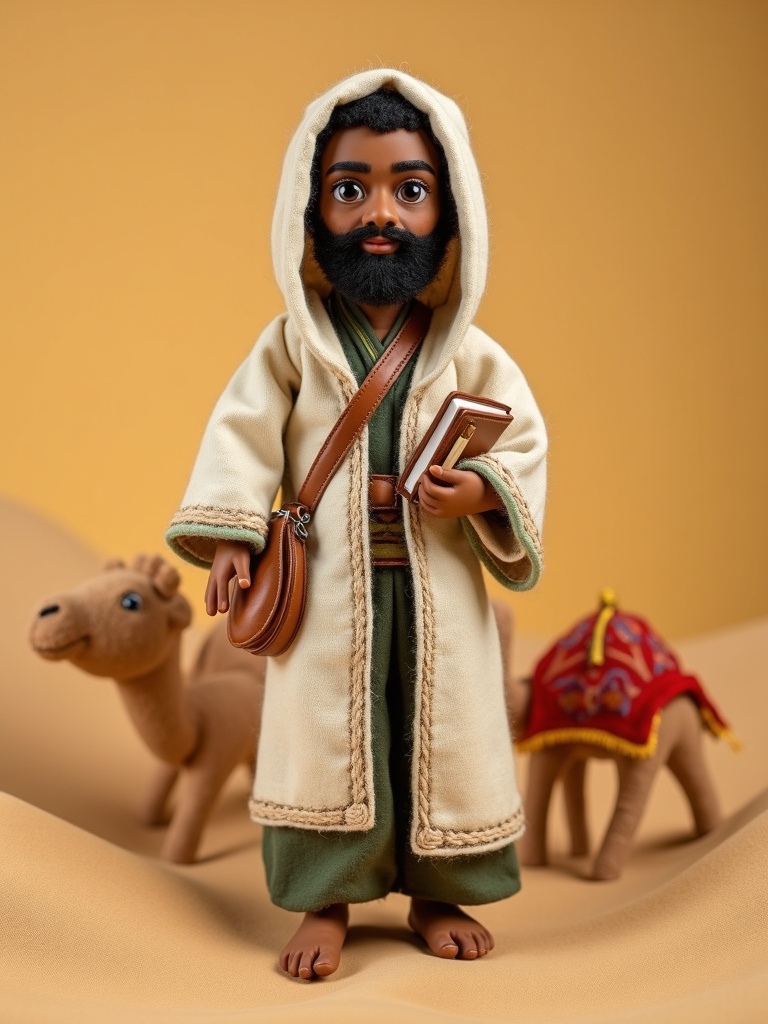
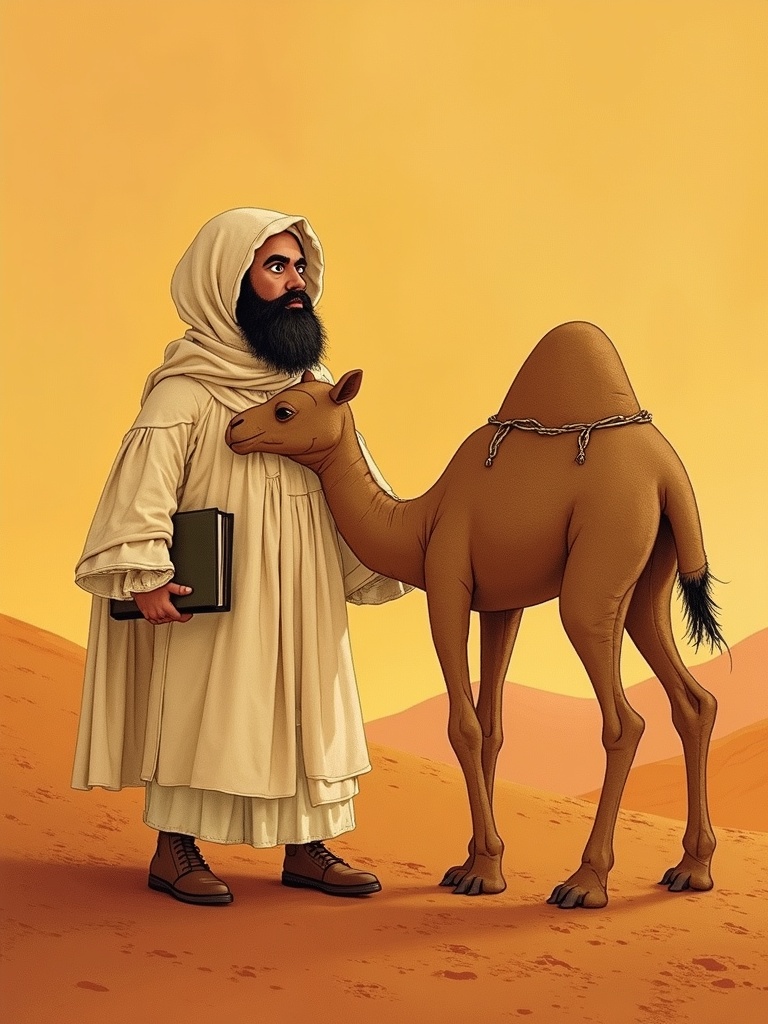
AI design preview — not a photo of the finished handmade doll
The Greatest Traveler
Ibn Battuta
At twenty-one, a young judge from Tangier left home to pray at Mecca — and kept walking for almost thirty years, until he had crossed more of the medieval world than anyone we can name.
- People
- Amazigh-Arab (Maghrebi)
- Country
- Morocco
- Region
- North Africa
- Era
- 1304–1369
- Theme
- The Greatest Traveler
Make your own
Design your Ibn Battuta
Pick a garment, a hairstyle and a scene, enter the PIN and generate a fresh image of Ibn Battuta with AI.
Each image is generated live with fal.ai.
Generated images
AI design preview — not a photo of the finished handmade doll
No images generated yet — be the first.
Tradition & Origin
At twenty-one, a young judge from Tangier left home to pray at Mecca — and kept walking for almost thirty years, until he had crossed more of the medieval world than anyone we can name.
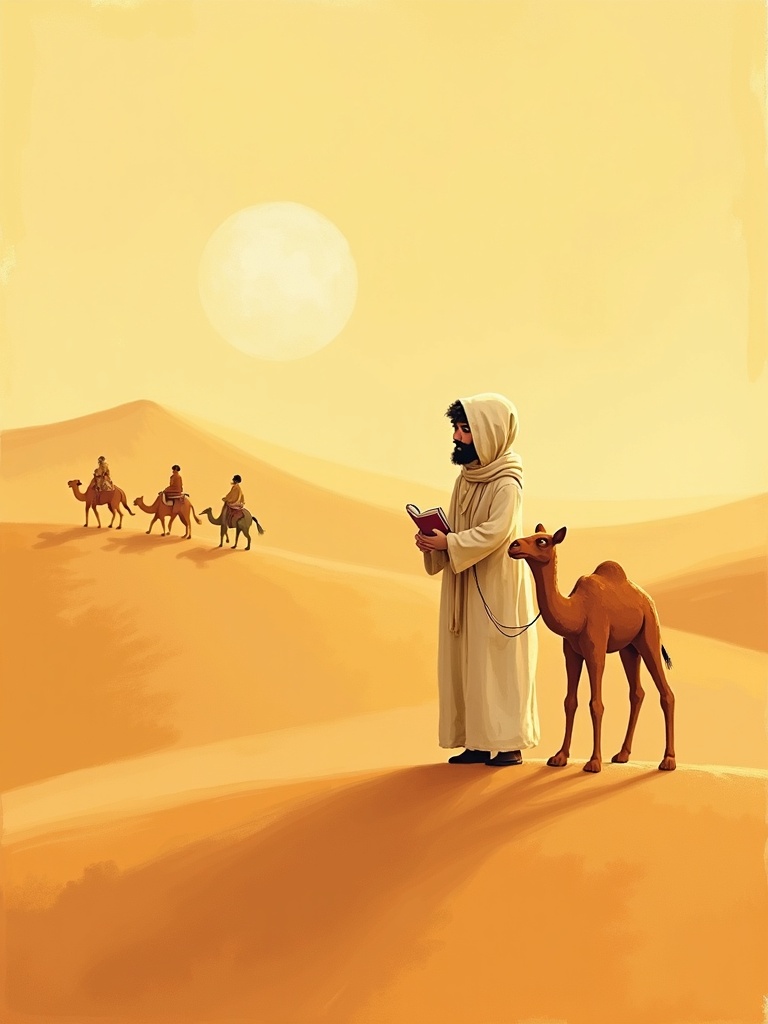
Abu Abdullah Muhammad ibn Battuta was born in Tangier, Morocco, in 1304, into an Amazigh-Arab family of Muslim legal scholars. Trained as a qadi — a Maliki judge — he set out in 1325 on the hajj to Mecca and simply never settled back down. One road led to another: Egypt, Arabia, Persia, India, the Maldives, perhaps China. By the time he came home he had travelled roughly 117,000 to 120,000 kilometres over about three decades, farther than Marco Polo. Near the end of his life the Sultan of Morocco had a scholar, Ibn Juzayy, write his memories into a book whose short name is the Rihla — 'the Journey.'
His African journeys are the heart of the story. In 1331 he sailed down the Swahili coast, describing Mogadishu — so famous for its cloth that it sold as far as Egypt — then pious Mombasa with its wooden mosques, and Kilwa, ruled by a sultan so giving he was nicknamed 'father of gifts.' Two decades later, in 1352, Ibn Battuta did something even harder: he bought camels at Sijilmasa and crossed the Sahara. After twenty-five days he reached Taghaza, a grim village whose very houses and mosque were built of blocks of rock salt, roofed with camel skin. Two months of desert later, the caravan arrived at Walata, on the edge of the Mali Empire.
In Mali he was an honest, sometimes prickly witness. At the court of Mansa Sulayman on the Niger he saw a plastered palace painted in bright patterns, court rituals where subjects threw dust over their heads, and the fabled city of Timbuktu. He grumbled that the sultan's welcome gift — bread, meat and yogurt — was beneath a traveller of his rank, and he disapproved of customs he found un-Islamic. Yet he also recorded real admiration: in Mali, he wrote, there was a 'complete security' he had rarely met — a place where neither traveller nor inhabitant feared robber or tyrant. That mix of complaint and praise is exactly why historians trust the Rihla: it reads like a real person, not a legend.
Ibn Battuta finally returned to Morocco and served once more as a judge until his death around 1369. His book did something quietly revolutionary: it put fourteenth-century African cities and empires onto the same page as Cairo, Delhi and the Silk Road — proof, in one Muslim traveller's own hand, that the Africa of his day was rich, connected, and worth the world's attention.
Timeline
- 1304Born in Tangier into an Amazigh-Arab family of Maliki legal scholars.
- 1325Sets out at twenty-one for the pilgrimage to Mecca, beginning a thirty-year journey.
- 1331Sails down the East African Swahili coast: Mogadishu, Mombasa and Kilwa.
- 1352Crosses the Sahara from Sijilmasa past the salt town of Taghaza toward Mali.
- 1352–53Visits the Mali Empire and Timbuktu at the court of Mansa Sulayman.
- ≈1369Dies in Morocco, having dictated his travels as the Rihla.
Did you know?
- At Taghaza, deep in the Sahara, the houses and even the mosque were built from carved blocks of rock salt and roofed with camel skins.DetailsEN
- Ibn Battuta praised Mali for a safety rare in his world — he wrote its people 'have a greater abhorrence of injustice than any other people.'DetailsEN
- He admired Mogadishu's cloth so much he noted it was exported all the way to Egypt, and met a Kilwa sultan nicknamed 'father of gifts' for his generosity.DetailsEN
- He never wrote a word himself — the Rihla was dictated to the scholar Ibn Juzayy on the orders of the Sultan of Morocco.DetailsEN
He went looking for the world, and brought home proof that Africa was already part of it.
Values & Capabilities
Capabilities
◆◆◆◆◆ shows how central a gift is — five diamonds mark a signature strength, fewer mark a supporting one.
He left home for the hajj at twenty-one and kept going for nearly thirty years, covering some 120,000 kilometres.
Back home, he dictated a book of his travels that still teaches us how medieval Africa and Asia really lived.
He joined a camel caravan from Sijilmasa and crossed the Sahara to reach the Mali Empire.
At the court of Mansa Sulayman he left the most detailed eyewitness picture we have of the Mali Empire at its height.
He praised Mali for a safety he had rarely seen — travellers there feared no robber and no tyrant.
Development
1 of 5 stages unlocked
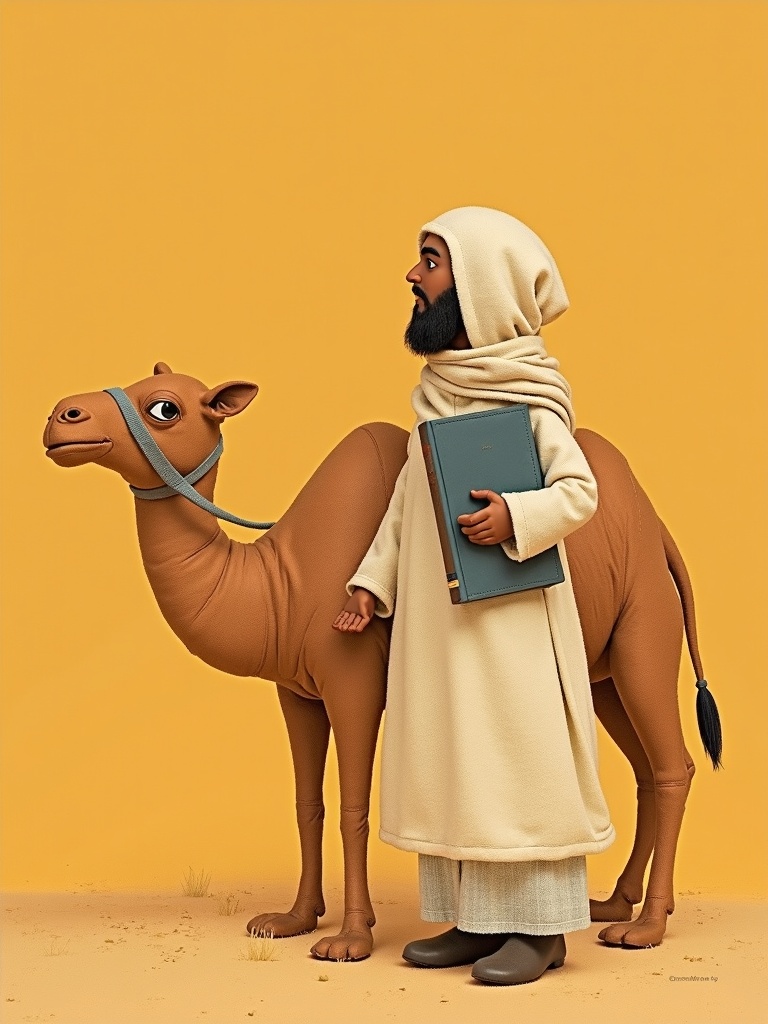
A trained Maliki qadi in Tangier sets out at twenty-one to make the pilgrimage to Mecca, meaning to come straight home.
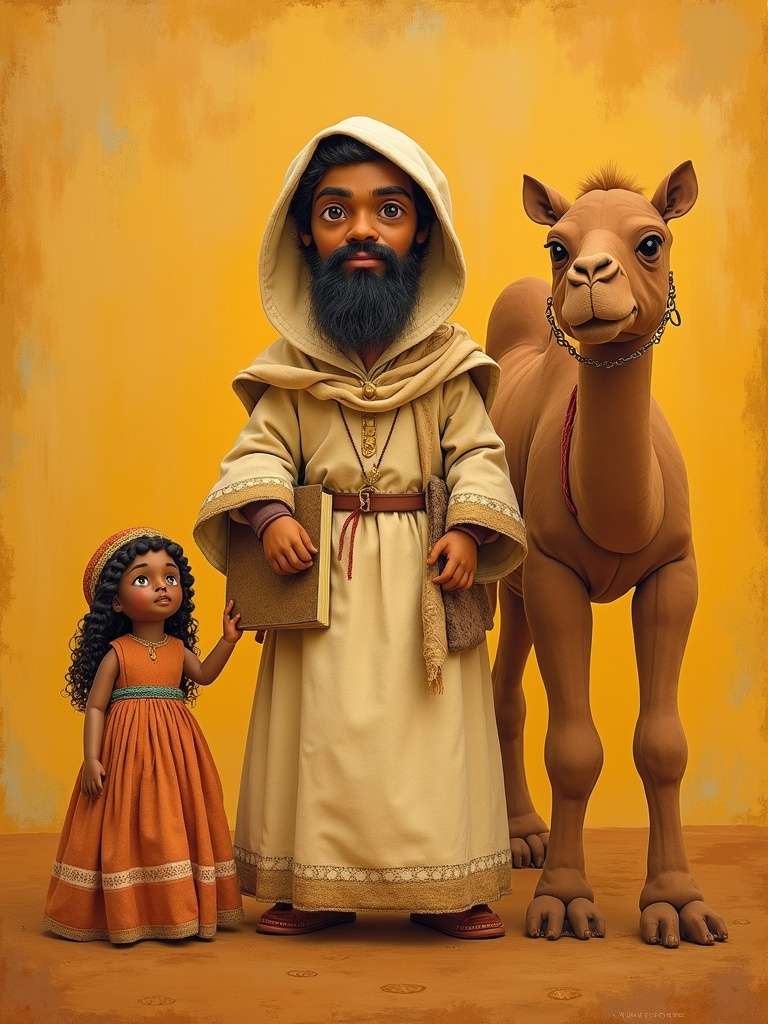
Answer all three to unlock this stage.
Unlock the previous stage first.
Unlock the previous stage first.
Unlock the previous stage first.
Crafting the doll
This doll is built from real Maghrebi cloth: a long loose djellaba of undyed cream wool with the pointed qob hood and a deep-green cotton tunic beneath, with the option of a hooded burnous wool cape for desert nights and a red felt fez with a tassel for court visits. His signature attributes are a small stitched travel journal and reed pen for the Rihla, a leather waterskin, and a little felt slab of Taghaza salt. An education card tucks into the back seam with his dates and a line on the trans-Saharan road. Sizes Classic 32 / Kidogo 18–20 / Shule 28. A share of proceeds supports African history and geography education for children.
How this doll is made
Ibn Battuta's doll wears the practical, dignified cloth of a fourteenth-century Maghrebi traveller — wool djellaba and burnous for the road, with the small props of a journal-keeping pilgrim.
- Garments 2
- Accessories 4
- Materials 1
- Techniques 3
Garments
Accessories
- Fez (tarboush)A truncated-cone red felt cap, often with a tassel, the classic Moroccan men's headdress for formal and festive dress.DetailsEN
- Babouche slippersSoft pointed leather slippers (balgha), worn by men across Morocco, often vegetable-dyed saffron yellow and crafted in Fez and Marrakech.DetailsEN
- Reed pen & travel journalA reed qalam pen and a small bound book stand for the Rihla, the record he dictated of everything he saw.DetailsEN
- Slab of Saharan saltA felt block recalling the salt mined at Taghaza from the dry lakebed in thick slabs, two to a camel, traded south for Mali's gold.DetailsEN
Materials
- Undyed sheep's woolCream and beige wool is the everyday cloth of Maghrebi outerwear, woven thick for warmth and shaped into djellabas and burnouses.DetailsEN
Techniques
- Hand-woven hood (qob)The djellaba's signature pointed hood is woven and stitched as one piece with the robe, tapering to a point at the back.DetailsEN
- Sfifa & aqad braidingMaghrebi robes are trimmed with handmade silk-cord braid (sfifa) and knotted-button fastenings (aqad) along the neck and front.DetailsEN
- Zellige star-tile motifThe studio card's eight-pointed star border borrows from Moroccan zellige mosaic tilework, a hallmark of Maghrebi craft.DetailsEN
How it's made
Every doll is sewn by hand from natural materials — built to last a lifetime and to be repaired, not replaced. Here is the shopping list and the work steps. Sizes: Classic 32 cm (heirloom) · Kidogo 18–20 cm (toddlers, no small parts) · Shule 28 cm (school edition).
Shopping list
- Natural cotton or linen for the body (skin tone), ~0.5 m
- Wool or cotton stuffing — no plastic
- Cotton thread and embroidery floss in matching colours
- Garment fabric in this doll's colours (see the fabrics above)
- Yarn for the hairstyle
- Beads, cowrie shells and trims as shown
- Sharps and embroidery needles, pins, fabric scissors, fabric marker
Work instructions
- Trace and cut the body pattern at your chosen size (Classic 32 cm / Kidogo 18–20 cm / Shule 28 cm).
- Sew the body pieces right sides together, leave an opening, turn and stuff firmly with natural fibre, then close by hand.
- Embroider the face gently and with dignity — no plastic parts for the toddler line.
- Make the hair from yarn following the chosen hairstyle and attach it securely.
- Cut and sew the garment from this doll's fabric, then dress the doll.
- Add the beadwork, shells, trims and any attribute by hand.
- Check every seam and reinforce it — the doll should be lifelong and repairable, with no loose small parts for small children.
Origin & Ethics
How we know this
Ibn Battuta is exceptionally well documented for a medieval traveller: his birth in Tangier in 1304, his roughly thirty-year journey of about 117,000–120,000 km, his 1331 Swahili-coast voyage, his 1352–53 visit to Mali under Mansa Sulayman, and the Rihla are all attested. Two honest cautions: a few episodes in the Rihla may be borrowed or embellished, as was common in the genre; and his observations carry the prejudices of a fourteenth-century scholar — he judged African customs harshly while also recording real admiration. Quotes here are from translations of the Rihla.
As an honest homage to a long-dead historical figure, this doll is offered with care for the cultures he travelled through: Moroccan and wider Maghrebi dress shown accurately, the Mali and Swahili peoples he described portrayed with dignity, and his own biases named rather than copied. History teachers, North African cultural educators and West and East African heritage partners are consulted in spirit so that both his curiosity and his blind spots are shown fairly.
Sources
- Ibn Battuta — Wikipedia
- Ibn Battuta | Biography, History, Travels & Map — Britannica
- The Travels of Ibn Battuta (the Rihla) — Wikipedia
- Across the Sahara to Mali: Ibn Battuta's never-ending trip — Daily Maverick
- Journey to Mali: 1350–1351 — ORIAS, UC Berkeley
- Ibn Battuta's Travels in Africa — Humanities LibreTexts
- Ibn Battuta in East Africa — Sacred Footsteps
- Sulayman of Mali — Wikipedia
- Djellaba — Wikipedia
- Burnous — Wikipedia