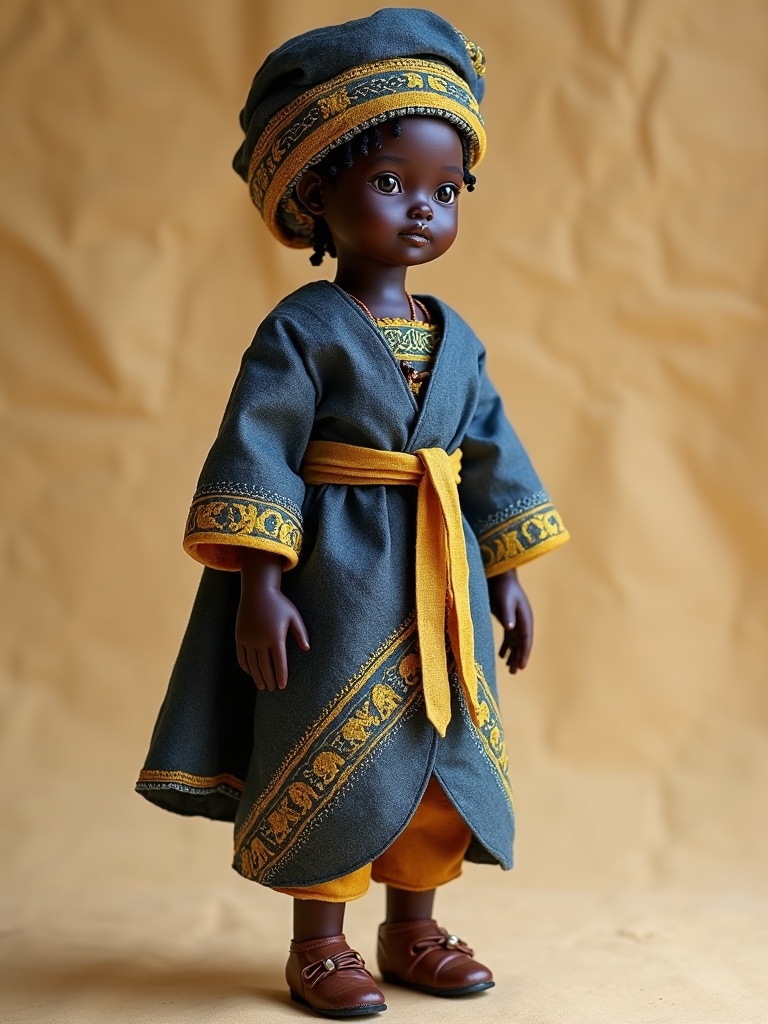
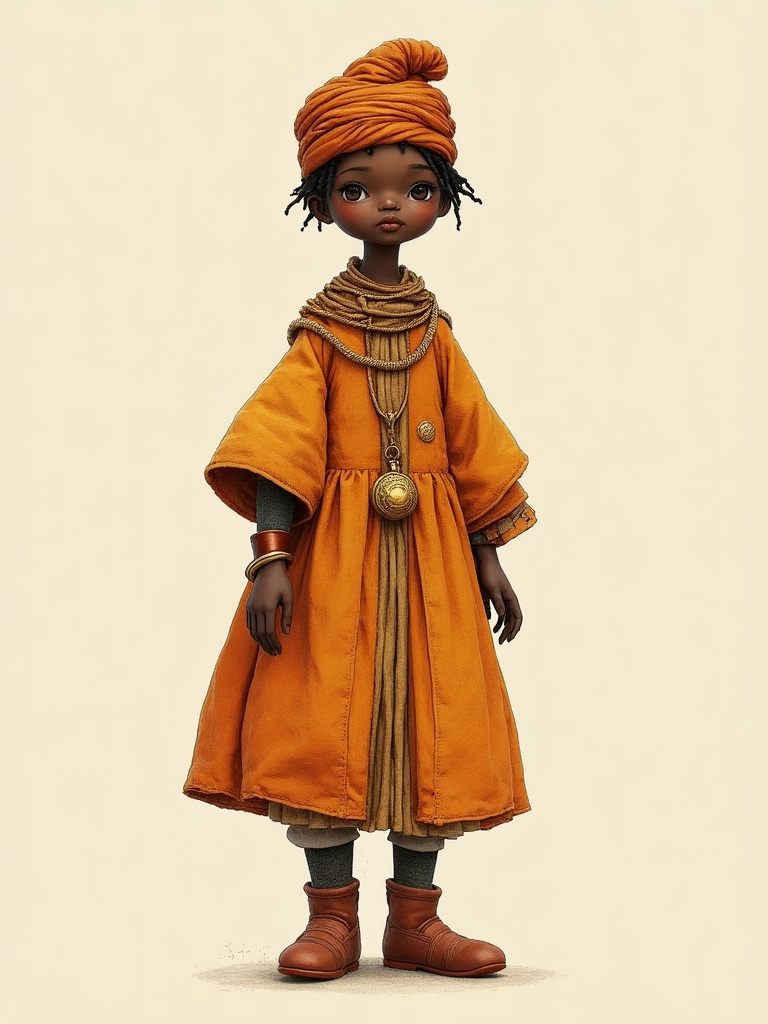
AI design preview — not a photo of the finished handmade doll
River Master · Two Faces
Sonni Ali Ber
He found Songhai a small kingdom on a bend of the Niger and left it the greatest empire in West Africa — a warrior-king the Songhai still call the magician, and the Timbuktu chronicles still call the tyrant.
- People
- Songhai
- Country
- Mali/Niger
- Region
- West Africa
- Era
- 1464–1492
- Theme
- River Master · Two Faces
Make your own
Design your Sonni Ali Ber
Pick a garment, a hairstyle and a scene, enter the PIN and generate a fresh image of Sonni Ali Ber with AI.
Each image is generated live with fal.ai.
Generated images
AI design preview — not a photo of the finished handmade doll
No images generated yet — be the first.
Tradition & Origin
He found Songhai a small kingdom on a bend of the Niger and left it the greatest empire in West Africa — a warrior-king the Songhai still call the magician, and the Timbuktu chronicles still call the tyrant.
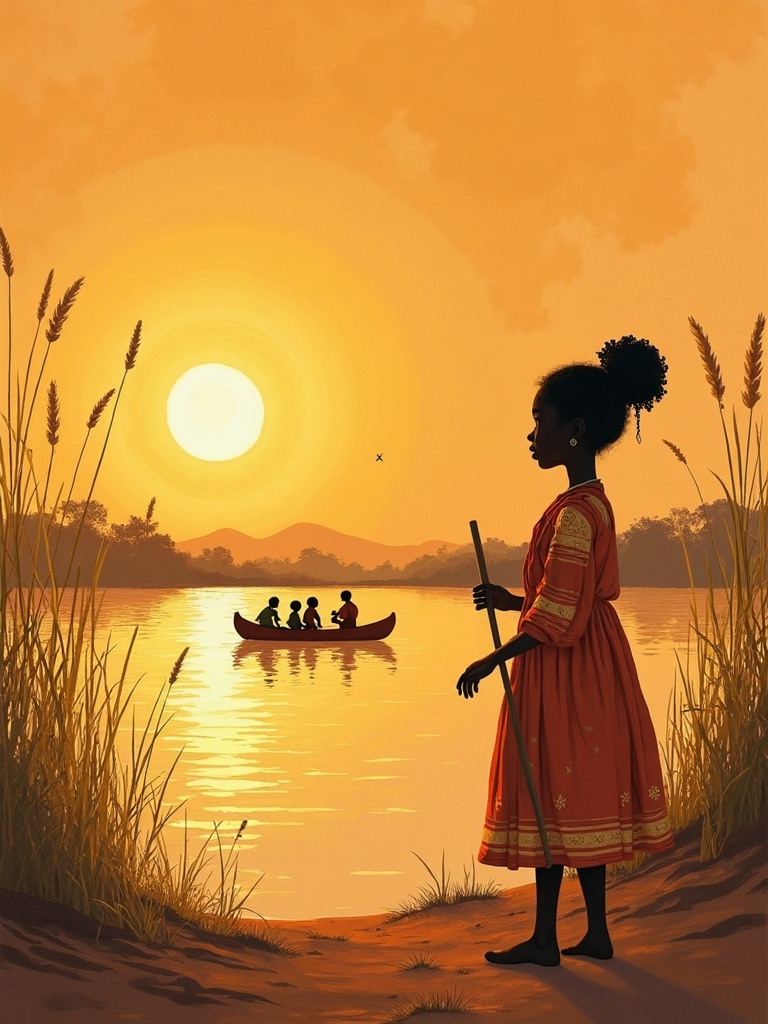
Songhai oral tradition counts 32 wars fought and 32 won — "always the conqueror, never the conquered." Remembered tradition, not contemporary record.
DetailsENWhen Sonni Ali Ber — also written Sunni Ali, or Si Ali Ber — took the throne around 1464, Songhai was little more than the trading town of Gao and its stretch of the upper Niger valley. Over a reign of some 28 years he turned it into the largest state the western Sudan had ever seen. He built an army around armoured cavalry and, uniquely, a war fleet on the Niger River — letting him move troops and lay siege along the great waterway that was the region's highway of gold, salt and grain.
His campaigns reshaped the map. In 1469 he took Timbuktu, driving out the Tuareg who had held it since the 1430s and ending Mali's grip on the legendary city of scholars. He then turned on the rich delta port of Djenné (Jenné), blockading it for years until hunger broke the defenders; the city fell around 1473. With the leading commercial cities under his control, Sonni Ali laid the economic foundation on which the Songhai Empire would flourish.
Yet his memory is fiercely contested. In Songhai oral tradition he is the founder-hero, a magician-king whose sorcery made him invincible — a ruler who, by one chronicle's count, fought thirty-two wars and won them all. But the great Arabic chronicles of Timbuktu — the Tarikh al-Sudan of al-Sadi and the Tarikh al-Fattash — remember him harshly: a cruel, capricious tyrant who persecuted the Muslim scholars (ulama) of Timbuktu. A Songhai by birth, he had an Islamic education and observed prayer, fasting and alms, yet practised a syncretic faith blending Islam with traditional African religion — and the orthodox clerics never forgave him for it. Honesty requires holding both portraits at once.
His end came in 1492. Returning from a campaign, Sonni Ali drowned crossing a river — the Niger, by the chronicles' account. His son Sonni Baru briefly succeeded him but was challenged as an unfaithful Muslim and overthrown by one of Ali's generals, who took the throne as Askia Muhammad and founded the Askia dynasty that carried Songhai to its zenith.
Timeline
- 1464Sonni Ali wird Herrscher der Songhai in Gao; Sohn einer Mutter aus traditioneller Religion, mit gemischtem Glauben.
- 1464–68Feldzüge gegen Dogon, Mossi & Fulbe; Aufbau der berühmten Niger-Kriegsflotte.
- 1468Eroberung Timbuktus — gefeiert als Befreiung von den Tuareg, zugleich Plünderung & Tötung vieler, auch Gelehrter.
- 1473Einnahme Djennés nach langer Belagerung; Kontrolle der großen Handelsstädte.
- 1483Aufgabe des riesigen Kanal-Projekts (Richtung Walata), um eine Mossi-Invasion abzuwehren.
- 1492Tod beim Überqueren eines Flusses; Askia Muhammad begründet danach eine neue Dynastie & söhnt sich mit den Gelehrten aus.
Did you know?
- Sonni Ali built the only war fleet on the Niger River, using armoured cavalry on land and ships on the water to besiege the great cities of the western Sudan.DetailsEN
- The Tarikh al-Sudan records that he died in 1492 by drowning while crossing a river on his way back from a campaign.DetailsEN
- Timbuktu he conquered was home to the Sankore University and the great mosques of Djingareyber, Sankore and Sidi Yahia — making it Islam's intellectual capital in West Africa in the 15th–16th centuries.DetailsEN
- Djenné, the delta city he starved into surrender, had been a market hub since 250 BC and one of the great centres for the spread of Islam.DetailsEN
Founder to some, tyrant to others — history rarely lets a builder be only one thing.
Values & Capabilities
Capabilities
◆◆◆◆◆ shows how central a gift is — five diamonds mark a signature strength, fewer mark a supporting one.
His greatest feat: turning a river into a road. The first systematic war fleet in West Africa. In play: whoever holds Sonni Ali moves across water to places others cannot reach.
From a small kingdom he forged the largest empire in African history. He teaches us to think on a grand scale — and to transform conquest into lasting order.
Songhai sources praise him as a brilliant administrator: provinces with governors, a newly reorganized army. He teaches that an empire must not only be conquered, but also wisely organized.
He sought to dig a canal hundreds of kilometers long to bring his fleet overland — bold engineering thinking. He teaches that great goals require a great, patient plan.
His most important "gift" for the child is not a victory, but a question: Why do different people tell his story so differently? He teaches critical thinking about sources.
Development
1 of 3 stages unlocked
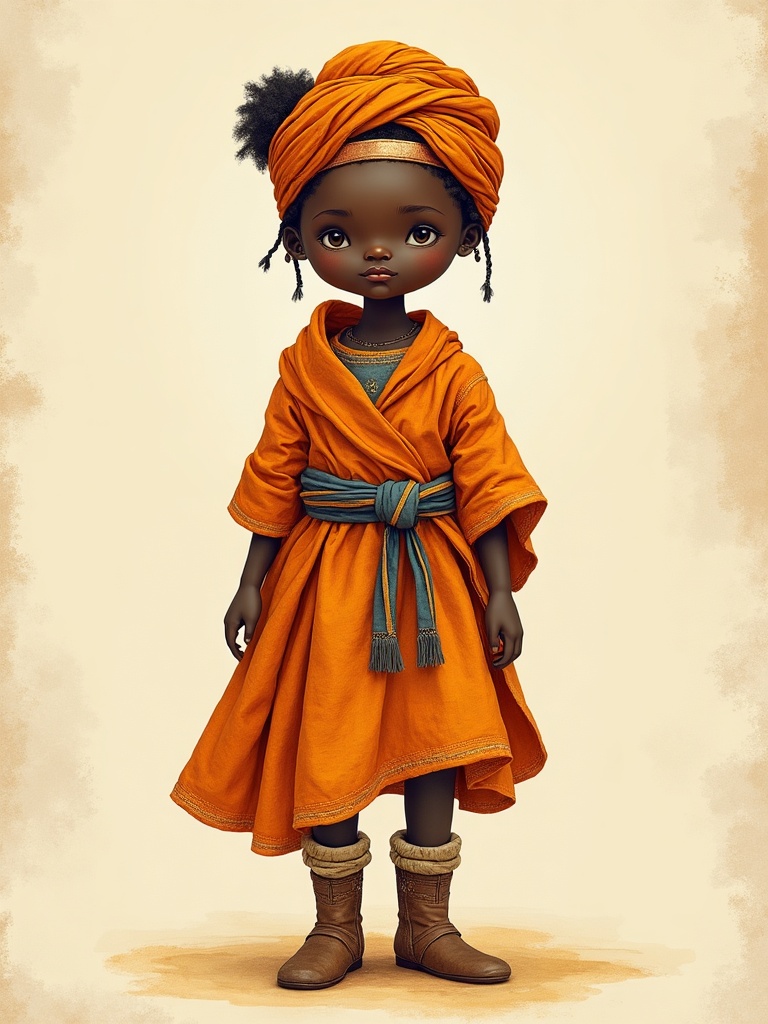
Young Ali, grown up by the great river, reading the water as others read a book — learning, observing, with a little paddle. Simple garment. Gift: Lord of the Niger (in the making).[1]
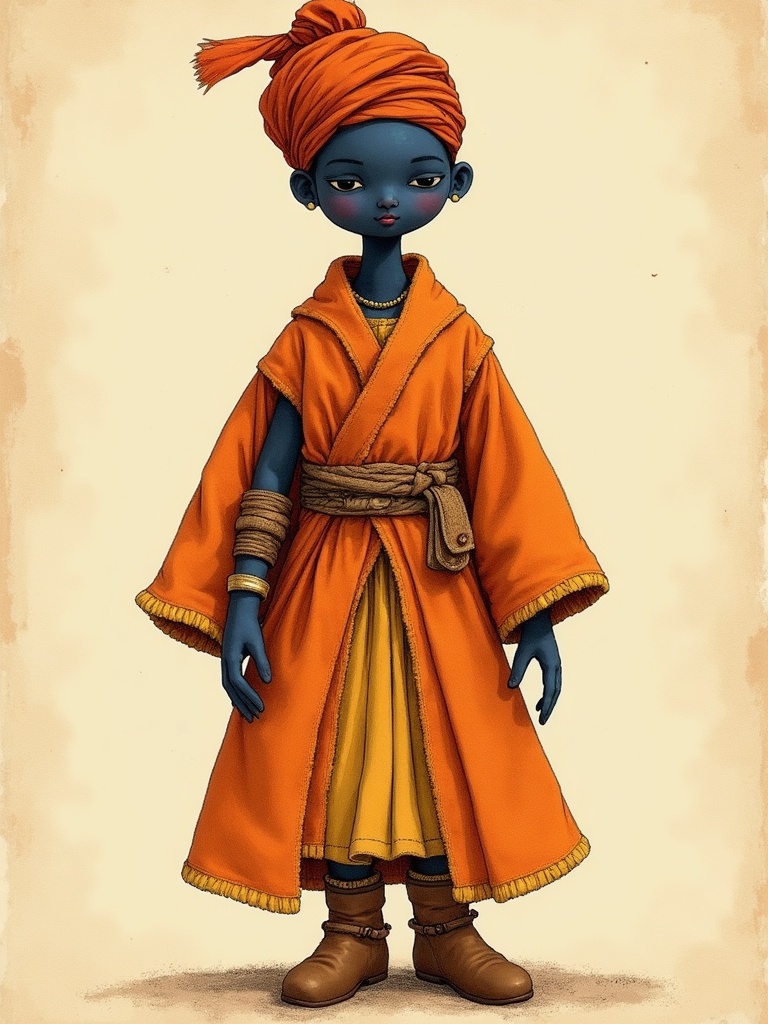
Answer all three to unlock this stage.
Unlock the previous stage first.
Crafting the doll
Fabrics & Manufacturing Notes
Real natural fibers, honest craftsmanship, lifelong repairability — and with Sonni Ali a unique attribute: a real carved mini-canoe.
The materials list
The robe: Niger indigo & Gao gold
Sonni Ali wears a ruler's robe of 100% cotton in river indigo blue and Gao gold, along with a wrapped Sahel turban and a copper bracelet. For the Admiral stage a more practical river-blue wrap robe. Ideal from Malian weaving cooperatives; indigo connects him to Amina's "blue" Hausa and Sundiata's Sahel.
The signature attribute: the canoe
His unique trademark: a small, real carved wooden canoe (pirogue) with paddle — ideally made by a carvers' cooperative on the Niger (double value creation like the Builder's soapstone bird). Optionally a felt rudder and a small felt fish eagle. No swallowable small parts in the school/toddler line; deliberately no weapons.
Signature & Education Card
Embroidered into the hem: "Sonni Ali" and the name of the seamstress. Enclosed is an Education Card, which — as the mature teaching piece of the series — places the two narratives side by side and asks: "Who wrote this down, and why?" With an age recommendation & discussion guide for parents/teachers. Optional QR thread.
Production Stages & Effort
Indigo-gold robe, turban, real mini canoe with paddle, education card with the two narratives. The "thinking doll" of the series.
Simplified robe, small wooden canoe. Affordable entry point.
Washable, reinforced seams, sturdy canoe. With a „Two Narratives" card — ideal for history & ethics lessons from middle-school level upward.
How this doll is made
Sonni Ali Ber ruled the Songhai Empire from its capital at Gao on the Niger River, a cosmopolitan market where cloth, horses, salt, iron and copper were traded. His regal look unites the flowing handwoven cotton robes and Islamic dress of the Sahel court with the equestrian and river-warrior material culture of the Songhai: quilted cavalry armour, talisman-laden tunics, tooled leather, forged iron, and the sewn pirogues of the Sorko boatmen.
- Garments 3
- Accessories 3
- Materials 2
- Techniques 3
Garments
- Grand boubou robeA flowing, wide-sleeved over-the-head robe worn by West African elites, falling to the lower leg and worn over other clothing. The grand boubou uses a large piece of handwoven cotton cloth and is the dignified ceremonial dress of a Sahel ruler.DetailsEN
- Talismanic war tunicA narrow-strip cotton tunic covered in painted Qur'anic verses, the 99 Names of God, magic squares and protective symbols, with leather-covered amulets sewn inside the upper part — made for an important warrior to wear into battle as a 'mantle of invulnerability'.DetailsEN
- Turban and Islamic court dressSonghai's royal court was Muslim from 1019; rulers and elites combined traditional West African dress with imported Islamic clothing, including the wrapped cloth turban that marked rank and piety at the Gao court.DetailsEN
Accessories
- Quilted cavalry armour (lifidi)Thick quilted cotton armour stuffed with kapok fibre, worn by the rider and draped over the horse to cover body and neck, often combined with an iron breastplate worn under the battle tunic — the protection of the Sahel heavy horseman.DetailsEN
- Leather gris-gris amuletsSmall leather-covered pouches holding folded Qur'anic verses or charms, originating in Muslim Mande communities and worn on the body or sewn to garments for protection — a hallmark of Sahel personal devotion and warrior dress.DetailsEN
- Tooled leather riding gearTuareg and Sahel leatherworkers tanned, dyed, tooled and fringed goatskin to make saddles, saddlebags and harness, working impressed and excised geometric motifs into the leather — the riding equipment of the mounted king.DetailsEN
Materials
- Handspun cotton clothCotton was hand-spun (traditionally by women) into thread; the finished narrow-strip cloth was prized and traded across the Sahel. It is the base material for the boubou, the talismanic tunic and quilted armour.DetailsEN
- Forged ironSmelted from local ore in clay furnaces and forged by hereditary numu/inadan blacksmiths into tools, weapons and breastplates; iron was both a trade good at Gao and the metal of Songhai arms and armour.DetailsEN
Techniques
- Narrow-strip weavingMen weave handspun cotton into thin bands on a double-heddle loom; the narrow strips are then sewn edge-to-edge into a larger cloth used for robes and tunics — the defining textile method of Mali and the Sahel.DetailsEN
- Leatherwork and amulet-makingLeather is tanned, dyed (indigo, pomegranate, ochre), then tooled, stamped, stitched, excised and fringed; blacksmith-caste artisans also fold and sew protective inscriptions into leather-covered amulets — the craft behind harness, pouches and gris-gris.DetailsEN
- Sewn-plank pirogue constructionSonghai/Sorko boatmen overcame timber scarcity by boring holes in small palm-wood planks and lashing them together with palm-fibre cord, then sealing the seams with bourgou-grass caulking — the river-navy craft that carried Sonni Ali's fleet on the Niger.DetailsEN
How it's made
Every doll is sewn by hand from natural materials — built to last a lifetime and to be repaired, not replaced. Here is the shopping list and the work steps. Sizes: Classic 32 cm (heirloom) · Kidogo 18–20 cm (toddlers, no small parts) · Shule 28 cm (school edition).
Shopping list
- Natural cotton or linen for the body (skin tone), ~0.5 m
- Wool or cotton stuffing — no plastic
- Cotton thread and embroidery floss in matching colours
- Garment fabric in this doll's colours (see the fabrics above)
- Yarn for the hairstyle
- Beads, cowrie shells and trims as shown
- Sharps and embroidery needles, pins, fabric scissors, fabric marker
Work instructions
- Trace and cut the body pattern at your chosen size (Classic 32 cm / Kidogo 18–20 cm / Shule 28 cm).
- Sew the body pieces right sides together, leave an opening, turn and stuff firmly with natural fibre, then close by hand.
- Embroider the face gently and with dignity — no plastic parts for the toddler line.
- Make the hair from yarn following the chosen hairstyle and attach it securely.
- Cut and sew the garment from this doll's fabric, then dress the doll.
- Add the beadwork, shells, trims and any attribute by hand.
- Check every seam and reinforce it — the doll should be lifelong and repairable, with no loose small parts for small children.
Ten Name Suggestions
The real name is preserved. These ten names — Songhai/Niger & from the Sahel — are suited to companion figures, river folk or the series around Sonni Ali. To be confirmed by Songhai/Malian authorities before use.
Lovely for the classroom: „Issa" (the river) and „Sorko" (the river people) open up the whole world of Niger river navigation — the river as the lifeline of West Africa.
Origin & Ethics
How we know this
On honesty: Sonni Ali is very well documented historically (Tarikh al-Sudan, Tarikh al-Fattash, modern research) — but his character is contested, which is why we deliberately use the grade „contested" instead of hero/villain stars. The main sources are the Timbuktu chronicles, written by the scholarly class he was in conflict with — they portray him as a cruel tyrant; the Songhai oral tradition reveres him as a great hero. Both are placed side by side here, neither smoothed over. The sacking of Timbuktu and the killing of scholars are named clearly, not glossed over — but also not loaded onto the doll as a „heroic deed"; the figure celebrates the river master & empire founder and is intended rather for older children & guided conversations. The „quote" shown about 32 wars is a paraphrase from the chronicle. Since Sonni Ali stands between Songhai pride and scholarly criticism, the final approval lies expressly with both affected communities — including the real possibility of a veto.
Elder approval & sources to watch
For no figure is approval as important as it is here. Sonni Ali is controversial: Songhai communities revere him, while the heirs of the Timbuktu scholars view him critically. Both voices must be heard — and it is conceivable that a council may reject him as a children's figure. This possibility is explicitly respected; the right of veto is real.
The approval council
The five-stage protocol
Contact via official channels — both sides: Songhai communities AND Timbuktu manuscript institutions, plus the Malian Ministry of Culture & historians. Presentation of the vision, the 42% rule, the veto right.
Hand over this compendium as a draft — especially the "two faces" framing, the non-violent depiction & the age recommendation, for review.
Both traditions are as equals heard; historians moderate the fair representation of both views.
Written approval — or a justified veto that is fully accepted. If one of the communities rejects the figure, it will not be produced.
Niger carvers (canoe) & community funds are given a share; part of the proceeds supports the preservation of the World Heritage cities of Gao & Djenné and the Timbuktu manuscripts in equal measure.
The most delicate aspect of the entire series: the fair, dual portrayal (hero AND shadow, without whitewashing and without demonization), the non-violent design of the doll, the clear age recommendation — and the honest willingness to drop the figure if the communities concerned reject it as a children's toy.
Sources to watch
Sources
- Sonni Ali, in Tarikh al-Sudan & al-Fattash as a Sonni ruler; mother from Fara (traditional religion), mixed/"unorthodox" faith; at his accession the Songhai controlled the Niger from Dendi to Mema. en.wikipedia.org: Sonni Ali.
- Reign 1464–1492, capital Gao; Songhai supplants Mali as the foremost power of West Africa; chronicle: 28 years, 32 wars, all won. worldhistory.org: Songhai Empire.
- Building of a Niger war fleet; siege of Djenné (surrender through starvation); canal project toward Walata, abandoned in 1483 because of the Mossi invasion. en.wikipedia.org: Sonni Ali.
- First ruler of West Africa to systematically deploy naval fleets on the Niger; war canoes transported the troops. encyclopedia.com: Sonni Ali.
- Navy + cavalry as a superior fighting force; conquest of Timbuktu (1468) & Djenné (1473) as hubs of the gold/trans-Saharan trade. worldhistory.org; ebsco.com: Sonni ʿAlī; study.com.
- Divided tradition: tyrant of the chronicles vs. hero of the Songhai oral tradition; conflict with the scholars due in part to his syncretic faith. worldhistory.org; britannica.com: Sonni Ali.
- Sacking of Timbuktu, killing of many inhabitants, among them scholars (scholars who had fled returned only after his death); systematic destruction over ~two years. encyclopedia.com: Sonni Ali.
- Reputation as a "cruel, capricious tyrant" above all through al-Sadi's Tarikh al-Sudan (~1656); the scholars' antipathy partly because of his unorthodox Islam. britannica.com: Sonni Ali.
- (Context: died 1492 while crossing a river; successor Askia Muhammad founds a new dynasty & reconciles with the scholars.) en.wikipedia.org: Sonni Ali; worldhistory.org.
- Remembered in Songhai oral tradition as a powerful, brilliant ruler; central administration, provinces with governors, reorganization of the army; promotion of African culture. slideshare.net: The Songhai Empire; historicalconquest.com.
- The Metropolitan Museum of Art — Robe (boubou), West Africa
- Smarthistory — Man's robe (boubou or kusaibi), Mandinka artists, on narrow-strip weaving
- The British Museum — Talismanic tunic with Qur'anic inscriptions and leather amulets, West Africa
- The Metropolitan Museum of Art — Talismanic Tunic, Mande peoples
- African History Extra — Knights of the Sahara: military horses and equestrian culture in Africa, on lifidi quilted armour
- Wikipedia — Gris-gris (talisman), Mande Muslim amulet pouches
- The Metropolitan Museum of Art — Saddle Bag, Tuareg peoples (tooled leather)
- Fowler Museum at UCLA — Art of Being Tuareg, on tanning, dyeing and tooling leather
- Wikipedia — Blacksmiths of western Africa (numu/inadan, iron smelting and forging)
- The Metropolitan Museum of Art — The Age of Iron in West Africa (essay)
- Indigenous Boats — Songhai Sewn Boat (palm-plank pirogue, palm-fibre stitching, bourgou caulking)
- South African History Online — Songhai, African Empire, 15-16th Century (Gao trade, dress, iron breastplates)
- Wikipedia — Songhai Empire (Sonni Ali, Gao capital, river navy)