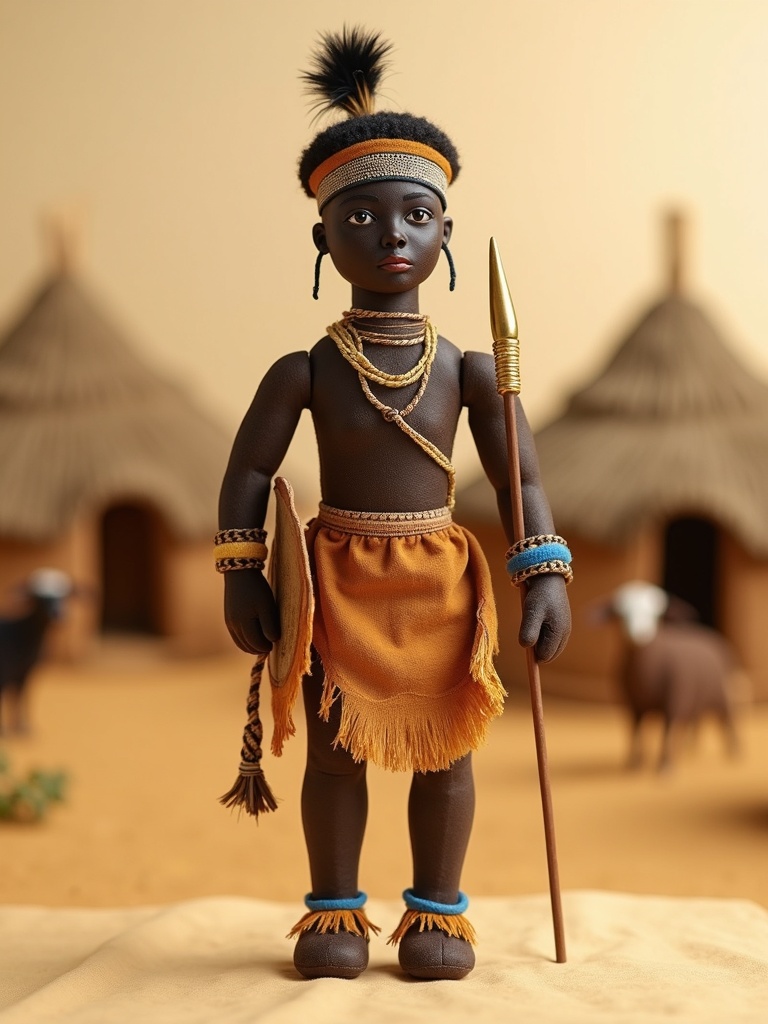
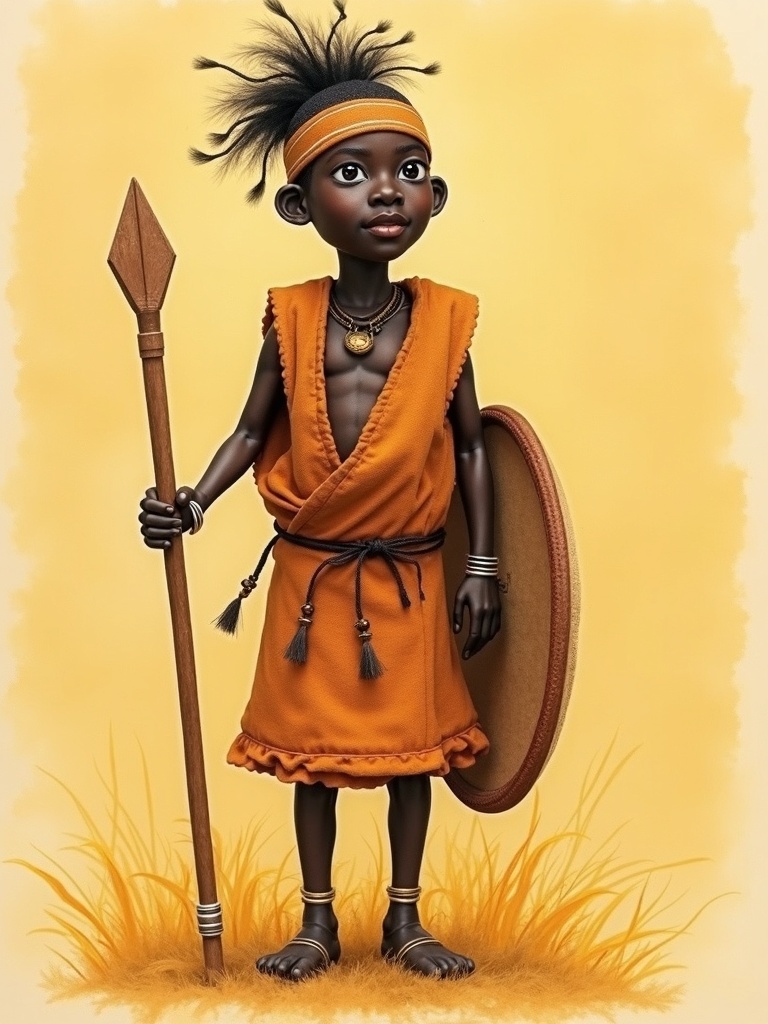
AI design preview — not a photo of the finished handmade doll
Founder of the Zulu Nation
Shaka Zulu
He began as a fatherless boy mocked by people who scorned his mother — and within barely a decade he forged the Zulu nation and rewrote the rules of war in southern Africa.
- People
- Zulu
- Country
- South Africa
- Region
- Southern Africa
- Era
- ≈1787–1828
- Theme
- Founder of the Zulu Nation
Make your own
Design your Shaka Zulu
Pick a garment, a hairstyle and a scene, enter the PIN and generate a fresh image of Shaka Zulu with AI.
Each image is generated live with fal.ai.
Generated images
AI design preview — not a photo of the finished handmade doll
No images generated yet — be the first.
Tradition & Origin
He began as a fatherless boy mocked by people who scorned his mother — and within barely a decade he forged the Zulu nation and rewrote the rules of war in southern Africa.
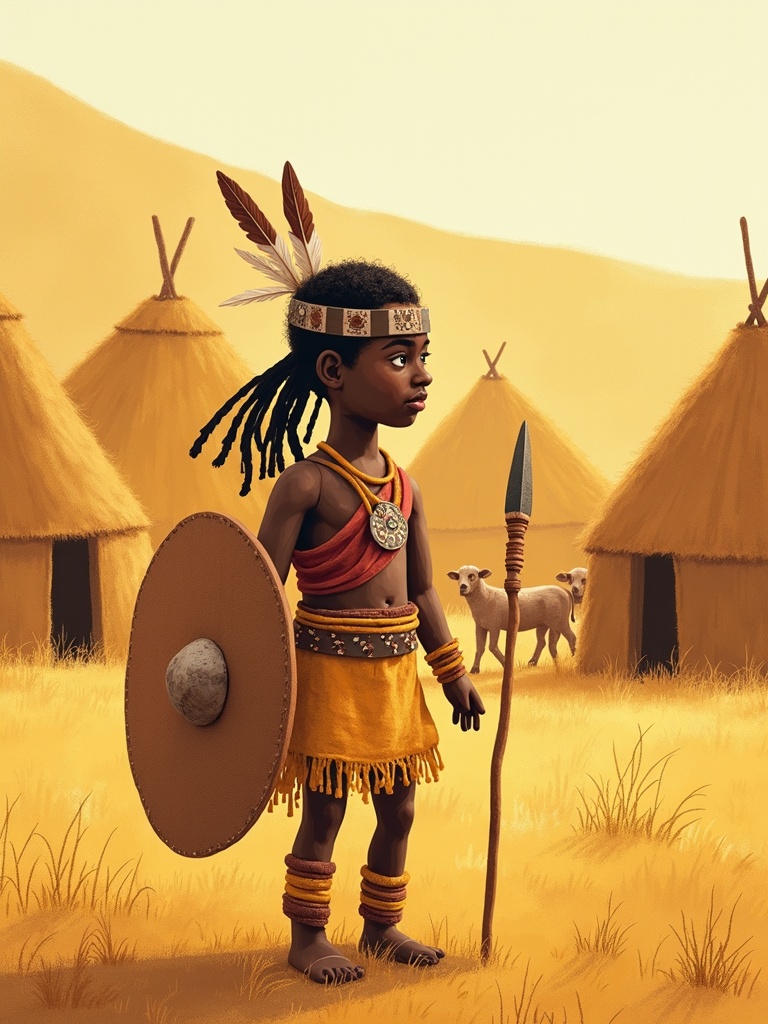
Shaka kaSenzangakhona was born around 1787, the son of the Zulu chief Senzangakhona and Nandi, a princess of the neighbouring Langeni who was treated as an outcast. By tradition, when she was found to be pregnant the elders teasingly blamed an intestinal beetle, the ishaka — and the boy carried that mocking name. He grew up despised and fatherless, and that early scorn seems to have hardened into fierce ambition.
As a young man Shaka became a celebrated warrior in the army of Dingiswayo, paramount of the powerful Mthethwa, where he learned command and tactics. Around 1816 he took over the small Zulu chiefdom and began transforming it. He is credited with the iklwa — a short stabbing spear for close combat — paired with a tall cowhide war-shield, and with drilling his men into age-regiments (amabutho) that fought in the famous 'bull horn' formation: a 'chest' to pin the enemy while two 'horns' swept around to surround them. In just over ten years more than a hundred chiefdoms were absorbed into one Zulu kingdom.
But the honest story names the cost. Shaka's rise overlapped the Mfecane — a decade of war, hunger and forced migration that scattered peoples across southern Africa. The death linked to it is fiercely disputed: estimates range from a few hundred thousand to one or two million, and historians such as Julian Cobbing have argued that later colonial and apartheid-era writers exaggerated Shaka as a lone 'monster' to excuse their own violence. When his mother Nandi died in 1827, Shaka's grief turned cruel, and the following year he was assassinated by his half-brothers Dingane and Mhlangana beside his royal barracks at Dukuza. Today he is honoured as the founder of the Zulu nation — and studied honestly, genius and harm together.
Timeline
- ≈1787Shaka is born to the Zulu chief Senzangakhona and Nandi, an outcast Langeni princess.
- ≈1810sHe becomes a celebrated warrior and commander in Dingiswayo's Mthethwa army.
- ≈1816Shaka becomes chief of the small Zulu clan and begins his reforms of weapons and tactics.
- 1816–1828He unites more than a hundred chiefdoms into one Zulu kingdom of ~250,000 people during the Mfecane upheaval.
- Oct 1827His mother Nandi dies; Shaka imposes a harsh, deadly period of mourning.
- Sept 1828He is assassinated by his half-brothers Dingane and Mhlangana; Dingane takes the throne.
Did you know?
- The iklwa spear is said to be named for the sucking sound it made when pulled back after a thrust — a short blade that forced warriors into close, decisive combat instead of throwing from a distance.DetailsEN
- Shaka colour-coded his army: veteran regiments carried mostly white cowhide shields while younger warriors carried black or patterned ones, so a commander could read the battle at a glance.DetailsEN
- He is alleged to have been assassinated while sitting on a rock near his barracks at Dukuza; that very rock still stands beside his memorial in present-day KwaDukuza.DetailsEN
- Much of what we 'know' about Shaka comes from oral tradition and from European writers with their own agendas — which is why historians still argue over his dates, his speeches and the true scale of his wars.DetailsEN
Greatness and harm can live in the same story — and growing up means being brave enough to hold both in view.
Values & Capabilities
Capabilities
◆◆◆◆◆ shows how central a gift is — five diamonds mark a signature strength, fewer mark a supporting one.
He is credited with the iklwa — a short, broad stabbing spear for close combat instead of the long throwing assegai.
His armies fought in the 'bull horn' formation — a strong chest in the centre, two horns sweeping around the flanks, and a reserve held back as the loins.
He brought more than a hundred chiefdoms together into a single Zulu kingdom that outlasted him.
He organised warriors into age-regiments (amabutho), drilled them hard, and is said to have had them march fast and barefoot to toughen them.
Mocked as a fatherless boy among people who scorned his mother, he grew into one of Africa's most famous leaders.
Development
1 of 6 stages unlocked
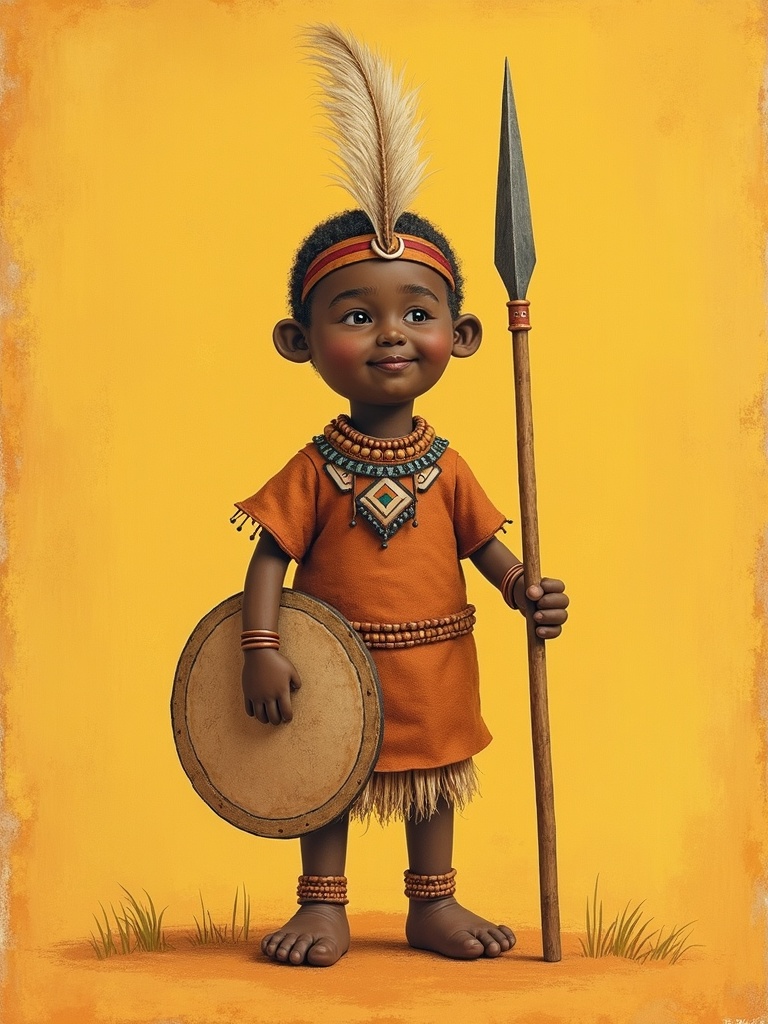
Born to an outcast mother, young Shaka grew up among people who despised her — and learned early what it is to be looked down on.
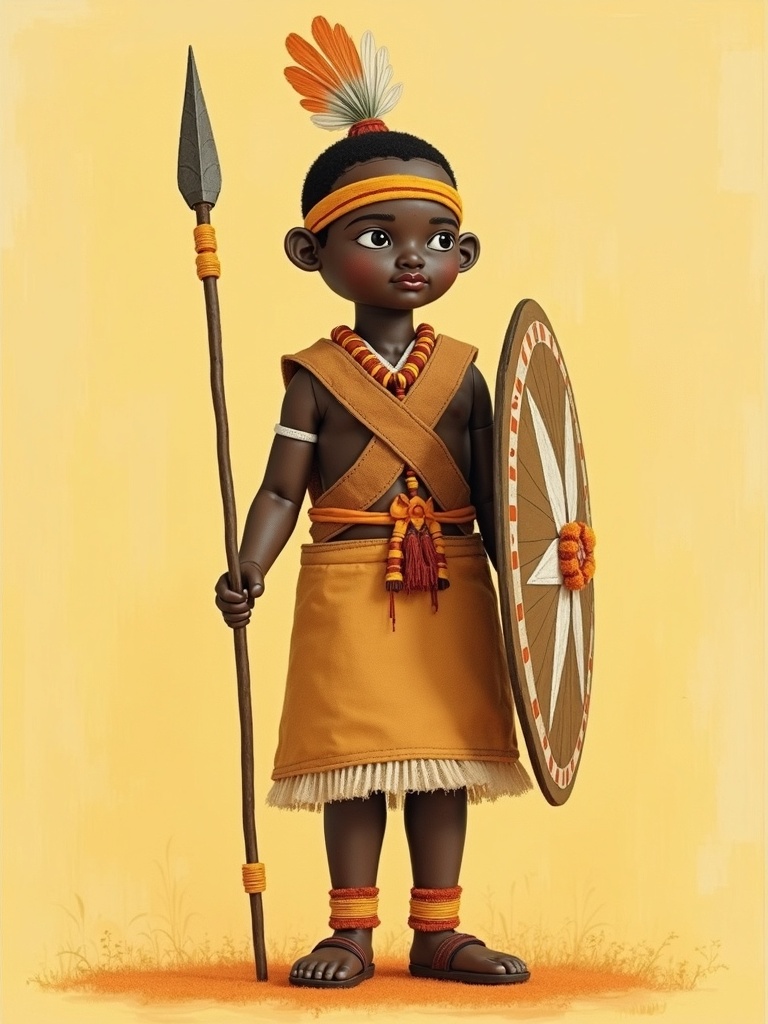
Answer all three to unlock this stage.
Unlock the previous stage first.
Unlock the previous stage first.
Unlock the previous stage first.
Unlock the previous stage first.
Crafting the doll
The doll is dressed in soft brown faux-hide for the Zulu warrior's loin-skirt (ibheshu) and aprons, with a fur headband (umqhele) crowned with black ostrich and blue-crane feathers, cow-tail tassels (amashoba) bound at the arms and knees, ringed brass armbands and small panels of bright geometric beadwork. His signature attributes are a tall oval cowhide war-shield (isihlangu) with a central staff and a short broad-bladed iklwa spear, always shown lowered and at rest — never aimed. The education card explains that Shaka founded the Zulu nation and reinvented its weapons and tactics, while naming honestly the human cost of his wars and the debate among historians. Sizes: Classic 32 / Kidogo 18–20 / Shule 28. A share of proceeds supports African heritage and history education for children.
How this doll is made
Shaka belongs to the early-19th-century Zulu world of the KwaZulu-Natal hills — a culture built around Nguni cattle, cowhide, beadwork and feathers. His doll's look is grounded in real Zulu warrior and royal regalia: the cowhide ibheshu, the feathered umqhele, cow-tail tassels, the great isihlangu shield and the iklwa spear.
- Garments 2
- Accessories 3
- Materials 2
- Techniques 3
Garments
- Ibheshu (cowhide loin-skirt)The man's rear apron of soft cattle hide worn at the waist, often with hanging hide strips in front; warriors wore plain cowhide while chiefs wore prestigious leopard skin.DetailsEN
- Umqhele (fur headband)A circular fur headband worn by married men and warriors as a crown of status, often built from rolled leopard or otter skin and topped with feathers.DetailsEN
Accessories
- Isihlangu war-shieldA large oval cowhide war-shield about 1.5 m tall, Shaka's shield of choice, with contrasting hide markings and a central wooden staff (mgobo) running down the back.DetailsEN
- Iklwa short spearA short stabbing spear with a long, broad, sword-like blade roughly 25 cm long, made for close hand-to-hand fighting rather than throwing — the weapon most associated with Shaka.DetailsEN
- Amashoba (cow-tail tassels) & beadworkBunches of white and black cow-tail hair tied around the upper arms and below the knees to make a warrior look broader and more powerful, worn with bright geometric Zulu beadwork.DetailsEN
Materials
- Nguni cowhideThe patched brown-and-white hide of long-horned Nguni cattle supplied skins for clothing and shields; a man's wealth was counted in cattle, and the herd was the centre of Zulu life.DetailsEN
- Crane and ostrich feathersTall blue-crane tail feathers and black ostrich plumes crowned the headbands of high-status men; the rare blue-crane feather was a special mark of honour.DetailsEN
Techniques
- Shield-making with laced hideThe shield is made from raw cattle hide with contrasting strips threaded through a double row of slits down the centre, then laced to a stout central staff that doubles as a grip.DetailsEN
- Beadwork as a languageZulu beadwork (ucu) is not only decoration but a code — colours and patterns send messages about status, age and love, an art passed down by the women of the homestead.DetailsEN
- Indlamu war-danceThe high-stamping indlamu dance, performed by warriors before battle and now at celebrations, drove the rhythm of regimental life; dancers stamp a raised foot down hard while feathers and cow-tails swing.DetailsEN
How it's made
Every doll is sewn by hand from natural materials — built to last a lifetime and to be repaired, not replaced. Here is the shopping list and the work steps. Sizes: Classic 32 cm (heirloom) · Kidogo 18–20 cm (toddlers, no small parts) · Shule 28 cm (school edition).
Shopping list
- Natural cotton or linen for the body (skin tone), ~0.5 m
- Wool or cotton stuffing — no plastic
- Cotton thread and embroidery floss in matching colours
- Garment fabric in this doll's colours (see the fabrics above)
- Yarn for the hairstyle
- Beads, cowrie shells and trims as shown
- Sharps and embroidery needles, pins, fabric scissors, fabric marker
Work instructions
- Trace and cut the body pattern at your chosen size (Classic 32 cm / Kidogo 18–20 cm / Shule 28 cm).
- Sew the body pieces right sides together, leave an opening, turn and stuff firmly with natural fibre, then close by hand.
- Embroider the face gently and with dignity — no plastic parts for the toddler line.
- Make the hair from yarn following the chosen hairstyle and attach it securely.
- Cut and sew the garment from this doll's fabric, then dress the doll.
- Add the beadwork, shells, trims and any attribute by hand.
- Check every seam and reinforce it — the doll should be lifelong and repairable, with no loose small parts for small children.
Origin & Ethics
How we know this
Real but partly legendary, and contested. Shaka's existence, his founding of the Zulu kingdom and his military reforms are well attested; the iklwa spear and bull-horn formation are firmly associated with him, though scholars debate how much he personally invented. Many vivid details — exact dates, speeches, death tolls and dramatic scenes — come from oral tradition and from European writers with their own purposes, and the death toll of the Mfecane (from a few hundred thousand to one or two million) is genuinely disputed. We present the documented core plainly and flag the legend and the debate as such.
Shaka is a historical figure who died in 1828, with no living person to consent, so this record is a matter of cultural and scholarly respect rather than personal permission. It follows mainstream history (Encyclopaedia Britannica, South African History Online and academic writing on the Zulu and the Mfecane) and Zulu cultural sources on dress and regalia (Ditsong Museums of South Africa, the Phansi Museum via Google Arts & Culture). It was reviewed for dignity and historical honesty — celebrating his nation-building and innovation while naming the violence of his wars plainly, and never depicting suffering or gore. Zulu heritage in dress and beadwork is shown with respect as living cultural property.
Sources
- Encyclopaedia Britannica — Shaka (Zulu chief)
- Wikipedia — Shaka
- South African History Online — Shaka Zulu
- Ditsong Museums of South Africa — Shaka Zulu's famous impondo zenkomo (the bull-horns formation)
- Wikipedia — Nguni shield (isihlangu)
- Age of Revolutions — The Zulu Iklwa: Evidence of an African Military Revolution
- Wikipedia — Impi (Zulu regiments and tactics)
- Encyclopaedia Britannica — Mfecane
- Wikipedia — Mfecane (death-toll debate, Cobbing)
- Vocal Media (History) — The Cultural Significance of Zulu Traditional Attire and Adornments
- Google Arts & Culture / Phansi Museum — Incwadi Yothando: The Secret Love Language of Beads
- Sifunda IsiZulu eMelika — Zulu names for boys and girls with their meanings