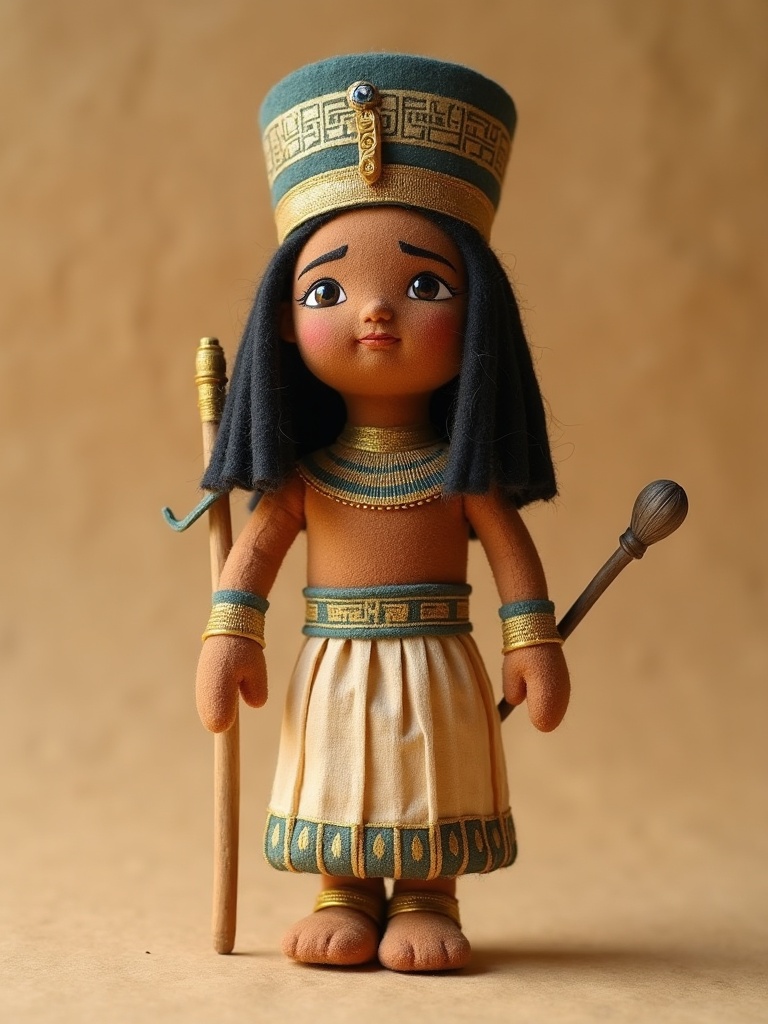
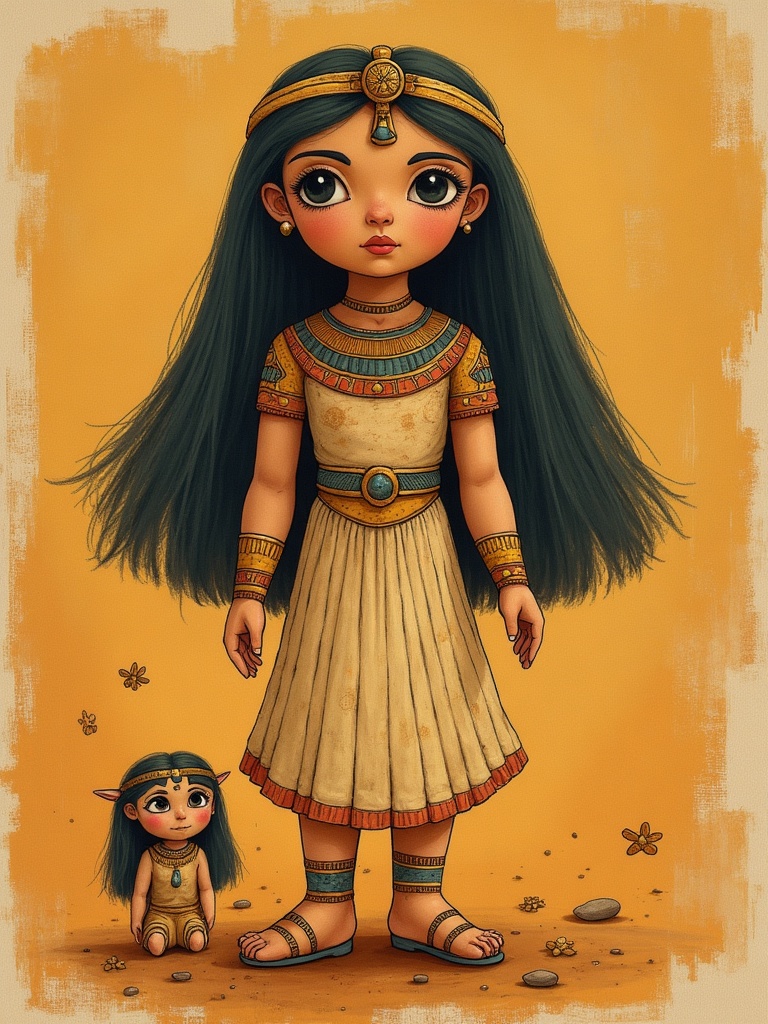
AI design preview — not a photo of the finished handmade doll
Legitimate Power & Building
Hatshepsut
The woman who became King — and built wonders that outlasted those who tried to erase her.
- People
- Ancient Egypt (Kemet)
- Country
- Egypt
- Region
- North Africa
- Era
- ≈1479–1458 BCE
- Theme
- Legitimate Power & Building
Make your own
Design your Hatshepsut
Pick a garment, a hairstyle and a scene, enter the PIN and generate a fresh image of Hatshepsut with AI.
Each image is generated live with fal.ai.
Generated images
AI design preview — not a photo of the finished handmade doll
No images generated yet — be the first.
Tradition & Origin
The woman who became King — and built wonders that outlasted those who tried to erase her.
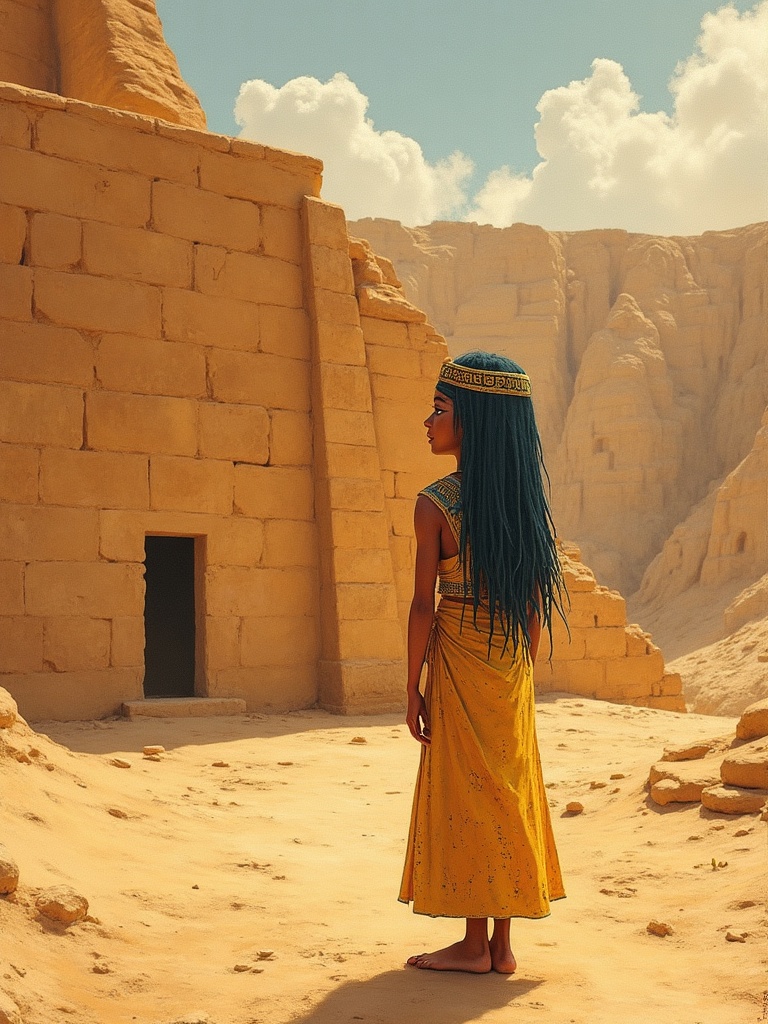
Reign length of ancient Egypt’s female pharaohs (years).
DetailsENHatshepsut was the daughter of Pharaoh Thutmose I. After her husband died she first ruled as regent for her infant stepson — then took the full power and titles of a pharaoh in her own right, as Maatkare Hatshepsut, one of the very few women ever to do so.
Hers was a reign of peace and prosperity rather than war. She raised the great terraced temple of Deir el-Bahari, erected four giant granite obelisks at Karnak, and sent a celebrated trading expedition to the Land of Punt that returned with myrrh, gold, ebony and living incense trees.
After her death her successor Thutmose III had her images chiselled from the walls — an early attempt to erase a powerful woman from history. Archaeology restored her name only in the 19th and 20th centuries.
Timeline
- ≈1507 BCEborn, daughter of Thutmose I
- ≈1479regent for the infant Thutmose III
- ≈1473declares herself Pharaoh (Maatkare)
- Years 8–9the peaceful expedition to Punt
- ≈1458dies; later Thutmose III erases her images
- 1822 / 1903deciphered & tomb found — legacy restored
Did you know?
They chiselled her name from the walls. Three thousand years later, we read it again.
Values & Capabilities
Capabilities
◆◆◆◆◆ shows how central a gift is — five diamonds mark a signature strength, fewer mark a supporting one.
She claimed the highest office in a world that reserved it for men, and held it for two decades.
Deir el-Bahari and the Karnak obelisks — beauty that lasted millennia.
The expedition to Punt enriched Egypt without war.
She wove her divine-birth story into her temple to legitimise her rule.
Erased by her successor, remembered anyway.
Development
1 of 3 stages unlocked
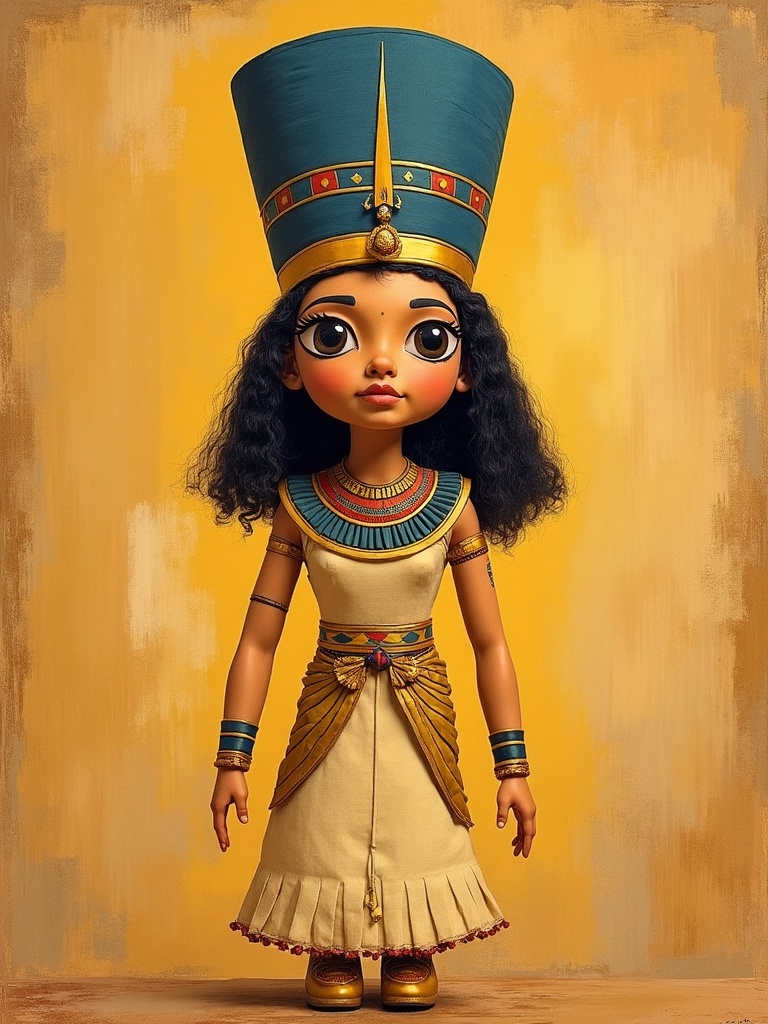
Young Hatshepsut at her father's court in Thebes, learning the rites of kingship.
Answer all three to unlock this stage.
Unlock the previous stage first.
Crafting the doll
Garment: 100% white pleated linen/cotton, a broad collar beaded in gold and lapis-blue, the nemes in striped blue-and-gold. Signature attribute: a tiny gilded obelisk and the crook & flail (felt). Education card: explains that Egypt is part of Africa and that powerful women were written out of history — and restored. Sizes Classic 32 / Kidogo 18–20 / Shule 28. Part of proceeds → Egyptian heritage / Deir el-Bahari conservation.
How this doll is made
As a female pharaoh of Egypt's 18th Dynasty, Hatshepsut was portrayed in the full regalia of an ideal king — the striped nemes headcloth with rearing uraeus, ceremonial false beard, and shendyt kilt — rendered in the New Kingdom's signature materials of fine pleated linen, gold and electrum, blue-green faience, and inlaid carnelian, turquoise, and lapis lazuli.
- Garments 2
- Accessories 4
- Materials 2
- Techniques 3
Garments
- Shendyt kiltThe pleated linen wrap-kilt with a stiff triangular front panel that was core royal attire; Hatshepsut's Deir el-Bahri statues show her in the nemes-headcloth and shendyt-kilt, the ceremonial dress of a king.DetailsEN
- Pleated linen kalasirisA close-fitting sheath/long tunic of sheer linen worn by elite women; the finest 'royal linen' was woven almost transparent and covered in fine accordion pleats that shimmered with movement.DetailsEN
Accessories
- Nemes headcloth & uraeusThe blue-and-gold striped royal head-cloth gathered at the nape, fronted by the uraeus — a rearing cobra symbolizing royalty and divine protection that spat fire at the king's enemies.DetailsEN
- Ceremonial false beardThe plaited, slightly upturned divine beard strapped to the chin as part of the king's regalia; Hatshepsut's sphinx and statues show the false beard worn with the nemes to project ideal kingship.DetailsEN
- Wesekh broad collarA wide curved collar of tubular and teardrop beads in rows, finished with terminals and sometimes a back counterweight; made of faience, glass, stone or metal beads strung on linen thread.DetailsEN
- Crook and flailThe heka (shepherd's crook = kingship) and nekhakha (beaded flail = the land's bounty), held crossed over the chest; royal examples used striped blue glass, obsidian and gold over a metal core with gilded-wood beads.DetailsEN
Materials
- Egyptian faienceA self-glazing quartz-based ceramic (crushed quartz/sand + lime + alkali) glazed blue-green by copper to imitate turquoise and lapis; the signature blue-green color of beads, collars and amulets.DetailsEN
- Gold, electrum & inlay stonesGold and electrum (a natural gold-silver alloy) formed the royal metalwork, set with the favored Egyptian triad of carnelian (red), turquoise (blue-green) and lapis lazuli (deep blue).DetailsEN
Techniques
- Linen weaving & pleatingFlax was pulled, retted, hackled and spun on drop spindles, then woven on upright New Kingdom looms; pleats were pressed into damp linen on grooved wooden boards so the dried fibers held the folds.DetailsEN
- Faience glazingThree methods produced the glaze: efflorescence (alkali salts migrate to the surface and fuse on firing), application (a silica-lime-alkali slurry brushed/dipped on), and cementation (the object fired buried in glazing powder).DetailsEN
- Goldsmithing: granulation & cloisonnéGoldsmiths joined tiny gold granules and wires by colloidal hard-soldering, and built cloisonné — thin gold wire cells filled with cut carnelian, turquoise and lapis (or colored glass paste) — for collars and pectorals.DetailsEN
How it's made
Every doll is sewn by hand from natural materials — built to last a lifetime and to be repaired, not replaced. Here is the shopping list and the work steps. Sizes: Classic 32 cm (heirloom) · Kidogo 18–20 cm (toddlers, no small parts) · Shule 28 cm (school edition).
Shopping list
- Natural cotton or linen for the body (skin tone), ~0.5 m
- Wool or cotton stuffing — no plastic
- Cotton thread and embroidery floss in matching colours
- Garment fabric in this doll's colours (see the fabrics above)
- Yarn for the hairstyle
- Beads, cowrie shells and trims as shown
- Sharps and embroidery needles, pins, fabric scissors, fabric marker
Work instructions
- Trace and cut the body pattern at your chosen size (Classic 32 cm / Kidogo 18–20 cm / Shule 28 cm).
- Sew the body pieces right sides together, leave an opening, turn and stuff firmly with natural fibre, then close by hand.
- Embroider the face gently and with dignity — no plastic parts for the toddler line.
- Make the hair from yarn following the chosen hairstyle and attach it securely.
- Cut and sew the garment from this doll's fabric, then dress the doll.
- Add the beadwork, shells, trims and any attribute by hand.
- Check every seam and reinforce it — the doll should be lifelong and repairable, with no loose small parts for small children.
Origin & Ethics
How we know this
On honesty: very well documented (monuments, reliefs, her tomb KV20). The “divine birth” is royal propaganda, shown as such; the false beard is historical kingship iconography, presented with dignity; we emphasise that Egypt / Kemet is African heritage.
Committee: Egyptian Ministry of Tourism & Antiquities; Egyptology scholars; museums (Deir el-Bahari / Karnak). 5-step protocol as standard; respect sacred and funerary iconography.
Sources
- Britannica — Hatshepsut
- Facts and Details — Hatshepsut
- History.com — Hatshepsut
- Madain Project — Hatshepsut
- Met Museum — Large Kneeling Statue of Hatshepsut (nemes, false beard, shendyt)
- Met Museum — Seated Statue of Hatshepsut
- Met Museum — Sphinx of Hatshepsut (nemes + false beard)
- Met Museum — Egyptian Faience: Technology and Production
- Met Museum — Gold in Ancient Egypt (electrum, granulation, wirework)
- Met Museum — Turquoise in Ancient Egypt (cloisonné inlay, color triad)
- Met Museum — Broad Collar of Wah (wesekh construction)
- Met Museum — Broad Collar, Amarna Period faience beads
- Wikipedia — Usekh collar (broad collar form, beads, materials)
- Wikipedia — Egyptian faience (composition, glazing methods)
- Wikipedia — Crook and flail (heka, nekhakha, materials, symbolism)
- The Archaeologist — Ancient Egyptian Linen: Weaving in the New Kingdom
- World History Encyclopedia — The Statuary of Maatkare Hatshepsut
- Museum of Fine Arts, Boston — Wesekh broadcollar