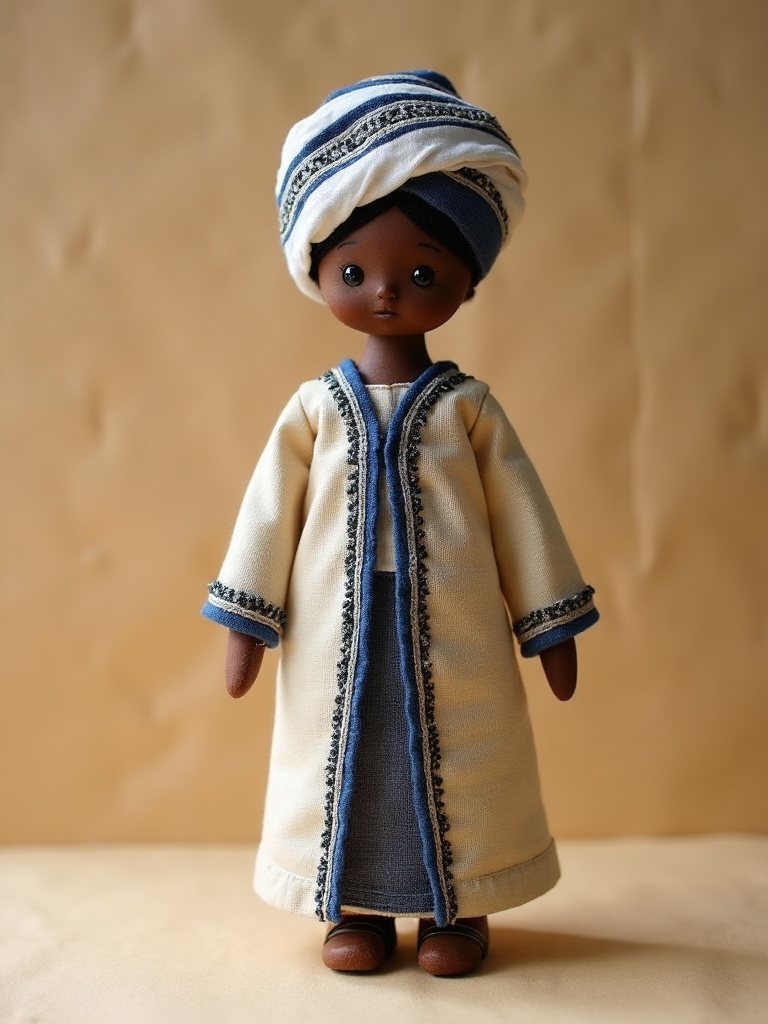
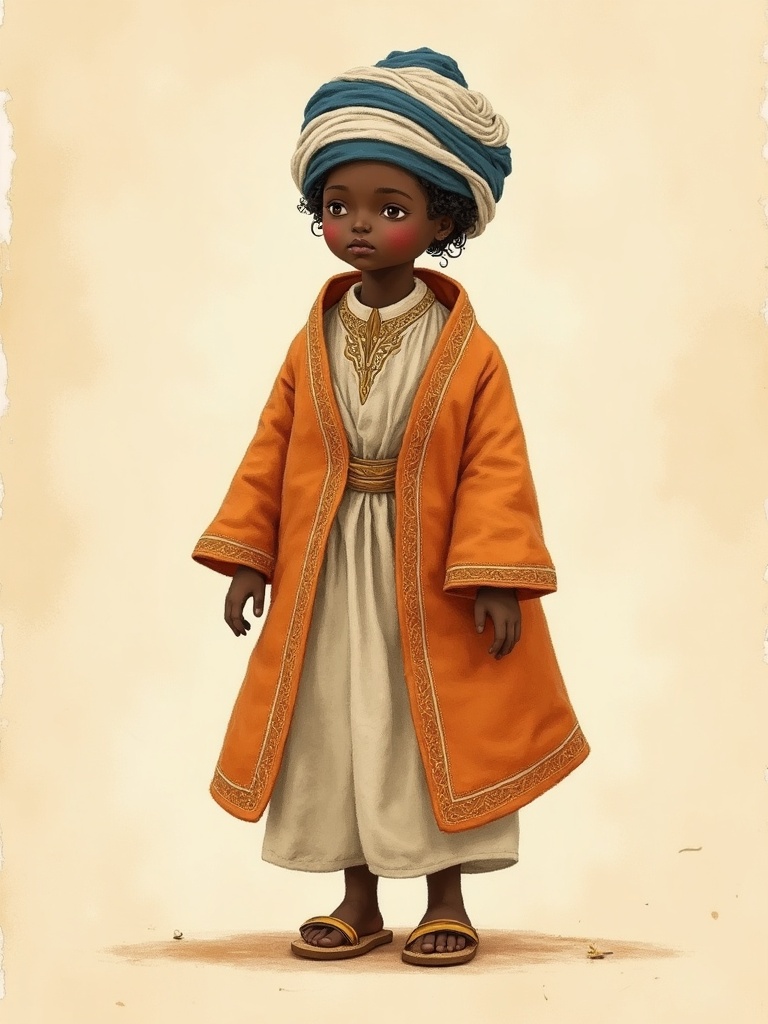
AI design preview — not a photo of the finished handmade doll
Intellectual Courage
Ahmad Baba
In Timbuktu, where the desert met the world's most prized commodity — books — Ahmad Baba al-Massufi wrote more than forty works and became the city's greatest scholar. When a foreign army carried him off in chains, he kept teaching anyway.
- People
- Songhai/Timbuktu
- Country
- Mali
- Region
- West Africa
- Era
- 1556–1627
- Theme
- Intellectual Courage
Make your own
Design your Ahmad Baba
Pick a garment, a hairstyle and a scene, enter the PIN and generate a fresh image of Ahmad Baba with AI.
Each image is generated live with fal.ai.
Generated images
AI design preview — not a photo of the finished handmade doll
No images generated yet — be the first.
Tradition & Origin
In Timbuktu, where the desert met the world's most prized commodity — books — Ahmad Baba al-Massufi wrote more than forty works and became the city's greatest scholar. When a foreign army carried him off in chains, he kept teaching anyway.
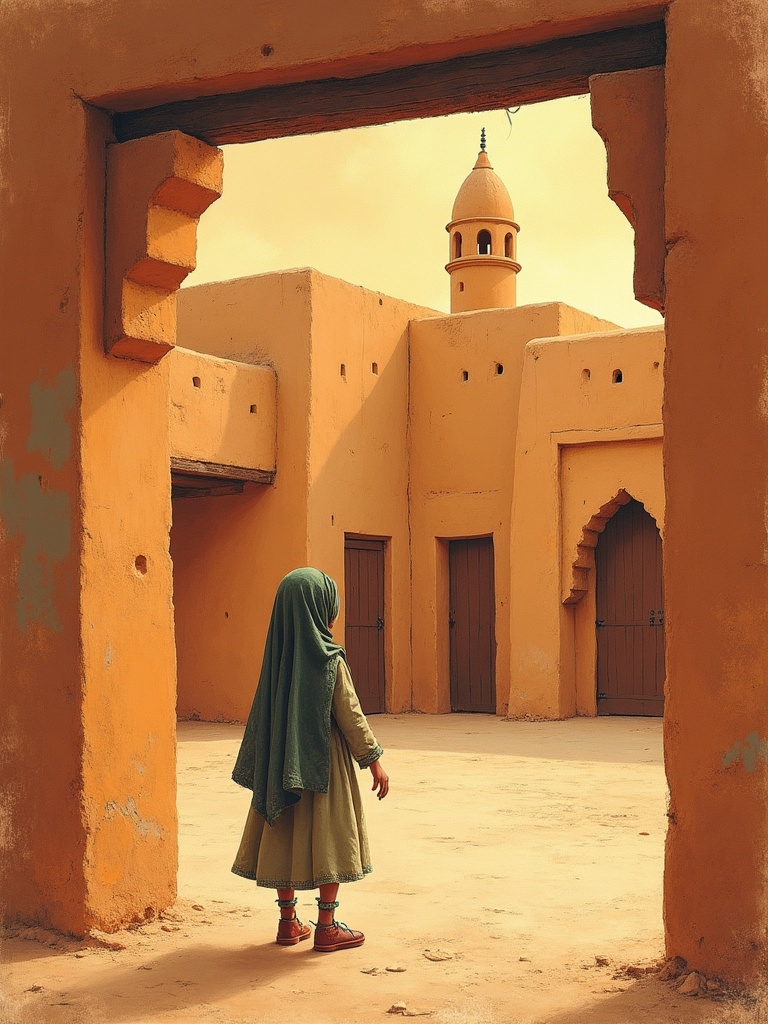
Militants torched about 4,200 manuscripts — a painful loss, yet a sliver beside the ~350,000 librarians had already spirited away in metal trunks.
DetailsENAhmad Baba al-Massufi al-Timbukti was born on 26 October 1556 in Araouane, a caravan town north of Timbuktu, into a Sanhaja Berber family of jurists. He came of age in the Songhai Empire at the height of Timbuktu's golden age, when the city was less a place than an idea: an intellectual and spiritual capital where the Sankore mosque-university anchored a teeming book trade. A Maliki jurist (qadi), grammarian and historian, Ahmad Baba would write more than forty books — by some accounts over fifty — on Islamic law, biography, theology and language, and is remembered as the most celebrated scholar Timbuktu ever produced.
His world broke apart in 1591, when the Saadi sultan of Morocco sent an army across the Sahara and shattered the Songhai Empire. Timbuktu's scholars resisted the occupation; Ahmad Baba was arrested and, in 1594, deported in chains to Morocco on accusations of sedition. He was imprisoned for roughly two years, then held in Marrakesh and Fez for over a decade. The exile was not silence: he was permitted to teach and give legal opinions, and Moroccan scholars are said to have crowded his lectures. Much of the work for which he is remembered — including his great biographical dictionary Nayl al-ibtihaj and Mi'raj al-Su'ud, a treatise that condemned the enslavement of free Muslims of the Sudan — dates from these years away from home. He finally returned to Timbuktu on 22 April 1608, and taught and wrote there until his death on the same date in 1627.
His name did not fade with him. Timbuktu's surviving manuscripts — astronomy, medicine, mathematics, poetry, law, copied and recopied across centuries — survived in family libraries, and in 1973 Mali founded a state center to gather and protect them: the Ahmed Baba Center for Documentation and Research (CEDRAB), today the Ahmed Baba Institute of Higher Learning and Islamic Research (IHERI-AB). It holds on the order of 30,000 to 40,000 manuscripts — a fraction of the hundreds of thousands believed to remain in Timbuktu's private hands.
That inheritance was nearly lost. During the jihadist occupation of 2012–2013, librarians led by Abdel Kader Haidara secretly smuggled an estimated 350,000 manuscripts out of Timbuktu in metal trunks, by truck and river boat, to safety in Bamako. As French forces closed in, militants set fire to the Ahmed Baba Institute and burned roughly 4,200 manuscripts — a real and painful loss, but a tiny fraction of a heritage that had once again outlasted the people who came to destroy it.
Timeline
- 26.10.1556Geboren in Araouane nahe Timbuktu, in die Gelehrtenfamilie der Aqit.
- JugendStudium bei seinem Vater & bei Mohammed Baghayogho al-Wangari („der Erneuerer"), über 10 Jahre.
- bis 1591Letzter Kanzler von Sankoré; über 40 Bücher; Bibliothek von 1.600 Bänden.
- 1591Marokkanische Eroberung (Schlacht von Tondibi); Ahmad Baba verweigert den Treueeid.
- 1594Verhaftung mit ~30 Gelehrten, Verschleppung nach Marrakesch; seine Bibliothek geht verloren.
- 1594–1608Haft, dann gefeierte Lehrtätigkeit in Marrakesch („die einzigartige Perle seiner Zeit").
- 1608Rückkehr nach Timbuktu; Wiederaufbau der Lehre.
- 1627Tod in Timbuktu; später wird das Ahmad-Baba-Institut nach ihm benannt.
Did you know?
- Some of Ahmad Baba's most important books, including his biographical dictionary Nayl al-ibtihaj, were written not at home but during his forced exile in Morocco, where he was still allowed to teach and issue legal rulings.DetailsEN
- Timbuktu's Sankore University once drew some 25,000 students and ran around 180 Koranic schools, making the city a center for the spread of Islamic learning across Africa in the 15th and 16th centuries.DetailsEN
- When militants torched the Ahmed Baba Institute in 2013, they burned about 4,200 manuscripts — yet that was only a sliver of Timbuktu's roughly 350,000 documents, nearly all of which librarians had already spirited away in metal trunks by truck and boat.DetailsEN
Empires can carry a scholar away in chains — but they cannot carry away what he wrote, nor the people who will hide his books to keep them alive.
Values & Capabilities
Capabilities
◆◆◆◆◆ shows how central a gift is — five diamonds mark a signature strength, fewer mark a supporting one.
His greatest deed: to show that knowledge is a power no sword can defeat. In the game: whoever holds Ahmad Baba can resolve a conflict with words and wisdom instead of force — and wins in the long run.
He refused to pledge his loyalty to the conquerors — and accepted exile and imprisonment in order to stay true to his conscience. He teaches: Sometimes the bravest thing is to say "No" politely but firmly.
After returning home, he rebuilt the destroyed body of learning and passed his knowledge on to a new generation. He teaches: Knowledge does not die as long as someone gives it to the next person.
Law, theology, grammar, astronomy, biographies — his knowledge spanned many fields. He teaches children that curiosity knows no bounds and that everything is connected.
His library of 1,600 volumes was, in his own eyes, the 'smallest' — because in Timbuktu books were the highest good. He teaches: the most valuable thing you can possess is what dwells in your head.
Development
1 of 3 stages unlocked
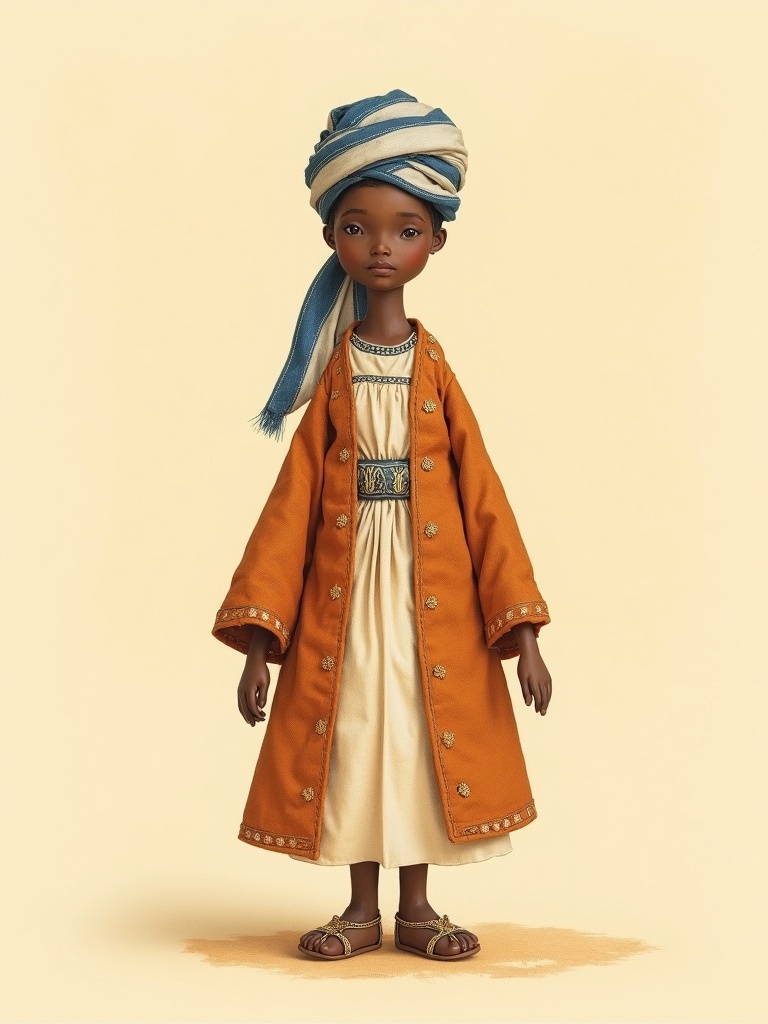
Ahmad Baba as a boy with a writing tablet (allo) and reed pen, learning from his teacher al-Wangari — eager to learn, reverent, bright. Simple scholar's robe. Gift: The Polymath (in the making).[6]
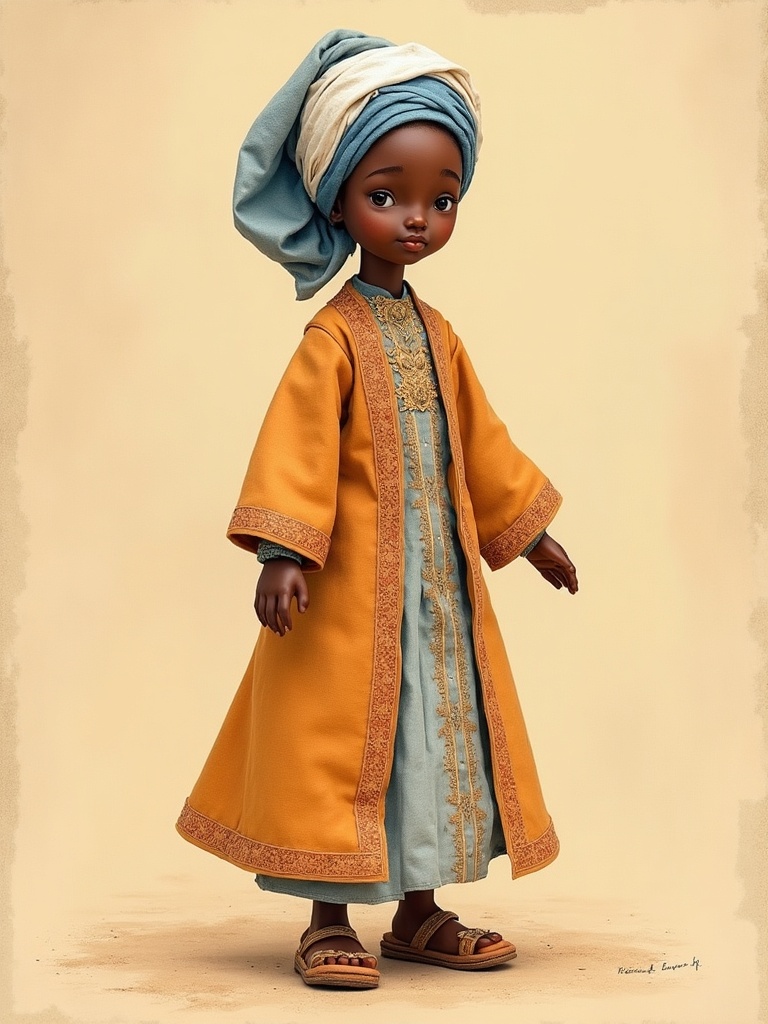
Answer all three to unlock this stage.
Unlock the previous stage first.
Crafting the doll
Fabrics & Production Notes
Genuine natural fibers, honest craftsmanship, lifelong repairability — and in Ahmad Baba's case the loveliest educational detail of the series: a real little manuscript.
The materials list
The garment: the scholar's robe
Ahmad Baba wears a flowing scholar's robe (jubba) made from 100 % cotton in indigo and cream tones with fine embroidery, plus a neatly wound white-and-blue turban. Deliberately plain and dignified — the message lies in knowledge, not in pomp. Ideally from Mali weaving cooperatives; embroidery by hand or machine, child-safe.
The signature attribute: the manuscript & the writing tablet
His hallmark is not the sword, but the book: a small, fold-open fabric/felt „manuscript" with an embroidered calligraphy pattern, plus a tiny wooden writing tablet (allo) and a blunt reed-pen. Optionally a mini stack of books. No small parts that pose a choking hazard in the school/toddler line.
Signature & the „knowledge doll" (Part 2)
Embroidered into the hem: „Ahmad Baba" and the name of the seamstress. Enclosed a biography card and — as with Mansa Musa — a real manuscript facsimile card from Timbuktu with translation. Mansa Musa & Ahmad Baba together form the "Knowledge Doll Pair": the patron and the scholar, both guardians of the Timbuktu manuscripts. Optional QR thread to the Ahmad Baba Institute.
Production stages & effort
Scholar's robe, turban, fold-open mini manuscript, writing tablet, biography & facsimile card. The collector's and role-model figure.
Simplified garment, small fabric book. Affordable entry point.
Washable, reinforced seams, sturdy fabric book. With facsimile card — the ideal 'knowledge doll' for the classroom.
How this doll is made
Ahmad Baba was a 16th-17th century jurist of Sankore, Timbuktu, and his look belongs to the scholarly material culture of the Songhai Sahel: a flowing indigo-and-white boubou, a wrapped turban, and the tools of a working copyist — reed pen, ink, and loose-leaf manuscripts protected in tooled leather satchels.
- Garments 3
- Accessories 5
- Materials 1
- Techniques 3
Garments
- Boubou (jubba) robeA wide, flowing over-robe cut from a single large rectangle of cloth (about 150 cm wide) folded in half, with a center neck opening and sides sewn part-way up to form ample sleeves; for men the neckline forms a V with a chest pocket. The boubou marked rank and identified the wearer as a Muslim scholar.DetailsEN
- Embroidered scholar's robe with talismanic motifsHigh-status boubous were of handspun cotton dyed with indigo, finished with polychrome silk/wool embroidery around the neckline; the protective Arabic-inspired motifs were typically designed and stitched by Qur'anic scholars themselves — directly tying the garment to learned men like Ahmad Baba.DetailsEN
- Turban / tagelmustA long wrapped head-cloth (often indigo-dyed cotton, up to several metres) wound around the head and, in the Saharan style, across the lower face. In Sahelian-Saharan society it signified adult male status and protected against sun and sand.DetailsEN
Accessories
- Leather manuscript satchelA tanned-leather arm-bag with a carrying strap and a triangular flap with fastening loop, often with tooled/decorative detailing, used by scholars to transport handwritten Qur'ans and other works; it was a recognised symbol of the West African learned class.DetailsEN
- Timbuktu manuscript (loose-leaf, leather-wrapped)West African books were unbound single leaves of paper held in a leather wrapper and tied with string or a leather strap, written in an African/Maghribi-derived script with black and red ink and red-and-black marginal decoration rather than gold illumination.DetailsEN
- Reed pen (qalam) and inkwellA pen cut from a dried hollow reed, the tip sliced at a slant with a split nib; ink was kept in a round (never square) inkwell fitted with a wool wick, alongside a penknife and a miqatta resting board for cutting nibs.DetailsEN
- Prayer beads (tasbih / misbaha)A strung loop of beads (33 or 99) of wood, seeds, bone, glass or stone, used to count dhikr; a near-universal accessory of a practicing Muslim scholar.DetailsEN
- Leather babouche slippersBackless, pointed- or rounded-toe flat slippers made of pliable vegetable-tanned goatskin, with single-piece uppers, hand-bevelled edges and saddle-stitched construction — the everyday footwear of the Saharan-Maghribi world.DetailsEN
Materials
- Handspun indigo & white cottonThe base cloth of Sahelian dress: cotton hand-spun and woven, then dyed in indigo for deep blue or left white; high-status robes combined indigo-dyed cotton with silk and wool embroidery thread.DetailsEN
Techniques
- Strip-weavingCloth was made on narrow hand looms as long strips a few centimetres wide, then sewn edge-to-edge to build up a large textile; this strip-weave is one of the oldest and most characteristic West African textile techniques and the basis of the boubou cloth.DetailsEN
- Manuscript copying & ink-makingScribes copied texts with a slant-cut reed qalam; black ink was made from soot/lamp-black bound with gum arabic (with gall-nuts/indigo added), strained before use, applied as black body text with red ink for vowel points and chapter marks.DetailsEN
- Leather satchel-making & flap bindingLoose-leaf books were protected not by sewn spines but by tanned-leather wrappers and strap-tied carrying satchels; the envelope flap — a leather flap attached to the back cover that wraps the leaves and tucks under the front — is the signature protective device of Islamic-African book-craft.DetailsEN
How it's made
Every doll is sewn by hand from natural materials — built to last a lifetime and to be repaired, not replaced. Here is the shopping list and the work steps. Sizes: Classic 32 cm (heirloom) · Kidogo 18–20 cm (toddlers, no small parts) · Shule 28 cm (school edition).
Shopping list
- Natural cotton or linen for the body (skin tone), ~0.5 m
- Wool or cotton stuffing — no plastic
- Cotton thread and embroidery floss in matching colours
- Garment fabric in this doll's colours (see the fabrics above)
- Yarn for the hairstyle
- Beads, cowrie shells and trims as shown
- Sharps and embroidery needles, pins, fabric scissors, fabric marker
Work instructions
- Trace and cut the body pattern at your chosen size (Classic 32 cm / Kidogo 18–20 cm / Shule 28 cm).
- Sew the body pieces right sides together, leave an opening, turn and stuff firmly with natural fibre, then close by hand.
- Embroider the face gently and with dignity — no plastic parts for the toddler line.
- Make the hair from yarn following the chosen hairstyle and attach it securely.
- Cut and sew the garment from this doll's fabric, then dress the doll.
- Add the beadwork, shells, trims and any attribute by hand.
- Check every seam and reinforce it — the doll should be lifelong and repairable, with no loose small parts for small children.
Ten Name Suggestions
The real name is preserved. These ten names — from Timbuktu's world of scholars & the Sahel — are suitable for companion figures, students or the series around Ahmad Baba. To be confirmed with Mali/Timbuktu authorities before use.
Lovely for the classroom: names like Haidara and Sa'di each open a story of their own — the manuscript families and the chronicler who preserved Timbuktu's memory. And Fatima/Khadija are a reminder that education was never solely a men's affair.
Origin & Ethics
How we know this
On honesty: Ahmad Baba is a historically very well-documented person (through his own works, the Timbuktu chronicles, and modern research, including J. O. Hunwick). Datings vary slightly (the invasion is given as 1591 or 1592; book count 40 to ~70). The main quotation shown (the farewell oath) is handed down, rendered here in paraphrased form; the closing „promise to a child" is a modern, paraphrased formulation of his stance, not a literal quotation. Deliberately not concealed: his writing on slavery (see box). The „Abilities" and „Life-stages" translate real deeds into collectible-card format. Since Timbuktu is a UNESCO World Heritage Site and a place of faith, and the manuscripts belong to living guardians (the Ahmad Baba Institute, manuscript families), the final approval rests with the Malian cultural, manuscript, and faith authorities.
Elder approval & Sources to watch
As with the other historical figures: "are we honoring them worthily?". With Ahmad Baba, two sensitive dimensions are added: the religious (Islam, Sankoré Mosque, Quran, manuscripts — with respect) and the honest handling of a difficult text in his work (see box).
⚖️ Staying honest: a difficult text
Ahmad Baba also wrote a work on the slavery of his time (Mi'raj al-Su'ud). In it he argued against the enslavement of freeborn Muslims — a remarkably critical step for his time —, but he did not reject slavery as an institution in principle. This is part of the truth and is not glossed over: even great scholars were children of their era. For children this is placed in an age-appropriate context — as an occasion to understand that progress happens step by step and that every age has its blind spots. At the heart of the figure stands his knowledge and his courage, not this treatise.
The Approval Body
The five-step protocol
Contact through official channels (Ahmad Baba Institute, Mali Ministry of Culture, UNESCO World Heritage Site Timbuktu, manuscript families). Presentation of the vision, 42% rule, veto right.
Hand over this compendium as a draft — especially the religious portrayal, the manuscript facsimile idea, and the honest contextualization of the writing on slavery for review.
Institute for figure & facts, manuscript families for facsimiles, a religious voice for matters of faith, historians for accuracy.
Written approval per element. Religious portrayal & manuscript use are non-negotiable without the consent of the guardians.
Manuscript institutes, weavers & community funds share in the proceeds; a portion of the revenue flows specifically into the protection & digitization of the Timbuktu manuscripts.
Most sensitive areas: the respectful portrayal of Islam (mosque, Quran, manuscripts — never as decoration), the use of authentic manuscript facsimiles (only with permission & accurate translation) and the honest, child-appropriate framing of his writings on slavery — neither concealed nor overemphasized.
Sources to observe
Sources
- Ahmad Baba (1556–1627), last chancellor of Sankoré University, the greatest scholar of Timbuktu; Sankoré as an intellectual center with many sciences; library of 1,600 volumes. face2faceafrica.com: Ahmed Baba of Timbuktu.
- Over 40 books on ethnography, theology, biography, astronomy, and more; protest against the Moroccan invasion (1591/92); farewell oath in Marrakesh. kentakepage.com: Ahmed Baba; newafrikan77.wordpress.com (J. H. Clarke).
- 'Smallest library' anecdote (1,600 volumes, smaller than those of his friends); the Ahmad Baba Institute preserves tens of thousands of manuscripts; center of the 2012 rescue. understandingslavery.com; afrikanews/Institute records.
- Born 26 Oct 1556 in Araouane; scholarly family of the Aqit; knowledge as an inherited calling; Maliki school. britannica.com: Ahmad Baba; nofi.media.
- Deportation to Marrakesh in 1594, ~2 years' imprisonment, loss of the library; daughter/family line of the Aqit; death — the state of the sources on Atagara/Timbuktu. face2faceafrica.com; effiongp.msu.domains (Ahmed Baba: Malian Scholar).
- Principal teacher Mohammed Baghayogho al-Wangari, 'the renewer' (al-mujaddid), over 10 years of teaching. oxfordre.com: At-Timbuktî, Ahmed Bâba.
- Library of over 1,600 volumes, lost during the expulsion from Timbuktu; accusation of subversion by the occupiers. effiongp.msu.domains: Ahmed Baba — Malian Scholar.
- Biographical dictionary of Maliki scholars, an important source to this day; fatwas of great clarity. britannica.com: Aḥmad Bābā.
- Battle of Tondibi (13 March 1591), Saadian conquest under al-Mansur, occupation by Pasha Mahmud; Ahmad Baba refuses the oath of allegiance, arrested with ~30 scholars in 1594. grokipedia.com: Ahmad Baba al-Timbukti.
- Return to Timbuktu in 1608 (permitted by Sultan Zaydan), resumption of teaching; death in 1627; institute named after him. grokipedia.com; kentakepage.com.
- Britannica — biography of Ahmad Baba al-Timbukti, Maliki jurist of Sankore
- Wikipedia — Ahmad Baba al-Timbukti, life and works
- Fashion History Timeline (FIT) — the boubou: cut, indigo cotton, strip-weave, embroidery
- The Metropolitan Museum of Art — Soninke Robe (Boubou Lomasa), Senegal: handspun cotton, indigo, strip weave, scholar-stitched motifs
- Nationalclothing.org — the Berber/Saharan tagelmust (cheche) indigo turban-veil
- Cambridge University Library Special Collections — West African Islamic manuscripts: loose-leaf, leather wrappers, tooled satchels, Maghribi script
- Northwestern University Herskovits Library — leather arm-bag and goatskin as symbols of West African scholarly culture
- Al-Furqan Islamic Heritage Foundation — reed pen cutting, inkwells, miqatta, ink categories in book production
- Wikipedia — Qalam: cutting reeds at script-specific angles for calligraphy
- Mosaic North Africa — Moroccan babouche: vegetable-tanned goatskin, hand construction
- Wikipedia — Misbaha/tasbih prayer beads: 33/99 beads, materials and use
- Library of Congress — Ancient Manuscripts from the Desert Libraries of Timbuktu (exhibition)
- UNESCO — Mali: Timbuktu Manuscripts, preservation and significance
- Met Museum — Flap of an Islamic bookbinding (envelope-flap protective binding)