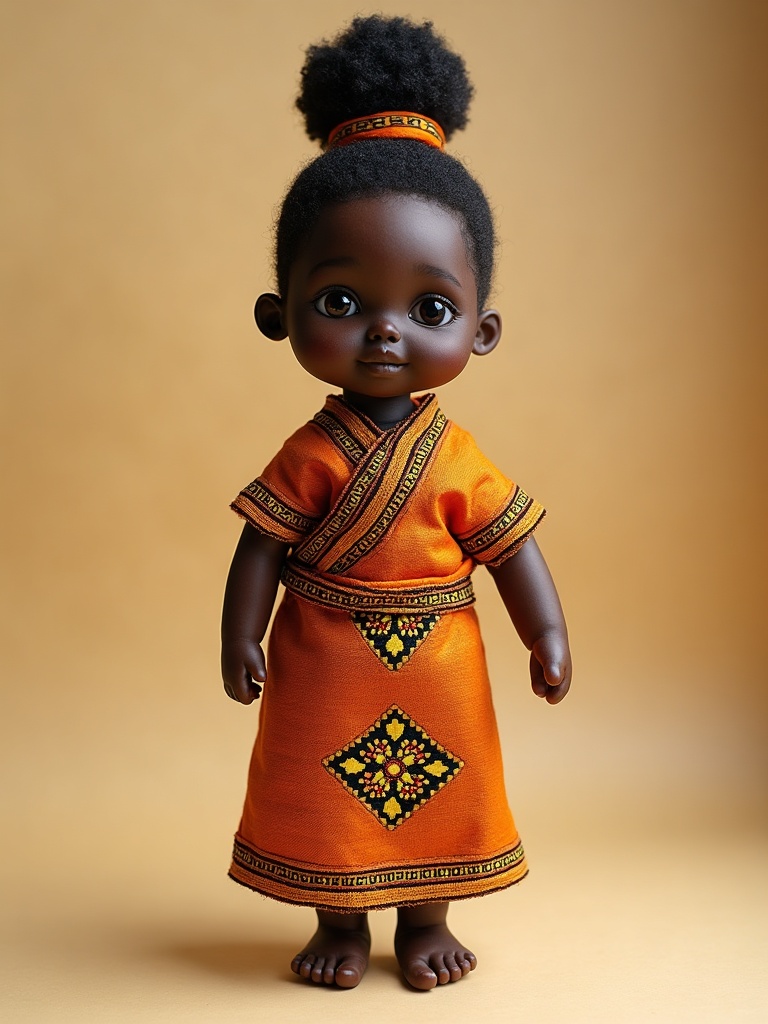
Flagship
Zuwena
The word "Swahili" comes from the Arabic sawāhil — "the coasts". The Swahili are not a single tribe, but a coastal people of trade : Bantu Africans, whose culture and language (Kiswahili) absorbed Arabic, Persian, and Indian threads over…
- People
- Swahili
- Country
- Zanzibar/Tanzania
- Region
- East Africa
- Era
- Present
- Theme
- The Speaking Cloth (Kanga)
Make your own
Design your Zuwena
Pick a garment, a hairstyle and a scene, enter the PIN and generate a fresh image of Zuwena with AI.
Each image is generated live with fal.ai.
Generated images
No images generated yet — be the first.
History & Meaning
①Tradition & Origin
The word "Swahili" comes from the Arabic sawāhil — "the coasts". The Swahili are not a single tribe, but a coastal people of trade: Bantu Africans, whose culture and language (Kiswahili) absorbed Arabic, Persian, and Indian threads over the centuries.[1] Stone Town — in Swahili Mji Mkongwe, "the old city" — was declared a UNESCO World Heritage Site in 2000: as an outstanding, well-preserved example of a Swahili trading city, whose houses of coral stone and mangrove wood with their intricately carved "Zanzibar doors" show the wealth and skill of their builders.[2][3]
The Spice Islands
In the 19th century, when Zanzibar became the capital of a sultanate, cloves, nutmeg, cinnamon and pepper made the island world-famous as the "Spice Islands".[3] To this day, the alleys of the Darajani Market are fragrant with cloves; spice tours lead across the plantations. In the evenings, people gather in the Forodhani Gardens for grilled fish and "Zanzibar pizza", while from the harbor the dhows with their lateen sails glide into the sunset.[4]
The Kanga — the cloth that speaks
Zuwena's centerpiece. A kanga consists of three parts: the pindo (border), the mji (central pattern — the Swahili word for "city") and the jina or ujumbe (the name/the message).[5] This proverb is the most important thing. Since the early 1900s, the Mombasa merchant Kaderdina Hajee Essak („Abdulla") printed Swahili sayings on his cloths to tell them apart — and thereby created "East Africa's first social media".[5][6] Women wear a Kanga to say something without speaking: love, comfort, a warning, a jab at a rival. There are even "Kanga wars", in which two women debate with opposing sayings.[6]
Add to that the Taarab music (since the 1880s, with Arabic and Indian influences, full of metaphors), the Henna for adorning the hands and the deep Swahili hospitality, in which family does not end at blood but includes the neighbor, the guest and the traveler.[7]
🕯️ An honest dark side
Truth is part of dignity: in the 19th century, Stone Town was also one of the largest slave markets of East Africa. Today the Anglican Christ Church Cathedral and a memorial stand exactly on the former marketplace.[8] Zuwena does not conceal this. But she tells it in a child-appropriate way and on the side of dignity: as a story of survival, of liberation and of the continued life of a culture, which was stronger than those who wanted to chain it. This part is explicitly presented to the Council of Elders and educators — it does not belong in every play situation, but it may never be falsified.
„Read what is written here. With us, even the clothing speaks —
and it always tells the truth."
⑤Transfer to the Present
How does a Swahili gift become an ability that helps a child in 2050?
The Speaking Cloth (Kanga)
Putting messages into words cleverly, subtly, with a wink.
Communication, rhetoric, media. The art of the concise, apt message — the foundation for journalism, marketing, diplomacy, and good, fair speech in a world full of noise.
Bridge of the Seas
Weaving something new from African, Arab, and Indian threads.
Trade, diplomacy, intercultural competence. Those who embrace diversity as a strength become bridge-builders in the AfCFTA single market and between Africa and the world.
Keeper of the Spices
A tiny spice connected continents.
Value creation, export, sustainability. From raw material to refined product: Africa no longer exports merely raw spice, but brand, quality and story — fair and ecological.
Door of Hospitality
The guest becomes family.
Tourism, hospitality, community. Zanzibar's hospitality as a model for a tourism that honors the locals — and for a togetherness that excludes no one.
Zuwena's promise to a child: „You are made of many worlds — and that is not a jumble, but your richness. Choose your words, and you build bridges."
Abilities & Development
Abilities
Zuwena's greatest gift: Every one of her Kangas carries a real proverb. She teaches children to speak with words that are wise, kind and sometimes playfully knowing — and that a well-chosen piece of wisdom achieves more than loud quarreling. In the game: "the one who knows the right word".
Zuwena understands that richness grows out of encounter. She shows children how Swahili wove African, Arabic, Persian and Indian threads into something new and beautiful — and that diversity is a strength, not a threat.
Clove, cinnamon, nutmeg, cardamom — Zuwena knows them all by their scent. She awakens curiosity about the plants, the trade, and the question of how a tiny spice connected the whole world.
Zuwena sings Taarab — poetry set to music, full of imagery and subtle allusions. She teaches that feelings can also be expressed in a coded, polite, and beautiful way.
Like the famous carved doors of Stone Town, Zuwena opens her house to every guest. Her gift: turning strangers into family — Swahili hospitality in its purest form.
Through the years
③Development Stages
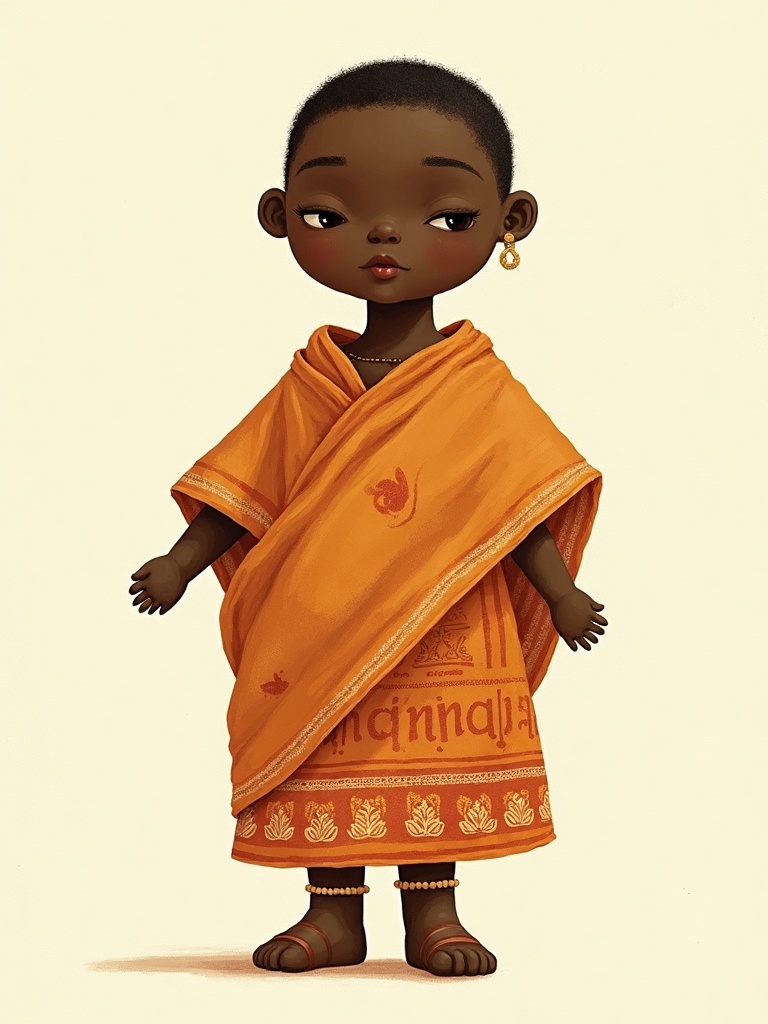
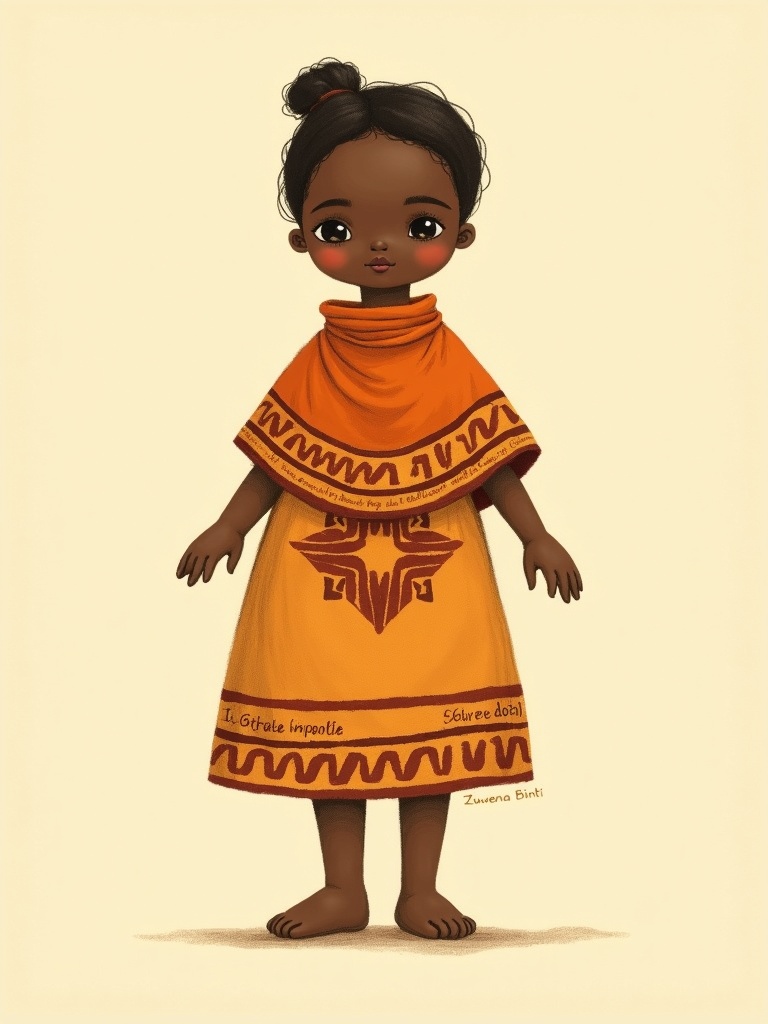
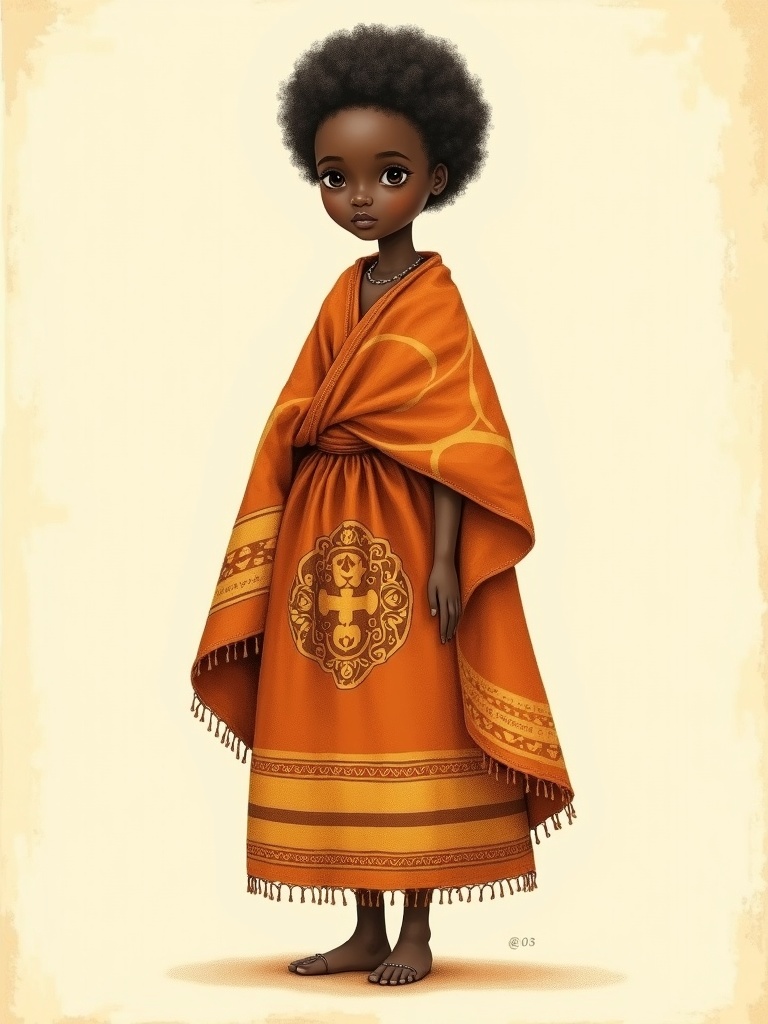
Zuwena develops along the life stages of a Swahili woman — from the learning daughter to the bearer of the word and keeper of the home.
The young Zuwena, spelling out her first Kanga proverb and counting the dhows at the harbor. Simple Kanga, a dab of henna on her hand. Gift: Door of Hospitality.
Zuwena now chooses her kanga herself — and with it her message. Full kanga set (two cloths), fine henna pattern, taarab on her lips. New gift: The speaking cloth.
The highest stage: Zuwena as keeper of the proverbs, whose word carries weight on feast days and in disputes. Festive kisutu kanga, dignified cloth over the hair. Signature gift united with Bridge of the Seas.
Note: mtoto, binti and bibi are common Swahili forms of address; the council of elders / the cultural partners confirm spelling and suitability.
Make & Learn
⑦Fabrics & Production Notes
Real natural fibers, honest craftsmanship, lifelong repairability. With Zuwena, everything stands or falls on one thing: the real Kanga.
The Material List
The Garment: real Kanga — the centerpiece
A Kanga is 100% cotton, about 1.5 × 1 m, with the three parts pindo, mji and jina.[5] For the dolls, real, printed kanga from East African makers is cut to doll size — wherever possible from long-established houses (the kanga-printing craft dates back to the 1880s and in part survives to this day).[6] Crucial: The imprinted proverb must be genuine, correct and fitting — it is the soul of the piece, not decoration.
Body, jewelry & henna look
Body as with the sisters: cotton/linen jersey knit, kapok filling, double- overlocked seams. Jewelry sparing, typical of the coast: small gilded earrings, occasionally a coral or cowrie detail. The famous henna patterns are suggested as fine, permanent embroidery or textile prints on hands/forearms — never as a detachable small part.
Signature & Message
Embroidered into the hem: „Zuwena", the name of the seamstress and a „Made in Stone Town" tag. A special feature found only with Zuwena: a small enclosed card translates the jina of her Kanga and explains the proverb — so the child learns the wisdom it carries.
Production Stages & Effort
Full Kanga set with a genuine proverb, headscarf, henna embroidery. Somewhat faster than Selam, since the Kanga is printed (not handwoven) — but with care taken for the correct message.
Single kanga, simplified headscarf, a subtle henna detail. Entry-level price, same dignity, same authentic proverb.
Washable, reinforced seams, sewn-on rather than inlaid kanga. The proverb card becomes a learning game for the memory room.
How it's made
Every doll is sewn by hand from natural materials — built to last a lifetime and to be repaired, not replaced. Here is the shopping list and the work steps. Sizes: Classic 32 cm (heirloom) · Kidogo 18–20 cm (toddlers, no small parts) · Shule 28 cm (school edition).
Shopping list
- Natural cotton or linen for the body (skin tone), ~0.5 m
- Wool or cotton stuffing — no plastic
- Cotton thread and embroidery floss in matching colours
- Garment fabric in this doll's colours (see the fabrics above)
- Yarn for the hairstyle
- Beads, cowrie shells and trims as shown
- Sharps and embroidery needles, pins, fabric scissors, fabric marker
Work instructions
- Trace and cut the body pattern at your chosen size (Classic 32 cm / Kidogo 18–20 cm / Shule 28 cm).
- Sew the body pieces right sides together, leave an opening, turn and stuff firmly with natural fibre, then close by hand.
- Embroider the face gently and with dignity — no plastic parts for the toddler line.
- Make the hair from yarn following the chosen hairstyle and attach it securely.
- Cut and sew the garment from this doll's fabric, then dress the doll.
- Add the beadwork, shells, trims and any attribute by hand.
- Check every seam and reinforce it — the doll should be lifelong and repairable, with no loose small parts for small children.
⑥Ten Name Suggestions
Swahili names with meaning. To be confirmed by the cultural partners before use.
Honest about the language: Many Swahili names have Arabic roots — an expression of exactly the fusion that Zuwena embodies. "Siti" honors Siti binti Saad (ca. 1880–1950), who was the first East African Taarab singer to make gramophone recordings.
⑧Curriculum Mapping & Subjects
Zuwena connects to Tanzania's school system, in which Kiswahili is the language of instruction — a stroke of luck, since Swahili is both one of the most widely spoken languages in Africa and a working language of the African Union. Zuwena's “word” gifts are thus language instruction in its purest form. (In diaspora and neighboring-country schools the same mapping can be applied to the respective curriculum.)
The speaking cloth
Proverbs, fitting words.
Kiswahili / Language & Literature. Methali (proverbs) are core teaching material. Learning objective: expression, metaphor, appreciation of one's own language.
Bridge of the Seas
Fusion of cultures.
History / Social Studies. The Indian Ocean trade as a lesson: how encounter creates culture — and, honestly, also what trade can destroy.
Keeper of the Spices
Plants, trade, geography.
General Studies / Geography / Biology. Spice plants, monsoon winds, world trade — cross-curricular from the plant to the world map.
Song of the Taarab
Poetry set to music.
Music & Art. Taarab as the union of language, rhythm and feeling — expression and self-confidence.
Door of Hospitality
A guest becomes family.
Values & Life Skills. Right of hospitality, respect for the stranger, community — core values of living together.
Each child designs a paper kanga and chooses a proverb (methali) as a jina — and explains why. Learning objective: language, values, creative expression, pride in Kiswahili.
From the Zanzibar tree via the dhow out into the world — the children follow a spice on the map. Learning objective: trade, geography, Africa's place in world history.
Two children "talk" to each other only through the proverbs of two kangas (the good, peaceful counterpart to the "kanga war"). Learning objective: resolving conflict with words and wit instead of quarrelling.
Origin & Ethics
How we know this
On honesty: As with Amani & Selam, this compendium combines documented facts (Kanga, Stone Town, the spice trade, Taarab, history) with a deliberately invented game layer ("abilities", "development stages"). The latter are respectful translations of real virtues, not handed-down Swahili concepts. Two areas demand particular care and explicit approval: language (every Kanga proverb must be correct) and the slavery history of Stone Town (dignified, true, never sensationalist). The meanings of names and stages vary by source; the cultural partners have the final word.
⑨Elder Approval & Sources to Observe
As with Selam, there is no single central council institution — authority is distributed. With Zuwena, a particular sensitivity is added: the language (every jina must be correct) and the history of the slave trade, which may only be told with the utmost care.
The approval body (multi-part)
The five-stage protocol
Contact via official channels (cultural authorities of Zanzibar, recognized Kanga manufacturers, museums/foundations such as the Emerson Zanzibar Foundation, community representatives). Presentation of the vision, the 42% rule, the veto right.
Hand over the compendium as a draft, with particular focus on the jina list and the narrative style of the slavery history.
Separate approvals: Language checks every jina, craft checks patterns, Elders check portrayal/names, historians check the shadow history.
Written approval per element. Each voice holds a binding veto in its own domain — a wrong jina or an undignified portrayal of slavery ends the element immediately.
Seamstresses, reviewers and community funds share in the proceeds on an ongoing basis; patterns and proverb collections are licensed, not bought outright.
Most sensitive areas: every single jina (language!), the respectful — never glossing-over and never sensation-seeking — portrayal of the slave trade, as well as religious sensitivity in the predominantly Muslim coastal communities (clothing, symbols).
Sources to watch
Sources
- Swahili as a fusion culture of the Indian Ocean (Bantu Africa + Arabic, Persian, and Indian influences); "Swahili" from the Arabic sawāhil, "coasts". zancelebratetours.com: Swahili Culture in Zanzibar (2025); kichanga.com: Guide to Swahili Culture.
- Stone Town as a UNESCO World Heritage Site (2000): coral stone & mangrove wood, carved "Zanzibar doors", a fusion of Swahili, Arab, Indian, and European. whc.unesco.org: Stone Town of Zanzibar; orikaafrica.com.
- Zanzibar became the capital under the Sultanate of Oman from 1840; "Spice Islands" (cloves, nutmeg, cinnamon, pepper) in the 19th century. kupi.com: Zanzibar City history; mustseespots.com.
- Dhow harbor, Forodhani night market, Darajani market, Taarab in the evening. ad-hoc-news.de: Stone Town Sansibar (2026); dumaexplorer.com.
- Kanga structure (pindo/mji/jina), "cloth that speaks", dimensions ~1.5×1 m, 100% cotton. pongwe.com: Zanzibar Proverbs; beachsafari.com: Traditional Clothing in Zanzibari Culture; dumaexplorer.com: Zanzibar Culture Glossary.
- Swahili proverbs on Kanga since the early 1900s through the Mombasa trader Kaderdina Hajee Essak ("Abdulla", KHE Ltd., since the 1880s); "Kanga wars"; Kisutu wedding kanga. omirenstyles.com: Kanga Cloth (2026); pongwe.com; aramcoworld.com.
- Taarab music (since the 1880s, Arabic-Indian influences, metaphors), henna, Swahili hospitality. kichanga.com; zancelebratetours.com.
- Stone Town as a historic slave market; Christ Church Cathedral & memorial on the former marketplace; UNESCO criterion (vi). orikaafrica.com; dawan.africa: Stone Town of Zanzibar (2026).