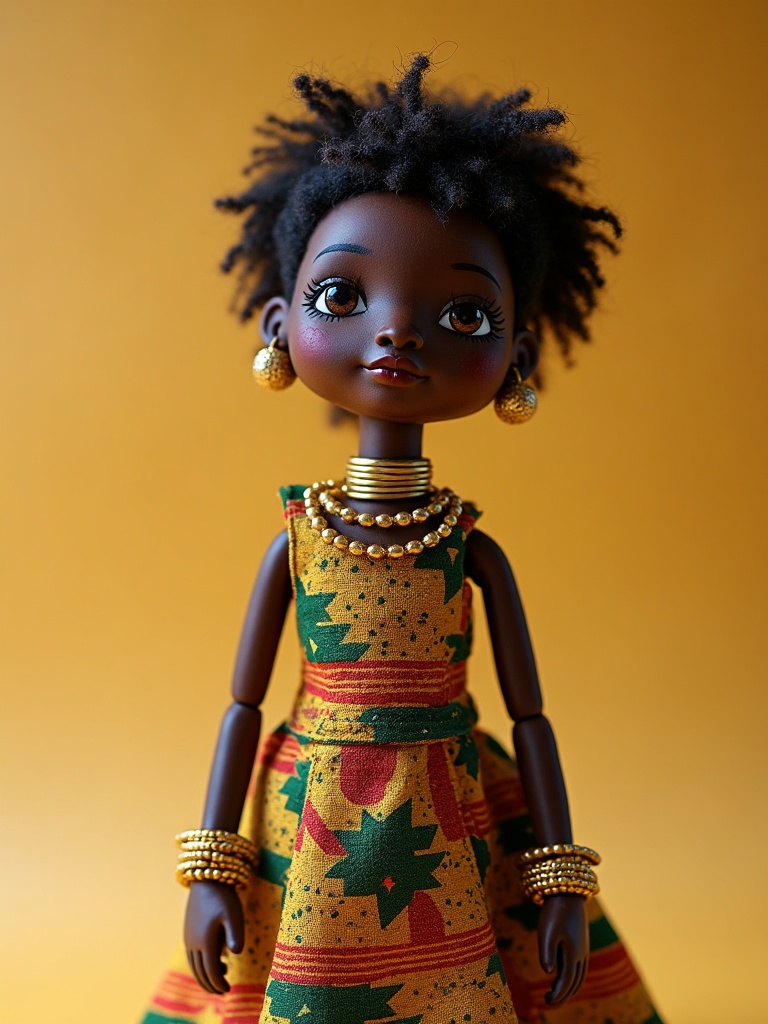
The Ten
Yaa Asantewaa
Yaa Asantewaa was born around 1840 in Besease geboren, near Ejisu in the Kingdom of Asante — today part of Ghana. She grew up without any notable incidents, became a successful farmer , married, had a daughter. Her brother Nana Akwasi…
- People
- Ashanti
- Country
- Ghana
- Region
- West Africa
- Era
- ≈1840–1921
- Theme
- Courage
Make your own
Design your Yaa Asantewaa
Pick a garment, a hairstyle and a scene, enter the PIN and generate a fresh image of Yaa Asantewaa with AI.
Each image is generated live with fal.ai.
Generated images
No images generated yet — be the first.
History & Meaning
①Tradition, Life & the Golden Stool
Yaa Asantewaa was born around 1840 in Besease geboren, near Ejisu in the Kingdom of Asante — today part of Ghana. She grew up without any notable incidents, became a successful farmer, married, had a daughter. Her brother Nana Akwasi Afrane Opese, the ruler of Ejisu, appointed her Queen Mother.[1][2]
What a Queen Mother is — and why it matters
The Asante are a matrilineal society: descent and inheritance run through the maternal line. The Queen Mother (Ohemaa) is not a mere wife, but an authority in her own right: she chooses and confirms the candidates for the royal throne and watches over the legitimacy of the rule.[7] This is the key to Yaa Asantewaa's power — she spoke not as a supplicant, but from a constitutional office.
The Golden Stool — the soul of a people
At the center of everything stands the Sika Dwa Kofi, the "Golden Stool born on a Friday". According to legend, the high priest Okomfo Anokye made it float down from the heavens onto the lap of the first Asante king Osei Tutu. It is regarded not as a piece of furniture, but as Vessel of the soul of the entire Asante nation — no king ever sits upon it; even the Asantehene only touches it.[8][9] Whoever claims the Golden Stool reaches not for a throne, but for the soul of a people.
👑 The Spark: 1900
In 1896 the British had banished King Prempeh I. and Yaa Asantewaa's grandson into exile on the Seychelles; she became regent of Ejisu-Juaben. In 1900 the British governor Frederick Hodgson then demanded the unthinkable: that the Golden Stool be brought to him so that he could sit upon it. For the Asante, this was the deepest conceivable desecration.[3][6] At the secret council assembly in Kumasi, the remaining chiefs hesitated. Then Yaa Asantewaa rose.
To show her determination, she seized a rifle and fired a shot in front of the men.[10] The chiefs mobilized their armies and chose her as Commander-in-Chief — the first and only time in Asante history that a woman held this office.[6]
This is the crucial point for children: The uprising was crushed militarily, yet the Golden Stool never fell into foreign hands — the British never got to see it. Yaa Asantewaa lost a battle and won what counted: The soul of her people remained untouched.[4]
Just like the grandmothers who sew the dolls today.
Courage has no age.
⑤Transfer to the Present
How does Yaa Asantewaa's life become a lesson for a child in 2050?
The call that breaks fear
She roused a resigned group.
Leadership, moral courage, public speaking. Whoever learns to stand up at the right moment and move others becomes a leader, an activist, a spokeswoman — courage as a learnable skill.
Breaker of roles
A woman led the army — for the first time.
Equality, women in leadership. Yaa shows girls: No office is "just for men." From engineer to president — roles are flexible.
Guardian of the Golden Stool
Some things are not for sale.
Values, identity, cultural preservation. The realization that dignity and heritage have no price — the heart of this whole movement. What makes up the soul of a people is not something you give away.
Courage has no age
At ~60 she became a war leader.
The power of the grandmothers. Exactly the message of the project: The eldest is not used up, she is the spearhead. Like the sewing grandmothers — experience as a head start.
Yaa Asantewaa's promise to a child: „If everyone hesitates, you don't have to be the strongest — only the one who stands up first."
Abilities & Development
Abilities
Her greatest deed: She instilled courage in people who had already given up. When the men hesitated, she stood up and turned the mood of the entire council. In the game: Whoever holds Yaa Asantewaa may "rouse" a hesitant group.
She defended not land or gold, but the soul of her people — a symbol. She teaches children that some things are not for sale, no matter what price is offered.
She led an army of 5,000 in the Asante square battle formation and besieged the British fort in Kumasi for months. Strategy, organization, endurance — not just passion.
She questioned the gender roles of her time and called on women to rise up and fight. A woman at the head of the army — unthinkable, until she did it.
Before she was a warrior, she was a farmer and mother — down-to-earth, patient, with her hands in the soil. Her strength grew from an ordinary life, not from privilege.
Through the years
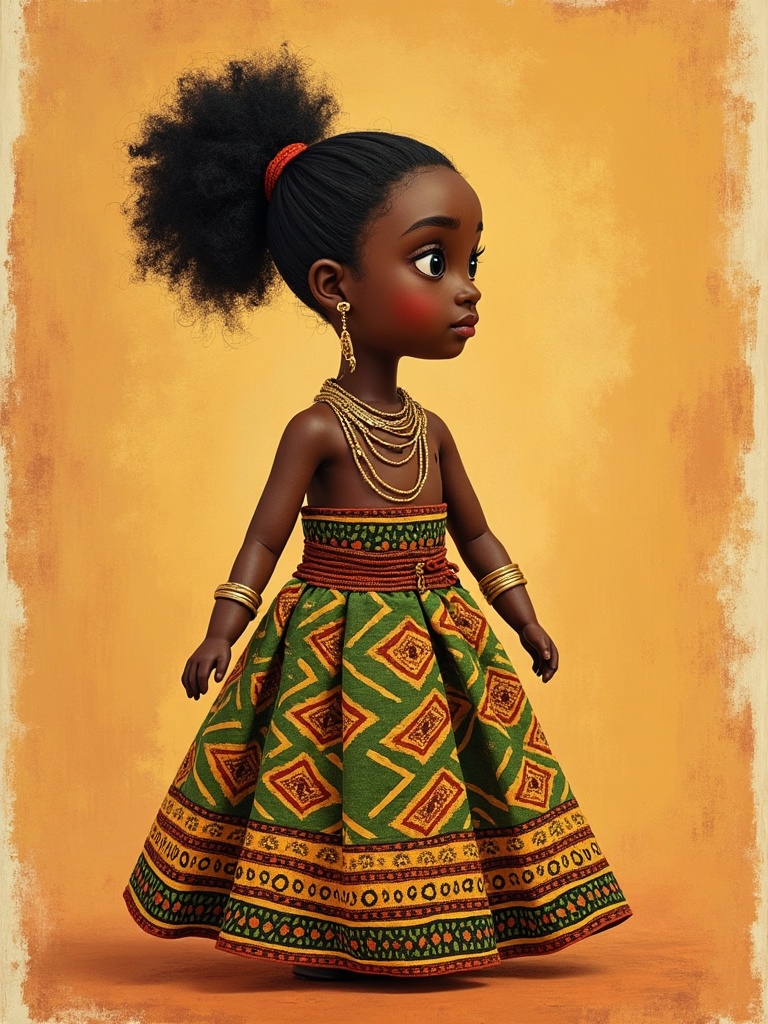
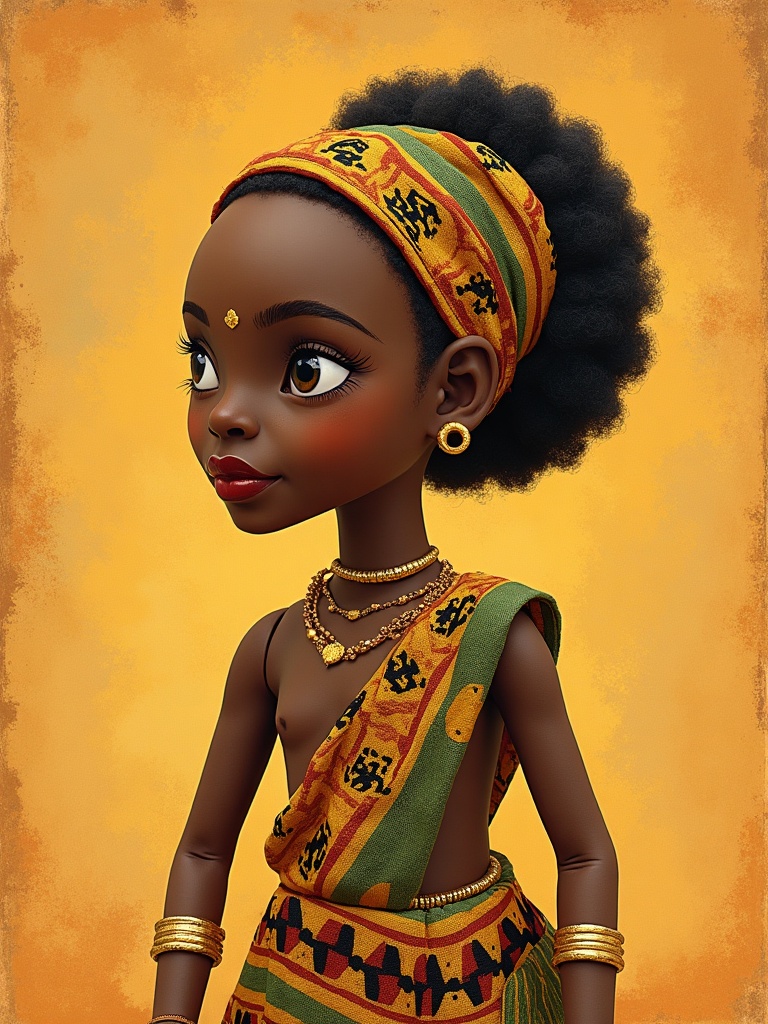
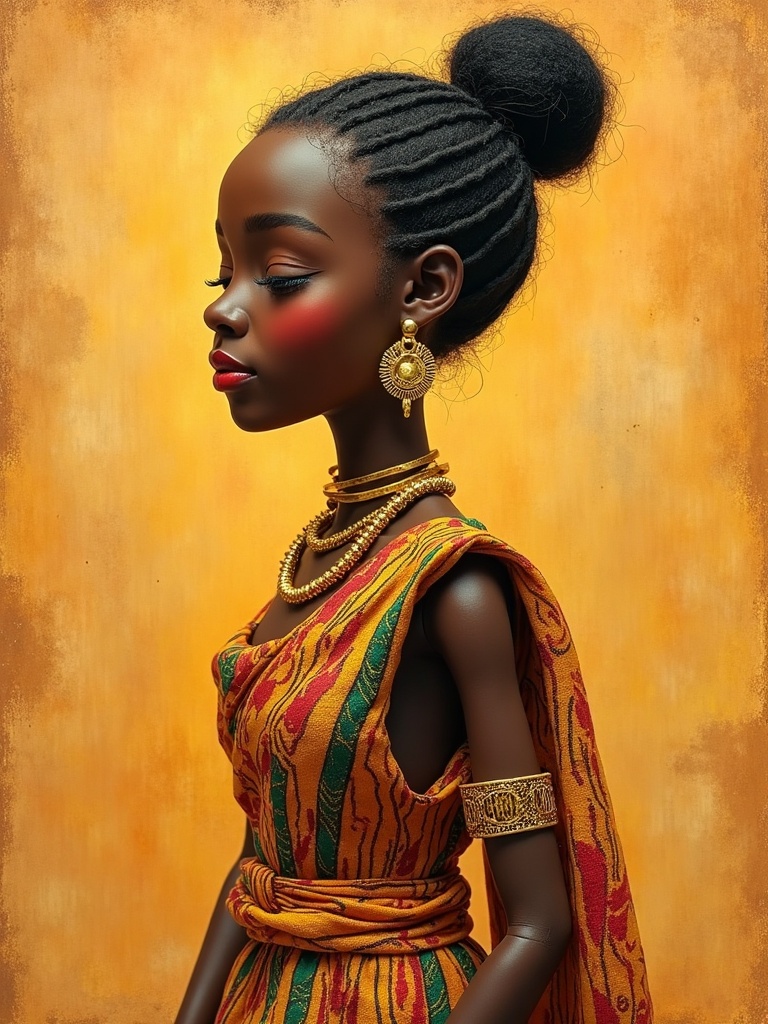
③Life Stages (historical)
Instead of invented "developments," the three stages show the true chapters of her life. Families can collect the same figure at three life stages — from the young girl to the legendary war leader.
Yaa as a young woman tilling the land around Boankra: down-to-earth, in a simple Kente wrap dress, a hoe in her hand. Gift: Roots in the Earth.[1]
Yaa as Ohemaa, the queen mother: dignified in full Kente, gold jewelry, with the authority to confirm kings. Gift: Keeper of the Golden Stool.[2][7]
Yaa at about sixty as commander-in-chief: upright, rifle in hand, the army behind her. Signature gift: The Cry That Breaks Fear.[6][10]
Note: The depiction of the warrior stage shows dignity and leadership, not the glorification of violence — the rifle is her historical symbol of determination, not a toy detail. For the youngest children, the peasant-woman or queen-mother stage is recommended.
Make & Learn
⑦Fabrics & Production Notes
Genuine natural fibers, honest craftsmanship, lifelong repairability — and for Yaa Asantewaa the most famous fabric in Africa: Kente.
The Materials List
The Garment: Kente — Royal Weaving Art
Kente is a hand-woven fabric made of narrow strips, in bright geometric patterns, traditionally from the village of Bonwire near Kumasi — a symbol of royal and cultural identity.[8][11] Each color carries meaning: gold = royalty/prosperity, green = growth, red = sacrifice/struggle, black = maturity/spiritual strength. Ideally it would be genuine Kente woven in Ghana by Bonwire cooperatives; where the bottleneck becomes too tight, a high-quality woven Kente ribbon appliqué — visibly marked, never passed off as hand-weaving.
Adinkra & Gold
For ceremonial variants Adinkra symbols as a fabric print — such as Gye Nyame ("except God", omnipotence of God) or Dwennimmen (ram's horns, strength in humility).[12] Gold jewelry as brass-/gold-tone appliqué, child-safely sewn on: disc earrings, necklaces, the "soul-washer" pendant (akrafokonmu) for the Queen Mother stage. No swallowable small parts in the school and toddler line.
Signature & Education Card
Embroidered into the hem: "Yaa Asantewaa" and the name of the seamstress. Enclosed a small biography card with life dates, the famous speech and an Adinkra symbol legend — so each figure becomes a history lesson. Optional QR thread to the authenticity/history page.
Production Stages & Effort
Full Kente, gold jewelry, queen-mother or war-leader outfit, biography card. The collector's and role-model figure.
Simplified Kente (printed instead of woven pattern), one gold element. Affordable entry point.
Washable, reinforced seams, Kente as durable ribbon appliqué. With biography card for history lessons.
How it's made
Every doll is sewn by hand from natural materials — built to last a lifetime and to be repaired, not replaced. Here is the shopping list and the work steps. Sizes: Classic 32 cm (heirloom) · Kidogo 18–20 cm (toddlers, no small parts) · Shule 28 cm (school edition).
Shopping list
- Natural cotton or linen for the body (skin tone), ~0.5 m
- Wool or cotton stuffing — no plastic
- Cotton thread and embroidery floss in matching colours
- Garment fabric in this doll's colours (see the fabrics above)
- Yarn for the hairstyle
- Beads, cowrie shells and trims as shown
- Sharps and embroidery needles, pins, fabric scissors, fabric marker
Work instructions
- Trace and cut the body pattern at your chosen size (Classic 32 cm / Kidogo 18–20 cm / Shule 28 cm).
- Sew the body pieces right sides together, leave an opening, turn and stuff firmly with natural fibre, then close by hand.
- Embroider the face gently and with dignity — no plastic parts for the toddler line.
- Make the hair from yarn following the chosen hairstyle and attach it securely.
- Cut and sew the garment from this doll's fabric, then dress the doll.
- Add the beadwork, shells, trims and any attribute by hand.
- Check every seam and reinforce it — the doll should be lifelong and repairable, with no loose small parts for small children.
⑥Ten Name suggestions
With a historical figure, the real name is of course preserved. These ten Akan/Twi names are suitable for companion figures, sisters, or the series around her — many follow the Akan tradition of naming children after the weekday of their birth. To be confirmed with Asante authorities before use.
Nice for the curriculum: The Akan day-names (Yaa = Thursday etc.) are their own mini learning topic — every child can find out their own "Akan day-name."
⑧Curriculum Mapping & Subjects
Yaa Asantewaa is primarily anchored to Ghana's curriculum, but can be applied anywhere colonial history, leadership and equality are the theme. Ghana teaches its national heroine in history and social studies lessons; her figure makes that tangible.
War of the Golden Stool
Resistance against the colonial power.
History / Social Studies. The Anglo-Asante conflict, colonialism and resistance — African history told from an African perspective.
Breaker of Roles
First female army commander.
Social Studies / Values & Citizenship. Equality, leadership, moral courage — discussion of gender roles then and now.
Kente & Adinkra
Colors and symbols carry meaning.
Art & Language. Reading and creating Adinkra symbols as a "visual language"; Kente color symbolism — connecting art and meaning.
Day-names (Yaa = Thursday)
Naming after the day of birth.
Language / Mathematics (Calendar). Every child finds their Akan day-name — weekdays, calendar arithmetic, a language game all in one.
Children read Yaa Asantewaa's speech and give their own small „courage speech" about something that matters to them. Learning goal: rhetoric, moral courage, historical empathy.
Children learn real Adinkra symbols and design or choose one that stands for their own strength. Learning goal: visual language, meaning, African design tradition.
Starting from the Golden Stool: What would you never give up, no matter the price? Learning objective: values, identity, weighing money against dignity.
Origin & Ethics
How we know this
On honesty: Yaa Asantewaa is a historically documented person, not a myth — her life dates, offices and the war of 1900 are well documented. Her famous quote was handed down orally and exists in several slightly differing versions; the one shown here is a common paraphrased rendering. The legend of the heavenly origin of the Golden Stool is marked as a legend. The "abilities" and "life stages" translate real deeds into the collectible-card format — respectfully and without inventing pseudo-facts. Since she is a Ghanaian national heroine and the Golden Stool is sacred, final approval rests with the Asante royal house and the Ghanaian cultural authorities.
⑨Elder Approval & Sources to Watch
For a historical national heroine, the approval question shifts: it is less about "are we inventing correctly?" than about "are we honoring with dignity?". Yaa Asantewaa belongs to the entire Ghanaian people and especially to the Asante royal house — her depiction needs their blessing, and the sacred Golden Stool is an absolute red line.
The Approval Body
The five-step protocol
Contact through official channels (Manhyia Palace, Ejisu Traditional Council, Yaa Asantewaa Museum, Ghana Museums & Monuments Board). Presentation of the vision, the 42% rule, the right of veto.
Hand over this compendium as a draft — with particular attention to the portrayal of the Golden Stool, the warrior stage, and the dignity of the heroine.
Royal house for royal symbols, historians for facts, weavers for Kente/Adinkra, Ejisu for local heritage.
Written approval for each element. The Golden Stool is non-negotiable — any undignified portrayal will be stopped.
Weavers & community funds receive a share; part of the proceeds goes toward maintaining the Yaa Asantewaa memorial sites — recognition rather than mere marketing.
Most sensitive areas: the portrayal of the Golden Stool (sacred, never shown as owned), the Warrior stage (dignity, not glorification of violence) and the respect for matrilineal dignity of the Queen Mother — no reduction to "warrior in costume".
Sources to observe
Sources
- Born around 1840 in Besease (parents Kwaku Ampoma & Ata Po); farmer around Boankra, married, one daughter; appointed Queen Mother by her brother. ejisunie.wordpress.com: Yaa Asantewaa I, Biography; penglobalinc.com.
- Queen Mother of Ejisu, appointed by the Edwesuhene; after 1894 nomination of her grandson as Ejisuhene. en.wikipedia.org: Yaa Asantewaa; ghanaweb.com.
- 1896 banishment of Prempeh I and her grandson to the Seychelles; she becomes regent; 1900 Hodgson's demand for the Golden Stool. barbadostoday.bb (2023); yaaasantewaa.co.uk: History.
- The Golden Stool was never surrendered; the uprising was put down militarily, the symbol remained untouched. originalpeople.org; aaregistry.org.
- (Context: Anglo-Asante Wars, 1902 incorporation into the British Empire.) aaregistry.org: Yaa Asantewaa; kunzaar.com.
- Army of ~5,000, siege of the Kumasi fort from March 1900; first & only female commander-in-chief in Asante history; later capture & exile. en.wikipedia.org; aaregistry.org; blackpast.org.
- Asante as a matrilineal society; the role of the Queen Mother (selection of candidates, legitimacy). blackpast.org; artofthemotherland.com: Heirs of the Golden Stool.
- Sika Dwa Kofi: divine throne, descended from the sky onto Osei Tutu's lap (legend, Okomfo Anokye); soul of the nation; no one sits on it. en.wikipedia.org: Golden Stool; utica.edu: Adinkra Notes.
- Golden Stool as the supreme symbol of power; Gye Nyame & Kente as Asante identity. momaa.org: Ashanti Art; ghanaculture.gov.gh.
- Yaa Asantewaa's famous speech & the shot fired before the chiefs; she challenged gender roles. encyclopedia.com: Yaa Asantewaa; penglobalinc.com; en.wikipedia.org.
- Kente as royal weaving art (Bonwire); color symbolism & geometric patterns. momaa.org; artofthemotherland.com.
- Adinkra symbols (Gye Nyame "except God", Dwennimmen "ram's horns"/strength); originally mourning/ceremonial cloth, symbols also in Yaa Asantewaa's shrine in Ejisu. researchgate: Philosophy of Adinkra Symbols; africanbeadsandfabrics.com.