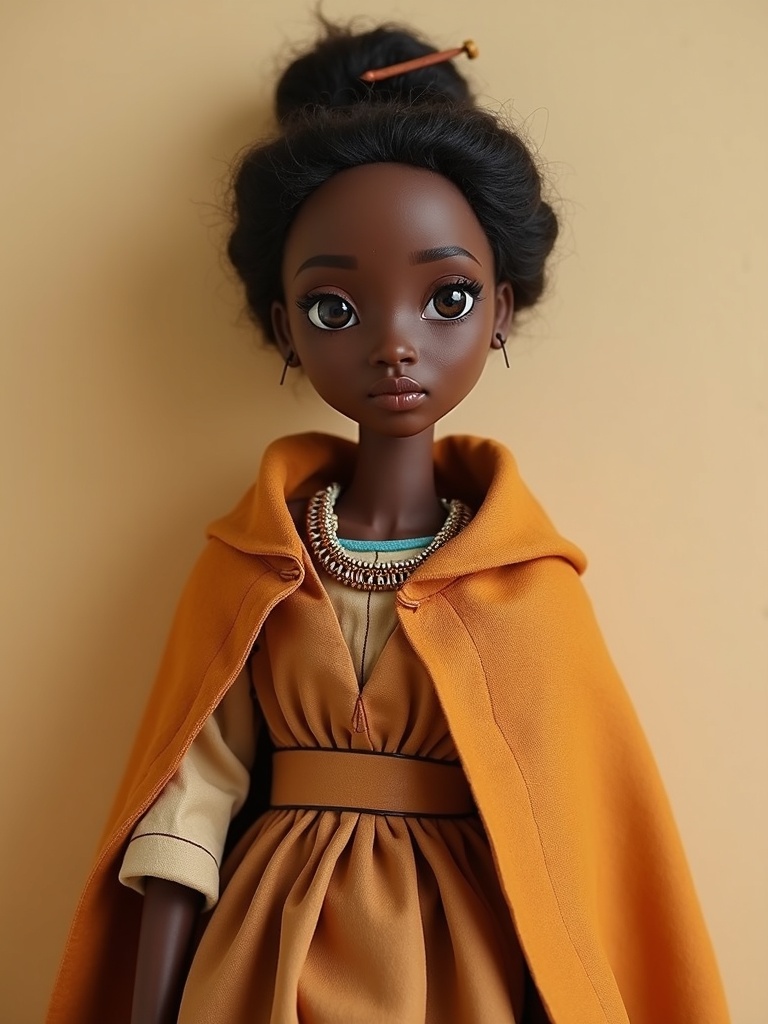
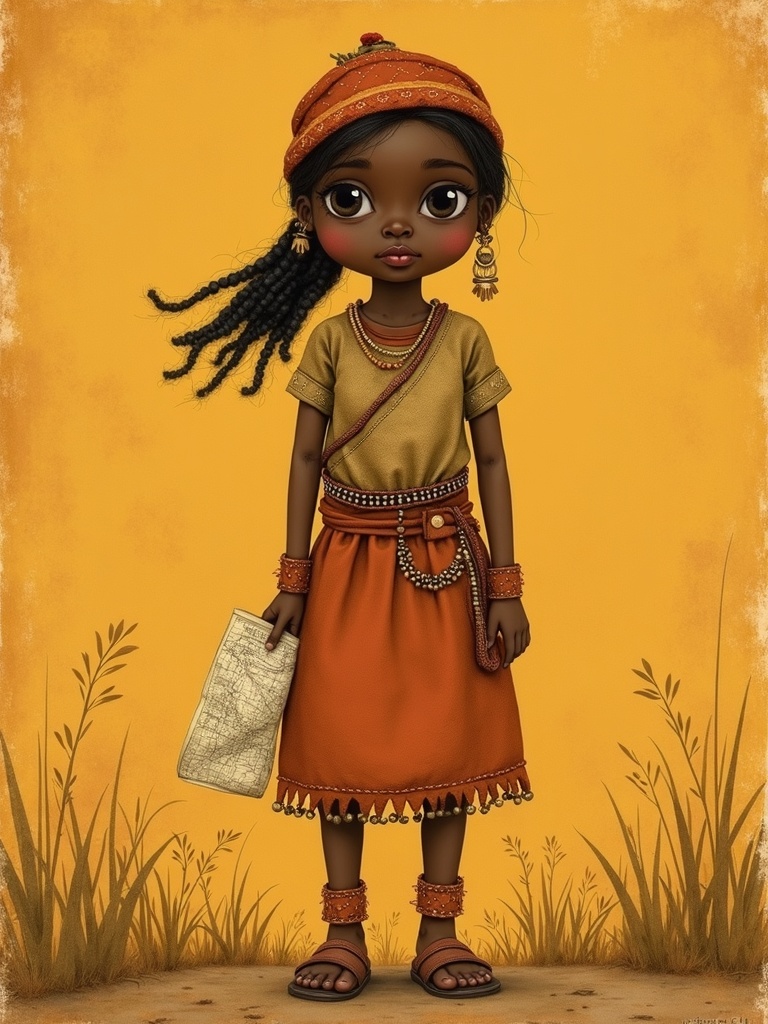
AI design preview — not a photo of the finished handmade doll
Freedom & Women's Rights
Wambui Waiyaki Otieno
She took the Mau Mau oath as a schoolgirl and spent the next sixty years refusing to be silenced — first by an empire, then by anyone who told a Kenyan woman to know her place.
- People
- Kikuyu
- Country
- Kenya
- Region
- East Africa
- Era
- 1936–2011
- Theme
- Freedom & Women's Rights
⚖ A respectful concept
Wambui Waiyaki Otieno (1936–2011) was a real Kenyan freedom fighter and women's-rights campaigner who died in 2011. This doll is a respectful homage, NOT an exact likeness of her face — it honours her courage and her lifelong fight for women's rights and dignity, never her suffering. Only her publicly documented words and well-sourced biography are used here; nothing is invented or put in her mouth. Any portrait must say 'respectful homage, no exact likeness', and the figure is a respectful draft, not a finished product. Consent of her family and of relevant Kenyan national/cultural institutions would be sought before any public sale.
Make your own
Design your Wambui Waiyaki Otieno
Pick a garment, a hairstyle and a scene, enter the PIN and generate a fresh image of Wambui Waiyaki Otieno with AI.
⚖ AI homage concept — not a likeness of the real person.
Each image is generated live with fal.ai.
Generated images
AI design preview — not a photo of the finished handmade doll
No images generated yet — be the first.
Tradition & Origin
She took the Mau Mau oath as a schoolgirl and spent the next sixty years refusing to be silenced — first by an empire, then by anyone who told a Kenyan woman to know her place.
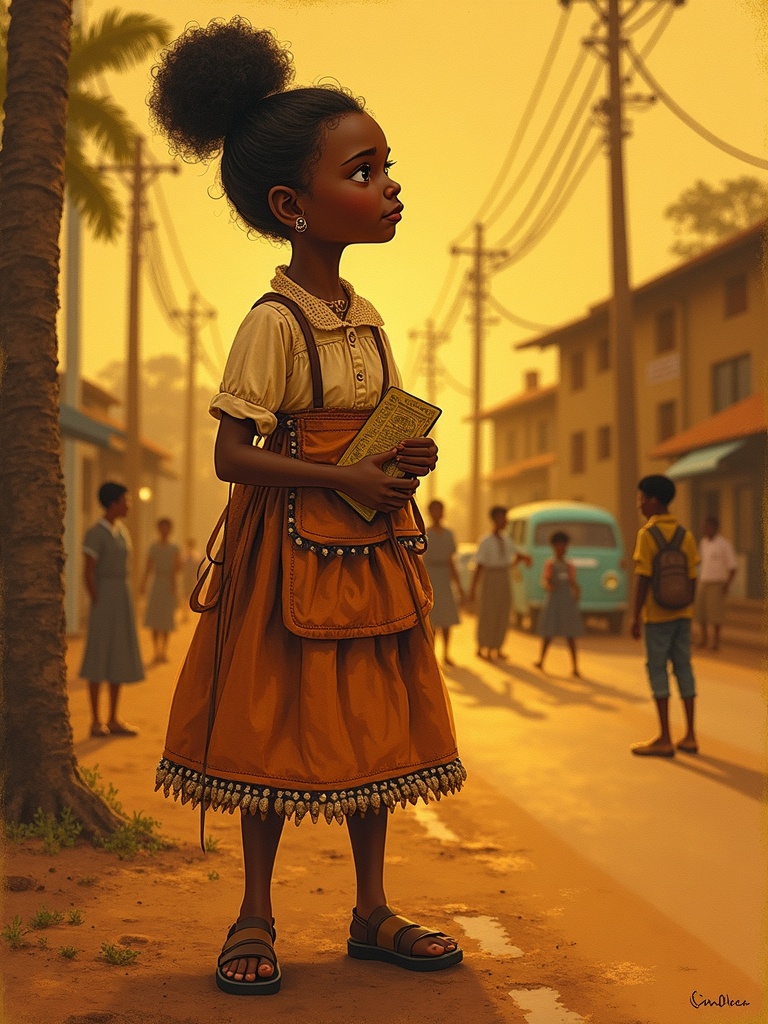
Virginia Edith Wambui Waiyaki was born in 1936 into one of Kikuyu-land's most famous families. Her great-grandfather, Waiyaki wa Hinga, had been seized by the Imperial British East Africa Company in 1892 for resisting colonial encroachment; her father was a senior police officer and her brother, Munyua Waiyaki, would become Kenya's foreign minister. Resistance was, quite literally, her inheritance — and as a teenager she chose to claim it.
When the State of Emergency fell over Kenya on 20 October 1952, Wambui was already sworn to the Mau Mau struggle. She served as a scout and intelligence agent in colonial Nairobi, organising women into cells to gather information and obtain arms, and reporting to the movement's War Council. Because some things were too dangerous to say aloud, she would sketch routes and layouts on paper. In 1960 she was arrested and held in a detention camp at Lamu, where she endured grievous abuse — one woman among the up to 150,000–160,000 Kenyans caught in Britain's vast network of emergency camps.
Independence in 1963 did not end her fight; it changed its target. As head of KANU's women's wing she campaigned so relentlessly for women that Kenyans nicknamed her chuo mon — 'husband of women' — and she insisted that the freedom war had never been only a men's war. That same year she married the Luo lawyer S.M. Otieno, a bold inter-tribal union in a divided country; together they raised five children of their own and fostered six orphans.
Her name entered Kenyan law books through grief. When S.M. Otieno died in 1986, Wambui fought his clan in court for the right to bury him as she said he wished. She lost: the 1987 Court of Appeal ruled that Luo customary law prevailed, and he was buried at Nyamila. Yet the case became the country's landmark precedent on burial, custom and the standing of a widow — forcing a modern nation to weigh whose voice counts when tradition and a woman's wishes collide. She told her own story in Mau Mau's Daughter (1998) and campaigned on until her death in 2011.
Timeline
- 1936Born into the prominent Kikuyu Waiyaki family near Kiambu, descended from Waiyaki wa Hinga.
- 1952Swears the Mau Mau oath as a schoolgirl and becomes a scout and intelligence agent.
- 1960Arrested and held in a detention camp at Lamu during the colonial State of Emergency.
- 1963Kenya wins independence; she leads KANU's women's wing and marries Luo lawyer S.M. Otieno.
- 1987Loses the landmark S.M. Otieno burial case, which becomes Kenya's precedent on widows' rights.
- 1998Publishes her autobiography 'Mau Mau's Daughter: A Life History'; she dies in 2011.
Did you know?
- Her great-grandfather Waiyaki wa Hinga was seized by the British in 1892 — so Wambui was a fourth generation of her family to defy empire.DetailsEN
- When words were too risky, she scouted by drawing maps: 'It was sometimes very difficult to explain things verbally, so I would draw them on a piece of paper.'DetailsEN
- She married across Kenya's deepest ethnic line — a Kikuyu woman wedding a Luo lawyer in 1963 — and the couple fostered six orphaned children alongside their own five.DetailsEN
- She lost the burial case, yet it remains the precedent Kenyan courts still cite when custom and a widow's wishes collide over where the dead are laid.DetailsEN
A scout learns to read the ground she stands on — and Wambui never stopped mapping the way toward a freer place for the women who would follow.
Values & Capabilities
Capabilities
◆◆◆◆◆ shows how central a gift is — five diamonds mark a signature strength, fewer mark a supporting one.
As a teenager she slipped through colonial Nairobi as a Mau Mau scout, mapping danger with a pencil when words were too risky.
She was born into a family that had defied empire for generations — and she chose to carry that flame on.
She fought so loudly for women's rights that people gave her a teasing title — and she wore it as a badge of honour.
In a divided country she married across ethnic lines for love, and never apologised for it.
She lost a painful court battle over her husband's burial — yet that loss forced a nation to ask whether a widow's voice counts.
Development
1 of 6 stages unlocked
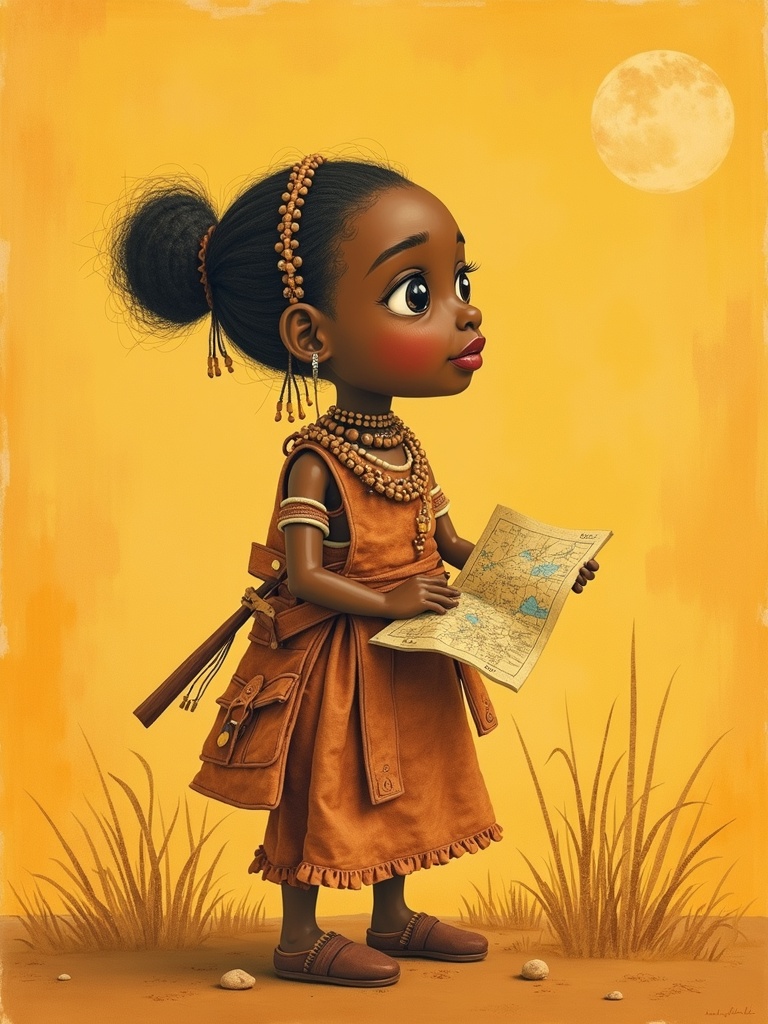
Born in 1936 into a proud Kikuyu family long known for resisting colonial rule.
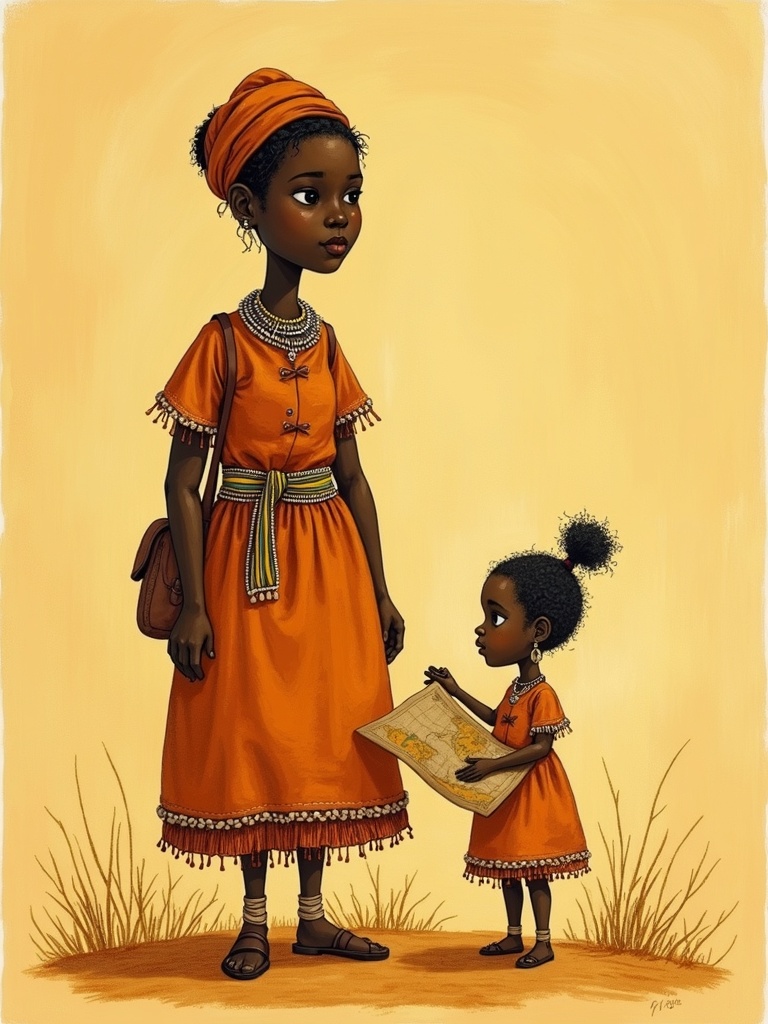
Answer all three to unlock this stage.
Unlock the previous stage first.
Unlock the previous stage first.
Unlock the previous stage first.
Unlock the previous stage first.
Crafting the doll
The doll is sewn to honour traditional Kikuyu women's dress: a tan leather-look wrap skirt (mũthuru), a finely beaded front apron (mũniũrũ) studded with cowrie shells, and a soft ochre-toned goatskin-look cloak (nguo ya ngoro / nyathiba), made here from felt, faux-leather and treated cotton rather than real hide. Brightly printed kitenge cotton gives an alternative 1960s independence-era dress and headwrap, and a strand of multi-coloured Kikuyu beads sits at the throat. Her signature attributes are a tiny hand-drawn scout's map and a stamp-sized memoir book ('Mau Mau's Daughter'). The education card explains the Mau Mau freedom struggle, women's role in it, and the landmark S.M. Otieno case on widows' rights — honestly, including the hard colonial history. Sizes Classic 32 / Kidogo 18–20 / Shule 28. A share of proceeds supports Kenyan women's-rights and heritage education.
How this doll is made
This homage grounds the doll in traditional Kikuyu women's dress — the leather wrap skirt (mũthuru), the cowrie-studded beaded apron (mũniũrũ) and a soft ochre goatskin-look cloak — alongside an independence-era kitenge dress, with a scout's pencil map and a tiny memoir book as making-accessories that tell her story of freedom and women's rights through cloth, not likeness.
- Garments 2
- Accessories 3
- Materials 2
- Techniques 3
Garments
- Mũthuru (leather wrap skirt)The foundational Kikuyu women's garment: a wrap-around skirt made from two sheep skins, tapered so it 'protected the lady nicely even when she bent over' for grinding grain or cultivating. Rendered here in tan faux-leather.DetailsEN
- Independence-era kitenge dressA smart 1960s tailored dress of bright kitenge / Ankara wax-print cotton with a matching tied headwrap — the proud everyday dress of a post-independence Kenyan woman leader. In green, red and gold.DetailsEN
Accessories
- Mũniũrũ (beaded apron)A fully beaded tracery apron worn by initiated Kikuyu women, decorated with cowrie shells — a sign of maturity; worn over the mũthuru skirt.DetailsEN
- Kikuyu beaded jewelleryEarrings, necklaces, bracelets and anklets of multi-coloured beads and cowrie shells, worn to express age, status and pride — re-created here in tiny felt and bead pieces.DetailsEN
- Scout's pencil mapA tiny folded hand-drawn map echoing Wambui's own account of sketching routes and layouts when scouting for Mau Mau because they were 'difficult to explain verbally'.DetailsEN
Materials
- Goatskin cloak (nguo ya ngoro / nyathiba)An upper cloak made from three to four goat skins, scraped of hair and treated 'with ochre and castor oil until it was soft' — represented here with soft ochre-toned felt and faux-leather rather than real hide.DetailsEN
- Cowrie shells & glass beadsCowrie shells and multi-coloured glass beads, the core ornament materials of Kikuyu women's aprons and jewellery, signalling status and fertility.DetailsEN
Techniques
- Leather scraping & ochre tanningPreparing the cloak by scraping the hair from goat skins and softening the leather with ochre and castor oil — the traditional Kikuyu leatherworking method, echoed with dyed felt.DetailsEN
- Beaded apron traceryStitching tiny beads into the fine tracery pattern of a mũniũrũ apron and sewing cowrie shells along seams and repair lines — decorative beadwork that doubled as construction.DetailsEN
- Kitenge dressmaking & headwrap tyingCutting and hemming printed cotton into a tailored 1960s dress, then folding and wrapping a matching length of the same cloth into a tied headwrap.DetailsEN
How it's made
Every doll is sewn by hand from natural materials — built to last a lifetime and to be repaired, not replaced. Here is the shopping list and the work steps. Sizes: Classic 32 cm (heirloom) · Kidogo 18–20 cm (toddlers, no small parts) · Shule 28 cm (school edition).
Shopping list
- Natural cotton or linen for the body (skin tone), ~0.5 m
- Wool or cotton stuffing — no plastic
- Cotton thread and embroidery floss in matching colours
- Garment fabric in this doll's colours (see the fabrics above)
- Yarn for the hairstyle
- Beads, cowrie shells and trims as shown
- Sharps and embroidery needles, pins, fabric scissors, fabric marker
Work instructions
- Trace and cut the body pattern at your chosen size (Classic 32 cm / Kidogo 18–20 cm / Shule 28 cm).
- Sew the body pieces right sides together, leave an opening, turn and stuff firmly with natural fibre, then close by hand.
- Embroider the face gently and with dignity — no plastic parts for the toddler line.
- Make the hair from yarn following the chosen hairstyle and attach it securely.
- Cut and sew the garment from this doll's fabric, then dress the doll.
- Add the beadwork, shells, trims and any attribute by hand.
- Check every seam and reinforce it — the doll should be lifelong and repairable, with no loose small parts for small children.
Origin & Ethics
How we know this
This record is strongly documented (★★★★★) for its core: Wambui's Mau Mau oath and scouting, her 1960 detention, her leadership of KANU's women's wing, her inter-tribal marriage to S.M. Otieno, the 1987 burial case and its legal significance, her 1998 memoir and her 2011 death are all in reputable press, encyclopaedia and scholarly sources. Some finer points — her precise Mau Mau rank and the framing of her ancestor — rest mainly on her own memoir and are flagged as such in the balance note. All quotes are documented, not invented; this is an homage doll, not a likeness, and no suffering is depicted.
As a recently deceased real person, this figure is offered as a respectful homage and would only proceed with the consent of Wambui Otieno's family and of relevant Kenyan national and cultural institutions. Traditional Kikuyu dress detail (mũthuru, mũniũrũ, beadwork) would be reviewed with Gĩkũyũ cultural advisers and Kenyan craftspeople, and only her publicly documented words and a well-sourced biography are used — each tied to a published source, with no scene of violence or suffering depicted.
Sources
- Wikipedia, Wambui Otieno — full biography, Waiyaki lineage, Mau Mau, detention, S.M. Otieno marriage and burial case, later activism, death
- Foreign Policy in Focus (FPIF), 'A Decade of Living Dangerously: Wambui Otieno's Mau Mau' — scout role, 15 oaths, War Council, 'chuo mon', neglected women veterans
- Wikipedia, Silvano Melea Otieno — S.M. Otieno (1931–1986), the burial dispute, 1987 Court of Appeal ruling and Nyamila burial
- The Standard, 'How SM Otieno case helps courts resolve burial rows' — the case as Kenya's landmark precedent on burial, custom and widows
- Wikipedia, Mau Mau rebellion — State of Emergency 1952–1960, scale of detention, women's role in the struggle
- Kenya Yearbook Editorial Board, 'Wambui Otieno – Rebel who redefined the gender relations debate' — her freedom-fighting and women's-rights legacy
- Lynne Rienner Publishers, 'Mau Mau's Daughter: A Life History' — her 1998 autobiography (publisher page)
- Gĩkũyũ Centre for Cultural Studies (mukuyu) — traditional Kikuyu women's dress: mũthuru, mwengũ, goatskin cloak, gĩcoco and mũniũrũ beaded aprons
- National Army Museum, 'Kenya Emergency' — the British emergency, detention and historical context