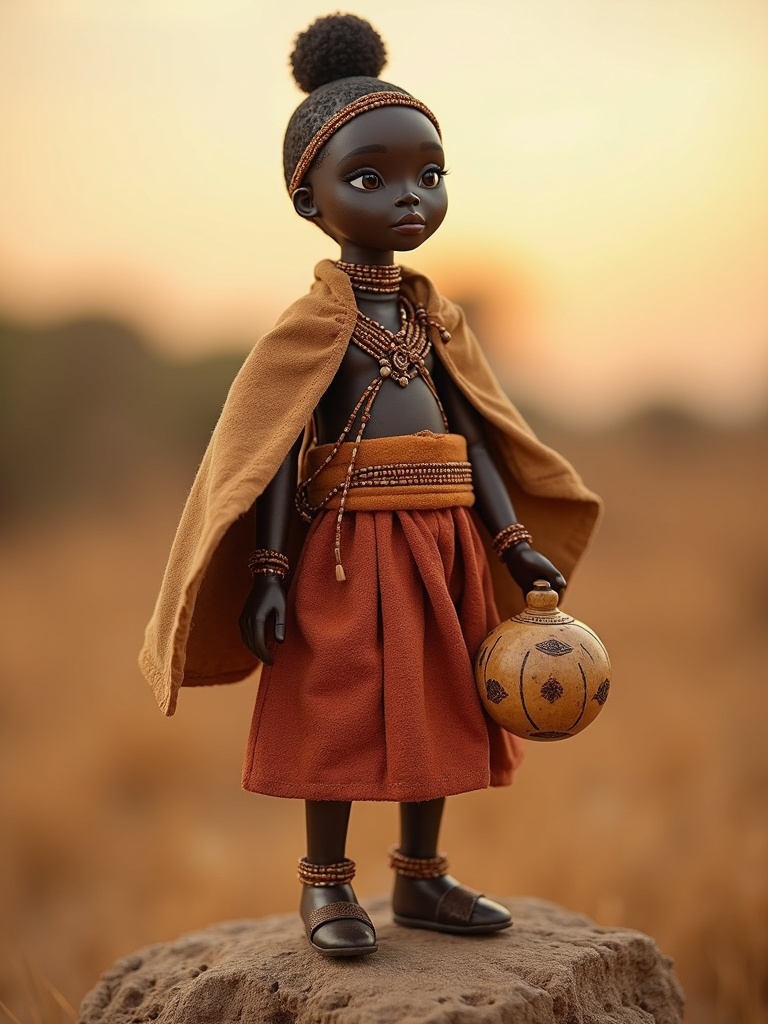
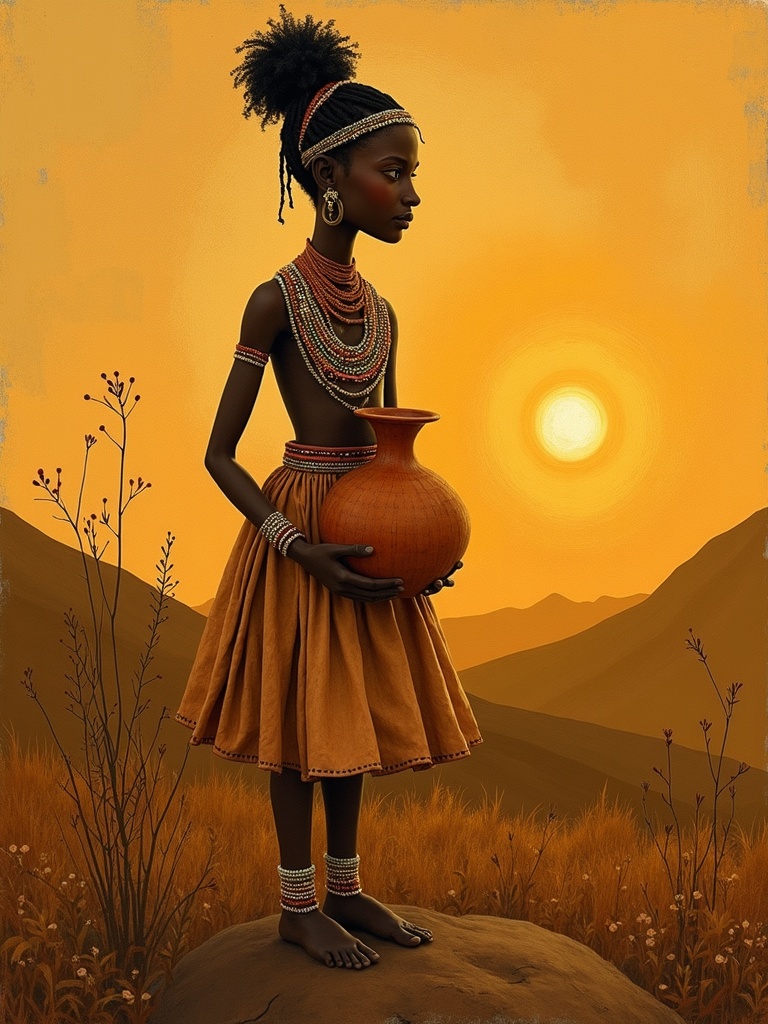
AI design preview — not a photo of the finished handmade doll
Vision & Prophecy
Syokimau
Long before a single rail was laid, an Akamba medicine woman of the Iveti Hills is said to have seen a long snake belching fire and smoke crossing the land — and named the strangers it would carry.
- People
- Akamba (Kamba)
- Country
- Kenya
- Region
- East Africa
- Era
- 19th century (oral tradition)
- Theme
- Vision & Prophecy
Make your own
Design your Syokimau
Pick a garment, a hairstyle and a scene, enter the PIN and generate a fresh image of Syokimau with AI.
Each image is generated live with fal.ai.
Generated images
AI design preview — not a photo of the finished handmade doll
No images generated yet — be the first.
Tradition & Origin
Long before a single rail was laid, an Akamba medicine woman of the Iveti Hills is said to have seen a long snake belching fire and smoke crossing the land — and named the strangers it would carry.
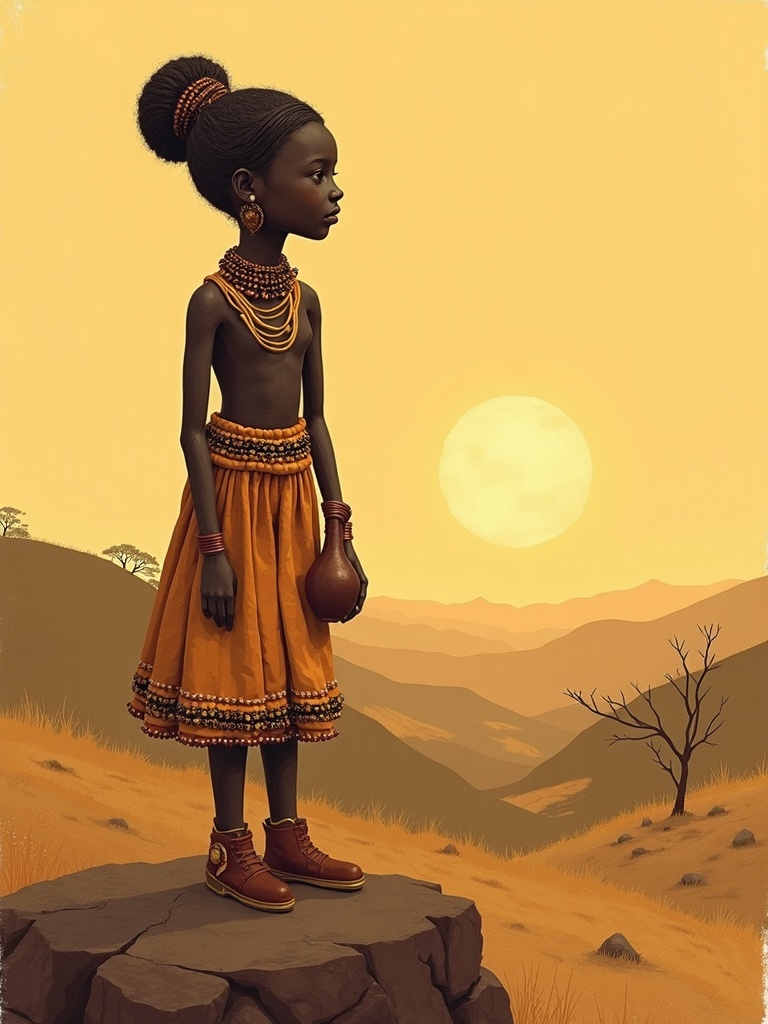
Syokimau lived in the 1800s among the Akamba (Kamba), raised in the Iveti Hills near today's Machakos, in the dry hill country of eastern Kenya. Her name means simply 'daughter of Kimau' — from the Kikamba prefix syo- for a female relation, joined to her father's name. To her people she was two things at once: a medicine woman who knew the herbs and the healing gourd, and a prophetess whose visions were taken seriously enough to shape how the community moved and defended itself.
Her most famous prophecy is startling in its specificity. By the mid-1800s she is said to have described a 'long snake spitting fire and smoke' that would travel 'from waters to another waters,' carrying people 'with skin like meat' whose speech was 'nonsensical like the chirping of the birds' and who 'carried fire in their pockets.' Generations later her words were read as the Kenya–Uganda Railway from Mombasa to Kisumu, the arrival of Europeans, matchboxes and firearms — and, in some tellings, even skyscrapers, 'houses built one on top of another.' Tradition also credits her with foreseeing raids by the Maasai and Kikuyu in time for Kamba warriors to prepare.
It matters to say plainly what kind of story this is. Almost everything we know of Syokimau comes from Akamba oral tradition, not from written records made in her lifetime; her dates drift between tellings, and some versions say she died and rose again twice. What is firmly documented is her legacy in the landscape: the Syokimau suburb of Machakos County, just south of Nairobi, and its Syokimau Railway Station — a commuter halt opened in 2012 and, beside it, the Standard Gauge Railway terminus — really carry her name, and a statue there honours the prophetess who, the story goes, saw the snake of fire long before it came.
Her people are no small thread of Kenya. The Kamba numbered over 4.6 million in the 2019 census — the country's fifth-largest community — living mainly across Machakos, Kitui and Makueni, the region called Ukambani. They are celebrated as long-distance traders and as master wood-carvers, a craft brought to commercial life by Mutisya Munge of Wamunyu after the First World War. Syokimau belongs to this living culture: a healer, a seer, and a woman whose name a modern nation chose to keep.
Timeline
- early 1800sSyokimau is born and raised among the Akamba in the Iveti Hills near present-day Machakos (per oral tradition).
- mid-1800sShe is said to prophesy the 'snake of fire,' the coming of pale strangers, and great change.
- 1896–1901The Kenya–Uganda Railway is built from Mombasa toward Kisumu — the 'snake' of her vision.
- 2012The Syokimau commuter railway station opens south of Nairobi, carrying her name.
- 2017The Mombasa–Nairobi Standard Gauge Railway terminus opens at Syokimau, where a statue honours the prophetess.
Did you know?
- Syokimau was not only a seer but a respected medicine woman — Kamba healers used a decorated gourd calabash, the kwausia, to give patients their cures.DetailsEN
- In tradition, a fellow prophetess named Syonguu wa Kathukya of Athi River was so amazed by Syokimau's gift that she named the place after her — the name that survives on a Nairobi-area railway station today.DetailsEN
- The Kamba believed in one creator, Ngai or Mulungu, reached through ancestral spirits called the Aimu — and seers like Syokimau danced the kilumi to commune with that unseen world.DetailsEN
- Her people are famed wood-carvers: the commercial Kamba carving trade began with Mutisya Munge of Wamunyu after WWI, and by the mid-1950s a single Kamba village grossed up to £250,000 a year from carvings.DetailsEN
She read a horizon no one else could yet see — and kept her hands busy healing the people who lived under it.
Values & Capabilities
Capabilities
◆◆◆◆◆ shows how central a gift is — five diamonds mark a signature strength, fewer mark a supporting one.
She foresaw a long snake belching fire and smoke moving from waters to waters — generations before the railway arrived.
She warned of pale strangers who spoke like chirping birds and carried fire in their pockets.
Beyond prophecy she was a medicine woman, mixing herbal cures and tending the sick of the Iveti Hills.
She is said to have foreseen raids by neighbouring peoples, giving Kamba warriors time to ready their defence.
Through the kilumi dance and the ancestral spirits, she carried questions from her people to the unseen world.
Development
1 of 4 stages unlocked
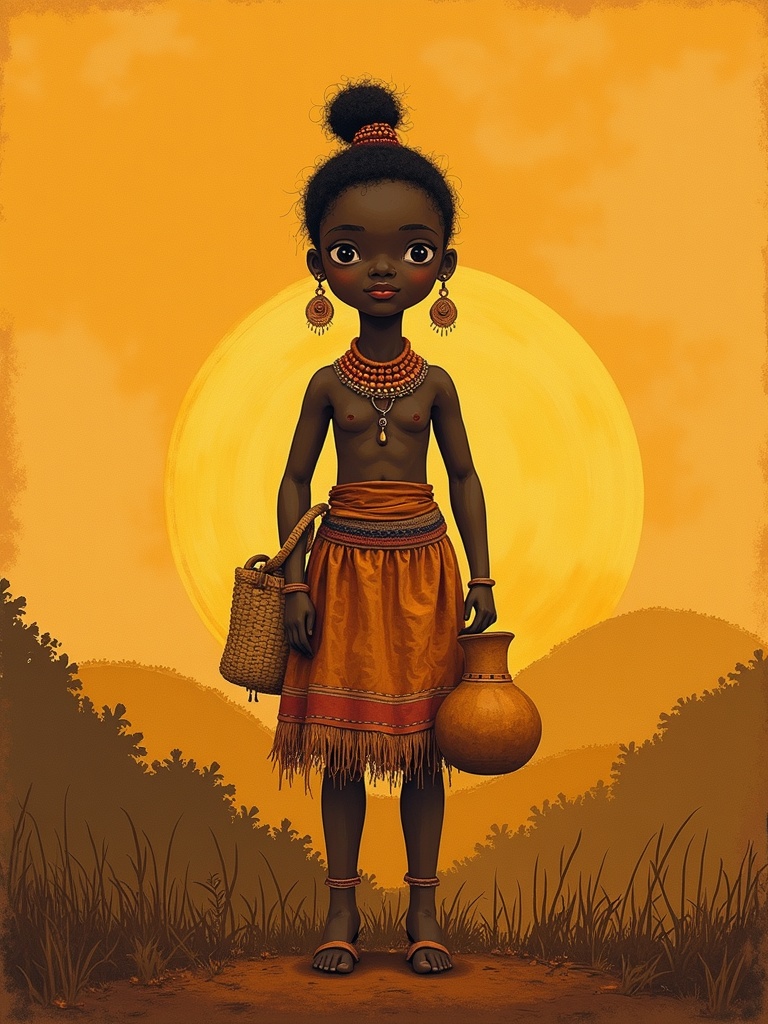
She grew up among the Akamba in the dry, beautiful hill country near today's Machakos.
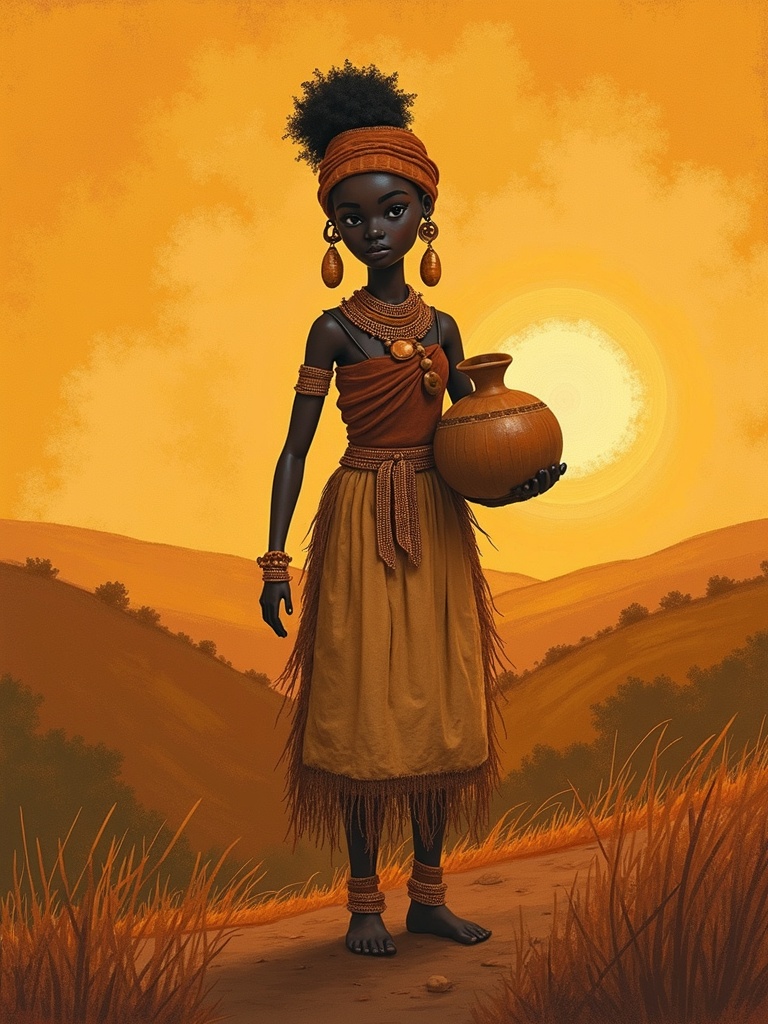
Answer all three to unlock this stage.
Unlock the previous stage first.
Unlock the previous stage first.
Crafting the doll
The doll is built from honest, regional materials: a knee-length skirt suggesting Akamba bark-cloth and softened leather, hand-sewn glass-bead panels in Kamba red, ochre, white and dark blue, and copper-and-brass-toned neck-rings, a ndiki chain and brass earrings reproduced in safe metal-look thread and findings. Her signature attribute is the small decorated gourd calabash (kwausia) of the medicine woman, with a beaded headband over a smooth head. A clip-on education card tells, in honest words, which parts of her story are documented and which are living oral tradition. Sizes Classic 32 / Kidogo 18–20 / Shule 28. A share of proceeds supports Kamba craft cooperatives and oral-history keepers in Ukambani.
How this doll is made
Syokimau's doll draws on real 19th-century Akamba women's dress and the material culture of the Kamba medicine woman — bark-and-leather skirts, dense beadwork, copper and brass ornaments, and the healer's gourd.
- Garments 2
- Accessories 3
- Materials 2
- Techniques 3
Garments
Accessories
- Copper & brass neck-rings (mûlia wa ngingo)Stacked copper rings worn at the neck, part of the Akamba love of copper and brass jewellery.DetailsEN
- Brass earrings (mûlia wa kûtû) with mûnyo chainBrass or copper earrings linked by a fine metal chain (mûnyo) — a signature Kamba ornament.DetailsEN
- Beaded headbandHeavily beaded headband worn over a shaved head, a distinctive part of Kamba women's adornment.DetailsEN
Materials
Techniques
- Geometric seed-bead weavingBeads strung and stitched in distinct geometric patterns that distinguished groups within the Kamba community.DetailsEN
- Kilumi spirit-dance regaliaBeaded necklaces fitted with small aluminium bells and accompanied by drums, worn by the diviner to set the rhythm of the kilumi dance.DetailsEN
- Kamba woodcarving heritageThe Kamba's celebrated craft tradition — wood-carving begun commercially by Mutisya Munge and centred at Wamunyu — informs the wooden beads and staff of the doll's props.DetailsEN
How it's made
Every doll is sewn by hand from natural materials — built to last a lifetime and to be repaired, not replaced. Here is the shopping list and the work steps. Sizes: Classic 32 cm (heirloom) · Kidogo 18–20 cm (toddlers, no small parts) · Shule 28 cm (school edition).
Shopping list
- Natural cotton or linen for the body (skin tone), ~0.5 m
- Wool or cotton stuffing — no plastic
- Cotton thread and embroidery floss in matching colours
- Garment fabric in this doll's colours (see the fabrics above)
- Yarn for the hairstyle
- Beads, cowrie shells and trims as shown
- Sharps and embroidery needles, pins, fabric scissors, fabric marker
Work instructions
- Trace and cut the body pattern at your chosen size (Classic 32 cm / Kidogo 18–20 cm / Shule 28 cm).
- Sew the body pieces right sides together, leave an opening, turn and stuff firmly with natural fibre, then close by hand.
- Embroider the face gently and with dignity — no plastic parts for the toddler line.
- Make the hair from yarn following the chosen hairstyle and attach it securely.
- Cut and sew the garment from this doll's fabric, then dress the doll.
- Add the beadwork, shells, trims and any attribute by hand.
- Check every seam and reinforce it — the doll should be lifelong and repairable, with no loose small parts for small children.
Origin & Ethics
How we know this
Syokimau is largely an oral-tradition prophetess: her existence, deeds and even dates come from Akamba storytelling, not contemporaneous written records, so this record clearly separates living legend (her visions, resurrections, exact dates) from what is documented (the named Syokimau suburb, railway station and statue near Nairobi; the real history of the Kenya–Uganda Railway and Kamba culture). No quotes are attributed to her as her literal words; the prophecy phrasings are as recorded by later sources. No rights/likeness issues apply.
This homage was prepared with reference to the National Museums of Kenya's published accounts of Syokimau and the Kamba community, and to Akamba cultural sources; because Syokimau is a legendary figure of oral tradition rather than a living person, no family or estate consent applies, but the record is framed to respect Kamba spirituality and the communities of Machakos, Kitui and Makueni who keep her memory. Kamba craft and heritage bodies are credited as cultural reference-holders.
Sources
- Prophetess Syokimau — Wikipedia
- Syokimau (suburb & railway station) — Wikipedia
- Syokimau: The Story of a Great Kamba Prophetess and Medicine Woman — National Museums of Kenya / Google Arts & Culture
- Kamba Beliefs, Folklore, and Magic — National Museums of Kenya / Google Arts & Culture
- Syokimau — Shujaa Stories
- Kamba people — Wikipedia
- Kamba People of Kenya: Traditional Kamba Attire and Jewellery — Lughayangu
- Kamba arts and crafts — Traditional Music & Cultures of Kenya (Jens Finke)
- The legacy of Mutisya Munge — a Kamba carver like no other — Duende Art Projects