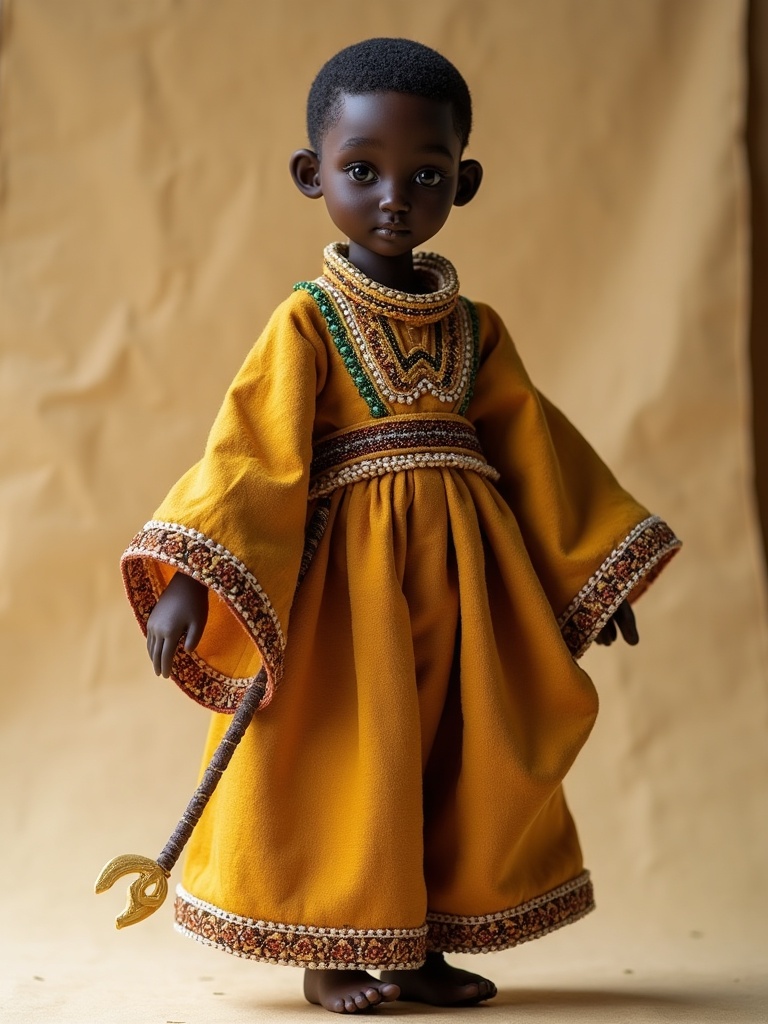
The Ten
Sundiata Keita
Sundiata Keita was born around 1210 as the son of the Mandinka king Naré Maghann Konaté and his wife Sogolon. His name derives from „Sogolon Djata" — „the Lion of Sogolon". [6] But as a child he could not walk ; his mother was mocked by…
- People
- Mandinka
- Country
- Mali
- Region
- West Africa
- Era
- ≈1210–1255
- Theme
- Will & Justice
Make your own
Design your Sundiata Keita
Pick a garment, a hairstyle and a scene, enter the PIN and generate a fresh image of Sundiata Keita with AI.
Each image is generated live with fal.ai.
Generated images
No images generated yet — be the first.
History & Meaning
①Tradition, Life & the Hungering Lion
Sundiata Keita was born around 1210 as the son of the Mandinka king Naré Maghann Konaté and his wife Sogolon. His name derives from „Sogolon Djata" — „the Lion of Sogolon".[6] But as a child he could not walk; his mother was mocked by the co-wives because of his disability. That struck him deeply — and awakened an indomitable will.[6]
From Exile to Founder
When the mighty Sosso king Soumaoro Kanté conquered the Mandinka land and toppled Sundiata's father, the family went into exile. But a prophecy saw in Sundiata the future liberator — messengers sought him out and called him back. On the plain of Siby he forged with the young war leaders of his generation a brotherhood pact to free the land.[7] Around 1235 he defeated Soumaoro in the decisive Battle of Kirina — and that same year founded the Mali Empire.[1][3] He was the first Mandinka ruler to assume the title Mansa ("King of Kings").[2]
Under Sundiata and his successors, Mali grew into an empire that spanned most of West Africa — from the Atlantic coast far beyond the Niger, from the goldfields of Wangara to the edge of the Sahara. He made Niani the capital.[9]
📜 The Manden Charter — one of the oldest constitutions in the world
Sundiata's greatest legacy was not a sword, but a law. After the victory, he assembled in the clearing Kurukan Fuga the clan chiefs and proclaimed the Manden Charter (Kurukan Fuga) — an oral constitution from 1235/36, declared an intangible cultural heritage by UNESCO in 2009.[10][11] Many call it one of the earliest declarations of human rights in the world — centuries before comparable European documents. Among other things, it proclaims:
- the inviolability of the human person and social peace in diversity;
- the right to education — "the raising of children is the duty of the whole society";
- food security and respect for nature;
- the abolition of enslavement through raids;
- freedom of speech and trade.[11][12]
To this end, Sundiata created the Gbara, a large assembly of clan representatives — a kind of parliament that advised him and kept him from ruling alone.[7]
The Griots — why we know all this
Sundiata's story survived 700 years because the Griots (Djeli) passed it down from generation to generation — the hereditary storytellers of West Africa, keepers of memory.[10] In the epic, the Balafon (the West African xylophon) a key role: Sundiata's griot Balla Fasséké captured Soumaoro's magical balafon.[2] Here the circle closes back to the whole project: what the griots were for Mali, the grandmothers are today — living libraries.
Then he walked — and an entire empire followed in his footsteps.
⑤Transfer to the Present
How does Sundiata's life become a lesson for a child in 2050?
The first step
The child who could not walk learned how.
Resilience, inclusion, growth mindset. For every underestimated child — with or without a disability — the proof: Your start is not your destination. Obstacles are the beginning of the story, not the end.
The just Mansa & the Charter
Laws, rights, a consultative parliament.
Law, democracy, human rights. Africa invented human-rights principles centuries before Europe. A root for jurists, politicians, constitutional thinkers — and for African self-confidence.
The Pact of Siby
Quarreling clans united into a single 'We'.
Teamwork, diplomacy, pan-African unity. From the school group to the AfCFTA: Together you achieve what is impossible alone.
Voice of the Griots
Storytellers preserved 700 years of history.
Memory, culture, preservation. Exactly the heart of the project: Those who honor their storytellers (today the grandmothers) preserve their identity. History as treasure, not as burden.
Sundiata's promise to a child: “They laughed at my beginning. At my end they never dared. Rise up — your first step counts more than their mockery.”
Abilities & Development
Abilities
His greatest gift: to rise when everyone has written you off. The child who could not walk learned it through sheer will. In play: whoever holds Sundiata may “rise again” once — after every setback.
He united feuding clans into an alliance of brothers. Sundiata did not win alone — he forged many individuals into a shared 'we.' Teaches children: Together, you are invincible.
Instead of ruling alone, he gave his people laws: the Manden Charter with human, women's, and education rights — and an advisory parliament. Power that sets its own limits.
At Kirina, he triumphed not through sorcery but through superior strategy, historians say. Wisdom and planning defeated brute force.
Sundiata honored the storytellers who preserved his deeds — that is why we know him today. He teaches: Whoever honors their storytellers lives forever.
Through the years
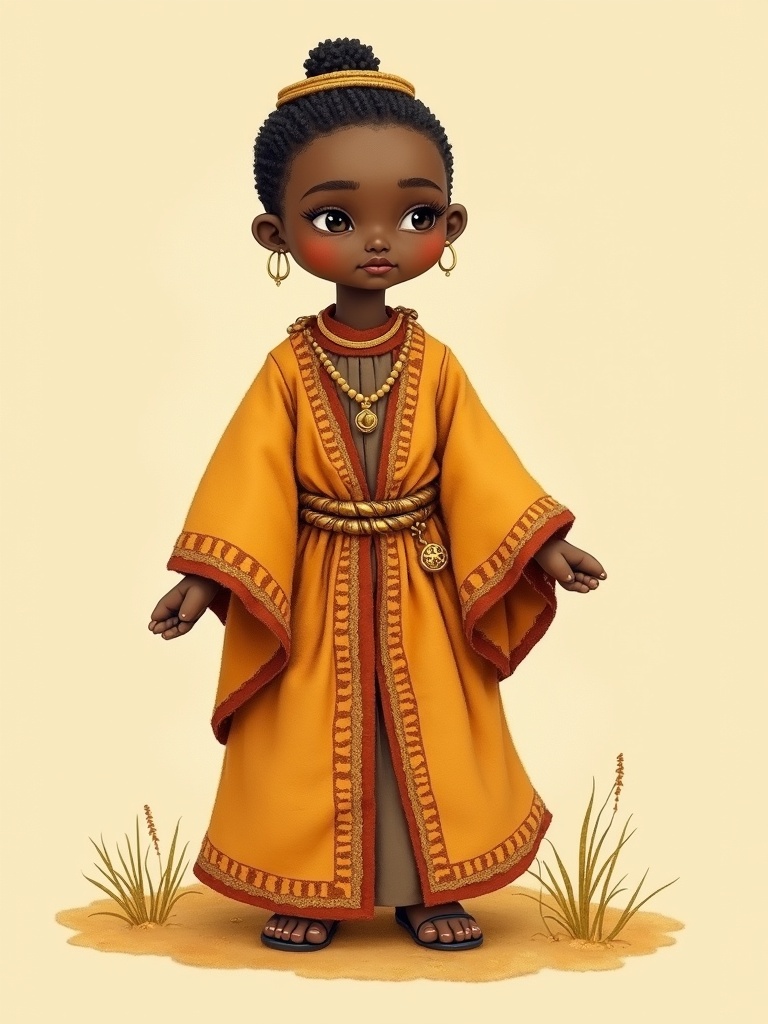
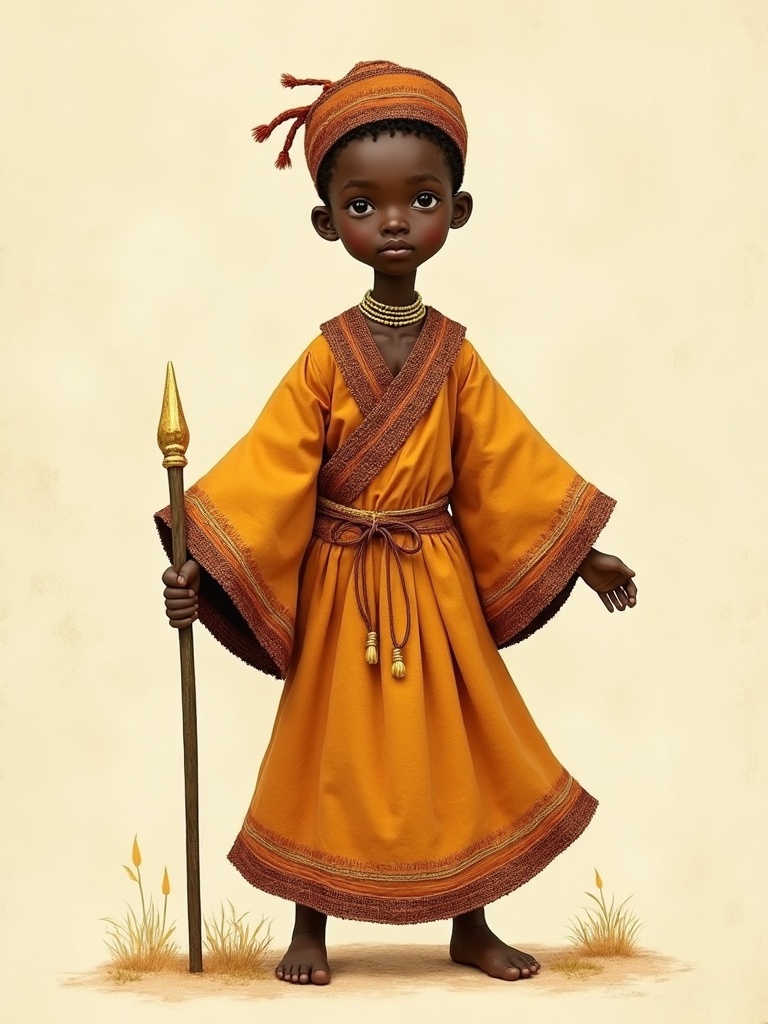
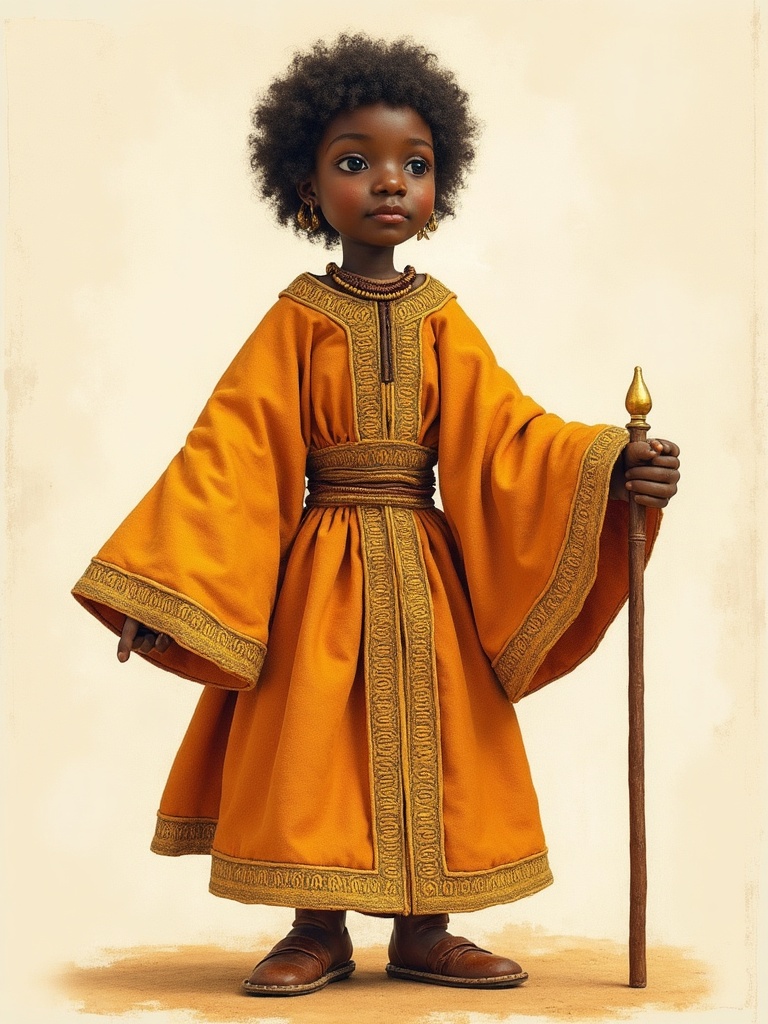
③Life Stages (historical)
The three stages follow his true life path — and tell exactly the arc that captivates children: from an underestimated child to a just ruler.
Sundiata as a small child who cannot walk — beside the heavy iron bar on which he is about to pull himself up. Vulnerable, but with fire in his eyes. Gift: The First Step.[6]
Sundiata as a young leader in exile, gathering allies: a staff-spear in hand, a young lion at his side. Gift: The Alliance of Siby.[7]
Sundiata as emperor: in full Mandinka splendor, the Manden Charter in hand, dignified and just. Signature gift united with The Just Mansa.[9][11]
Beautiful and important: The child stage depicts a disability with dignity — not as an object of pity, but as a starting point of strength. For children with a disability, this makes Sundiata a rare, precious hero figure who looks like their own beginning.
Make & Learn
⑦Fabrics & Manufacturing Notes
Real natural fibers, honest workmanship, lifelong repairability — and with Sundiata, a fabric with its own magic: Bogolan, the mud cloth.
The Materials List
The Garment: Bogolan & Boubou
For the warrior and hunter variants Bogolan (mud cloth) — hand-woven cotton, dyed with fermented mud in earth-brown geometric patterns, a West African hallmark. For the Mansa level, a wide Boubou-robe of 100 % cotton in gold and earth tones, with woven trim. Ideally sourced from Mali/Mandé weaving cooperatives. Where genuine Bogolan dyeing is too elaborate, a high-quality printed Bogolan pattern — visibly marked, never passed off as a genuine mud cloth.
The signature attribute: the iron bar
Instead of a weapon, Sundiata carries his iron bar bent into a bow — as a small, sturdy wood/felt prop (no sharp metal, child-safe). Optionally a tiny felt lion and a mini-Balafon made of wooden sticks. Amulets and cowries sewn on, no small parts that can be swallowed in the school/toddler line.
Signature & education card
Embroidered into the hem: „Sundiata Keita" and the name of the seamstress. Enclosed, a Biography card with life dates, the story of the first step and the five core points of the Manden Charter — this turns every figure into a history and values lesson. Optional QR thread to the authenticity/history page.
Production stages & effort
Full boubou or bogolan, iron staff, lion, biography card. The collector's and role-model figure — especially for boys.
Simplified garment (printed bogolan pattern), iron staff as a mini prop. Affordable entry point.
Washable, reinforced seams, bogolan as a durable ribbon appliqué. With biography card for history lessons.
How it's made
Every doll is sewn by hand from natural materials — built to last a lifetime and to be repaired, not replaced. Here is the shopping list and the work steps. Sizes: Classic 32 cm (heirloom) · Kidogo 18–20 cm (toddlers, no small parts) · Shule 28 cm (school edition).
Shopping list
- Natural cotton or linen for the body (skin tone), ~0.5 m
- Wool or cotton stuffing — no plastic
- Cotton thread and embroidery floss in matching colours
- Garment fabric in this doll's colours (see the fabrics above)
- Yarn for the hairstyle
- Beads, cowrie shells and trims as shown
- Sharps and embroidery needles, pins, fabric scissors, fabric marker
Work instructions
- Trace and cut the body pattern at your chosen size (Classic 32 cm / Kidogo 18–20 cm / Shule 28 cm).
- Sew the body pieces right sides together, leave an opening, turn and stuff firmly with natural fibre, then close by hand.
- Embroider the face gently and with dignity — no plastic parts for the toddler line.
- Make the hair from yarn following the chosen hairstyle and attach it securely.
- Cut and sew the garment from this doll's fabric, then dress the doll.
- Add the beadwork, shells, trims and any attribute by hand.
- Check every seam and reinforce it — the doll should be lifelong and repairable, with no loose small parts for small children.
⑥Ten Name Suggestions
The real name is of course retained. These ten Mandinka/Mandé names are suitable for companion figures, the brothers of Siby or the series around him. To be confirmed by Mali/Mandé authorities before use.
Honest about the spelling: Mandinka names exist in many variants (Sundiata/Sunjata/Son-Jara; Soumaoro/Sumanguru). The ones chosen here are common forms; Mandé authorities have the final word.
⑧Curriculum mapping & Subjects
Sundiata is primarily anchored to Mali's/West Africa's curricula, but can be deployed anywhere medieval history, human rights and resilience are topics. He corrects a worldwide school deficit: West Africa's advanced civilizations barely appear in many curricula.
Manden Charter
One of the oldest constitutions in the world.
History / Social Studies / Values. Human rights, constitution, democracy — through an African example, centuries before European counterparts.
The first step
Disability overcome through willpower.
Life Skills / Inclusion / Sport. Resilience, growth mindset, inclusion of children with disabilities — a hero who looks like their own beginning.
Griots & Balafon
Oral history, music.
Music & Language. Oral tradition, listening to the balafon, retelling an epic — a culture of remembrance as a subject.
Gold-Salt Trade
An empire on the trans-Saharan routes.
Geography & Economics. Trans-Saharan trade, gold & salt, the Niger as a lifeline — Africa as the center of medieval world trade.
Children tell of something they couldn't do at first and then learned after all. Learning objective: resilience, growth mindset, empathy for children with disabilities.
Starting from the Manden Charter, the class writes its own fundamental rights and rules. Learning objective: constitution, rights & duties, negotiating together.
Children become Griots and pass on the Sundiata story with rhythm. Learning objective: oral storytelling, memory, African culture of remembrance.
Origin & Ethics
How we know this
On honesty: Sundiata Keita is historically attested (among others by Ibn Khaldun), yet most of what we know comes from the epic that the Griots pass down orally — a blend of history and legendary motifs (prophecy, magic, the bent iron bar). Such elements are marked here as tradition/legend; the core facts (Kirina ~1235, the founding of the empire, the Manden Charter) are considered secure. The “abilities” and “life-stages” translate real deeds into the collectible-card format, without inventing pseudo-facts. Since the epic is living cultural heritage of the Mandé Griots, the final approval rests with them and the cultural authorities of Mali and its neighbouring countries.
⑨Elder Approval & Sources to Watch
As with Yaa Asantewaa, the question is „do we honor worthily?". Sundiata belongs to many peoples and countries (Mali, Guinea, Gambia, Senegal, Côte d'Ivoire) — and above all to the Griots, the living keepers of its history. They are the most important voice here.
The Approval Body (multi-part)
The five-step protocol
Contact through official channels (Mali Ministry of Culture, UNESCO contact points for the Manden Charter, recognized Griot associations, museums). Presentation of the vision, 42% rule, veto right.
Hand over this compendium as a draft — especially the depiction of disability, charter, and epic for review.
Griots for the epic, clan council for dignity, historians for facts, weavers for Bogolan/Boubou.
Written approval per element. The depiction of disability must be dignified; the epic must not be distorted.
Griot communities, weavers & community funds share in the profits; part of the proceeds supports the living Griot tradition and the Kurukan Fuga commemorations.
Most sensitive areas: the dignified portrayal of the disability (strength, not pity), the fidelity to the epic (no Disney distortion) and the correct, non-appropriating rendering of the Manden Charter.
Sources to watch
Sources
- Born around 1210 as the son of chief/king Naré Maghann; victory at Kirina in 1235 through superior strategy; founding of the Mali Empire in the same year. blackpast.org: Sundiata Keita; en.wikipedia.org: Battle of Kirina.
- First Mandinka ruler with the title Mansa; the Balafon & the Griot Balla Fasséké in the epic; expansion to Senegal, Niger, the Wangara goldfields. ancient-origins.net: Sundiata Keita, the Lion King of Mali.
- Battle of Kirina (~1235) against Sumanguru/Soumaoro Kanté; beginning of the Mali Empire, which ruled West Africa for two centuries. en.wikipedia.org: Battle of Kirina; web.cocc.edu: Epic of Sundjata.
- (Context: Mali as the second of the three great medieval West African empires.) web.cocc.edu: Epic of Sundjata.
- (Reserved.)
- Sundiata unable to walk as a child, his mother Sogolon mocked; name "Sogolon Djata" → Sundiata; through sheer will he learned to walk. tangietwoods.blog: Prince Sundiata Keita; grokipedia: Sundiata Keita.
- Exile & recall through prophecy; brotherhood pact on the plain of Siby; the Gbara assembly (32 clan representatives) as an advisory parliament. tangietwoods.blog; worldhistoryedu.com: Sundiata Keita, the Lion King.
- The Epic of Sundiata as a national epic, transmitted orally through Griots; the iron-bar/rising-up motif. web.cocc.edu; ancient-origins.net.
- Niani as the capital; extent of the empire & administration. worldhistoryedu.com; grokipedia: Sundiata Keita.
- Manden Charter / Kurukan Fuga: oral constitution after Kirina, handed down by Griots/Jelis, UNESCO World Heritage 2009. en.wikipedia.org: Kouroukan Fouga; archiqoo.com.
- Contents of the Charter: inviolability of the human being, social peace, the right to education, food security, abolition of enslavement through raids, freedom of speech/trade; often described as one of the earliest declarations of human rights. jpic-jp.org: The oldest constitution in the world; bigthink.com; standard.gm.
- Promulgation 1235/36, centuries-long transmission by the Malinke & Griots, set down in writing by Y. T. Cissé, UNESCO 2009. jpic-jp.org; en.wikipedia.org: Kouroukan Fouga.