Peace & Diversity
Selam
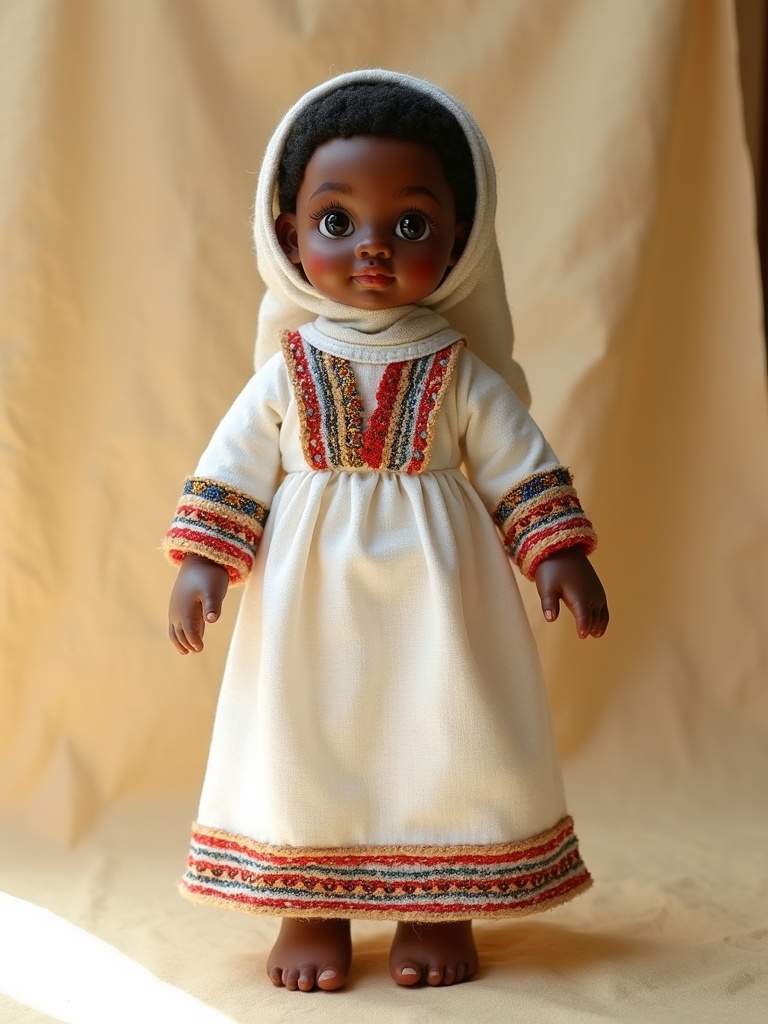
Her name is the first word a stranger hears in Ethiopia: ሰላም — selam, "peace." Selam is a present-day Habesha girl of the Ethiopian highlands, carrying a heritage that was old when Rome was young — and that never bowed to a coloniser.
- People
- Habesha
- Country
- Ethiopia
- Region
- Horn of Africa
- Era
- Present
- Theme
- Peace & Diversity
Make your own
Design your Selam
Pick a garment, a hairstyle and a scene, enter the PIN and generate a fresh image of Selam with AI.
Each image is generated live with fal.ai.
Generated images
No images generated yet — be the first.
Tradition & Origin
Her name is the first word a stranger hears in Ethiopia: ሰላም — selam, "peace." Selam is a present-day Habesha girl of the Ethiopian highlands, carrying a heritage that was old when Rome was young — and that never bowed to a coloniser.
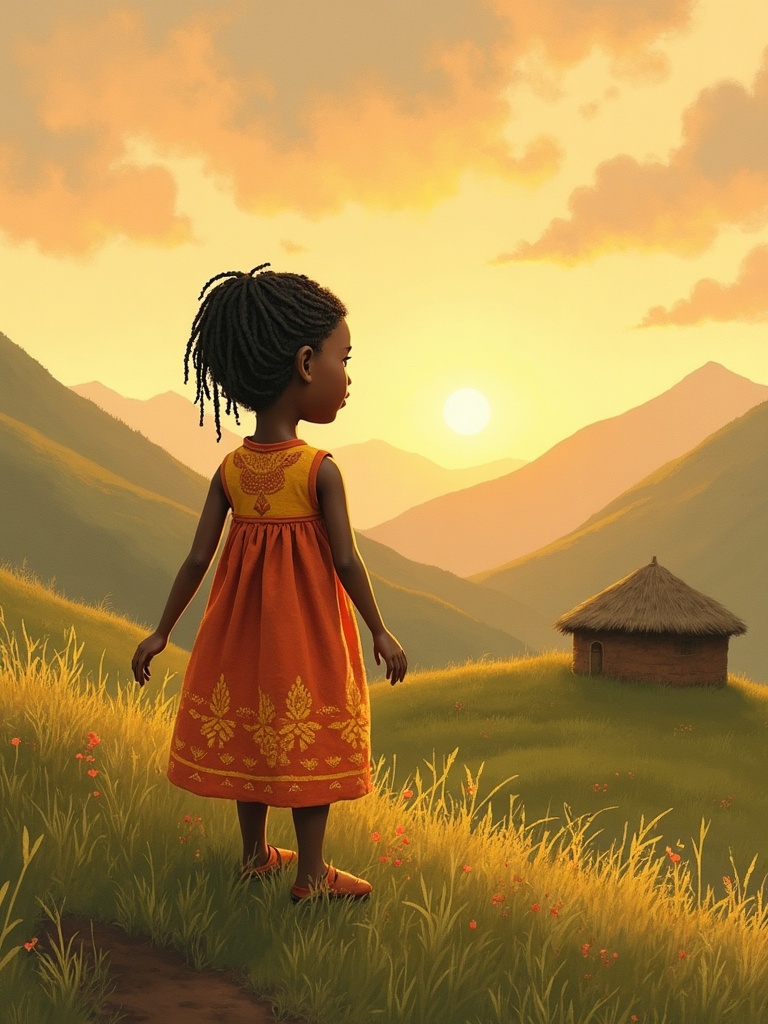
Ethiopia is home to 80+ ethnic groups and over 80 languages — Semitic, Cushitic, Omotic and Nilotic — sharing one nation.
DetailsENSelam grows up in a land that wrote its own story in its own letters. The highlands she calls home were the heart of the Kingdom of Aksum (roughly the 1st–8th centuries CE), a trading empire that sat at the crossroads of Africa, Arabia and the Greco-Roman world, commanding the Red Sea routes from its port of Adulis and dealing in ivory, gold and incense. Aksum's kings raised colossal stone stelae over their tombs — carved to look like multi-storey towers. The tallest one still standing reaches about 24 metres; the giant fallen Great Stela was carved to mimic a thirteen-storey building and is among the largest single stones humans ever quarried and tried to raise.
When Selam learns to read, she learns a script that has been in continuous use for well over two thousand years. Ge'ez (called Fidel) is an abugida — each character a consonant married to a vowel — and one of the oldest writing systems on Earth still alive today. Ge'ez survives as the liturgical language of the Ethiopian Orthodox Tewahedo Church, and its alphabet was adapted to write Amharic, Tigrinya and other languages of the region. So the same letters that carved imperial inscriptions in stone also spell out a six-year-old's homework.
Her faith is just as ancient. The Ethiopian Orthodox Tewahedo Church is one of the oldest Christian traditions in the world, and its most astonishing monument is Lalibela — eleven churches not built up from the ground but carved downward out of the living volcanic rock, hewn from a single mass of red scoriaceous basalt with hammers and chisels in the late 12th–early 13th century under King Gebre Meskel Lalibela of the Zagwe dynasty, who set out to build a "New Jerusalem" in the African highlands.
And Selam belongs to a country that is itself a chorus of peoples: Ethiopia is home to more than 80 ethnic groups and over 80 languages, spanning Semitic, Cushitic, Omotic and Nilotic tongues. It is also the rarest thing in Africa — a nation that defeated European conquest. On 1 March 1896 at the Battle of Adwa, Emperor Menelik II's army routed an invading Italian force, so that Ethiopia was never colonised (apart from a brief Italian occupation, 1936–1941). That is the inheritance behind her name: a child of peace, diversity and a freedom her ancestors won and kept.
Did you know?
- Ge'ez script is one of the oldest writing systems still in everyday use — an abugida over two millennia old that is now the basis for writing Amharic and Tigrinya.DetailsEN
- Aksum sat at the crossroads of three continents and was once ranked among the great powers of the ancient world, controlling Red Sea trade from its port of Adulis.DetailsEN
- The churches of Lalibela were not built upward but carved downward into solid rock, a whole sacred city excavated from basalt as a "New Jerusalem."DetailsEN
- Ethiopia's victory at Adwa in 1896 made it the only African nation to defeat European colonisation outright, inspiring anti-colonial movements across the continent.DetailsEN
Selam — peace — spoken by a people who carved cathedrals from mountains and were never anyone's to conquer.
Values & Capabilities
Capabilities
◆◆◆◆◆ shows how central a gift is — five diamonds mark a signature strength, fewer mark a supporting one.
Selam's greatest gift: she brings people together. Whoever holds it is the host of the circle — she practices what the coffee ceremony teaches: to listen, to share, to leave no one standing outside. In the game: "the one who invites".
Selam knows the mysterious characters of Ge'ez. She awakens in children the desire to decipher a script of their own — and the pride that their ancestors were writing when elsewhere no one yet wrote.
Selam carries the knowledge of Adwa within her: that even as the supposedly weaker party, one can stand firm against a great power. For children who feel small, she is the quiet assurance: „Your people once achieved the impossible."
In the Eskista, only the shoulders move — a joy that needs no words at all. Selam teaches children that celebration and expression need no language, only rhythm and courage.
Selam's diaspora gift: She helps children far from home reconnect a thread to where they come from. Those who feel „in between" — two countries, two cultures — find in her the message: Homecoming is possible, and it begins in the heart.
Development
1 of 3 stages unlocked
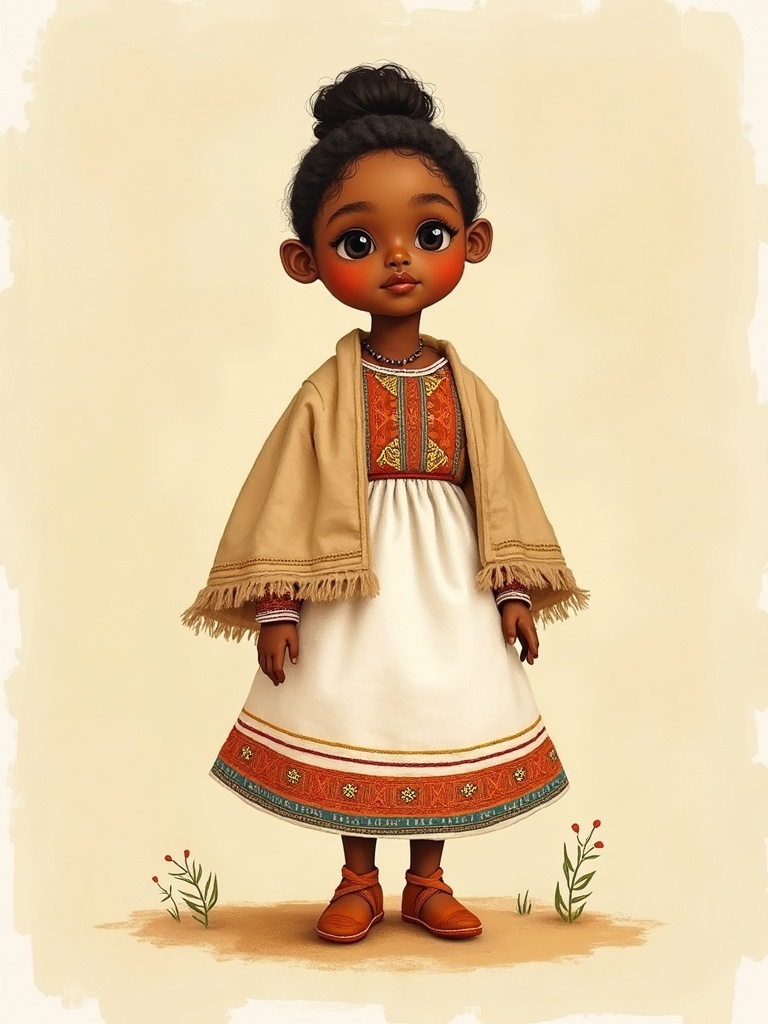
The young Selam, painting the Ge'ez characters for the first time and allowed only to watch the coffee circle. A simple white kemis without tibeb. Gift: Keeper of the Script.
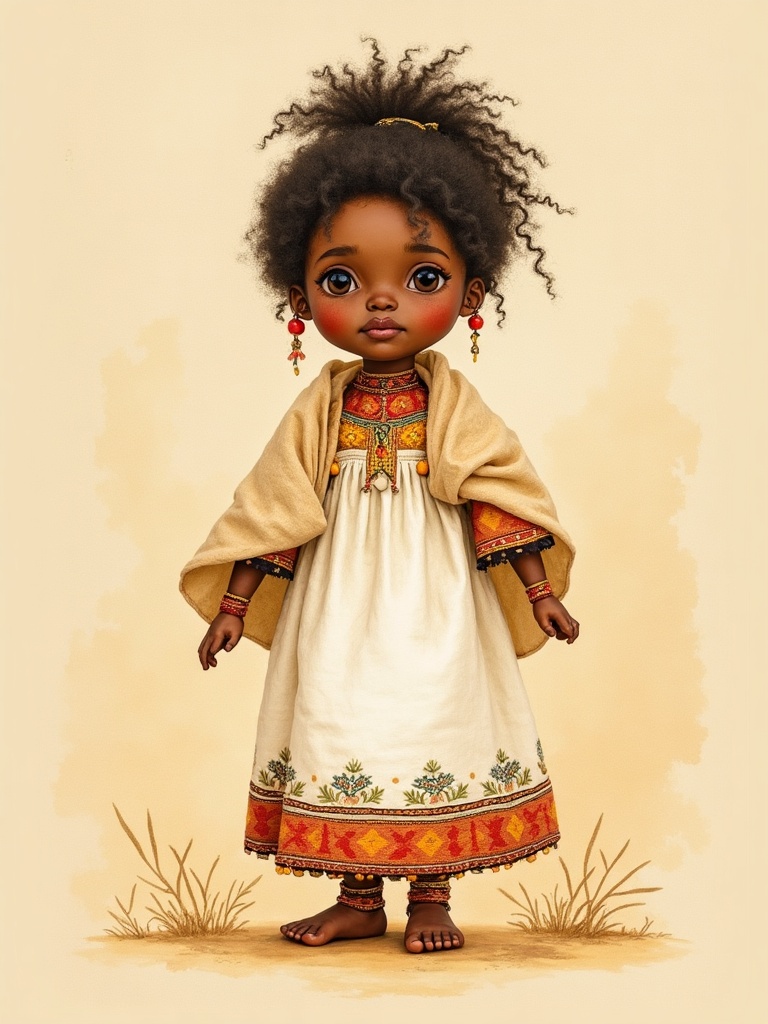
Answer all three to unlock this stage.

Unlock the previous stage first.
Crafting the doll
Fabrics & Manufacturing Notes
As with Amani: genuine natural fibers, honest craftsmanship, lifelong repairability. With Selam, one special quality is added — the fabric itself is already culture.
The Materials List
The Garment: Shemma & Tibeb — the Centerpiece
The Kemis comes alive through the Shemma, a handwoven cotton fabric — woven in the Amhara communities for millennia: women spin the cotton by hand, men weave it on narrow looms; around 76 % of Ethiopian smallholder cotton comes from the Amhara region.[9] The colored border, the Tibeb, is the true signature and patterned differently depending on region and family.[10] Ideally, one would source genuine Shemma fabric from Ethiopian weaver cooperatives — this way part of the value created flows directly to the bearers of the tradition. A single Kemis can take weeks to make by hand.[10]
Body, Jewelry & the Sacred
Body as with Amani: cotton/linen jersey knit, kapok filling, double-overlocked seams. Jewelry sparing and refined: finely worked gold thread in the Tibeb, delicate silver stud earrings. The Ethiopian cross is a sacred symbol and permitted only in the festive-religious variants — sewn child-safe, never as a swallowable small part, and always with the approval of the cultural-spiritual partners.
Signature & dual homeland
Embroidered into the hem: “Selam” and the Ge'ez character ሰላም, plus the name of the seamstress and a “Made in Shashemene” tag — which tells the diaspora story right on the product itself. Optionally the QR thread to the authenticity/history page (Trust Ledger).
Production stages & effort
Full Kemis with a real Tibeb hem, Netela, Shuruba braiding. The most elaborate of the three flagship dolls — because of the woven trim.
Simplified Kemis with a narrow printed trim instead of a woven one, a silver cross pendant optional. Entry-level price, same dignity.
Washable, reinforced seams, Tibeb as a durable woven band appliqué. Shares the sewing pattern with the classic line.
How this doll is made
Selam's look is rooted in the material culture of the Habesha peoples of the Ethiopian highlands: the white handwoven cotton habesha kemis dress and its matching netela shawl, both framed by colourful woven tibeb borders, completed with a silver Ethiopian cross, telsum amulets and braided shuruba hair. White cotton signals purity, peace and devotion, worn at Orthodox holidays such as Timket.
- Garments 3
- Accessories 3
- Materials 2
- Techniques 3
Garments
- Habesha kemis (dress)Ankle-length women's dress of white handwoven cotton, the traditional attire of the Ethiopian highlands. Made in fabric grades such as fetel (soft, gauze-like), menen (a finer cloth named after Empress Menen Asfaw) and saba (premium high-thread-count cloth blended with silk). White symbolises purity and is worn for weddings, church and holidays.DetailsEN
- Netela / shemma shawlA light, slightly translucent white shawl of fine shemma cotton, woven on narrow looms and sewn into wide panels, with coloured tibeb borders. Lighter than the thicker kuta, it is draped over the head and shoulders, especially for church and prayer.DetailsEN
- Historic shamma (museum example)A surviving Ethiopian shamma/natala shawl in the V&A: white cotton, probably handwoven, with a woven coloured border in yellow, orange and red. It belonged to Queen Terunesh, wife of Emperor Tewodros II, and shows how the netela form has looked for over 150 years.DetailsEN
Accessories
- Ethiopian / Coptic crossWorn as a pendant by Ethiopian Orthodox Christians as a sign of faith. Cast in silver (sometimes gold) by the traditional lost-wax method, with intricate lattice openwork representing eternal life and three terminal points symbolising the Holy Trinity.DetailsEN
- Telsum silver amulet necklaceNecklace of silver-alloy pendants in triangular or crescent shapes, handcrafted as protective amulets against the evil eye. Worn predominantly by Ethiopian women at ceremonies and festivals; also a marker of status and wealth, sometimes strung with amber or glass beads.DetailsEN
- Shuruba braided hairTraditional Amhara/Habesha hairstyle of fine cornrows braided tight to the scalp from the forehead, then released into volume at the back. Variants such as albaso (a braid-on-braid technique with thin cornrows) and asa-siret (fish-shaped braid) mark region and age. Doll hair can be cornrowed or wool-wrapped to echo it.DetailsFR
Materials
- Handspun highland cottonLocally grown cotton is the base of all Habesha cloth. It is ginned (seeds removed by hand, historically with an iron medamager rod), bowed to fluff the fibre, then spun into thread on a drop spindle or wheel before weaving. This is the white cloth used for both kemis and netela.DetailsEN
- Tibeb border yarnsThe coloured patterned borders (tibeb) are formed with extra (supplementary) weft yarns of cotton, silk, metallic, rayon, acrylic or wool laid into the white ground. Historically a single continuous extra weft; modern weavers use many short coloured wefts to build dense multicoloured geometric bands.DetailsEN
Techniques
- Pit / treadle handloom weavingShemma is woven on a double-treadle pit loom: the weaver sits at the edge of a dug pit and works foot pedals that raise the heddles while throwing the shuttle, producing long narrow cotton strips that are later joined into a full cloth. The Dorze and Konso are the most renowned weavers, with a famous weaving quarter at Shiro Meda, Addis Ababa.DetailsEN
- Tibeb supplementary-weft patterningTibeb is the decorative band made either by handweaving a supplementary weft into the border of the shemma on the loom, or by hand-embroidering the same geometric motifs onto the cloth edge. For a doll, the band can be recreated with coloured embroidery thread along neckline, sleeves and hem.DetailsEN
- Hand-sewing the cloth doll & dressA simple cloth doll is made by folding fabric right sides together, tracing and cutting body, arms and legs, sewing and turning them, stuffing, and closing the seam with a hand running stitch. The kemis is a hemmed white rectangle with a tibeb-style stitched border; face and braids are added with embroidery floss and yarn.DetailsEN
How it's made
Every doll is sewn by hand from natural materials — built to last a lifetime and to be repaired, not replaced. Here is the shopping list and the work steps. Sizes: Classic 32 cm (heirloom) · Kidogo 18–20 cm (toddlers, no small parts) · Shule 28 cm (school edition).
Shopping list
- Natural cotton or linen for the body (skin tone), ~0.5 m
- Wool or cotton stuffing — no plastic
- Cotton thread and embroidery floss in matching colours
- Garment fabric in this doll's colours (see the fabrics above)
- Yarn for the hairstyle
- Beads, cowrie shells and trims as shown
- Sharps and embroidery needles, pins, fabric scissors, fabric marker
Work instructions
- Trace and cut the body pattern at your chosen size (Classic 32 cm / Kidogo 18–20 cm / Shule 28 cm).
- Sew the body pieces right sides together, leave an opening, turn and stuff firmly with natural fibre, then close by hand.
- Embroider the face gently and with dignity — no plastic parts for the toddler line.
- Make the hair from yarn following the chosen hairstyle and attach it securely.
- Cut and sew the garment from this doll's fabric, then dress the doll.
- Add the beadwork, shells, trims and any attribute by hand.
- Check every seam and reinforce it — the doll should be lifelong and repairable, with no loose small parts for small children.
Ten Name Suggestions
Primarily Amharic names, each with a meaning. To be confirmed by the cultural partners before use.
Honest about the language: meanings of Amharic names vary depending on the source and transliteration; “Lensa” is deliberately Oromo, because Shashemene today lies mostly in Oromia — a sign that Selam honors several peoples of this region.
Origin & Ethics
How we know this
On honesty: As with Amani, this compendium combines documented facts (Habesha dress, Ge'ez, coffee ceremony, festivals, Shashemene history) with a deliberately invented game layer ("abilities", "development stages"). The latter are respectful translations of real virtues, not traditional Habesha concepts. Sacred elements (Orthodox cross, liturgical references) and the Rastafari diaspora are used with particular care and only with the explicit consent of the respective communities. Some name and stage meanings vary depending on transliteration; the cultural partners have the final word.
Elder Approval & Sources to Watch
Important difference from Amani: The Habesha have no single, central council institution like the Njuri Ncheke. Authority over tradition is distributed — among the Church, community Elders, weaver and craft guilds and, for the Diaspora dimension, the communities in Shashemene. The approval protocol must therefore seek multiple voices.
The Approval Body (multi-part)
The five-step protocol
Contact through official channels (cultural authorities in Oromia/Amhara, church parishes, recognized weaver cooperatives, Shashemene community representations). Presentation of the vision, the 42% rule, veto right.
Submit this compendium as a draft, with an explicit request for correction — especially regarding sacred symbols and Tibeb patterns.
Obtain separate approvals: the Church for sacred matters, cooperatives for textiles/patterns, community elders for names/portrayal, the diaspora for the homecoming narrative.
Written approval for each element. Each of the four voices holds a binding veto within its own domain. A sacred 'no' from the Church is final.
Weavers, seamstresses, and community funds share in the proceeds on an ongoing basis; Tibeb patterns are licensed, not bought outright.
The most sensitive areas that must be explicitly submitted for review: the use of the Orthodox cross and any liturgical references, the authenticity of Shemma/Tibeb (not passing off cheap printed imitation as hand-weaving) and the respectful, non-appropriating portrayal of the Rastafari diaspora.
Sources to watch
Sources
- "Habesha" as an overarching identity (Amhara, Tigray, diaspora), mostly Orthodox Tewahedo Christians. zehabesha.com: The Habesha Identity / Understanding the Meaning of Being Habesha (2025).
- Aksumite Empire (ca. 100–940 AD) as the root; earliest evidence of the term in South Arabian inscriptions in the 2nd/3rd century. en.wikipedia.org: Habesha kemis; gorebet.com: Habesha.
- Ge'ez script since Aksum; early clothing as wrapped cloths, sewn traditional dress & Tibeb only later after the shift into the Amhara region. en.wikipedia.org: Habesha kemis.
- Festivals Timkat (Epiphany), Meskel (Finding of the Cross), Enkutatash (New Year in September). zehabesha.com; ethiopiaimmigration.org: Habesha People Guide (2024).
- Ethiopian-Eritrean coffee ceremony: grass & yellow flowers, roasting on the spot, three rounds, handleless little cups. en.wikipedia.org: Coffee ceremony of Ethiopia and Eritrea.
- Injera/Wot, communal eating, Eskista shoulder dance, pentatonic music, hospitality. polyglotclub.com: Ethiopian Traditions; gorebet.com: Habesha.
- In 1948 Haile Selassie granted about 500 acres of land near Shashemene to the Ethiopian World Federation for the return of the diaspora. jamaicans.com: The Story of Shashemene; en.wikipedia.org: Shashemene.
- Marcus Garvey's "Back to Africa" movement, Rastafari return from Jamaica/the Caribbean, "little Jamaica". lifegate.com: Rastafarians of Ethiopia (2020); wrldrels.org: Shashemene (2020).
- Shemma (hand-woven cotton): women spin, men weave; ~76% of smallholder cotton comes from the Amhara region. en.wikipedia.org: Habesha kemis.
- Tibeb embroidery as a signature that varies by region/family; a kemis takes weeks of handwork. ethiopian.store: The History of Habesha Kemis (2025); eastafrodress.com: Habesha dress.
- Habesha kemis overview, fabric grades (fetel/menen/saba), tibeb and netela
- The netela shawl: fine shemma cotton, narrow-loom weaving, tibeb borders
- V&A historic Ethiopian shamma of Queen Terunesh: white cotton, yellow/orange/red woven border
- Ethiopian / Coptic cross: lost-wax silver casting, lattice and Trinity symbolism
- Telsum silver amulets: triangular/crescent protective pendants worn by Ethiopian women
- Shuruba / albaso traditional Habesha braiding styles and meanings
- Ethiopian cotton: ginning, bowing, drop-spindle spinning and pit-loom weaving
- History of Ethiopian weaving, tibeb supplementary-weft yarns (cotton/silk/metallic)
- Weaving in Ethiopia: pit/ground looms, Dorze and Konso weavers, narrow strips
- Saving Ethiopian handloom weaving: tibeb as woven or embroidered border craft
- Indigenous Ethiopian traditional weaving designs for beauty and diversity (Textile journal)
- White kemis at Timket: purity, humility and devotion in Ethiopian Orthodox celebration
- Habesha kemis as age-old holiday attire, ~20-25 days to make one dress
- Step-by-step hand-sewing a simple cloth doll and its clothing