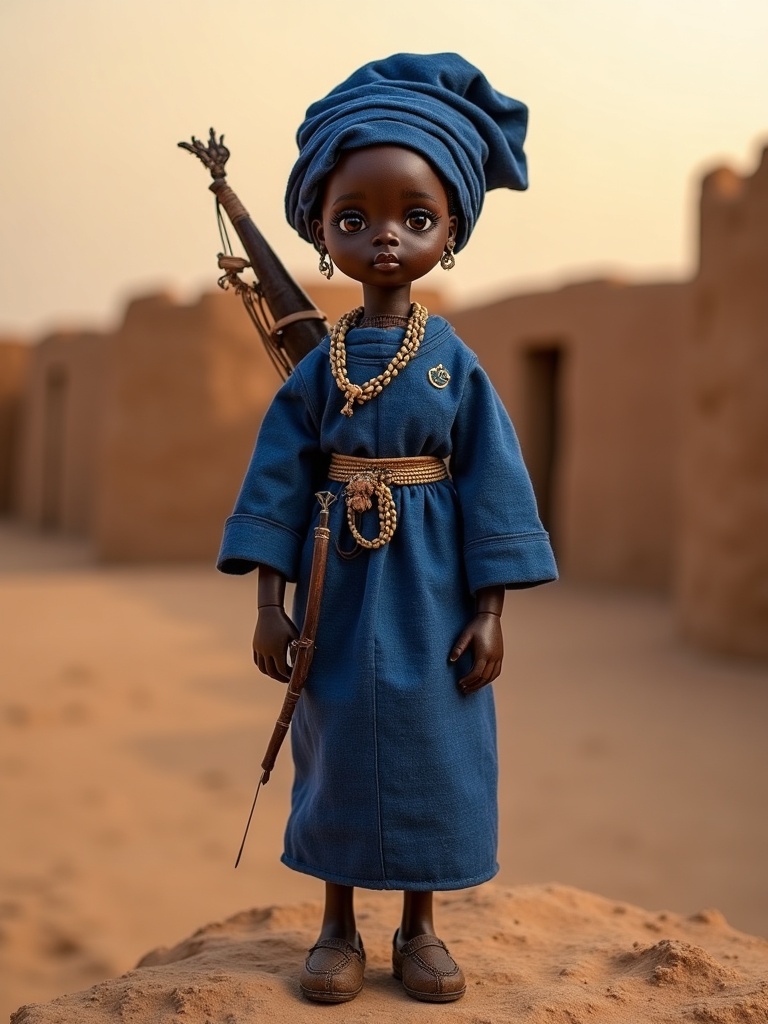
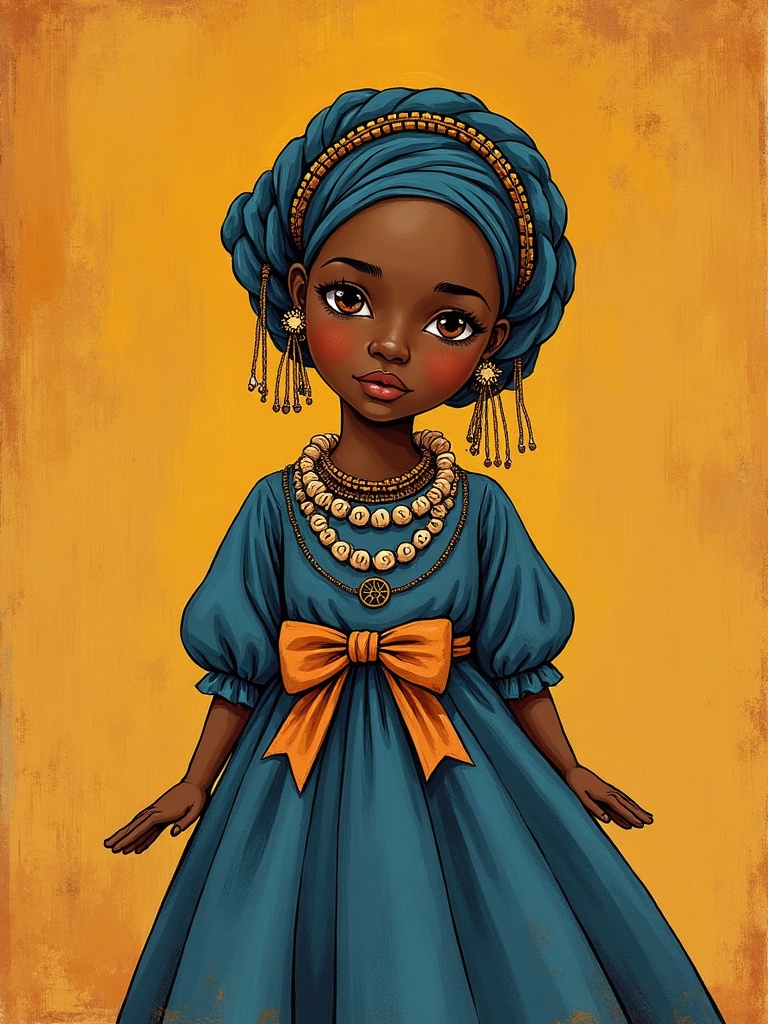
AI design preview — not a photo of the finished handmade doll
The Queen Who Stopped a Column
Sarraounia Mangou
When the most feared military column of the French conquest marched across the Sahel and chiefs everywhere bowed, one queen at Lougou refused — and gave it the hardest fight of its bloody journey.
- People
- Azna (Hausa), Niger
- Country
- Niger
- Region
- West Africa
- Era
- late 19th c. (fl. 1899)
- Theme
- The Queen Who Stopped a Column
Make your own
Design your Sarraounia Mangou
Pick a garment, a hairstyle and a scene, enter the PIN and generate a fresh image of Sarraounia Mangou with AI.
Each image is generated live with fal.ai.
Generated images
AI design preview — not a photo of the finished handmade doll
No images generated yet — be the first.
Tradition & Origin
When the most feared military column of the French conquest marched across the Sahel and chiefs everywhere bowed, one queen at Lougou refused — and gave it the hardest fight of its bloody journey.
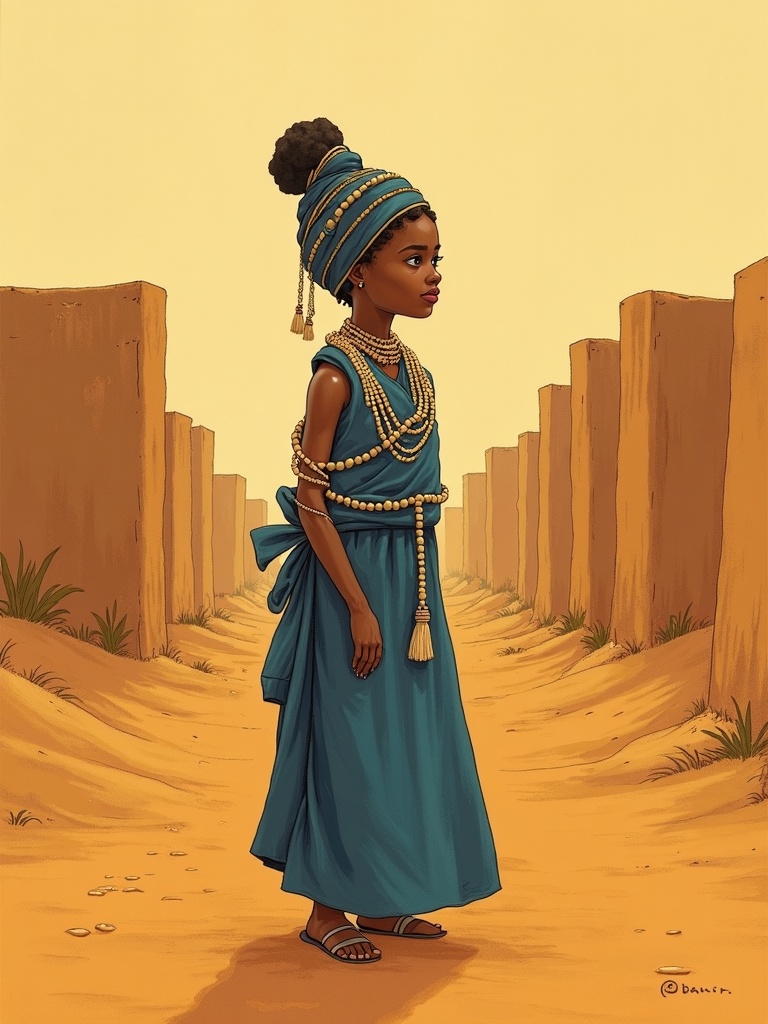
In the Hausa language, Sarraounia is not a name but a title — “queen” or “female chief” — and it belonged to a lineage of women who held both political and spiritual power among the Azna, an animist branch of the Hausa in what is now Niger. Sarraounia Mangou ruled the town of Lougou and was a priestess of Bori, the pre-Islamic Hausa tradition of spirit possession, healing and divination in which women like the royal Inna, “Mother of us all,” once led whole kingdoms. By accounts she was skilled in archery and herbalism as well as rule.
In late 1898 France launched the Voulet–Chanoine Mission, a column of some 2,000 soldiers, porters and auxiliaries, to push its empire east toward Lake Chad. Its commanders, Paul Voulet and Julien Chanoine, became infamous for cruelty: their march left massacres behind it, including roughly 101 killed at Sansanné-Haoussa in January 1899 and, weeks later, a slaughter at Birni-N’Konni remembered as one of the worst in French colonial history. Most rulers in their path chose submission.
Sarraounia did not. On 16 April 1899 the column stormed her fortress at Lougou and met its hardest battle yet — four soldiers killed, six wounded. Outgunned, she pulled her fighters back into the dense thornbush and turned to guerrilla war, raiding by night until the French abandoned their plan to subdue her. She then vanished from the colonial record — but within three months Voulet and Chanoine were dead, shot by their own mutinying soldiers.
For decades her story survived mostly in memory. Then the Nigerien writer Abdoulaye Mamani gave it to the world in his 1980 novel, and the Mauritanian director Med Hondo filmed it in 1986; Sarraounia won the grand prize at the FESPACO festival in 1987. A thinly-documented queen had become a lasting symbol of African resistance.
Timeline
- Nov 1898The French Voulet–Chanoine Mission, some 2,000 strong, departs to march east across the Sahel.
- 8 Jan 1899The column massacres about 101 people at Sansanné-Haoussa — a sign of the cruelty to come.
- 16 Apr 1899Battle of Lougou: Sarraounia's fortress is stormed; she resists and gives the column its hardest fight.
- Apr–May 1899She withdraws into the thornbush and wages a guerrilla campaign that wears the invaders down.
- Jul 1899Voulet and Chanoine are killed by their own mutinying soldiers; the mission collapses into scandal.
- 1980 / 1986Abdoulaye Mamani's novel and Med Hondo's prize-winning film turn her into a symbol of resistance.
Did you know?
- “Sarraounia” isn't her personal name — it's a royal title for a line of Hausa-Azna women who ruled with both political and religious power.DetailsEN
- She led the Azna in Bori, a pre-Islamic Hausa religion whose ceremonies were once headed by powerful priestesses like the royal Inna.DetailsEN
- After the fortress fell she didn't surrender — she melted into the thornbush and fought a guerrilla war that wore the invaders down.DetailsEN
- The deep indigo blue of Hausa cloth comes from dye pits like Kano's Kofar Mata, a craft kept alive for more than 500 years.DetailsEN
History gave her only a few lines — but those lines were enough to refuse an empire.
Values & Capabilities
Capabilities
◆◆◆◆◆ shows how central a gift is — five diamonds mark a signature strength, fewer mark a supporting one.
When almost every chief in the region submitted, she chose to fight one of the most feared columns of the French conquest.
Outgunned, she traded the fortress walls for the thornbush and turned the land itself into a weapon.
She was not only a war-leader but a priestess of the old Azna religion, guardian of rites the conquerors and converters wanted gone.
She would not bow to the French, nor be converted by force — her people's freedom was not for sale.
She gave the dreaded column its hardest fight — then simply outlasted a mission that destroyed itself.
Development
1 of 5 stages unlocked
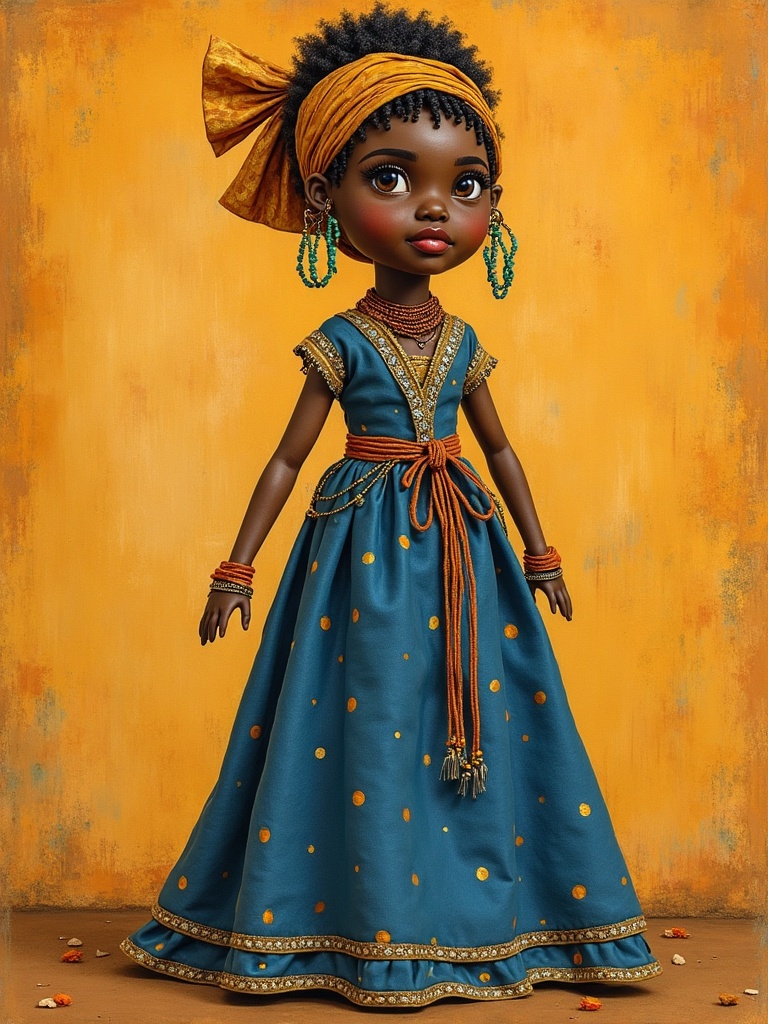
She inherited the title Sarraounia, leading the animist Azna of Lougou in both worldly and spiritual life.
Answer all three to unlock this stage.
Unlock the previous stage first.
Unlock the previous stage first.
Unlock the previous stage first.
Crafting the doll
The doll is built around real Hausa material culture: cotton cloth dyed deep indigo blue, the famed shade of the Kano dye pits that earned the Hausa the nickname “the blue people,” worn as a wrapper (zani) and blouse, with touches of restrained gold embroidery and strands of cowrie shells and leather amulets at the neck. Her signature attribute is a small leather bow and quiver, nodding to accounts of her archery, with a calabash and herb-pouch for her herbalist's knowledge. An education card tucked in the box tells the honest story of Lougou and gently separates documented history from the novel and film that made her famous. Sizes: Classic 32 / Kidogo 18–20 / Shule 28. A share of proceeds supports girls' education and heritage projects in the Sahel.
How this doll is made
Her doll is grounded in 19th-century Hausa and Azna material culture of the Niger Sahel: indigo-dyed cotton cloth, cowrie and leather adornment, and the gear of an archer and herbalist.
- Garments 2
- Accessories 3
- Materials 2
- Techniques 3
Garments
Accessories
- Bow and quiverA worn leather quiver and small bow, referencing accounts of Sarraounia's skill in archery.DetailsEN
- Cowrie & amulet strandsStrands of cowrie shells and small leather amulets worn at neck and wrist, marking spiritual authority.DetailsEN
- Herbalist's calabashA small calabash gourd with a pouch of dried herbs and roots, nodding to her knowledge of herbalism.DetailsEN
Materials
Techniques
- Pit indigo dyeingCloth is repeatedly dipped in deep circular dye pits and exposed to air; knowledge is passed down through families of dyers.DetailsEN
- Tie-resist patterningEdges of the cloth are tied before dyeing to make motifs such as 'moon and star' or 'Hausa bakwai' in the blue ground.DetailsEN
- Hand cloth-doll sewingThe figure itself is a hand-sewn cloth doll, stuffed and stitched, with garments cut and dyed to echo the indigo blues.DetailsEN
How it's made
Every doll is sewn by hand from natural materials — built to last a lifetime and to be repaired, not replaced. Here is the shopping list and the work steps. Sizes: Classic 32 cm (heirloom) · Kidogo 18–20 cm (toddlers, no small parts) · Shule 28 cm (school edition).
Shopping list
- Natural cotton or linen for the body (skin tone), ~0.5 m
- Wool or cotton stuffing — no plastic
- Cotton thread and embroidery floss in matching colours
- Garment fabric in this doll's colours (see the fabrics above)
- Yarn for the hairstyle
- Beads, cowrie shells and trims as shown
- Sharps and embroidery needles, pins, fabric scissors, fabric marker
Work instructions
- Trace and cut the body pattern at your chosen size (Classic 32 cm / Kidogo 18–20 cm / Shule 28 cm).
- Sew the body pieces right sides together, leave an opening, turn and stuff firmly with natural fibre, then close by hand.
- Embroider the face gently and with dignity — no plastic parts for the toddler line.
- Make the hair from yarn following the chosen hairstyle and attach it securely.
- Cut and sew the garment from this doll's fabric, then dress the doll.
- Add the beadwork, shells, trims and any attribute by hand.
- Check every seam and reinforce it — the doll should be lifelong and repairable, with no loose small parts for small children.
Origin & Ethics
How we know this
The documented record is real but thin: colonial and scholarly sources confirm Sarraounia as queen-priestess of Lougou and her 1899 resistance to the Voulet–Chanoine column, but she vanishes from the documents afterward and many vivid details (supernatural powers, full biography) come from oral tradition and from Mamani's 1980 novel and Hondo's 1986 film. As a 19th-century historical figure she carries no living-person rights restrictions; the doll is homage, not portrait.
Because Sarraounia lived and died in the 19th century, no living person or royal house must consent — but the figure is offered as respectful homage, not exact likeness, shaped in consultation with the published historical and scholarly record on the Azna of Lougou, the Voulet–Chanoine Mission, and Hausa Bori tradition, and with care that her animist faith and her people's dignity are shown honourably rather than as exotic spectacle.
Sources
- Sarraounia — Wikipedia (overview, Azna, Lougou, legend vs record)
- Voulet–Chanoine Mission — Wikipedia (dates, Lougou 16 April 1899, massacres, mutiny)
- Sarraounia Mangou, Battle of Lougou 1899 — TalkAfricana
- Hausa animism (Bori, Azna/Arna, priestesses, Inna) — Wikipedia
- Sarraounia (film) — Wikipedia (Med Hondo 1986, Mamani novel 1980, FESPACO)
- Kofar Mata Dye Pits, Kano — Wikipedia (Hausa indigo dyeing)
- Sarraounia Mangou — Face2Face Africa
- Sarraounia Mangou — She is Africa