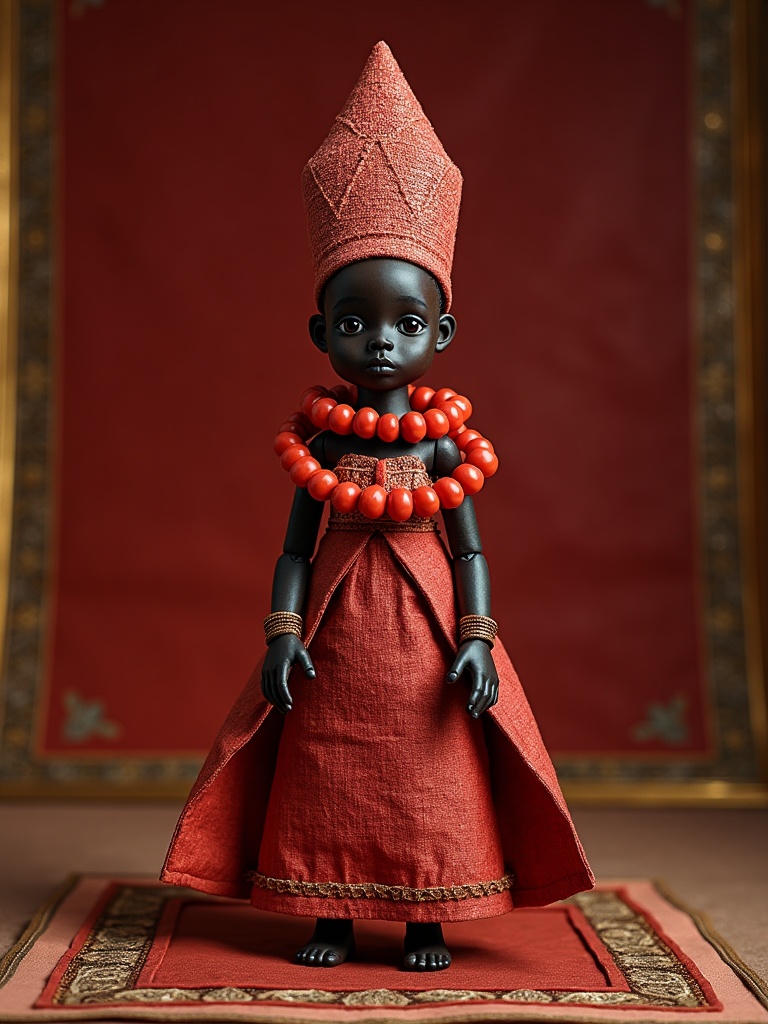
Mother & Strategist
Queen Idia
She was the power behind the throne of Benin — the first Iyoba, a mother who raised an army for her son and was carved into the most famous ivory face in African history.
- People
- Edo (Benin Kingdom)
- Country
- Nigeria
- Region
- West Africa
- Era
- ≈1500
- Theme
- Mother & Strategist
Make your own
Design your Queen Idia
Pick a garment, a hairstyle and a scene, enter the PIN and generate a fresh image of Queen Idia with AI.
Each image is generated live with fal.ai.
Generated images
No images generated yet — be the first.
Tradition & Origin
She was the power behind the throne of Benin — the first Iyoba, a mother who raised an army for her son and was carved into the most famous ivory face in African history.
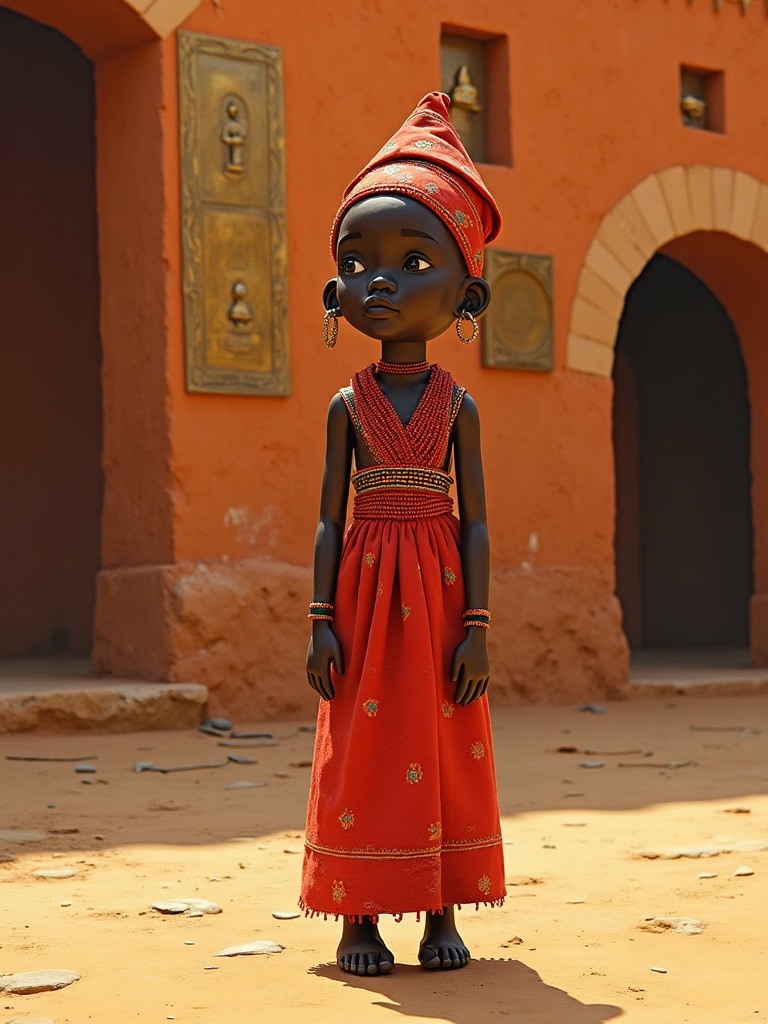
The two finest pendant masks, looted in 1897, remain in London and New York; when Nigeria asked Britain to lend the original for FESTAC '77, it was refused.
DetailsENIn the early 1500s, the Kingdom of Benin (in present-day Edo State, Nigeria) faced a succession crisis. When Oba Ozolua died, his sons Esigie and Arhuaran fought over the throne. Esigie's mother, Idia, did not stand aside. According to Edo tradition she rallied support, marshalled forces, and used her renowned knowledge of medicine and the spiritual arts to secure her son's victory — making her, in the words of historians, the true power behind the throne.
Esigie went on to reign from roughly 1504 to 1550, leading Benin through its great war against the Igala kingdom of Idah to the north. Idia is credited in oral history with helping win that war through her counsel, her mobilisation of soldiers, and her mystical and medicinal expertise. In gratitude, Esigie did something unprecedented: he created the title Iyoba — "Queen Mother" — and gave it to her, granting her a palace, her own court, and real political authority. Idia was the first Iyoba, founding an institution that shaped Benin's monarchy for centuries.
Her likeness survives in a serene ivory face that has become an emblem of a continent. Around 1520, Benin's royal carvers produced a pair of nearly identical ivory pendant masks of Idia — her brow ringed with tiny carved heads of Portuguese traders, symbols of Benin's wealth and reach. Esigie is said to have worn such a mask at his hip during rites honouring his mother. The two masks are roughly 24 cm tall and rank among the masterpieces of world art.
In 1897, a British Punitive Expedition sacked Benin City, burned the royal palace, and looted thousands of its bronzes and ivories. Soldiers reportedly found several Idia masks in the Oba's chambers; the two finest were carried off and now sit in the British Museum in London and the Metropolitan Museum of Art in New York. When Nigeria hosted FESTAC '77 and chose Idia's mask as its emblem, it asked Britain to lend the original — and was refused. Nigerian artists carved a new mask instead. The looted originals remain at the heart of one of the world's most charged restitution debates.
Timeline
- ≈1500Idia, a wife of Oba Ozolua, gives birth to and raises the future Oba Esigie.
- ≈1504Esigie becomes Oba of Benin amid a contested succession.
- 1515–1516The Idah (Igala–Benin) war; Idia helps raise and steady the army and Benin wins.
- ≈1516Esigie creates the title of Iyoba (Queen Mother) for Idia, with a palace at Uselu.
- ≈1520Royal guilds carve ivory pendant masks and cast brass heads in Idia's likeness.
- 1897British troops sack Benin City and loot the Benin Bronzes, including an Idia ivory mask.
Did you know?
- By Edo tradition, Idia raised an army to defeat her son's rival brother Arhuaran and is credited with helping Esigie win the war against Idah through her counsel and her mystical and medicinal knowledge — a role passed down largely through oral history.DetailsEN
- The two ivory pendant masks of Idia are nearly identical 16th-century works — one in the British Museum, one in the Metropolitan Museum of Art — each framed by carved heads of Portuguese figures signalling Benin's trade and power.DetailsEN
- When Nigeria chose Idia's mask as the symbol of FESTAC '77, the British Museum refused to lend the original, so Nigerian artists carved a new ivory mask for the festival held in Lagos in 1977.DetailsEN
A son became king; a mother became an institution — and the face the empire could not keep still asks the world to give it back.
Values & Capabilities
Capabilities
◆◆◆◆◆ shows how central a gift is — five diamonds mark a signature strength, fewer mark a supporting one.
Idia raised and helped command the army that won the Idah (Igala–Benin) war of 1515–1516, securing her son's throne and Benin's grip on the river trade.
In gratitude, Oba Esigie created the title Iyoba (Queen Mother) for her — a new, powerful office in the Benin court held by every queen mother after her.
Tradition holds that Idia was a healer and a woman of deep ritual knowledge whose counsel and protective power guided her son through danger.
Esigie's artists immortalised her in ivory pendant masks and brass commemorative heads — among the most famous artworks Africa ever made.
When succession disputes and an outside threat nearly broke Benin, Idia held the kingdom together for her son until the danger had passed.
Development
1 of 5 stages unlocked
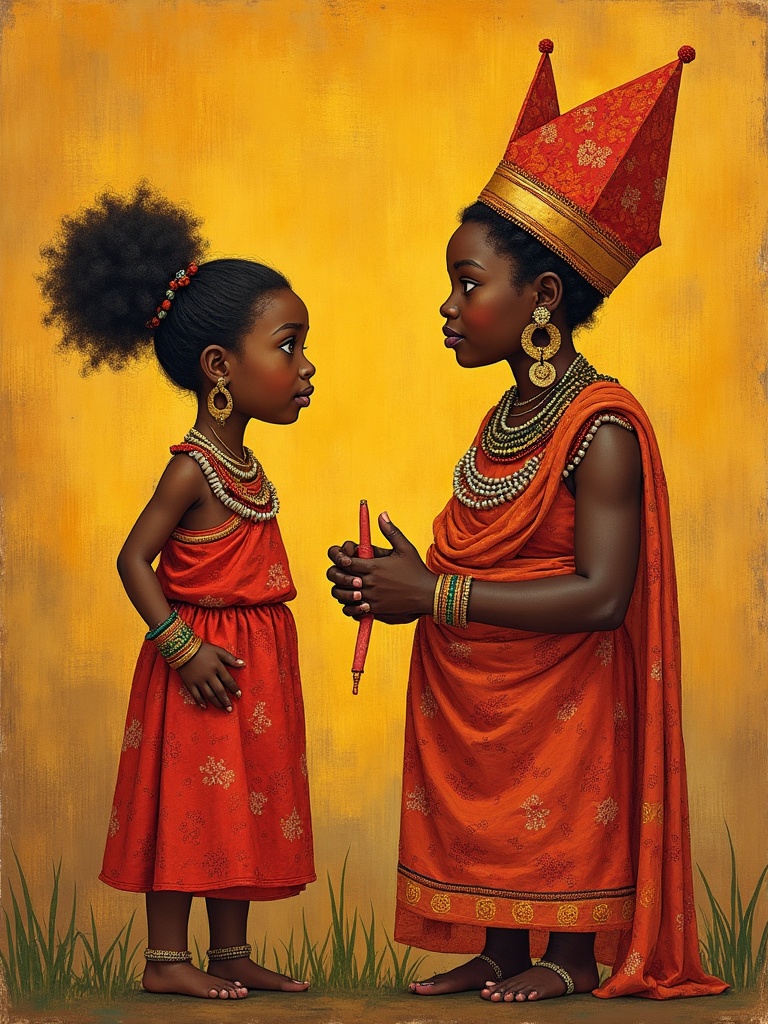
Idia becomes a wife of Oba Ozolua of Benin and the mother of a future king, Esigie.
Answer all three to unlock this stage.
Unlock the previous stage first.
Unlock the previous stage first.
Unlock the previous stage first.
Crafting the doll
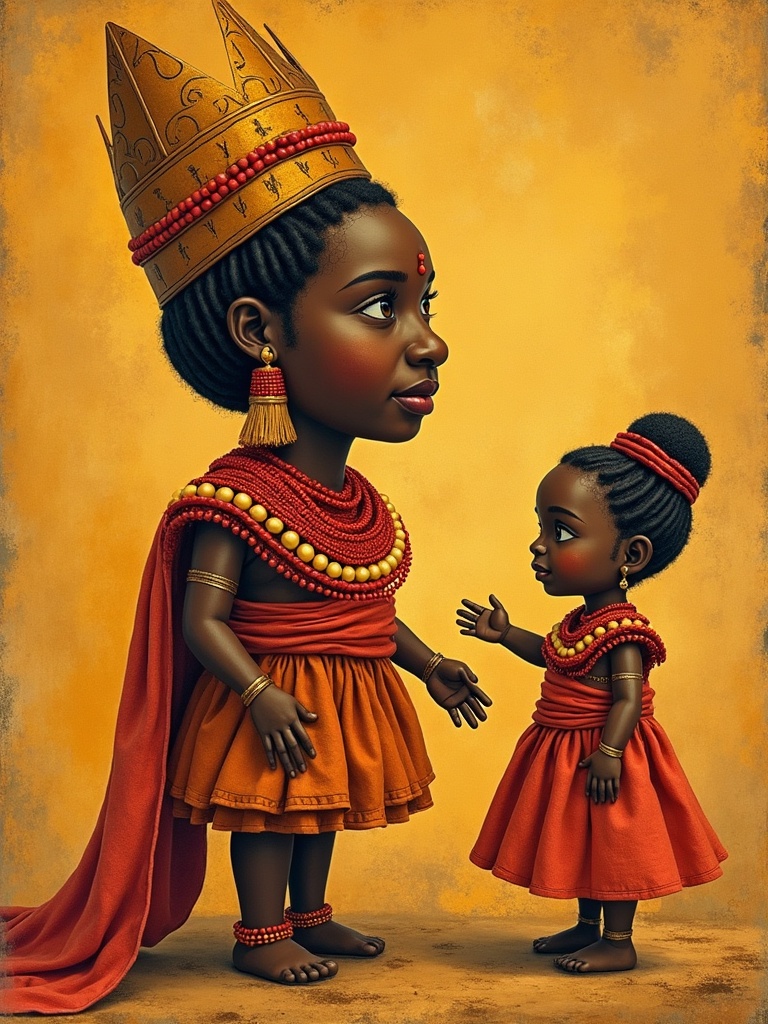
Idia's doll is built around Benin court material culture: a deep-red ododo court cloth and wrapper, with her signature woven from rows of red cylindrical coral (ileke) beads — a high netted collar, crossed bandoliers, and the peaked ukpe-okhue 'parrot's beak' crown. Her signature attribute is a small carved ivory pendant mask, its tiara ringed with tiny Portuguese heads and mudfish. The education card explains the first Iyoba, the Idah war, and honestly notes the looting of the Benin Bronzes in 1897 and the ongoing restitution debate. Sizes Classic 32 / Kidogo 18–20 / Shule 28. A share of proceeds supports African-led heritage and craft education.
How this doll is made
Idia's look is grounded in the coral-and-brass court art of the Benin Kingdom: dense rows of red coral beads (the privilege she was first to wear), the peaked ukpe-okhue crown, ivory pendant masks carved by the Igbesanmwan guild, and brass commemorative heads cast by the Igun Eronmwon in lost wax for the Oba.
- Garments 2
- Accessories 3
- Materials 2
- Techniques 3
Garments
- Coral-bead regalia (ododo)The full Iyoba dress: a high netted coral collar, crossed coral bandoliers and a deep-red ododo court cloth, all hung with rows of red cylindrical coral beads — the badge of Queen-Mother rank.DetailsEN
- Forehead rows of coral beadsTight horizontal strings of red coral worn across the forehead beneath the crown, framing the face — a recurring feature on both the ivory masks and the brass Iyoba heads.DetailsEN
Accessories
- Ukpe-okhue peaked crownThe Queen Mother's 'parrot's beak' crown: a snood-like net of royal ileke coral beads rising to a high, forward-pointing peak — originated and first worn by Idia herself.DetailsEN
- Ivory pendant / hip maskA carved ivory mask of Idia's serene face, its tiara ringed with miniature bearded Portuguese heads and a band of mudfish, with iron-inlaid eyes; worn suspended at chest or hip in ceremony.DetailsEN
- Mudfish and Portuguese-head motifsSymbolic borders on the masks: the mudfish links the Oba's world to the watery realm of the sea-god Olokun, while the bearded heads recall the Portuguese traders allied to 16th-century Benin.DetailsEN
Materials
- Red coral (ileke) beadsMediterranean red coral, traded into Benin and reserved for royalty; cylindrical 'ileke' beads were the exclusive privilege Idia was first granted, signalling rank and ritual power.DetailsEN
- Ivory and brassElephant ivory for the pendant masks (carved by the Igbesanmwan guild) and leaded brass for the commemorative heads — the two royal materials in which Idia's memory was fixed.DetailsEN
Techniques
- Lost-wax brass casting (cire perdue)A wax model is coated in clay, the wax melted out, and molten brass poured into the empty mould; the mould is broken to free a unique cast. The method behind every Benin commemorative head.DetailsEN
- Igun Eronmwon hereditary guildThe royal brass-casters' guild on Igun Street in Benin City, casting only for the Oba; skills pass father to son back to at least the 13th century, and casters still work there today.DetailsEN
- Igbesanmwan ivory carvingThe royal ivory- and wood-carving guild that carved Idia's pendant masks, working fine detail — scarification, coral rows, tiara figures — into single pieces of tusk for the king.DetailsEN
How it's made
Every doll is sewn by hand from natural materials — built to last a lifetime and to be repaired, not replaced. Here is the shopping list and the work steps. Sizes: Classic 32 cm (heirloom) · Kidogo 18–20 cm (toddlers, no small parts) · Shule 28 cm (school edition).
Shopping list
- Natural cotton or linen for the body (skin tone), ~0.5 m
- Wool or cotton stuffing — no plastic
- Cotton thread and embroidery floss in matching colours
- Garment fabric in this doll's colours (see the fabrics above)
- Yarn for the hairstyle
- Beads, cowrie shells and trims as shown
- Sharps and embroidery needles, pins, fabric scissors, fabric marker
Work instructions
- Trace and cut the body pattern at your chosen size (Classic 32 cm / Kidogo 18–20 cm / Shule 28 cm).
- Sew the body pieces right sides together, leave an opening, turn and stuff firmly with natural fibre, then close by hand.
- Embroider the face gently and with dignity — no plastic parts for the toddler line.
- Make the hair from yarn following the chosen hairstyle and attach it securely.
- Cut and sew the garment from this doll's fabric, then dress the doll.
- Add the beadwork, shells, trims and any attribute by hand.
- Check every seam and reinforce it — the doll should be lifelong and repairable, with no loose small parts for small children.
Origin & Ethics
How we know this
The core story is solid and corroborated by major museums and Edo tradition: Idia was the first Iyoba, mother of Oba Esigie, and central to the Idah war (1515–1516), and she is the subject of the famous ivory pendant masks and brass Iyoba heads. Exact dates, her own words, and the detail of her 'mystical' powers come from oral tradition and are uncertain. The ivory mask's location and ownership are genuinely contested (1897 looting; partial restitution).
As a historical figure of around 1500, Queen Idia has no living rights-holder, so no rechteHinweis is needed. The Benin court she founded is, however, very much alive: the Oba of Benin still reigns in Benin City and the Iyoba title endures. This figure is offered as respectful homage — not an exact likeness, and not a reproduction of any sacred mask or regalia. Cultural framing should defer to the Oba's palace, the Edo people and Nigerian heritage bodies, and the doll must never be presented as official Benin royal regalia.
Sources
- Wikipedia — Idia, first Iyoba of Benin, mother of Esigie, role in the Idah war
- Wikipedia — Benin ivory mask: the Idia ivory pendant masks, c.1520, Portuguese-head tiara, 1897 looting, FESTAC 1977
- Wikipedia — Ukpe-okhue: the Iyoba's coral 'parrot's beak' crown, ileke beads, originated by Idia
- Wikipedia — Igala–Benin War (Idah war, 1515–1516)
- The Metropolitan Museum of Art — Pendant Mask of Iyoba Idia, Edo peoples (Igbesanmwan ivory carvers)
- The Metropolitan Museum of Art — Head of a Queen Mother (Iyoba), brass, Igun Eronmwon casting guild
- Smarthistory — Queen Mother Pendant Mask (Iyoba), Edo peoples: coral regalia, peaked crown, mudfish, Portuguese heads
- Smarthistory — Igun Eronmwon (brass-casters' guild): hereditary lost-wax casting for the Oba
- DailyArt Magazine — The History of Queen Mother Idia of Benin
- Al Jazeera — Germany signs deal to return Nigeria's Benin Bronzes (2022)
- The Art Newspaper — Idia ivory masks: five known, none in Nigeria, looted 1897 (2022)