The Ten
Nzinga
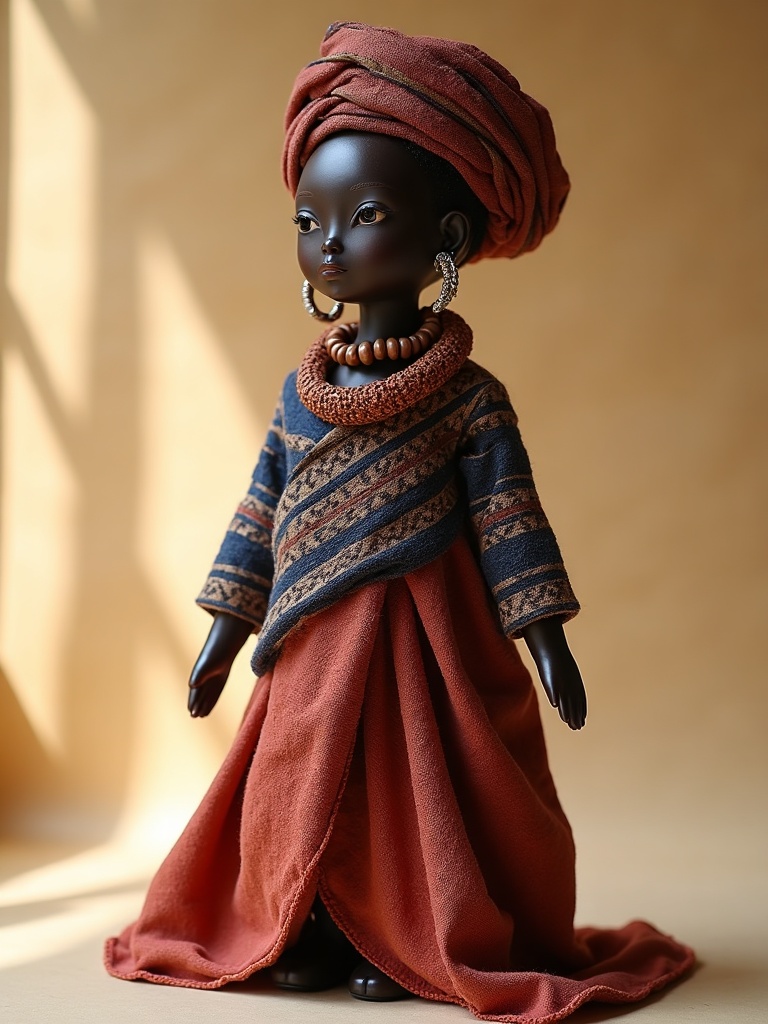
Nzinga was 1583 as the daughter of the Ngola (King) Kiluanji into the ruling house of Ndongo born, a kingdom of the Mbundu people in present-day northern Angola. Her name traces back to the Kimbundu word kujinga — "to wind, twist" —,…
- People
- Mbundu
- Country
- Angola
- Region
- Central Africa
- Era
- 1583–1663
- Theme
- Cunning & Diplomacy
Make your own
Design your Nzinga
Pick a garment, a hairstyle and a scene, enter the PIN and generate a fresh image of Nzinga with AI.
Each image is generated live with fal.ai.
Generated images
No images generated yet — be the first.
History & Meaning
①Tradition, Life & the Chair
Nzinga was 1583 as the daughter of the Ngola (King) Kiluanji into the ruling house of Ndongo born, a kingdom of the Mbundu people in present-day northern Angola. Her name traces back to the Kimbundu word kujinga — "to wind, twist" —, because at her birth the umbilical cord lay around her neck; in folk belief a sign that she would grow into an extraordinary, proud person.[2][8] Indeed, she was destined to "twist" the fate of nations. From her father's title, Ngola, incidentally derives the present-day country name Angola .[7]
Even as a girl, her father took her along to council meetings and even to war; she learned court ceremonial, Kimbundu oratory, diplomacy — and from Afro-Portuguese interpreters the language of the Portuguese.[6] This later made her indispensable: she was one of the few at court who could speak directly with the colonial rulers.
♟️ The most famous scene — and how we tell it to children
1622 her brother, King Ngola Mbandi, sent her as an envoy to peace negotiations with the Portuguese governor João Correia de Sousa to Luanda. The governor sat on a magnificent chair — but for Nzinga there was only a mat on the floor. In Mbundu etiquette, this was the place for subordinates: a calculated humiliation.[9][10]
Nzinga would not be deterred. She gave one of her companions a sign — and from then on negotiated as an equal with the governor, rather than sitting beneath him. She left the room with a treaty on equal terms, without subjecting her kingdom to vassalage.[10][11] (Note on the depiction: The historical sources tell that a servant served as the seat. In this project's child-appropriate version, the message is at the forefront — „I will not let myself be belittled" —, without showing or glorifying the subjugation of a human being. We coordinate the final narrative with Angolan authorities; see section ⑨.)
Forty years of resistance — and statecraft
When her brother died in 1624, Nzinga became queen — against the resistance of rivals who would not recognize a woman. She moved her realm to the neighboring Matamba, which had a tradition of female rule, and built it into a powerful center of trade and resistance.[1][3] She forged alliances — even with the Dutch against Portugal —, took freed enslaved people into her ranks and waged a decades-long guerrilla war. Well into her sixties, she is said to have led her armies herself.[3][4]
But she was more than a warrior: in her final years she turned from war to state-building, reformed Matamba's law, fostered trade, and ensured a peaceful succession for her sister. 1657 she concluded a peace treaty with Portugal as equals; at her death 1663 Matamba was a respected trading state that stood on equal footing with the Portuguese colony.[4][5]
She had something better: a quicker mind.
⑤Transfer to the Present
How does Nzinga's life become a lesson for a child in 2050?
On equal footing
Would not be belittled.
Self-worth, negotiation, quick wit. For every child who gets overlooked: you decide whether you let yourself be made small. Dignity is a decision, not a gift from others.
The Bridge Builder
Alliances across every border.
Diplomacy, negotiation, networks. From the UN to the AfCFTA: those who build bridges win more than those who put up walls. Negotiating is a superpower.
Language of the Others
She knew the other side's way of thinking.
Multilingualism, empathy, strategy. Those who understand several languages and perspectives cannot be deceived — an advantage in an interconnected world.
Brains beat size
She did not have the larger army.
Creativity, entrepreneurship, underdog strength. Small countries, small teams, small people can defeat the great — through cleverness, endurance and courage. David's sling is the mind.
Nzinga's promise to a child: „They gave me no chair. So I built my own place. Do the same — no one else will give it to you."
Abilities & Development
Abilities
Her greatest gift: never letting herself be belittled. Where others accept humiliation, Nzinga finds a way within seconds to stay dignified and on equal terms. In the game: Whoever holds Nzinga may elegantly counter a „humiliation attempt".
She forged alliances across all borders — even with the Dutch against Portugal. She teaches: The wisest fighter seeks allies first, not enemies.
Because she spoke Portuguese and knew the customs of the other side, no one could deceive her. She teaches children: Learn the language and way of thinking of the other — then they cannot outwit you.
For nearly four decades she held firm — lost, rebuilt, kept negotiating. She led her people into her sixties. She teaches: Giving up is not an option, there are only detours.
In the end she laid down the sword and built: law, trade, a peaceful succession. She teaches that true strength does not only conquer, but erects something lasting.
Through the years
③Life Stages (historical)
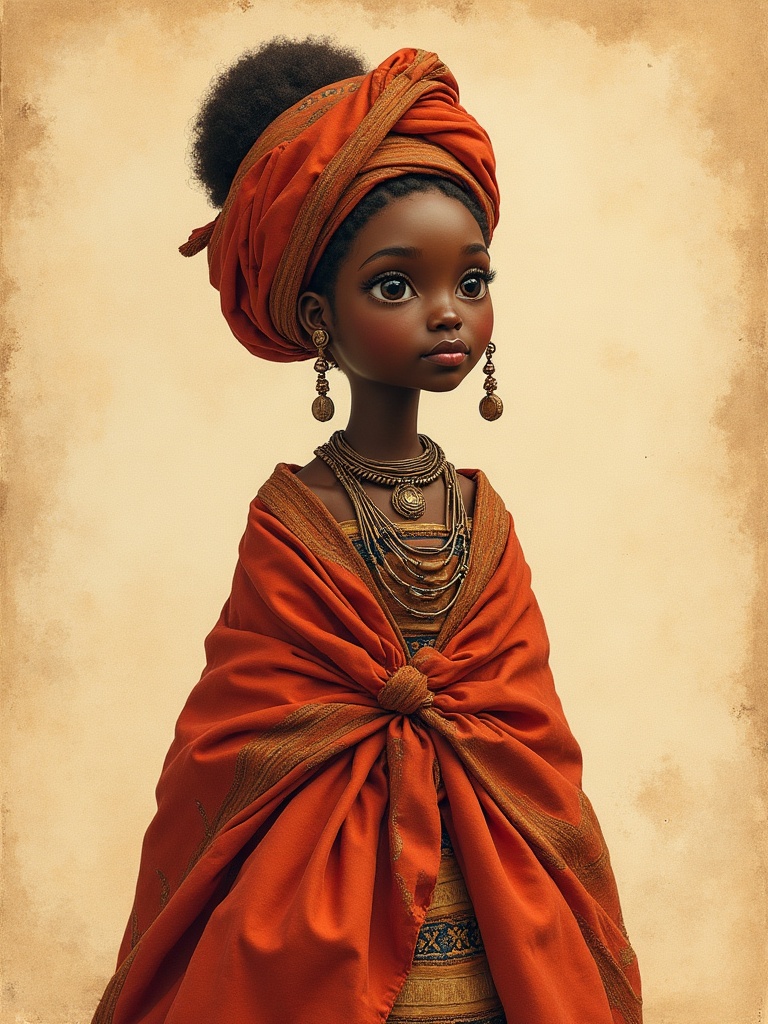
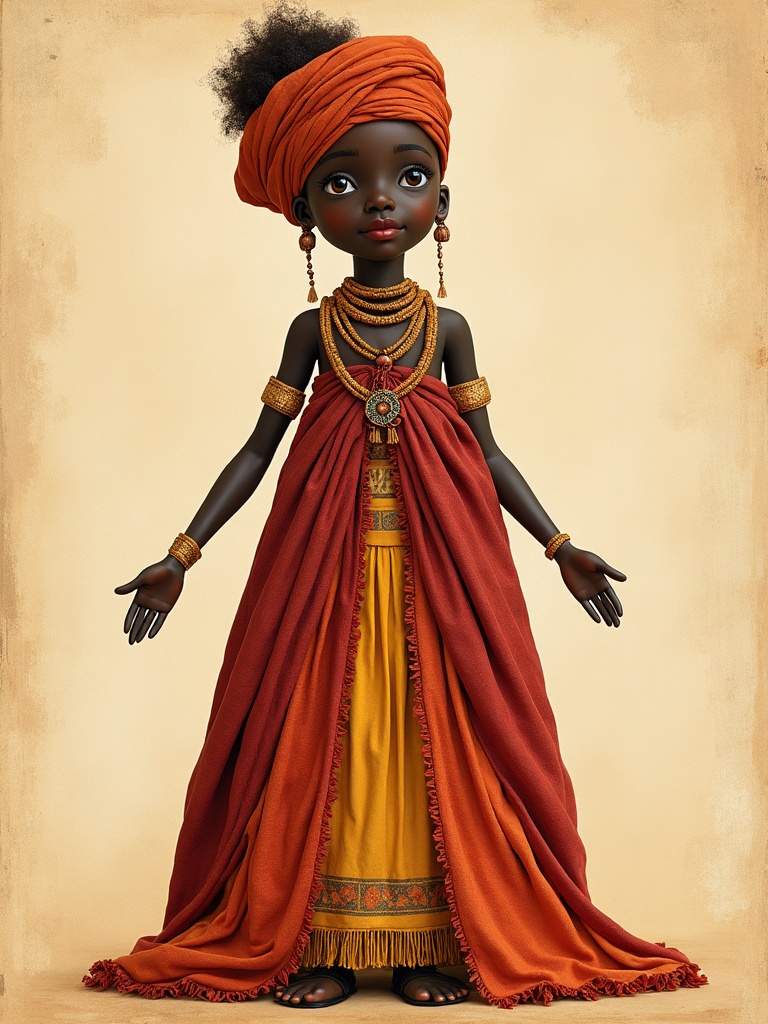
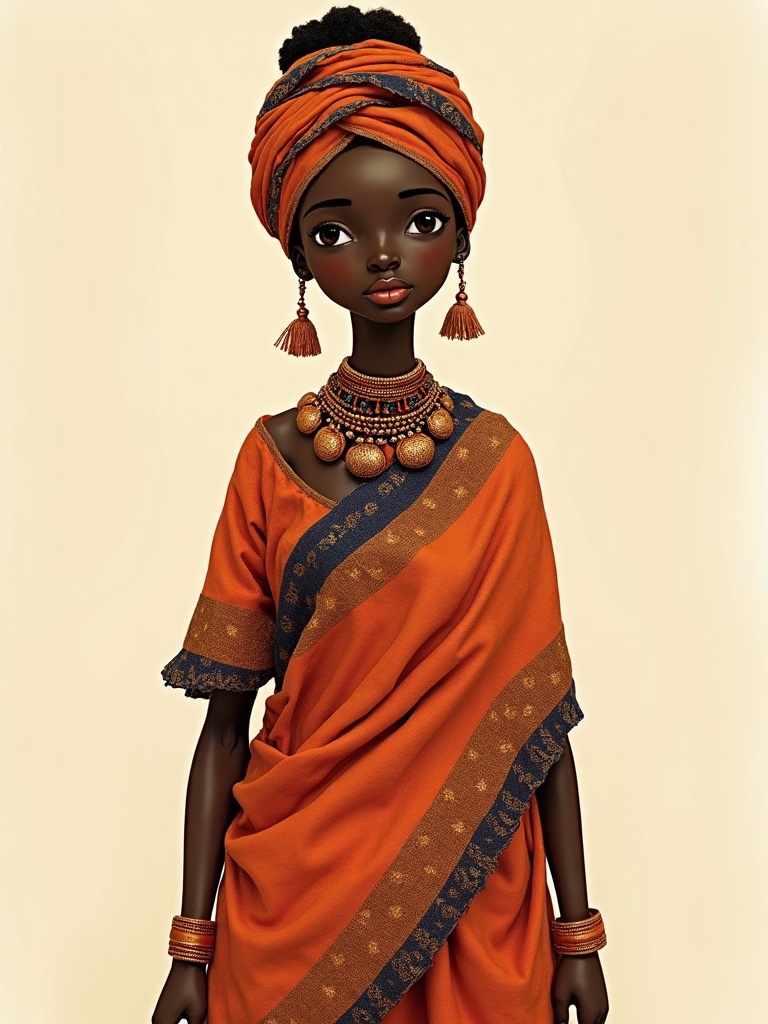
The three stages follow her true path — from the learning princess, through the brilliant envoy, to the wise queen and nation-builder.
Nzinga as a young girl at her father's side: attentive in council and speeches, learning, curious. Simple royal cloth. Gift: Language of Others.[6]
Nzinga in full dignity at the negotiation: upright, self-assured, in magnificent robes. The moment that made her immortal. Gift: On Equal Footing.[10]
Nzinga as queen and nation-builder: crown, scepter, the gaze of one who steers a realm. Signature gift combined with The Nation-Builder.[5]
Note: Historically, Nzinga at times wore men's clothing and took the title "King" (Ngola) to show her full authority — a fascinating detail about gender roles that can be told to older children and coordinated with Angolan authorities.
Make & Learn
⑦Fabrics & Production Notes
Genuine natural fibers, honest workmanship, lifelong repairability — and for Nzinga a Central African classic: woven raffia and copper jewelry.
The Materials List
The Garment: Raffia & Wrap Cloths
Central Africa's royal houses are famous for woven raffia textiles (palm fiber) with geometric patterns and for richly dyed cotton wrap cloths in deep red and indigo. For Nzinga a wrapped garment of 100 % cotton with raffia-inspired woven trim, plus a dignified head wrap. Ideally from Central African weaver cooperatives; where necessary, a high-quality woven band appliqué — visibly labeled, never passed off as hand-weaving.
Jewelry: Copper instead of Gold
Unlike the gold-rich empires of West Africa, Central Africa was a Copper and Raffia World. Nzinga's jewelry is Copper/Brass tone: Bangles, large earrings, beaded necklaces — sewn child-safe, no swallowable small parts in the school/toddler line. Her signature attribute is the carved ruler's staff (not a sword) as a wood/felt prop.
Signature & Education Card
Embroidered into the hem: "Nzinga" and the name of the seamstress. Enclosed is a Biography Card with life dates, the chair story (child-appropriate) and the message "on equal footing" — so every figure becomes a history and values lesson. Optional QR thread to the authenticity/history page.
Manufacturing Stages & Effort
Full wrap garment, copper jewelry, head wrap, ruler's staff, biography card. The collector's and role-model figure.
Simplified garment (printed raffia pattern), one copper element. Affordable entry point.
Washable, reinforced seams, woven trim as durable ribbon appliqué. With biography card for history lessons.
How it's made
Every doll is sewn by hand from natural materials — built to last a lifetime and to be repaired, not replaced. Here is the shopping list and the work steps. Sizes: Classic 32 cm (heirloom) · Kidogo 18–20 cm (toddlers, no small parts) · Shule 28 cm (school edition).
Shopping list
- Natural cotton or linen for the body (skin tone), ~0.5 m
- Wool or cotton stuffing — no plastic
- Cotton thread and embroidery floss in matching colours
- Garment fabric in this doll's colours (see the fabrics above)
- Yarn for the hairstyle
- Beads, cowrie shells and trims as shown
- Sharps and embroidery needles, pins, fabric scissors, fabric marker
Work instructions
- Trace and cut the body pattern at your chosen size (Classic 32 cm / Kidogo 18–20 cm / Shule 28 cm).
- Sew the body pieces right sides together, leave an opening, turn and stuff firmly with natural fibre, then close by hand.
- Embroider the face gently and with dignity — no plastic parts for the toddler line.
- Make the hair from yarn following the chosen hairstyle and attach it securely.
- Cut and sew the garment from this doll's fabric, then dress the doll.
- Add the beadwork, shells, trims and any attribute by hand.
- Check every seam and reinforce it — the doll should be lifelong and repairable, with no loose small parts for small children.
⑥Ten Name suggestions
The real name is preserved. These ten names — primarily Kimbundu/Angola — are suitable for companion figures, sisters or the series around Nzinga. To be confirmed by Angolan authorities before use.
Honest about the spelling: Nzinga's name exists in many forms (Nzinga/Njinga/Ginga/Ana de Sousa). Kimbundu meanings vary regionally; Angolan authorities have the final word.
⑧Curriculum Mapping & Subjects
Nzinga is primarily anchored to the curricula of Angola / southern Africa (Portuguese as the school language, national heroine of Angola), but can be used anywhere that colonialism, diplomacy and gender roles are topics.
The chair scene
Dignity in negotiation.
Social studies / Values / Language. Negotiating, self-assertion, quick wit — role-plays on meeting as equals and respect.
40 Years of Resistance & Alliances
Diplomacy against a great power.
History / Politics. Colonialism in Central Africa, slave trade, resistance — African actors as acting subjects, not victims.
Woman on the Throne
She ruled despite resistance.
Values / Equal rights. Gender roles then and now; women in leadership; the courage to take unusual paths.
Ngola → Angola
From royal title to country name.
Geography / Language. How names come into being; Central Africa on the map; Kimbundu & Portuguese as a language pair.
Children act out situations in which someone is passed over — and practice dignified, clever responses (instead of anger or withdrawal). Learning goal: assertiveness, quick-wittedness, respect.
A task that can only be solved through clever alliances. Learning objective: diplomacy, cooperation, the idea that together you achieve more.
Examples from history & everyday life where the smaller ones won through cleverness. Learning objective: underdog thinking, creativity, courage despite being outmatched.
Origin & Ethics
How we know this
On honesty: Nzinga is a historically very well-documented person (among others through Portuguese and Capuchin chronicles as well as modern research by Heywood, Thornton, Miller). The famous chair scene is well attested, but exists in several versions; the quote shown here is a paraphrased rendering of the message, not a verbatim quote. Two topics are deliberately handled with care: the chair scene is presented in a child-appropriate way (an empty chair instead of a person used as furniture), and Nzinga's multi-layered relationship with slavery is not glossed over, but told only with accompanying historical context. The „abilities" and „life stages" translate real deeds into a collectible-card format, without pseudo-facts. Since Nzinga is an Angolan national heroine, the final approval rests with Angolan cultural and community bodies.
⑨Elder approval & Sources to observe
As with the other historical figures: „are we honoring worthily?". Nzinga is Angola's national heroine — her portrayal belongs under the blessing of Angolan authorities. One special consideration arises: the delicate chair scene and Nzinga's relationship to slavery (she fought against the Portuguese slave trade, but as a ruler of her time was herself entangled in enslavement) — both demand historical care.
The approval committee
The five-step protocol
Contact through official channels (Angolan Ministry of Culture, National Museum, UNESCO contact points on Nzinga, Kimbundu language associations). Presentation of the vision, 42% rule, veto right.
Hand over this compendium as a draft — especially the depiction of the chair scene and the slavery dimension for review.
Cultural authorities for the heroine, Mbundu for customs/names, historians for facts, artisans for raffia/copper.
Written approval per element. The child-appropriate chair depiction (empty chair instead of human-as-furniture) is binding; the slavery dimension is told only with historical guidance.
Mbundu communities, artisans & community funds are included; a portion of the proceeds supports Angolan cultural and memorial work.
Most sensitive areas: the dignified, non-degrading depiction of the chair scene (empty chair instead of human-as-furniture), the honest, child-appropriate contextualization of the history of slavery and Nzinga's gender role (men's clothing/title "King") — all only with approval.
Sources to watch
Sources
- Nzinga of Ndongo & Matamba, ~17th c., Mbundu people in present-day Angola; outstanding diplomat & military leader against Portugal. blackhistorymonth.org.uk: Queen Nzinga Mbande; worldhistoryedu.com.
- Born in 1583 as the daughter of the Ngola Kiluanji; name from kujinga "to turn/twist" (umbilical cord around the neck). atlasobscura.com; illustratedwomeninhistory.com.
- Relocation of the realm to Matamba (tradition of female rule); built up into a center of trade/resistance; she led into her sixties. worldhistoryedu.com; atlasobscura.com.
- ~40 years of diplomacy & guerrilla warfare; alliance with the Dutch; 1657 peace treaty, 1663 death, Matamba an equal trading state. historyhit.com; thejoytripproject (substack).
- Late phase of state-building: legal reform, trade, peaceful succession of her sister; death 17 Dec 1663. historyhit.com; historic-figures.com.
- Courtly upbringing in ceremonial, Kimbundu oratory, diplomacy; learned Portuguese; accompanied her father to council & war. historic-figures.com; badasswomeninhistory (wordpress).
- "Ngola" (royal title) → country name Angola; alliances, among others with the Dutch; at times men's clothing/the title "King". alchetron.com; atlasobscura.com; history-uncovered.com.
- Name & circumstance of birth (kujinga); interpreted as a sign of pride/greatness. nigeriamag.com; everlivingroots (wordpress).
- 1622 envoy of her brother to Luanda; the governor offered only a floor mat (a place for subordinates). alchetron.com; blackpast.org: Queen Nzinga.
- The chair scene: Nzinga seated herself at eye level, concluded a treaty on equal footing without feudal submission. illustratedwomeninhistory.com; britannica.com: Nzinga; blackpast.org.
- Treaty on equal terms, Ndongo refuses vassal status; later Portuguese treaty breaches. badasswomeninhistory (wordpress); everlivingroots.