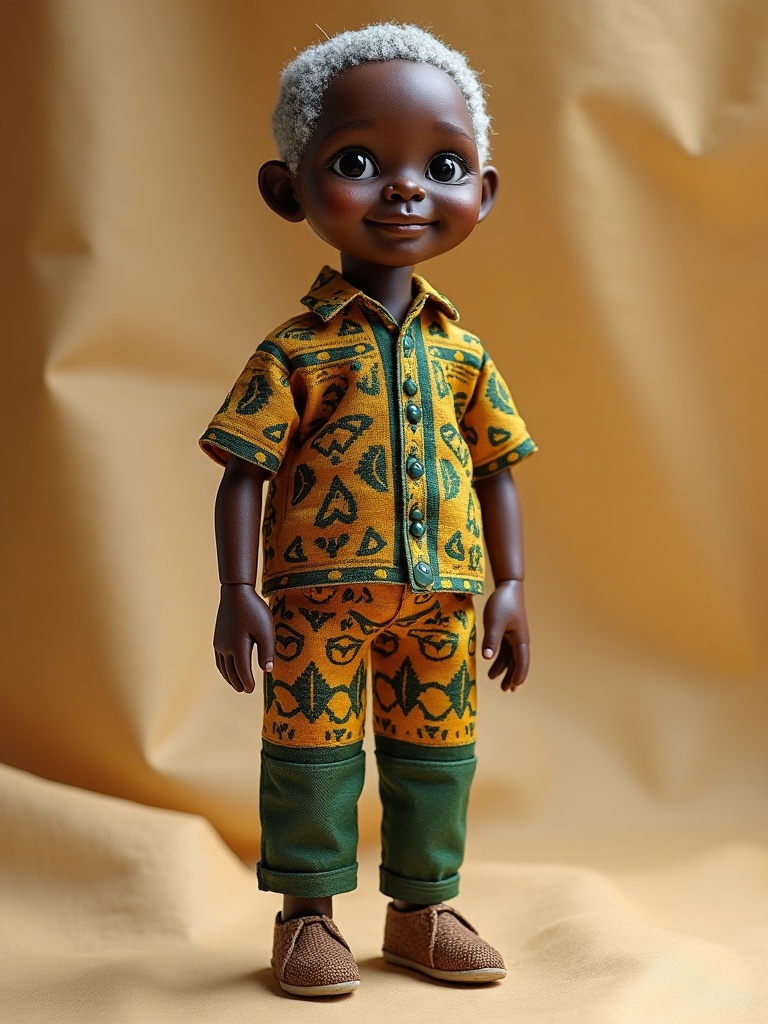
Modern Heroes
Nelson Mandela
Nelson Rolihlahla Mandela was born on 18 July 1918 in the village of Mvezo, into the Madiba clan of the Xhosa-speaking Thembu people; his father was a chief and counsellor to the kings. [1] Mandela was the first in his family to attend…
- People
- Thembu/Xhosa
- Country
- South Africa
- Region
- Southern Africa
- Era
- 1918–2013
- Theme
- Reconciliation & Ubuntu
Make your own
Design your Nelson Mandela
Pick a garment, a hairstyle and a scene, enter the PIN and generate a fresh image of Nelson Mandela with AI.
Each image is generated live with fal.ai.
Generated images
No images generated yet — be the first.
History & Meaning
①Tradition, Life & the Long Walk to Freedom
Nelson Rolihlahla Mandela was born on 18 July 1918 in the village of Mvezo, into the Madiba clan of the Xhosa-speaking Thembu people; his father was a chief and counsellor to the kings.[1] Mandela was the first in his family to attend school — education would remain his guiding star his whole life long.[1] As a young man he joined the African National Congress (ANC) and became one of the most important voices against apartheid.[3]
What apartheid was — explained for children
„Apartheid" means „separateness". It was a system of laws that separated people by their skin color and stripped the black majority of almost all rights — where you were allowed to live, learn, work, even which bench you were allowed to sit on.[5] Mandela devoted his life to the fight against it — at first peacefully, later, when peaceful protest was crushed in bloodshed, also through the armed wing of the ANC. In 1964, in the Rivonia Trial he was sentenced to life imprisonment.[2][3]
27 years — and the spirit stayed free
Mandela spent 27 years in prisonof them 18 on the notorious island Robben Island off Cape Town — in a tiny cell, with hard labor in the limestone quarry, one letter and one visit only every six months.[1][7] But he did not give up. Several times he was offered freedom if he would renounce his struggle — he refused every time.[6] The prisoner became the worldwide symbol of resistance. On 11 February 1990 he walked free.[2]
🕊️ The heart of it: Reconciliation instead of revenge
When Mandela was free, many expected revenge — some even demanded it. But he chose the harder path: forgiveness. He negotiated a peaceful transition with the white government; in 1993, together with President de Klerk, he received the Nobel Peace Prize.[2][4] In 1994, in the first free elections, South Africa elected Mandela as president. He founded the Truth and Reconciliation Commission, so that the country could heal its wounds — through truth, not through retribution.[4]
Behind this stands an old South African word: „Ubuntu" — „I am because we are." A person only becomes whole through other people. Mandela lived this wisdom: The liberation of the oppressed had to free the oppressors as well.
Mandela did not cling to power: after a single term, he stepped down voluntarily in 1999 — a rarity that made him even greater.[2] He then devoted himself to the Nelson Mandela Foundation (1999) and to the cause of education, health and justice. On the December 5, 2013 he died at 95; the whole world mourned.[4][6] His birthday, July 18, is today the worldwide Mandela Day of service.[4]
When he came out, he could have hated.
Instead, he reached out his hand. That was his greatest battle — and his greatest victory.
⑤Transfer to the Present
How does Mandela's life become a lesson for a child in 2050?
The Power of Forgiveness
No revenge after 27 years.
Conflict resolution, reconciliation, empathy. In a schoolyard quarrel as between peoples: forgiving is stronger than striking back. The single most important peace skill there is.
The indomitable spirit
Imprisoned, but never broken.
Resilience, perseverance, conscience. For every child who has it hard: circumstances can confine you, but your inner footing is something you determine yourself.
Ubuntu
“I am because we are.”
Community, diversity, cohesion. In a divided world: We belong together; the well-being of the other is also my well-being. The root of togetherness.
Education as a weapon
Learning even in prison.
Education & equal opportunity. Mandela's conviction that education changes the world is the heart of this entire project. Learning liberates.
Mandela's documented words to the youth: „Education is the most powerful weapon which you can use to change the world." — Nelson Mandela, speech at the launch of the Mindset Network, July 2003 [8]
Abilities & Development
Abilities
His greatest act: after 27 years of injustice, taking no revenge but reconciling instead. In the game: whoever holds Mandela can turn an enemy into an ally — the strongest „weapon" of all.
27 years of imprisonment, repeatedly offered freedom in exchange for giving up — he always refused. He teaches: You can imprison the body, but never a free spirit and a firm conscience.
He believed that liberation must free everyone — the opponents too. He teaches the South African Ubuntu: No person is whole alone; we belong to one another.
Even in prison he continued to study law. Education was for him the tool of liberation. He teaches: Learning is power — and no one can take it away from you.
After a single term in office he stepped down voluntarily — he did not cling to power. He teaches: True greatness knows when to make way and trust others.
Through the years
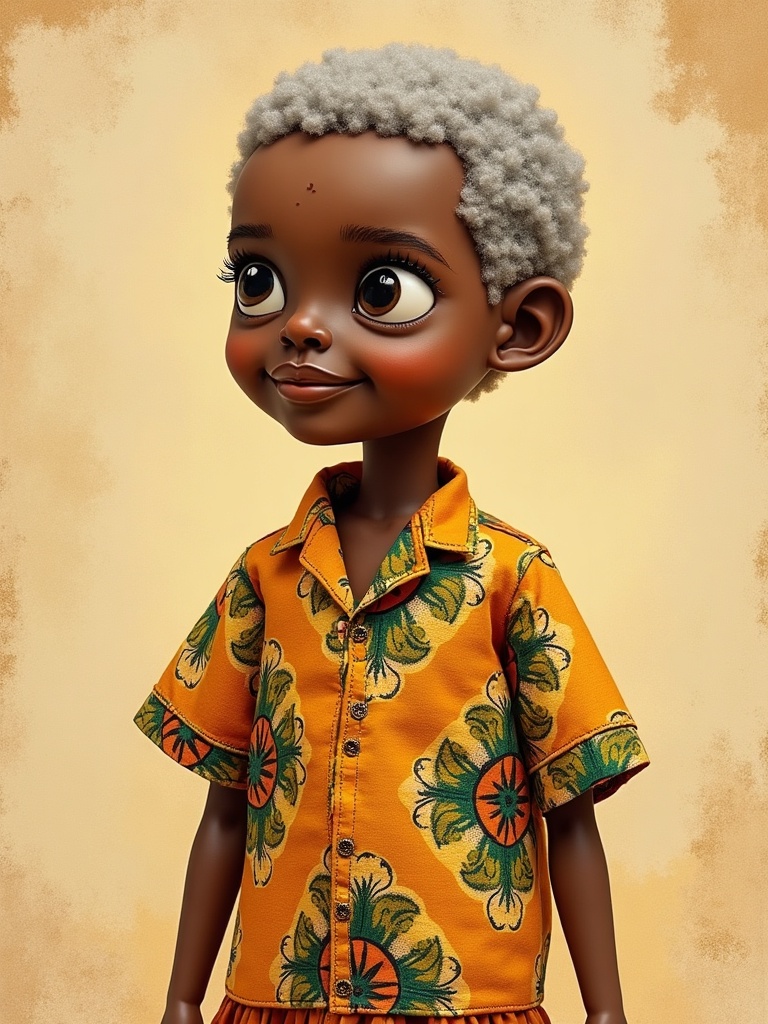
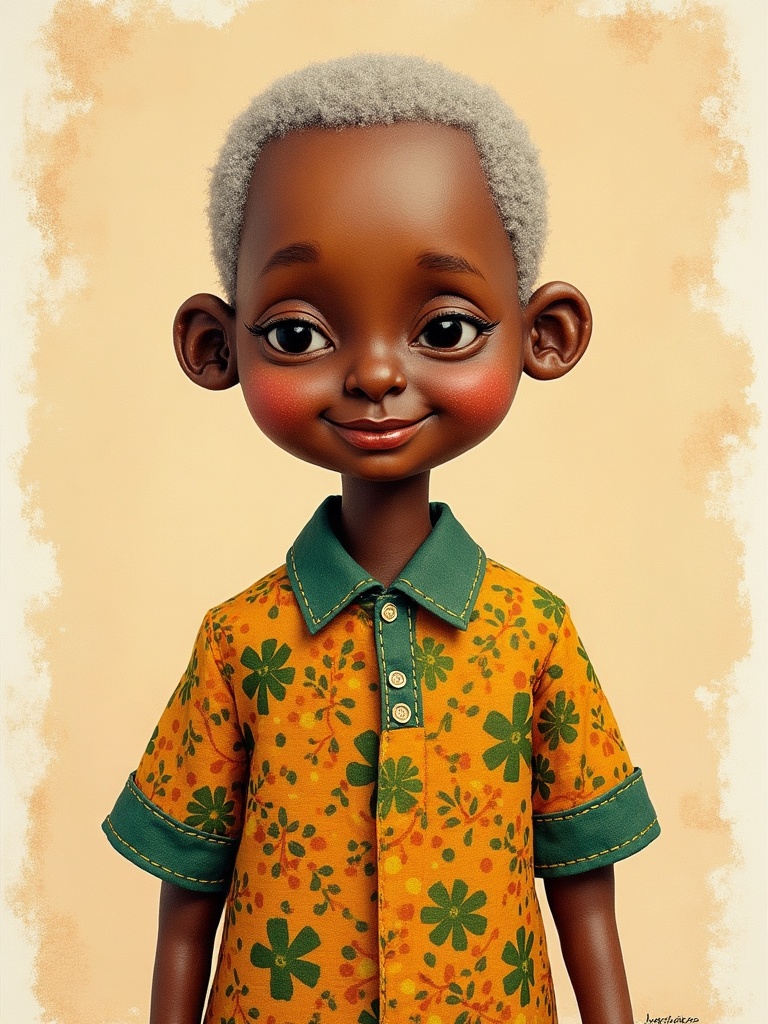
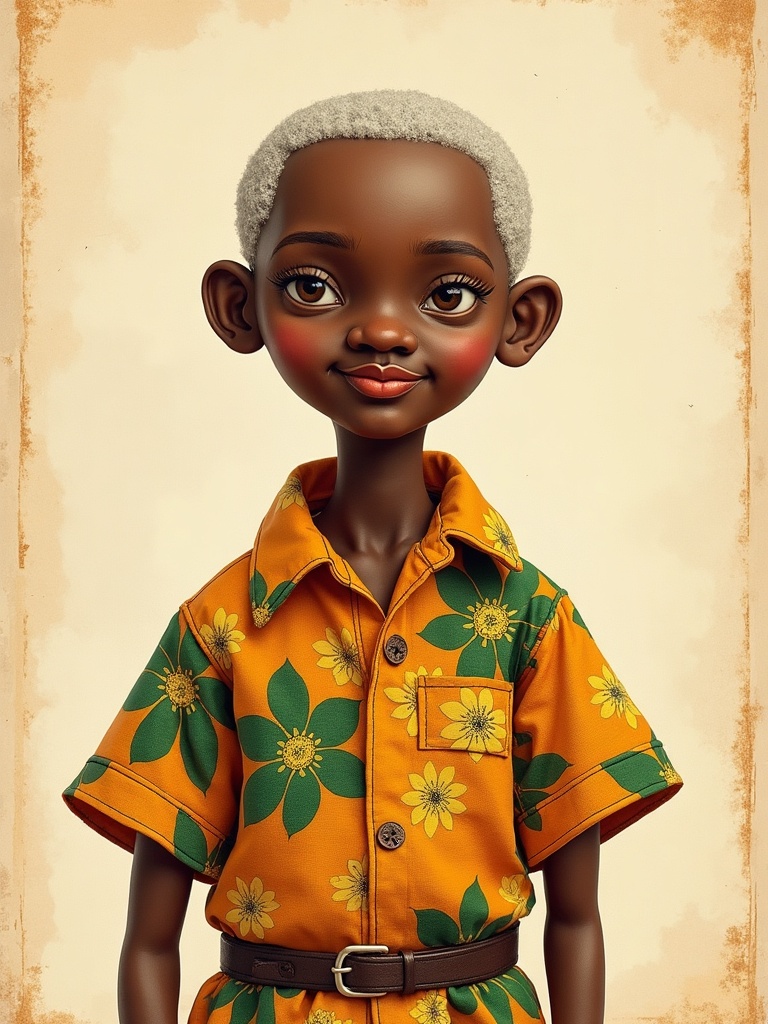
③Life Stages (historical)
The three stages follow his path — from the shepherd boy, through the prisoner with an unbroken spirit, to the reconciling statesman.
Young Rolihlahla, who herds the cattle and is the first in his family to attend school — curious, justice-loving. Simple rural clothing. Gift: Education as a weapon (in the making).[1]
Mandela in prison clothing, upright, a book in his hand — the body imprisoned, the spirit free. Dignified, never broken. Gift: The unbending spirit.[7]
Mandela in the colorful "Madiba shirt," smiling, his hand outstretched in reconciliation — the first president of a free South Africa. Signature gift: The Power of Forgiveness.[4]
Dignified and important: Stage 2 shows dignity, not suffering — no misery put on display. Mandela himself wanted to be remembered as a person of hope, not as a victim.
Make & Learn
⑦Fabrics & Manufacturing Notes
Real natural fibers, honest workmanship, lifelong repairability — and with Mandela the most joyful hallmark of the entire series: the colorful Madiba shirt.
The Materials List
The Garment: the Madiba shirt
Mandela's unmistakable mark is the loose, colorfully patterned „Madiba shirt" — made of 100 % cotton/silk-look in gold, green and turquoise, with a generous pattern. It is the warmest, most joyful outfit in the collection. For the statesman stage, a plain dark suit with a green band. Important: Patterns only in respectful homage, not an exact copy of protected designs.
Signature attributes: open hand, book, dove
Instead of a weapon, Mandela carries the open hand (extended in greeting) as his trademark, plus a small fabriclaw book (education) and optionally a feltdove of peace. Deliberately no chains, no prisoner symbols as a "toy" — dignity, not suffering. No small parts that can be swallowed in the school/toddler line.
Signature, License & Educational Card
The name "Mandela"/"Madiba" may only go on the hem under license from the foundation. Enclosed is a Education card with life dates, the Ubuntu idea and a real, authenticated Mandela quote (checked against the foundation's quote database). Optional QR thread to the Nelson Mandela Foundation.
Production stages & effort
Madiba shirt, open hand, fabric law book, education card with real quote. The reconciliation figure (licensed only).
Simplified shirt, small book. Affordable entry point.
Washable, reinforced seams. With an educational card for values and history lessons.
How it's made
Every doll is sewn by hand from natural materials — built to last a lifetime and to be repaired, not replaced. Here is the shopping list and the work steps. Sizes: Classic 32 cm (heirloom) · Kidogo 18–20 cm (toddlers, no small parts) · Shule 28 cm (school edition).
Shopping list
- Natural cotton or linen for the body (skin tone), ~0.5 m
- Wool or cotton stuffing — no plastic
- Cotton thread and embroidery floss in matching colours
- Garment fabric in this doll's colours (see the fabrics above)
- Yarn for the hairstyle
- Beads, cowrie shells and trims as shown
- Sharps and embroidery needles, pins, fabric scissors, fabric marker
Work instructions
- Trace and cut the body pattern at your chosen size (Classic 32 cm / Kidogo 18–20 cm / Shule 28 cm).
- Sew the body pieces right sides together, leave an opening, turn and stuff firmly with natural fibre, then close by hand.
- Embroider the face gently and with dignity — no plastic parts for the toddler line.
- Make the hair from yarn following the chosen hairstyle and attach it securely.
- Cut and sew the garment from this doll's fabric, then dress the doll.
- Add the beadwork, shells, trims and any attribute by hand.
- Check every seam and reinforce it — the doll should be lifelong and repairable, with no loose small parts for small children.
⑥Ten Name Suggestions
Mandela's name itself is protected. These ten names — from his world, the Xhosa & South Africa — are suitable for companion figures or a respectful series in the spirit of Mandela (not as a substitute "Mandela"). To be confirmed by South African bodies before use.
Lovely for the classroom: „Amandla!" (Power!) — together with the response „Awethu!" („it belongs to us!") — became the rallying cry of the freedom movement: a whole story in a single word.
⑧Curriculum Mapping & Subjects
Mandela can be taught worldwide — from South Africa to the diaspora. He connects history, values education and peace education like hardly any other figure.
Fight against apartheid
Resistance against racial segregation.
History / Values. What was apartheid? Racism, human rights, equality — through a concrete, recent example.
Reconciliation & TRC
Truth instead of revenge.
Ethics / Peace Education. How does a country heal its wounds? Conflict resolution, forgiveness, justice without retribution.
"I am because we are"
An African philosophy.
Philosophy / Values. What does community mean? Ubuntu as Africa's contribution to world ethics.
Peaceful or armed?
The ANC & its armed wing.
Ethics (older students). When is resistance justified? Mandela's path from protest to the armed wing and back to reconciliation — nuanced & guided.
Children resolve a conflict once with "revenge," once with reconciliation. Learning goal: forgiveness, empathy, peaceful conflict resolution.
The class explores Ubuntu through everyday examples. Learning goal: sense of community, responsibility for one another, diversity as strength.
Children check quotes attributed to Mandela (some are false!) against the foundation's database. Learning goal: source criticism, quotation honesty.
Origin & Ethics
⚖ A respectful concept
Real person. License of the Nelson Mandela Foundation mandatory. Only documented quotes. Homage, not a likeness.
How we know this
On honesty: Mandela is fully documented (★★★★★) — his own autobiography, speeches, archives, the foundation. Unlike the centuries-old figures, here only real, documented quotes with their occasion & source are used — no „loosely invented" ones. The foundation explicitly warns against falsely attributed quotes. Mandela's story also has difficult parts (the armed wing of the ANC, personal & political conflicts) — these are not hidden, but placed in context in an age-appropriate way & with guidance. Above all, however: name & likeness are legally protected; this compendium is a respectful draft, and a real doll would only be possible with the explicit license of the Nelson Mandela Foundation. Final approval rests strictly with the foundation & family.
⑨Approval (the foundation!) & Sources
Here Mandela differs fundamentally from all other figures: It is not (only) about cultural appreciation, but about tangible rights. Mandela's name, image and voice are protected; the Nelson Mandela Foundation is the central, binding authority. Without its license there is no doll — period.
The approval body
The five-step protocol
Unlike usual, here the formal licensing request to the Nelson Mandela Foundation right at the very beginning — before any design. Presentation of the vision, 42% rule, educational revenue model.
Draft & have all texts/quotes authenticated via the official quote database of the foundation (strictly avoid misattributed quotes).
Foundation & family for rights/dignity, cultural bodies for remembrance, Xhosa/Thembu voice for clan references.
Written License — or a refusal that is fully accepted. Without a license, nothing is produced, shown or sold.
An agreed share of the proceeds flows (in addition to the seamstresses' 42 %) to the Foundation & its educational work — the doll serves his legacy, not just his image.
Golden rules regarding Mandela: no portrayal without a license, only authenticated quotes, dignity instead of suffering (no prisoner clichés as toys), no party promotion and the honest, age-appropriate framing of the difficult parts of his history (the armed wing of the ANC).
Sources to watch
Sources
- Nelson Rolihlahla Mandela, born 18 July 1918 in Mvezo (Madiba clan, Thembu/Xhosa), the first in his family to attend school; 18 of his 27 years of imprisonment on Robben Island. libguides.nypl.org: Nelson Mandela Biography.
- Military ANC leader, sentenced to life imprisonment in 1964; negotiations from 1982 onward; freed on 11 February 1990 after 27 years; voluntary withdrawal in 1999. nobelprize.org: Nobel Peace Prize 1993.
- Joined the ANC, Defiance Campaign, armed wing Umkhonto we Sizwe; 27 years of imprisonment as a symbol of resistance. ebsco.com: Nelson Mandela.
- Nobel Peace Prize 1993 (with de Klerk); first Black president in 1994; Truth & Reconciliation Commission 1995, new constitution 1996; Nelson Mandela Foundation 1999; Mandela Day. britannica.com: Nelson Mandela.
- Best-known leader of the resistance against apartheid; Robben Island 1964–82; first Black president 1994–99. britannica.com: Nelson Mandela (overview).
- Personal sacrifice: 27 years of imprisonment, offers of release in exchange for giving up the struggle always refused; after his release no revenge, but reconciliation; died 5 December 2013 at the age of 95. businessandleadership.com: Mandela's Leadership.
- Robben Island: tiny cell, hard labor in the limestone quarry, one letter/visit every six months; 1994 inauguration speech 'time to heal the wounds'. polsci.institute: Apartheid to Reconciliation.
- "Education is the most powerful weapon which you can use to change the world." — Speech at the launch of the Mindset Network, July 2003. globalcitizen.org: Mandela Quotes.
- "No one is born hating …" — from "Long Walk to Freedom" (1994/95). goodreads.com: Nelson Mandela Quotes; humanrightscareers.com.
- The Nelson Mandela Foundation maintains authenticated quotations and warns against misattributed ones (e.g. "our deepest fear" is by Marianne Williamson, NOT by Mandela); the official rights and remembrance authority. nelsonmandela.org: FAQs.