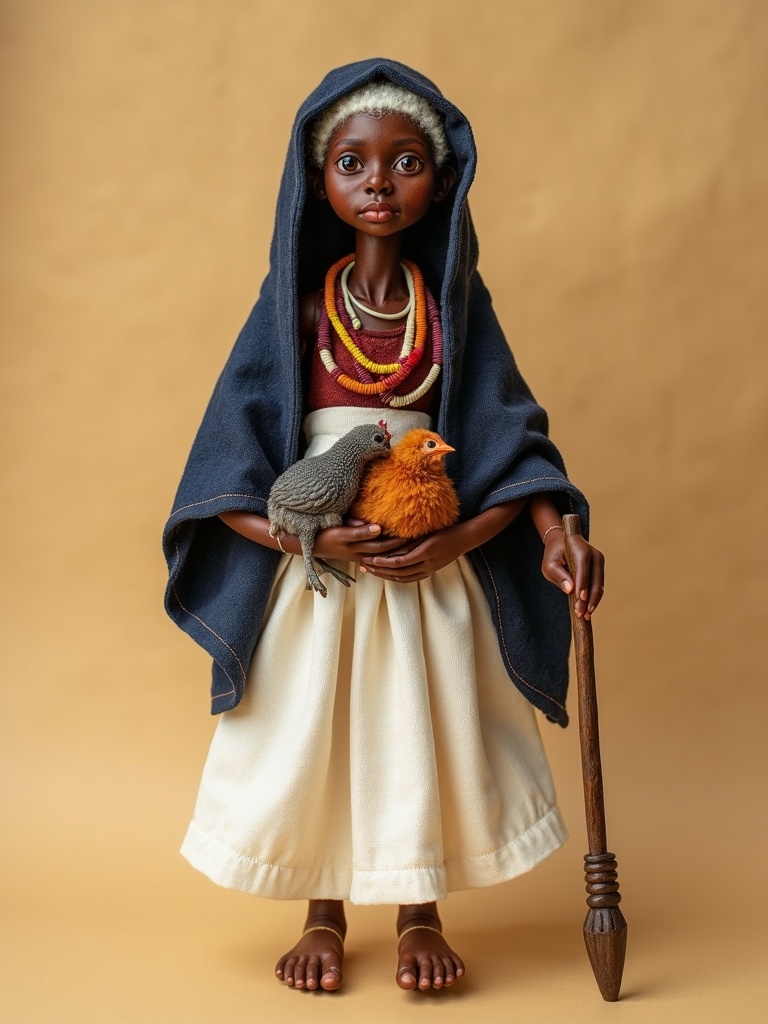
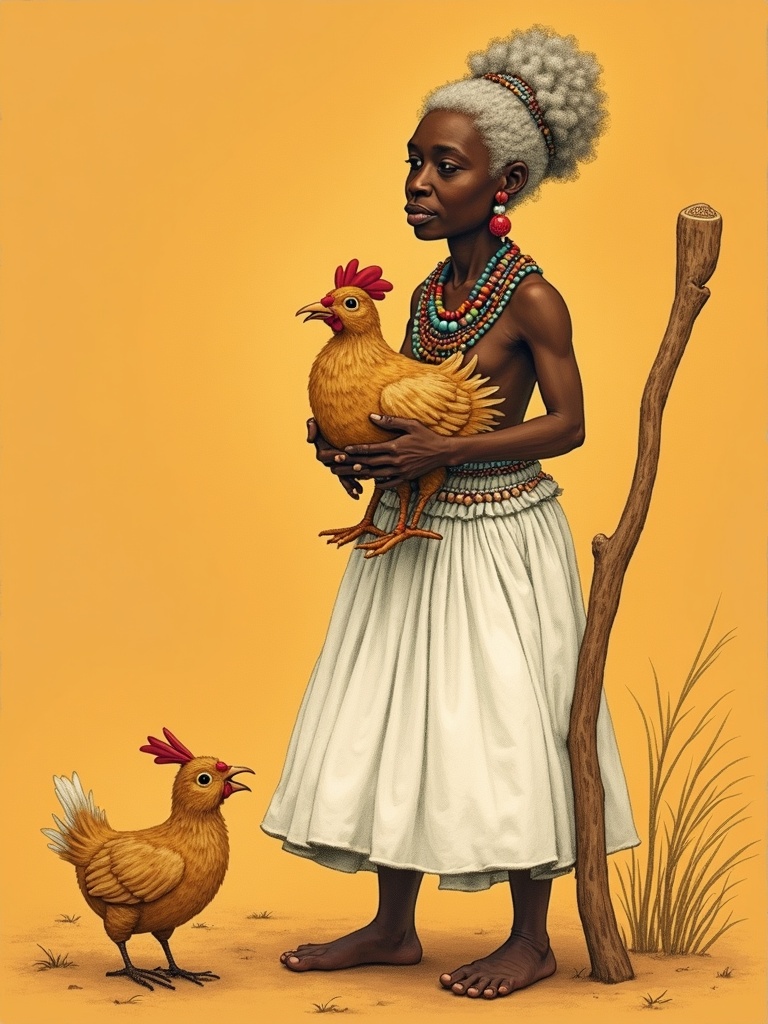
AI design preview — not a photo of the finished handmade doll
Resistance & the Coast
Mekatilili wa Menza
In 1913, on the Kenyan coast that this very project calls home, a Giriama widow in her seventies held out a hen and her chicks to a colonial officer and dared him to take just one — and for a moment, an empire flinched.
- People
- Giriama (Mijikenda)
- Country
- Kenya
- Region
- East Africa
- Era
- ≈1840s–1924
- Theme
- Resistance & the Coast
Make your own
Design your Mekatilili wa Menza
Pick a garment, a hairstyle and a scene, enter the PIN and generate a fresh image of Mekatilili wa Menza with AI.
Each image is generated live with fal.ai.
Generated images
AI design preview — not a photo of the finished handmade doll
No images generated yet — be the first.
Tradition & Origin
In 1913, on the Kenyan coast that this very project calls home, a Giriama widow in her seventies held out a hen and her chicks to a colonial officer and dared him to take just one — and for a moment, an empire flinched.
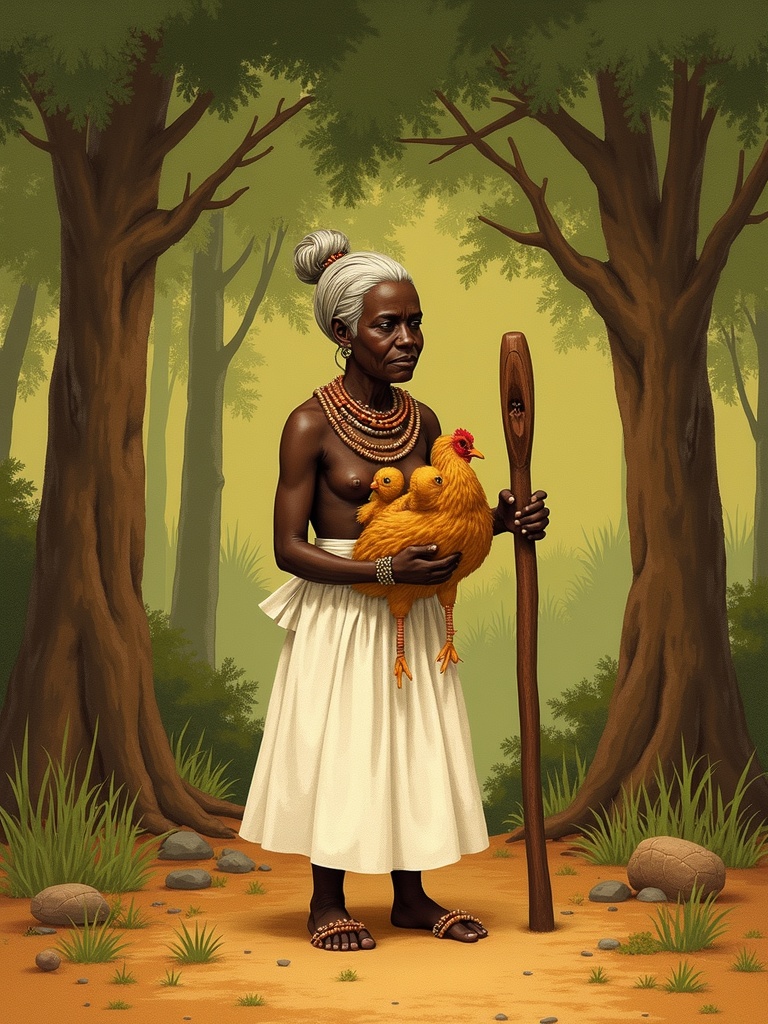
She was born around the 1840s as Mnyazi wa Menza, near Bamba in what is now Kilifi County, among the Giriama — the largest of the nine Mijikenda peoples who live along the coast of Kenya and northern Tanzania. The Giriama had no kings; their world was governed by councils of elders gathered in the sacred forest villages called kaya, where a buried talisman, the fingo, was believed to hold the people's spiritual power. After marriage and the birth of a son named Katilili, Mnyazi became known as Mekatilili — 'mother of Katilili'.
By 1913 the British were tightening their grip hard, and this must be named plainly. They imposed hut taxes, tried to control the Giriama palm-wine (mnazi) and ivory trade, ordered families to give up their young men for forced labour and the coming World War, and demanded the Giriama abandon their fertile lands north of the Sabaki river. When administrator Arthur Champion created new colonial chiefs over a people who had always ruled by council, Mekatilili rose. She danced the sacred kifudu funeral dirge from village to village to gather huge crowds, and at Kaya Fungo she helped bind women with the mukushekushe oath and men with the fisi oath, vowing never to cooperate. Champion admitted in his own report that 'every Giriama is much more afraid of the kiraho (oath) than of the government'.
The British answer was brutal: they dynamited the sacred Kaya Fungo, burned villages and seized livestock, and on 17 October 1913 arrested Mekatilili and the elder Wanje wa Mwadorikola, exiling her to Kisii in far-western Kenya. But the story did not end there. The elderly woman escaped and walked roughly 700 kilometres home; recaptured and banished as far as Kismayu in Somalia, she found her way back again, astonishing colonisers who could not believe a woman of her age had survived. Around 1919 she returned to lead the Giriama women's council, and died about 1924, buried in the Dakatcha Woodland — today honoured as one of Kenya's earliest freedom fighters, with statues, a national garden in Nairobi, and an annual festival in her name on the coast.
Timeline
- ≈1840sBorn Mnyazi wa Menza near Bamba in Giriama country, on the Kenyan coast (today's Kilifi County).
- May 1913Administrator Arthur Champion imposes new colonial chiefs and locations over the council-led Giriama.
- 13 Aug 1913At a colonial baraza Mekatilili confronts Champion with a hen and her chicks, refusing to give up the young men.
- 17 Oct 1913Arrested with elder Wanje wa Mwadorikola; the British dynamite sacred Kaya Fungo and burn villages; she is exiled to Kisii.
- ≈1914She escapes exile and walks roughly 700 km back to the coast; recaptured and sent as far as Kismayu, she escapes again.
- ≈1919–1924Allowed home, she leads the Giriama women's council; she dies about 1924, buried in the Dakatcha Woodland.
Did you know?
- To rally her people she danced the kifudu — a funeral dirge meant to draw the living close to the ancestors — constantly from town to town, until whole villages followed her wherever she went.DetailsEN
- At a colonial meeting she held out a mother hen with her chicks and warned the British officer, 'this is what you will get if you try to take one of our sons' — and the hen pecked his hand.DetailsEN
- Every August the Mijikenda still gather on the Kenyan coast for the Mekatilili wa Menza Festival, with dance, song and ceremony honouring her memory.DetailsEN
She had no army and no throne — only a dance, an oath, and a hen with her chicks — and still she made an empire stop and listen.
Values & Capabilities
Capabilities
◆◆◆◆◆ shows how central a gift is — five diamonds mark a signature strength, fewer mark a supporting one.
She carried a mother hen and her chicks to the colonial meeting and dared the officer to snatch a single chick.
She danced the sacred funeral dance from town to town until whole villages followed her, ready to resist.
At the sacred Kaya she helped bind the people with oaths to refuse colonial labour, taxes and orders.
Exiled hundreds of kilometres away, she escaped and walked back to her coast — twice.
In her old age she came home to lead her people's council and guard their traditions and freedom.
Development
1 of 5 stages unlocked
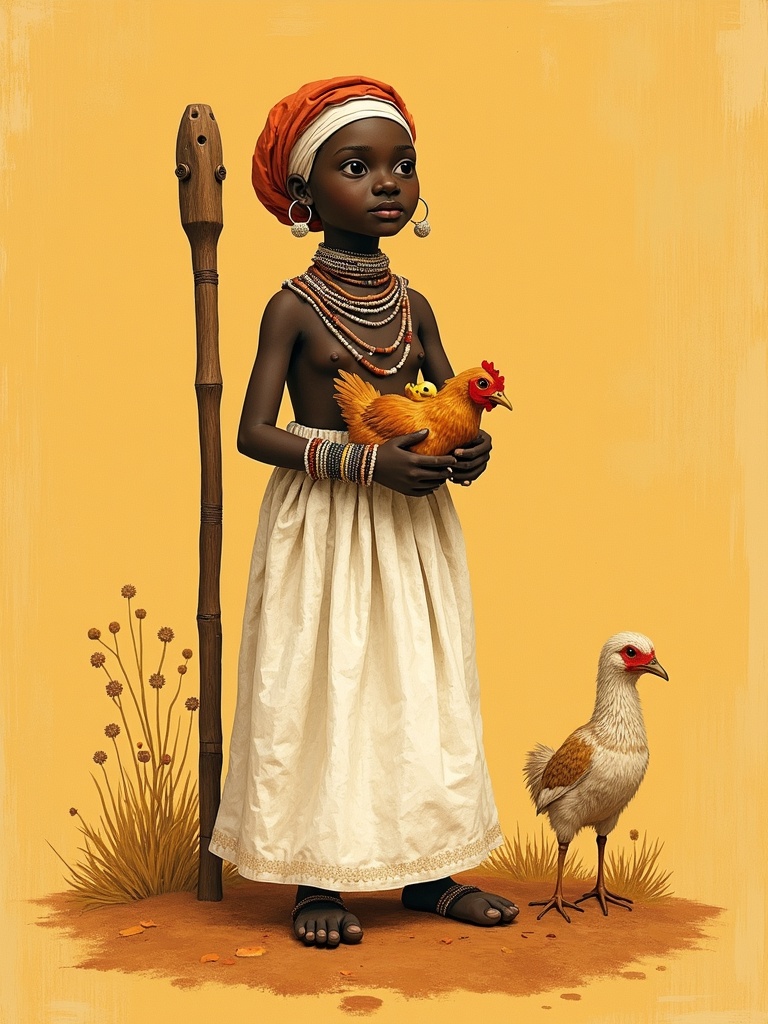
Born around the 1840s near Bamba in Giriama country, named Mnyazi wa Menza, one daughter among several children.
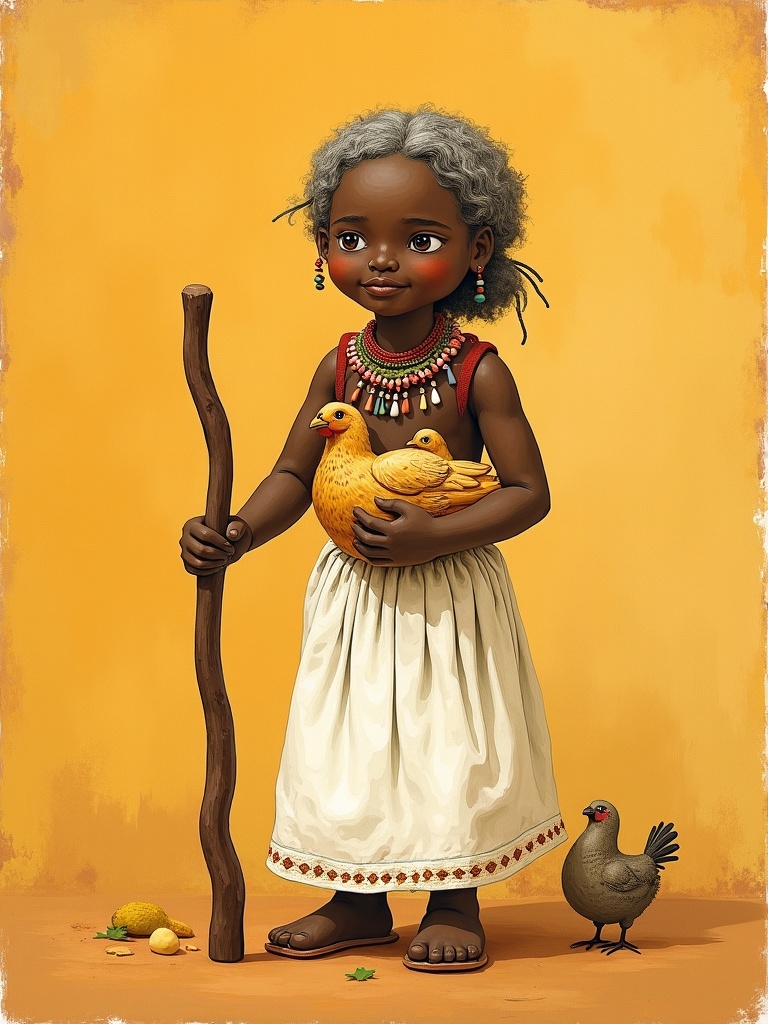
Answer all three to unlock this stage.
Unlock the previous stage first.
Unlock the previous stage first.
Unlock the previous stage first.
Crafting the doll
The doll is sewn from coastal Giriama dress: a gathered white cotton hando skirt folded into soft pleats at the hips, a dark indigo kaniki cloth wrapped over the chest, and bright printed leso/kanga cloths for festival looks. Her ornaments are strands of red, yellow and white waist beads (tunda), paired beaded arm bands (vivorodete) and a polished aluminium bangle, with a woven makuti palm-leaf sun hat. Her signature attribute is a small mother hen with her chicks, joined by a carved elder's staff (fimbo) and a little gourd rattle for the kifudu dance. The education card explains the Giriama uprising of 1913–1914, the sacred Kaya forests, and how a widow elder defended her people's land and freedom. Sizes Classic 32 / Kidogo 18–20 / Shule 28. A share of proceeds supports Mijikenda heritage, the Kaya forests and coastal Kenyan girls' education.
How this doll is made
This doll is grounded in the material culture of the Giriama women of the Kenyan coast — the gathered white hando skirt, dark kaniki wrap, bright leso cloths and strands of waist beads — with a small hen and chicks, an elder's staff and the sacred Kaya forest behind it all.
- Garments 2
- Accessories 4
- Materials 2
- Techniques 2
Garments
- Hando skirtThe traditional Mijikenda/Giriama women's skirt: long cotton material gathered into soft folds to give a rounded shape at the hips, usually immaculate white but sometimes in red, blue, green or black, each colour carrying meaning; worn for modesty and dignity.DetailsEN
- Leso / kanga wrapBright rectangular printed cotton cloths, often carrying a Swahili proverb, wrapped around the body and over the shoulder — the everyday and festival dress of coastal Mijikenda women.DetailsEN
Accessories
- Tunda waist beadsStrands of coloured beads — usually red, yellow and white — intertwined around the waist of Giriama women as ornament and marker of identity.DetailsEN
- Vivorodete arm bandsPaired beaded arm bands worn by married Mijikenda women above the elbow at ceremonies and festivals, alongside aluminium bangles worn at the wrist.DetailsEN
- Hen and chicksA small cloth mother hen with chicks, the central symbol of Mekatilili's defiance when she dared the colonial officer to take one of her 'sons'.DetailsEN
- Elder's staff (fimbo)A carved dark-wood walking staff, the mark of an elder's authority, fitting for a woman who led her people's council in old age.DetailsEN
Materials
- Cotton cloth (white & kaniki)Plain white cotton for the hando and dark indigo-dyed kaniki cloth for the wrap — the core fabrics of Giriama women's dress, beaten and softened by hand.DetailsEN
- Makuti palm leafDried coconut-palm (makuti) leaf woven into sun hats that shield coastal women from the strong equatorial sun — a signature coastal material.DetailsEN
Techniques
- Making the handoThreads are pulled along the grain of the cotton to fray it, the fabric is soaked and beaten against stone or wood to soften the strands, then combed straight with a wide-toothed wooden comb (mkowa) and gathered into folds.DetailsEN
- Kifudu dance stagingRe-enacting the sacred Giriama funeral dance — a dirge that draws the living close to the ancestors — with a gourd rattle and measured steps, the very method Mekatilili used to gather her people.DetailsEN
How it's made
Every doll is sewn by hand from natural materials — built to last a lifetime and to be repaired, not replaced. Here is the shopping list and the work steps. Sizes: Classic 32 cm (heirloom) · Kidogo 18–20 cm (toddlers, no small parts) · Shule 28 cm (school edition).
Shopping list
- Natural cotton or linen for the body (skin tone), ~0.5 m
- Wool or cotton stuffing — no plastic
- Cotton thread and embroidery floss in matching colours
- Garment fabric in this doll's colours (see the fabrics above)
- Yarn for the hairstyle
- Beads, cowrie shells and trims as shown
- Sharps and embroidery needles, pins, fabric scissors, fabric marker
Work instructions
- Trace and cut the body pattern at your chosen size (Classic 32 cm / Kidogo 18–20 cm / Shule 28 cm).
- Sew the body pieces right sides together, leave an opening, turn and stuff firmly with natural fibre, then close by hand.
- Embroider the face gently and with dignity — no plastic parts for the toddler line.
- Make the hair from yarn following the chosen hairstyle and attach it securely.
- Cut and sew the garment from this doll's fabric, then dress the doll.
- Add the beadwork, shells, trims and any attribute by hand.
- Check every seam and reinforce it — the doll should be lifelong and repairable, with no loose small parts for small children.
Origin & Ethics
How we know this
This record is semi-documented (★★★★ of an oral-tradition kind). The Giriama uprising of 1913–1914, the oaths, the hen-and-Champion confrontation, her arrest and exile, and her later council leadership are supported by historians and colonial records. Many vivid details — her exact birth and death years, the lengths and routes of her escapes, and the wording of her quotes — come from Giriama oral tradition and vary between tellings, and are presented here as honoured memory. Nothing is invented; uncertain points are flagged.
As a historical figure (died about 1924) Mekatilili needs no living person's consent, but her memory is still sacred to the Giriama and the wider Mijikenda. This figure would be made in respectful dialogue with Mijikenda cultural elders and bodies such as the Malindi District Cultural Association (MADICA), which leads the annual Mekatilili wa Menza Festival, and with the custodians of the Sacred Mijikenda Kaya Forests — so that the dress, the sacred dance and the Kaya are shown with honour and not as kitsch.
Sources
- Wikipedia, Mekatilili Wa Menza — biography, kifudu dance, oaths, arrest, exile, escapes, death, legacy
- Google Arts & Culture, 'Mekatilili Wa Menza: The Story of the Giriama Wonder Woman' — birth name, hen-and-chicks incident, escapes, festival
- History Matters (University of Sheffield), 'Mekatilili Wa Menza and the Giriama War' — causes, hut taxes, mnazi, oaths, Champion, dates, 'kiraho' quote, 1919 release
- Encyclopaedia Africana, 'Mekatilili Wa Menza' — biography, statue, festival, national-hero status
- The Open University / Ferguson Centre, '(re)creation of a heroine: the case of Mekatilili wa Menza' (Nicholls & Mwakimako) — scholarly study of the heroine and her memory
- Wikipedia, Kaya (Mijikenda) — the nine Mijikenda groups, Kaya Fungo / Kaya Giriama, fingo talisman, UNESCO 2008 inscription, ~60 makaya
- UNESCO World Heritage Centre, Sacred Mijikenda Kaya Forests (List no. 1231) — 11 forests, 1,538 ha, 2008 inscription
- Mijikenda.co.ke, 'Cultural Threads: the meaning behind Mijikenda clothing' — leso/kanga, shuka colours, beads, makuti hats
- Eastleigh Voice, 'Why Mijikenda are pushing for protection, preservation of hando attire' — the hando skirt, how it is made, kaniki, beads
- The Star (Kenya), 'Annual Mekatilili Menza festival starts in Malindi' — the living festival honouring her on the coast