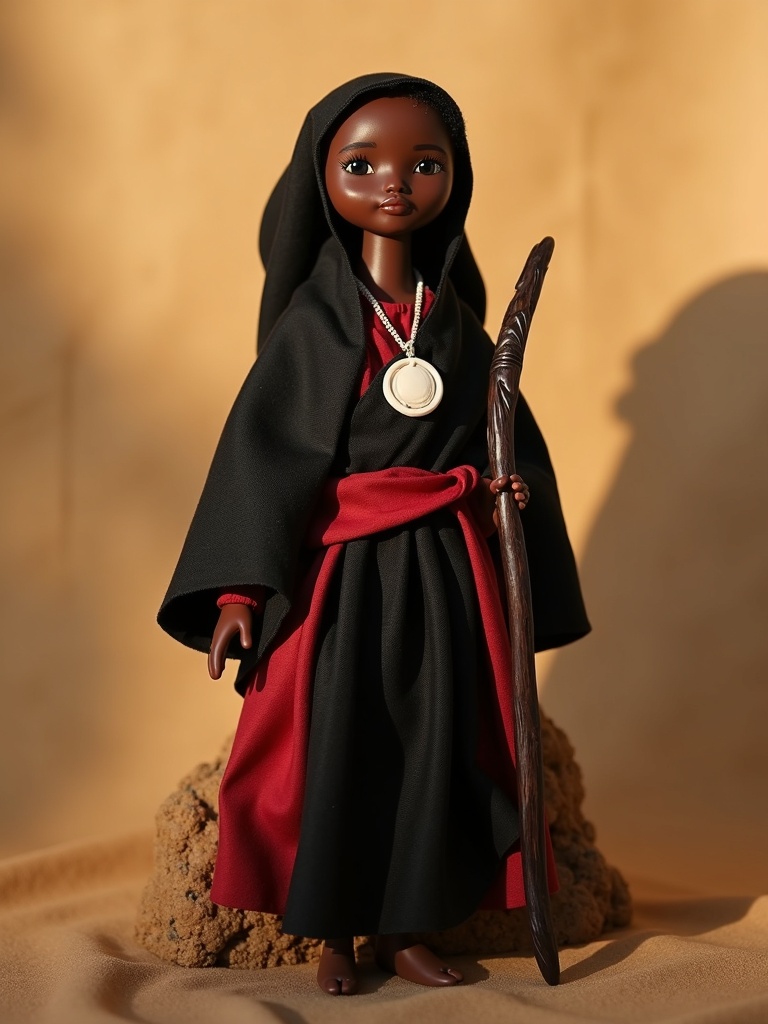
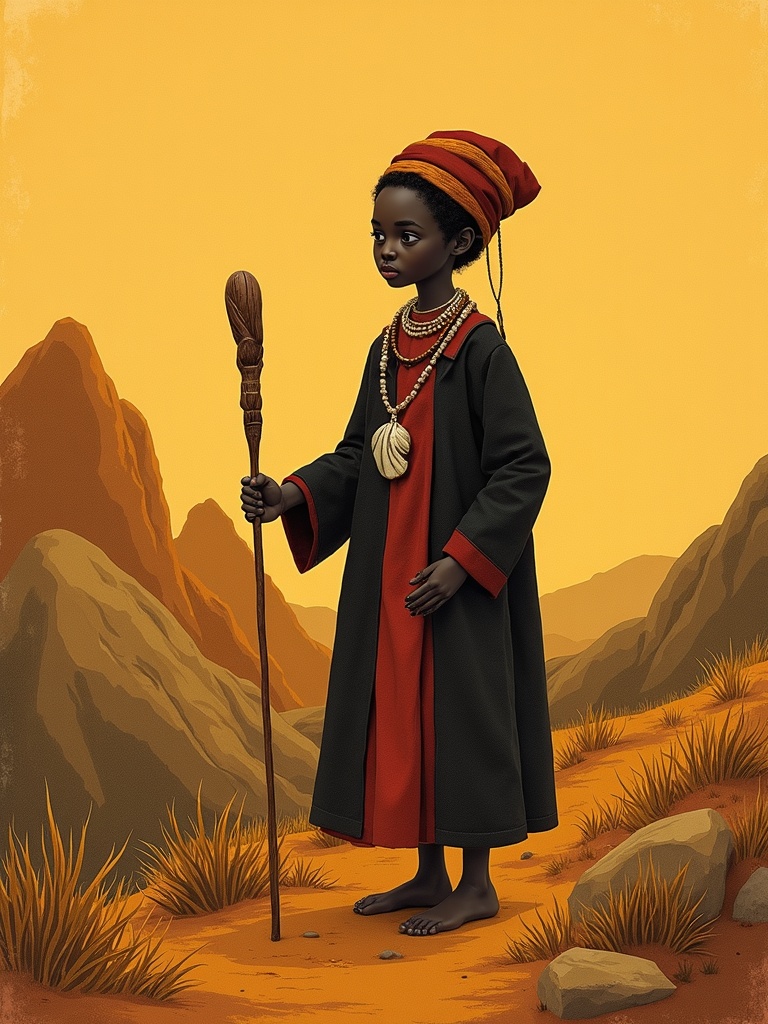
AI design preview — not a photo of the finished handmade doll
Spirit of the First Chimurenga
Mbuya Nehanda
She was a woman who lent her voice to a spirit older than memory — and when the empire hanged her in 1898, she promised her bones would rise again. Two generations later, they did.
- People
- Shona (Zezuru)
- Country
- Zimbabwe
- Region
- Southern Africa
- Era
- ≈1840–1898
- Theme
- Spirit of the First Chimurenga
Make your own
Design your Mbuya Nehanda
Pick a garment, a hairstyle and a scene, enter the PIN and generate a fresh image of Mbuya Nehanda with AI.
Each image is generated live with fal.ai.
Generated images
AI design preview — not a photo of the finished handmade doll
No images generated yet — be the first.
Tradition & Origin
She was a woman who lent her voice to a spirit older than memory — and when the empire hanged her in 1898, she promised her bones would rise again. Two generations later, they did.
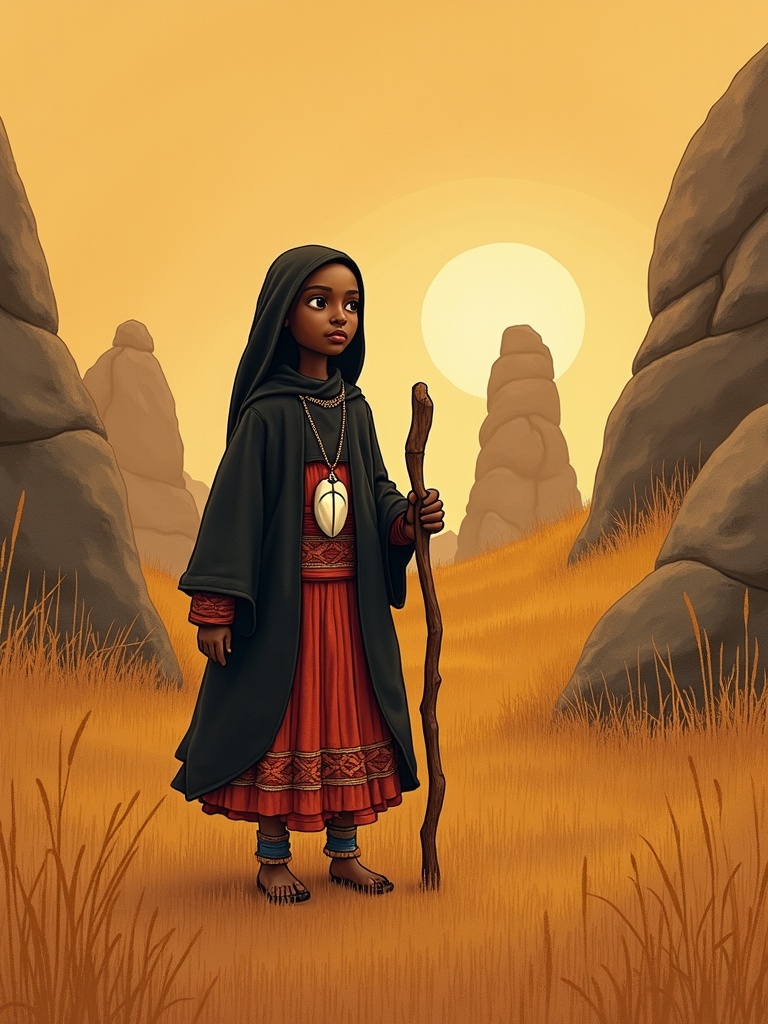
Mbuya Nehanda — by her own name Charwe Nyakasikana — was born around 1840 among the Zezuru Shona of Mashonaland, in the granite-strewn highveld of what is now Zimbabwe. She was a svikiro, a spirit medium, believed to carry the voice of Nehanda, a female mhondoro or royal ancestral spirit. In Shona belief that spirit reached back to the founders of the medieval Mutapa state: tradition names the first Nehanda as Nyamhita, daughter of the Mutapa ruler Mutota, around the 1430s. As medium, Charwe gave oracular counsel and led the ceremonies thought to ensure rain and good harvests, holding one of the highest religious offices in 19th-century Mashonaland — the only woman of such authority on record.
Then the colonisers came. In 1890 Cecil Rhodes's British South Africa Company occupied Mashonaland; in 1894 it imposed a hated hut tax on every household, on top of land seizures and forced labour. In June 1896 the Ndebele and Shona rose together in the First Chimurenga — the first war of liberation. From October 1896, Nehanda and the male medium Kaguvi helped rally Mashonaland to the fight, and the two became the spiritual heart of the resistance. The Company answered with overwhelming force, and the uprising was crushed by 1897 — a hard, colonial history that should be named plainly, not softened.
Captured after the rebellion, Charwe was charged over the death of the cruel Native Commissioner H. H. Pollard and condemned by a colonial court in 1898. A Jesuit priest who attended her recorded that she refused to be converted to Christianity and would not be turned from the faith of her ancestors. She was hanged on 27 April 1898. We honour her life and her courage — never her death. What endured was a remembered prophecy: "Mapfupa angu achamuka", my bones shall rise again. In the Second Chimurenga of the 1960s and 70s her name became a battle-cry, and in 1980 Zimbabwe won its independence. Her trial dockets now sit in UNESCO's Memory of the World register, and in 2021 a statue of Mbuya Nehanda was raised in central Harare.
Timeline
- ≈1840Charwe Nyakasikana is born among the Zezuru Shona of Mashonaland, in present-day Zimbabwe.
- 1890Cecil Rhodes's British South Africa Company occupies Mashonaland and seizes Shona land.
- 1894The Company imposes a hated hut tax on every household, deepening resentment.
- 1896–97The Shona and Ndebele rise in the First Chimurenga; Nehanda and Kaguvi help lead the Mashonaland resistance.
- 27 Apr 1898Captured and condemned, she refuses to convert and is executed by hanging in Salisbury (Harare).
- 1980 / 2021Her prophecy echoes in Zimbabwe's 1980 independence; a statue of Mbuya Nehanda is unveiled in Harare in 2021.
Did you know?
- Nehanda is a mhondoro — a 'lion' spirit; in Shona belief such royal ancestral spirits rest in the bodies of maneless lions until they find a human medium to speak through.DetailsEN
- When the first European settlers arrived she is said to have urged calm — 'they are only traders' — and only later, under harsh Company rule, did she preach that they must be driven out.DetailsEN
- Her remembered last words, 'my bones shall rise again,' are believed by many Zimbabweans to have foretold the Second Chimurenga of the 1960s–70s that won independence in 1980.DetailsEN
- The sacred Shona cloth Jira reRetso — a red ground with a bold black-and-white geometric pattern — is linked to the ancestors and worn in spiritual contexts, the kind of machira a medium might wear.DetailsEN
A medium gave her voice to the ancestors; in the end, a whole nation gave its voice to her.
Values & Capabilities
Capabilities
◆◆◆◆◆ shows how central a gift is — five diamonds mark a signature strength, fewer mark a supporting one.
As a svikiro she was believed to speak with the voice of the great ancestral spirit Nehanda, guiding her people.
She made oracular pronouncements and led the ceremonies believed to bring the rains and good crops.
She helped rally the Shona to join the great 1896–97 uprising against the British South Africa Company.
Captured and sentenced, she refused to convert or recant, staying true to her people's faith to the end.
Her remembered prophecy — that her bones would rise again — became a rallying cry for Zimbabwe's freedom.
Development
1 of 5 stages unlocked
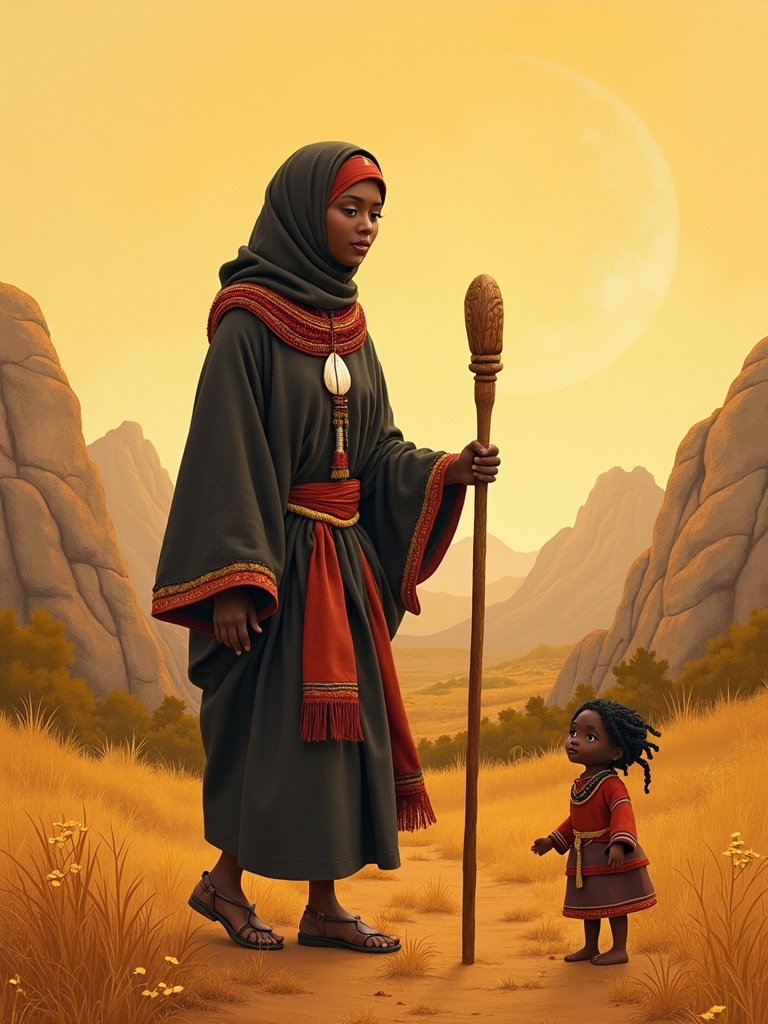
Charwe Nyakasikana is born around 1840 among the Zezuru Shona of the highveld, in the land of granite hills.
Answer all three to unlock this stage.
Unlock the previous stage first.
Unlock the previous stage first.
Unlock the previous stage first.
Crafting the doll
The doll is sewn from the dress of a 19th-century Shona (Zezuru) medium: a plain black ritual cloth with a deep-red sash, or the sacred Jira reRetso machira — a red ground with a black-and-white geometric pattern — tied at shoulder and waist, with a black or earth-toned dhuku headcloth and a soft animal-skin (kaross) mantle for an elder's look. Her ornaments are a white conus-shell ndoro pendant and a few strands of trade beads. Her signature attributes are a carved dark-wood walking staff (tsvimbo), a small snuff calabash and horn, and a wooden mbira in its gourd — the instrument that calls the ancestral spirits. The education card explains the First Chimurenga, the Shona svikiro and mhondoro tradition, and the long road to Zimbabwe's independence. Sizes Classic 32 / Kidogo 18–20 / Shule 28. A share of proceeds supports Zimbabwean heritage, Shona-language schooling and girls' education.
How this doll is made
This doll is grounded in the material culture of a 19th-century Shona (Zezuru) spirit medium — the plain black-and-red ritual cloth, the sacred retso machira, an animal-skin mantle, a white ndoro shell, a carved staff and the mbira that calls the ancestors — all shown with the dignity owed to a living sacred tradition.
- Garments 2
- Accessories 3
- Materials 2
- Techniques 3
Garments
- Svikiro ritual clothShona spirit mediums are described as wearing black and white (and red) cloth when possessed, together with animal-skin clothing — the solemn ritual dress of a svikiro.DetailsEN
- Jira reRetso (machira)The best-known Shona ancestral cloth: a red ground with a distinct black-and-white geometric pattern, worn as a wrap, headdress or scarf and linked to spirituality and the ancestors.DetailsEN
Accessories
- Dhuku headclothA cloth headwrap traditionally worn by Shona women to cover the head; in plain black or earth tones it suits a medium's grave dress.DetailsEN
- Walking staff / knobkerrieA svikiro's regalia includes walking sticks and knobkerries — instruments or tools that could have belonged to the ancestor being channelled.DetailsEN
- Snuff calabash & hornSnuff, taken by a medium before becoming possessed, carried in a small gourd or horn — part of a svikiro's ritual tools.DetailsEN
Materials
- Animal skin (kaross)Soft tanned animal-skin garments form part of the medium's regalia, worn as a wrap or mantle over the shoulder.DetailsEN
- Ndoro shell ornamentThe ndoro is a white conus-shell prestige ornament of Shona tradition, once worn on the forehead or at the neck and echoed in carved circle motifs.DetailsEN
Techniques
- Calling the spirit with mbiraAncestral spirits are called down through mbira (thumb-piano) and drum music while the medium takes snuff or traditional drink — the ritual setting for a svikiro.DetailsEN
- Weaving the retso patternThe retso cloth's signature is its bold black-and-white geometric pattern on a red ground — the woven/printed motif that marks it as a sacred ancestral textile.DetailsEN
- Channelling the mhondoroA mhondoro medium speaks as the ancestral 'lion' spirit itself, often with an assistant to interpret — the staging of authority a doll's pose can honour with stillness and dignity.DetailsEN
How it's made
Every doll is sewn by hand from natural materials — built to last a lifetime and to be repaired, not replaced. Here is the shopping list and the work steps. Sizes: Classic 32 cm (heirloom) · Kidogo 18–20 cm (toddlers, no small parts) · Shule 28 cm (school edition).
Shopping list
- Natural cotton or linen for the body (skin tone), ~0.5 m
- Wool or cotton stuffing — no plastic
- Cotton thread and embroidery floss in matching colours
- Garment fabric in this doll's colours (see the fabrics above)
- Yarn for the hairstyle
- Beads, cowrie shells and trims as shown
- Sharps and embroidery needles, pins, fabric scissors, fabric marker
Work instructions
- Trace and cut the body pattern at your chosen size (Classic 32 cm / Kidogo 18–20 cm / Shule 28 cm).
- Sew the body pieces right sides together, leave an opening, turn and stuff firmly with natural fibre, then close by hand.
- Embroider the face gently and with dignity — no plastic parts for the toddler line.
- Make the hair from yarn following the chosen hairstyle and attach it securely.
- Cut and sew the garment from this doll's fabric, then dress the doll.
- Add the beadwork, shells, trims and any attribute by hand.
- Check every seam and reinforce it — the doll should be lifelong and repairable, with no loose small parts for small children.
Origin & Ethics
How we know this
This record is semi-documented (★★★★). The First Chimurenga of 1896–97, the hut tax, her role as a leading medium with Kaguvi, the murder charge over Native Commissioner Pollard, her refusal to convert, and her execution by hanging on 27 April 1898 are supported by colonial court records (now in UNESCO's Memory of the World), missionary accounts and historians. Because Nehanda is also an ancestral mhondoro spirit channelled through many mediums, the boundary between the historical woman and the timeless spirit is told differently across sources, and her famous prophecy 'my bones shall rise again' comes from honoured oral tradition rather than a transcript. Nothing is invented; legend and record are flagged separately and her death is named but never shown.
As a historical figure (died 1898) Mbuya Nehanda needs no living person's consent, but her memory is sacred to Zimbabweans and to the Shona, and the spirit-medium tradition she belonged to is living and revered. This figure would be made in respectful dialogue with Zimbabwean cultural and heritage bodies — such as the National Museums and Monuments of Zimbabwe and Shona traditional and chiefly authorities — and with custodians of the svikiro tradition, so that her ritual dress and the mhondoro tradition are shown with honour, never as costume or kitsch, and her execution is never depicted.
Sources
- Wikipedia, Nehanda Charwe Nyakasikana — biography, the spirit Nehanda, svikiro role, First Chimurenga, Kaguvi, Pollard, trial, execution 27 April 1898, Richartz account, legacy, UNESCO docket, 2021 statue
- BlackPast.org, 'Mbuya Nehanda (c. 1840–1898)' — biography, spirit medium, rebellion, capture, execution, legacy (real reference page; may bot-block)
- Britannica, 'Nehanda — Shona Spirituality, Prophecy & Witchcraft' — the spirit Nehanda, mediumship, oracular pronouncements, rain and crops, the rebellion
- The Herald (Zimbabwe), 'Nehanda hanging — true account' — the execution, Fr. Richartz's account, her refusal to convert
- Smithsonian Magazine, 'Zimbabwe Unveils Statue of Anti-Colonial Leader Mbuya Nehanda' — the 2021 Harare statue, sculptor David Mutasa, controversy, prophecy, legacy
- Wikiquote, Mbuya Nehanda — the remembered last words 'My bones shall rise again'
- Nehanda and Kaguvi Mediums' Judgment Dockets — UNESCO Memory of the World / CIPDH — the 1898 trial records inscribed in 2015
- Wikipedia, Svikiro — Shona spirit mediums, regalia (black/white/red cloth, animal skin, snuff, walking sticks), mhondoro
- Wikipedia, Mhondoro — royal ancestral 'lion' spirits, maneless lions, Nehanda as a female mhondoro of the Zezuru
- Taste of Southern Africa, 'Cultural Wear and Fabrics from Southern Africa' — Shona machira cloths, Jira reRetso (red with black-and-white geometric pattern), spiritual fabrics