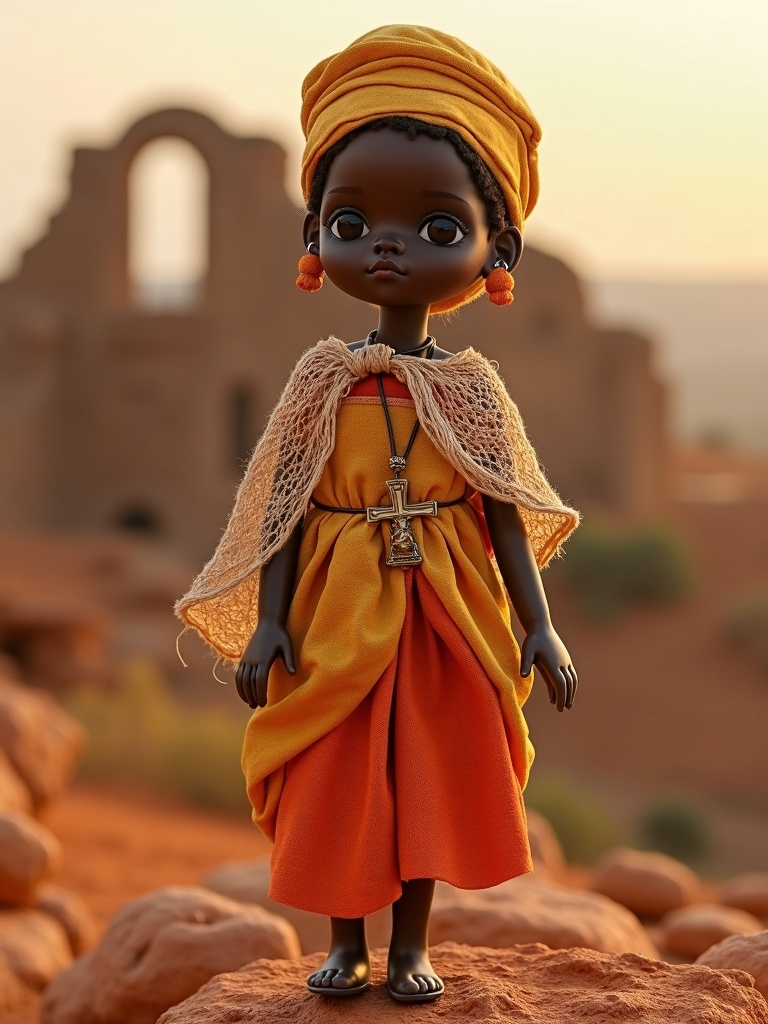
AI design preview — not a photo of the finished handmade doll
Prophetess of the Kongo
Kimpa Vita (Dona Beatriz)
In a kingdom worn down by civil war, a young noblewoman said she had died and come back carrying the spirit of a saint — and for two years, Kimpa Vita very nearly remade the Kongo with her words alone.
- People
- Kongo (BaKongo)
- Country
- Angola
- Region
- Central Africa
- Era
- ≈1684–1706
- Theme
- Prophetess of the Kongo
Make your own
Design your Kimpa Vita (Dona Beatriz)
Pick a garment, a hairstyle and a scene, enter the PIN and generate a fresh image of Kimpa Vita (Dona Beatriz) with AI.
Each image is generated live with fal.ai.
Generated images
AI design preview — not a photo of the finished handmade doll
No images generated yet — be the first.
Tradition & Origin
In a kingdom worn down by civil war, a young noblewoman said she had died and come back carrying the spirit of a saint — and for two years, Kimpa Vita very nearly remade the Kongo with her words alone.

The Kingdom of Kongo was no small place. Founded before the Portuguese arrived in 1483, ruled from the plateau capital of Mbanza Kongo — renamed São Salvador — it had been Christian for over two centuries and its kings corresponded with Rome. But the catastrophic Battle of Mbwila in 1665 broke the central monarchy, and decades of civil war followed. By 1678 the once-great capital, which legend said had held more than 100,000 people, stood abandoned. Rival kings raised armies of up to 20,000 soldiers, and the slave trade fed on the chaos.
Into this broken world Kimpa Vita was born around 1684, near Mount Kibangu, into the Mwana Kongo nobility — hence her Catholic title Dona. She was trained in Kongo religious tradition as a young medium and in Catholic prayer. In late 1704 a near-fatal illness changed everything: she said she had died and returned bearing the spirit of Saint Anthony of Padua — in Kongo, Toni Malau, 'Anthony of Good Fortune' — sent by God to heal a dying kingdom.
Her teaching was startling and tender at once. Jesus, Mary and the saints, she said, had been Kongolese; São Salvador was a new Bethlehem; the kingdom must be reunited and its capital rebuilt. She translated the Catholic Salve Regina into the Kikongo Salve Antoniana and sent out disciples called the 'little Anthonys'. Thousands of ordinary people — and some nobles — followed her back to repopulate the ruined capital. Her movement was, above all, a movement for peace and unity.
It could not last. The rival kings and the Italian Capuchin missionaries saw a threat, and in 1706 she was condemned for heresy and executed — a young woman silenced for her ideas. Yet her vision outlived her. It deepened the Africanisation of Kongo Christian art, and two centuries later it echoed in the great prophet Simon Kimbangu. Today a statue honours her in Angola, and almost everything we know of her comes — with all its bias — from the very missionaries who opposed her.
Timeline
- 1665The Battle of Mbwila shatters Kongo's central authority and begins decades of civil war.
- 1678The capital São Salvador (Mbanza Kongo) is abandoned amid the fighting.
- ≈1684Kimpa Vita is born near Mount Kibangu into the Mwana Kongo nobility.
- 1704After a near-fatal illness she says Saint Anthony's spirit speaks through her; the Antonian movement begins.
- 1705Her followers reoccupy and begin to rebuild the abandoned capital, São Salvador.
- 1706Condemned for heresy, she is executed; her vision survives in Kongo Christian art and later prophetic movements.
Did you know?
- She taught that black skin stood for true, living humanity and that heaven was filled with Black saints — an Africa-shaped vision of the holy world.DetailsEN
- Her followers wore small Saint Anthony 'Toni Malau' figures as protective amulets and signs of loyalty — to the dismay of the European missionaries.DetailsEN
- Almost all we know of her was written by the two Capuchin missionaries who opposed her; reliable Kongo oral traditions about her are largely lost.DetailsEN
- Some traditions in Mbanza Kongo link her memory to the family of Simon Kimbangu, the 20th-century prophet whose church still honours her.DetailsEN
She asked what a kingdom — and a heaven — might look like if it were finally shaped like home.
Values & Capabilities
Capabilities
◆◆◆◆◆ shows how central a gift is — five diamonds mark a signature strength, fewer mark a supporting one.
After a near-fatal illness in 1704 she said the spirit of Saint Anthony spoke through her, and a whole movement was born from her words.
She taught that Jesus, Mary and the saints had been Kongolese, and that the holy story belonged to her own land too.
She wanted to end years of civil war and gather a broken kingdom back together under one restored capital.
She sent out trained messengers across the land to carry her teaching to ordinary people, not only to kings.
She stood by her message before the king and the missionaries, even when it cost her everything.
Development
1 of 5 stages unlocked
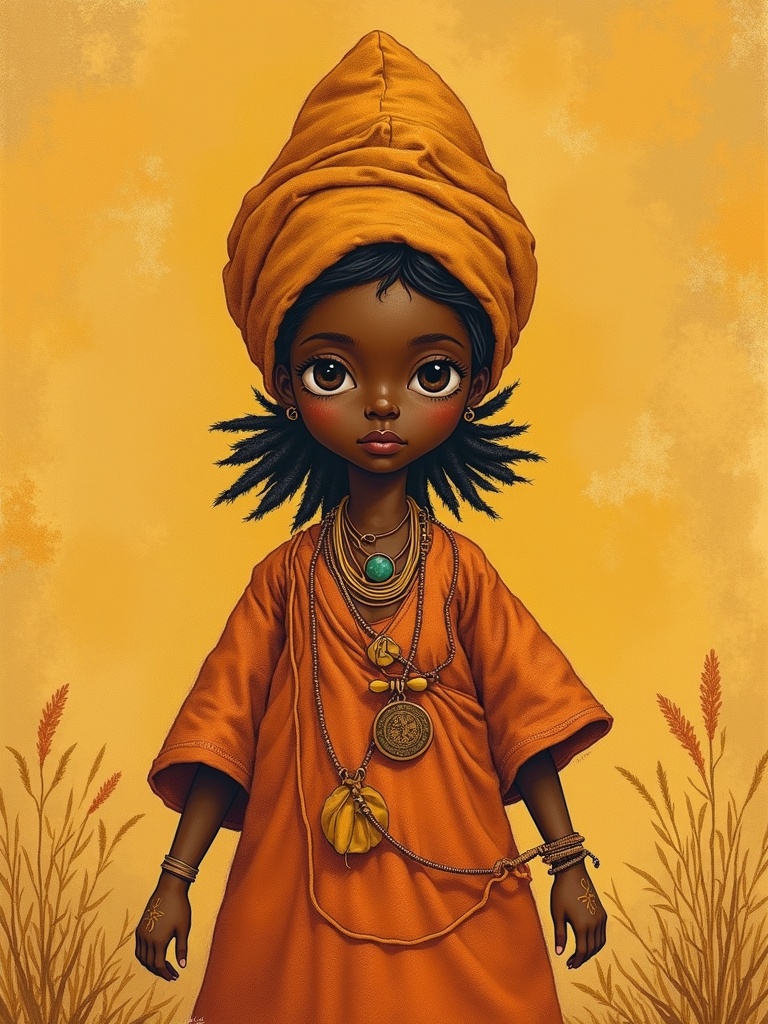
Born about 1684 near Mount Kibangu into the Mwana Kongo nobility, she grew up in a kingdom exhausted by civil war and a capital left empty.
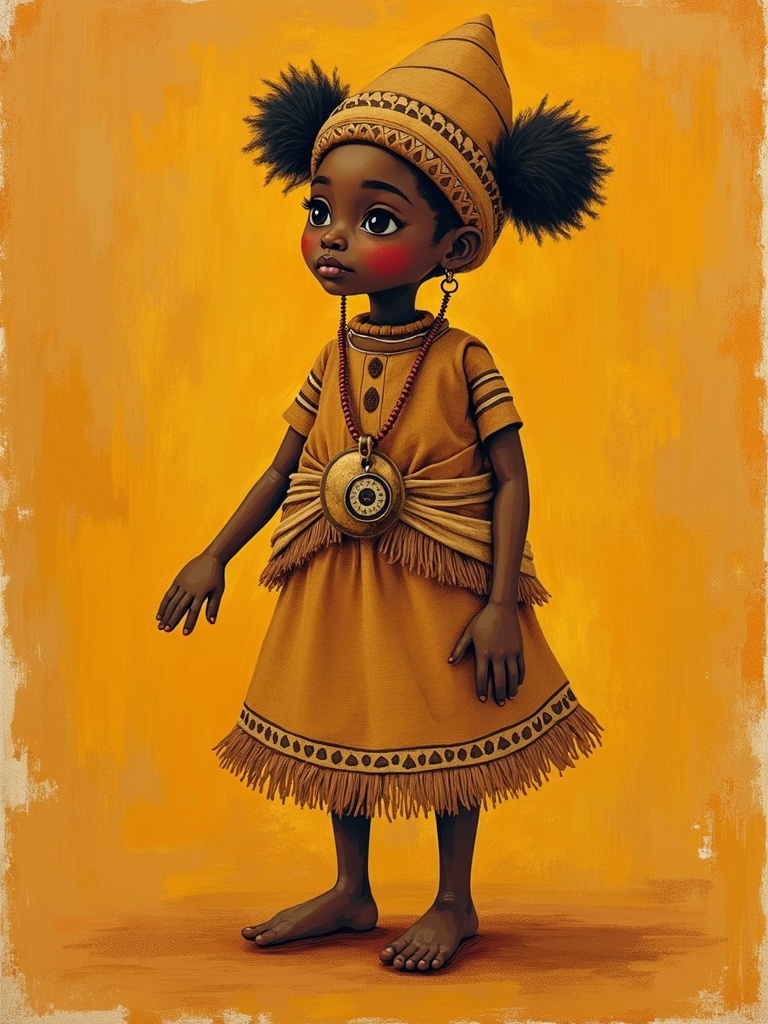
Answer all three to unlock this stage.

Unlock the previous stage first.
Unlock the previous stage first.
Unlock the previous stage first.
Crafting the doll
The doll is built from real Kongo materials: hand-combed raffia-palm cloth (lubongo) softened by pounding, dyed in natural gold, takula redwood red, chalk white and charcoal black, with woven geometric diamonds and chevrons; an openwork nkutu net cape and a spiral-knotted mpu prestige cap. Her signature attribute is a small brass-look Toni Malau (Saint Anthony) pendant on a fibre cord. An education card carries her story and the ⚖ source-bias note. Sizes Classic 32 / Kidogo 18–20 / Shule 28. A share of proceeds supports heritage education in Mbanza Kongo and Kongo-language learning.
How this doll is made
Kimpa Vita lived in a kingdom whose nobility were known across Europe for their woven raffia regalia; the doll grounds her look in real Kongo textile arts and the Toni Malau figures her movement carried.
- Garments 2
- Accessories 2
- Materials 2
- Techniques 3
Garments
- Raffia wrapper (lubongo)Layered ankle-to-shoulder wrappers woven from hand-combed raffia-palm fibre, softened by soaking and pounding; the everyday and prestige cloth of Kongo.DetailsEN
- Nkutu net capeAn openwork knotted net cape worn over the chest and shoulders by Kongo nobility, marking elite rank.DetailsEN
Accessories
- Mpu prestige capA supple knotted cap of golden raffia or pineapple fibre, built spirally from the crown outward with openwork and interlaced geometric bands; a sign of sacred Kongo office.DetailsEN
- Toni Malau pendantA small cast or carved figure of Saint Anthony holding the Christ child, worn on a cord as a protective amulet by Antonians as a sign of allegiance.DetailsEN
Materials
- Takula redwood dyeA deep red pigment from takula (redwood) used with chalk white and charcoal black to colour and pattern Kongo cloth; red carried meanings of marriage and life-force.DetailsEN
- Raffia palm fibreFilament stripped from raphia palm fronds, dried and repeatedly combed into ever-finer thread — the foundation of all Kongo weaving and once a form of currency.DetailsEN
Techniques
- Single-heddle weavingRaffia thread woven on a single-heddle loom at fixed vertical or oblique tension, then panels sewn together; luxury cloth could take 15–16 days of skilled work.DetailsEN
- Geometric interlace patterningTwill and plaiting techniques create zig-zags, diamonds and chevrons in dyed and natural raffia — the 'patterns without end' admired in Renaissance Europe.DetailsEN
- Indigenised Christian imageryKongo artists recast European Christian forms — crucifixes (nkangi) and Saint Anthony figures — in local style, a tradition her movement strengthened.DetailsEN
How it's made
Every doll is sewn by hand from natural materials — built to last a lifetime and to be repaired, not replaced. Here is the shopping list and the work steps. Sizes: Classic 32 cm (heirloom) · Kidogo 18–20 cm (toddlers, no small parts) · Shule 28 cm (school edition).
Shopping list
- Natural cotton or linen for the body (skin tone), ~0.5 m
- Wool or cotton stuffing — no plastic
- Cotton thread and embroidery floss in matching colours
- Garment fabric in this doll's colours (see the fabrics above)
- Yarn for the hairstyle
- Beads, cowrie shells and trims as shown
- Sharps and embroidery needles, pins, fabric scissors, fabric marker
Work instructions
- Trace and cut the body pattern at your chosen size (Classic 32 cm / Kidogo 18–20 cm / Shule 28 cm).
- Sew the body pieces right sides together, leave an opening, turn and stuff firmly with natural fibre, then close by hand.
- Embroider the face gently and with dignity — no plastic parts for the toddler line.
- Make the hair from yarn following the chosen hairstyle and attach it securely.
- Cut and sew the garment from this doll's fabric, then dress the doll.
- Add the beadwork, shells, trims and any attribute by hand.
- Check every seam and reinforce it — the doll should be lifelong and repairable, with no loose small parts for small children.
Origin & Ethics
How we know this
Her noble birth, her Kimpasi-style training, the 1704 illness, the Antonian teachings, the Salve Antoniana, and her execution in 1706 are documented — but almost entirely through the Capuchin missionaries who opposed her, so her own voice survives only filtered through hostile colonial sources. Some details and most oral traditions are uncertain or reconstructed. She is a real historical person, so the doll is respectful homage, not an exact likeness.
Because Kimpa Vita is a historical figure from the early 1700s, no living family or royal council holds rights to her image. This record was drafted with care for the BaKongo heritage community across Angola and the two Congos, in the spirit of the scholarship that reconstructs her story, and with respect for the living Christian traditions — including Kimbanguism — that remember her. The portrayal centres her dignity and conviction and never her execution.
Sources
- Kimpa Vita — Wikipedia
- Women Leaders in African History: Dona Beatriz, Kongo Prophet — The Metropolitan Museum of Art
- One woman's mission to unite a divided kingdom: Beatriz Kimpa Vita — African History Extra
- Kimpa Vita — Centre for the Critical Study of Apocalyptic and Millenarian Movements (CDAMM)
- Kimpa Vita — Dictionary of African Christian Biography
- The Kongolese Saint Anthony: Dona Beatriz Kimpa Vita and the Antonian Movement (John Thornton) — Cambridge University Press
- Kongo textiles — Wikipedia
- Textile trade and Industry in the kingdom of Kongo — African History Extra
- Figure of Saint Anthony (Toni Malau) — The Menil Collection
- Mbanza Kongo, Vestiges of the Capital of the former Kingdom of Kongo — UNESCO World Heritage Centre