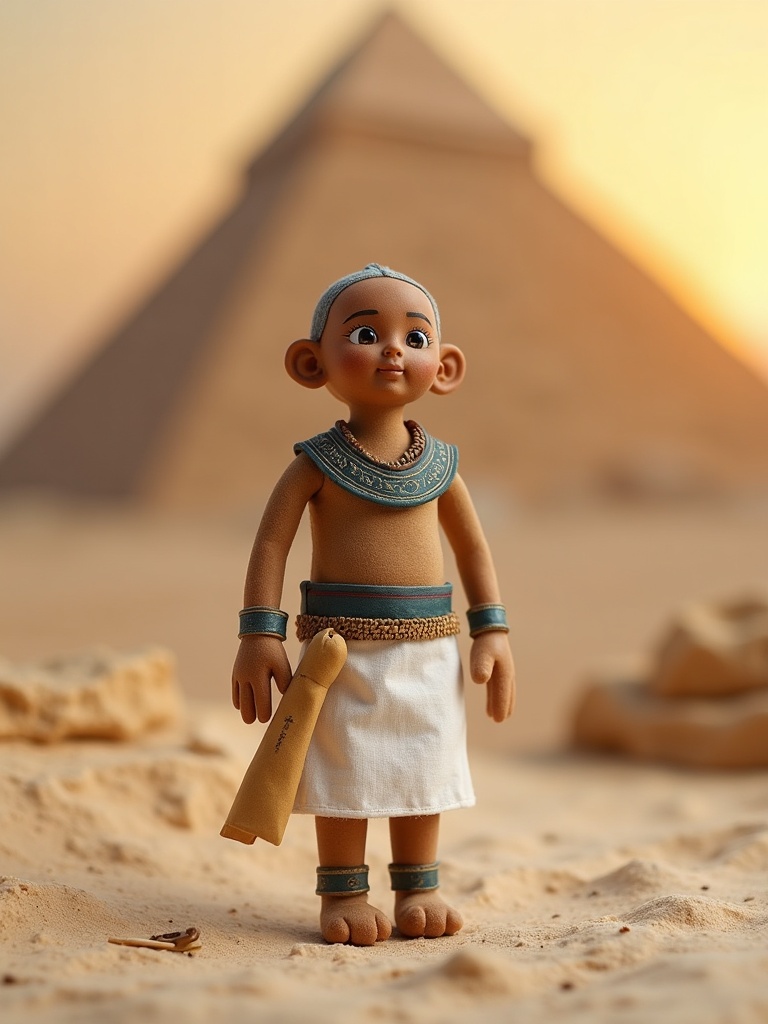
Knowledge, Medicine & Building
Imhotep
A commoner who rose to become the right hand of a pharaoh, then designed humanity's first monumental building in cut stone — and centuries after his death, became a god.
- People
- Ancient Egypt (Kemet)
- Country
- Egypt
- Region
- North Africa
- Era
- ≈27th century BCE
- Theme
- Knowledge, Medicine & Building
Make your own
Design your Imhotep
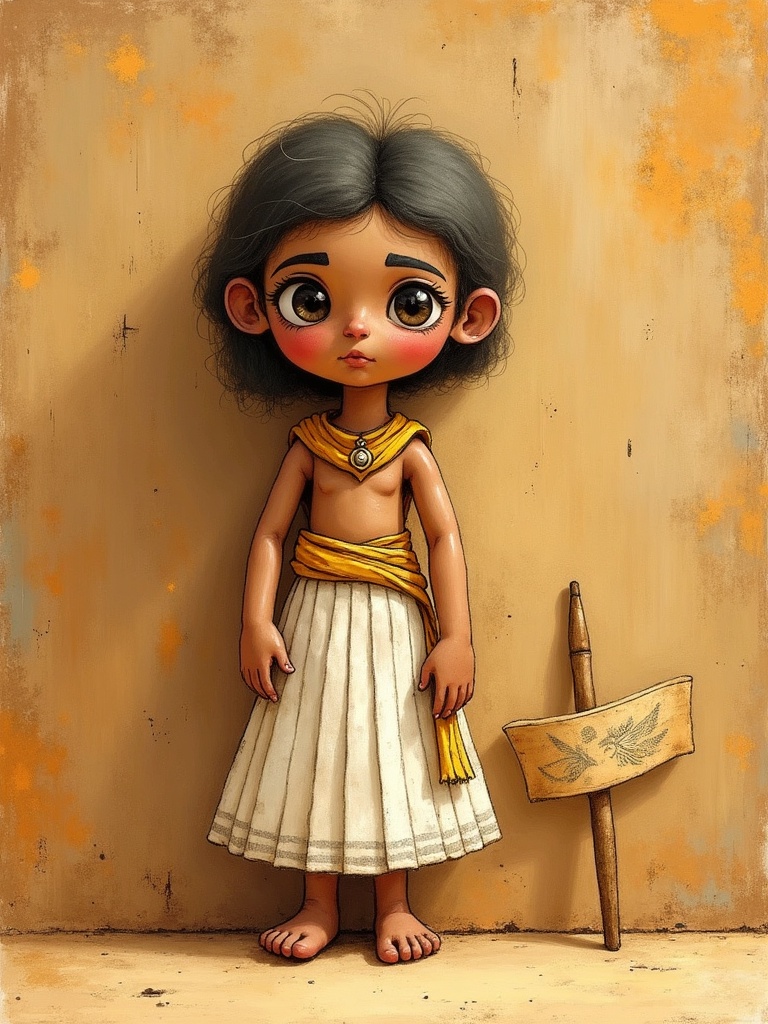
Pick a garment, a hairstyle and a scene, enter the PIN and generate a fresh image of Imhotep with AI.
Each image is generated live with fal.ai.
Generated images
No images generated yet — be the first.
Tradition & Origin
A commoner who rose to become the right hand of a pharaoh, then designed humanity's first monumental building in cut stone — and centuries after his death, became a god.
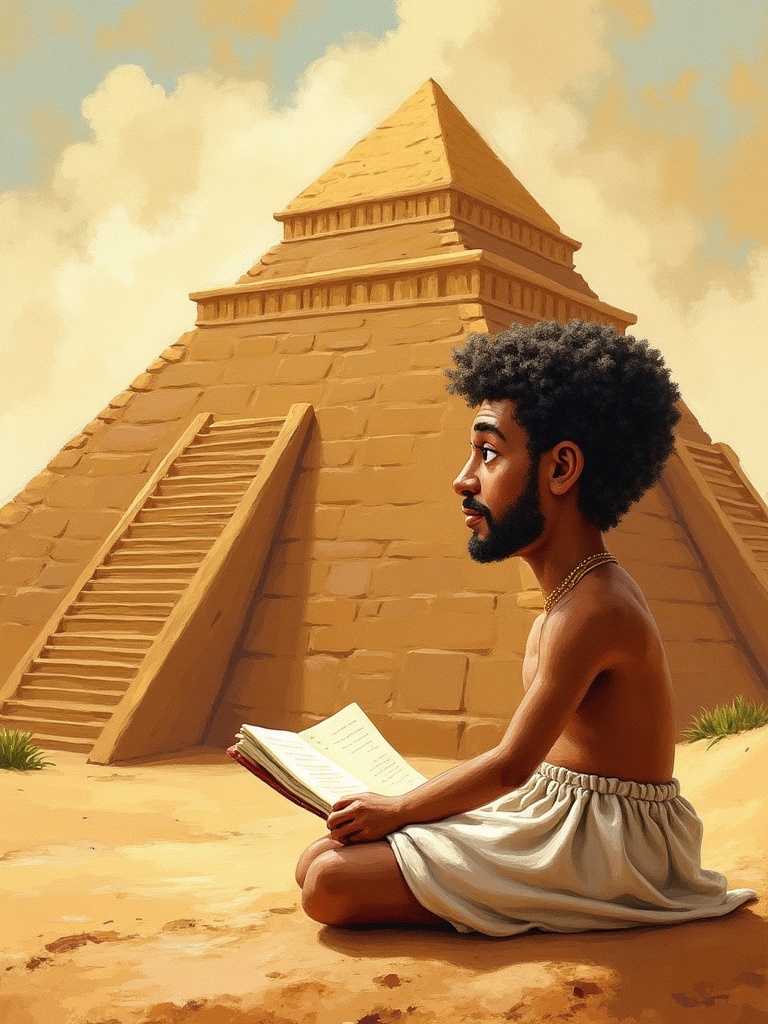
Imhotep is among the fewer than 12 non-royal Egyptians ever raised to full godhood after death.
DetailsENImhotep lived in the late 27th century BCE, during Egypt's Third Dynasty, and served as chancellor and vizier to Pharaoh Djoser (Netjerikhet). We are not guessing about him: his historicity is confirmed by inscriptions carved during his lifetime on the pedestal of one of Djoser's statues, found at Saqqara (Cairo JE 49889). On it Djoser broke with ancient precedent — which reserved monuments for the king's name alone — and had Imhotep's name and titles inscribed too: high priest of Heliopolis, royal seal-bearer, and overseer of sculptors.
His enduring monument is the Step Pyramid of Saqqara, which Egyptologists credit to his design. It is the earliest colossal stone building in Egypt and the first Egyptian pyramid ever built — a six-tier structure that originally rose about 62.5 metres (205 feet). Before it, tombs were low mud-brick mastabas; Imhotep stacked them, in stone, into a stairway to the heavens. The later historian Manetho remembered him simply as the inventor of building in stone.
In his own age he was honoured as a sage, scribe and physician. But the towering medical legend came much later. The first references to Imhotep as a healer appear only from the Thirtieth Dynasty (c. 380–343 BCE) onward — some 2,200 years after he died. By the Late and Ptolemaic periods a full cult had grown around him: he was worshipped as a god of medicine and wisdom, and the Greeks identified him with Asclepius, their own god of healing. The famous medical texts and cures attributed to him belong to this later tradition, not to documented fact.
That deification is what makes him extraordinary. Imhotep is among the fewer than a dozen non-royal Egyptians ever raised to full godhood after death — a carpenter's-square reputation built on real achievement, then enlarged by two millennia of memory into something divine.
Timeline
- ≈2670 BCEImhotep serves Pharaoh Djoser as chancellor, high priest and chief builder.
- ≈2670 BCEHe designs the Step Pyramid of Saqqara — the first large stone building in the world.
- ≈2600 BCE+His step-pyramid idea inspires the true pyramids of later dynasties.
- ≈1600 BCEThe Edwin Smith surgical papyrus is copied from a far older medical tradition tied to his name.
- ≈525 BCEImhotep is deified and worshipped as a god of healing and wisdom.
- Greco-Roman eraGreeks equate Imhotep with their healing god Asklepios; pilgrims pray for cures.
Did you know?
- Djoser disregarded the ancient rule that only a king's name appear on his monuments and had Imhotep's name inscribed alongside his own — a near-unheard-of honour for a non-royal.DetailsEN
- The historian Manetho remembered Imhotep as the inventor of building in stone, and Egyptologists credit him with the design of the Step Pyramid complex at Saqqara.DetailsEN
- By Greco-Roman times Imhotep was worshipped as a god of medicine, and the Greeks equated him with their own healing god Asclepius — a cult that grew long after his death.DetailsEN
He built the first thing made to outlast a human life — and in the end, memory made him outlast death itself.
Values & Capabilities
Capabilities
◆◆◆◆◆ shows how central a gift is — five diamonds mark a signature strength, fewer mark a supporting one.
He designed the Step Pyramid of Saqqara — the world's first large building made entirely of stone.
As chancellor to Pharaoh Djoser he was 'first after the king' — adviser, high priest and chief builder.
Trained as a scribe, he is shown forever with an open papyrus scroll across his lap.
Later Egyptians revered him as a master physician, observing and treating injuries rather than relying on magic.
Centuries after his death he was lifted into legend and worshipped as a god of healing.
Development
1 of 5 stages unlocked
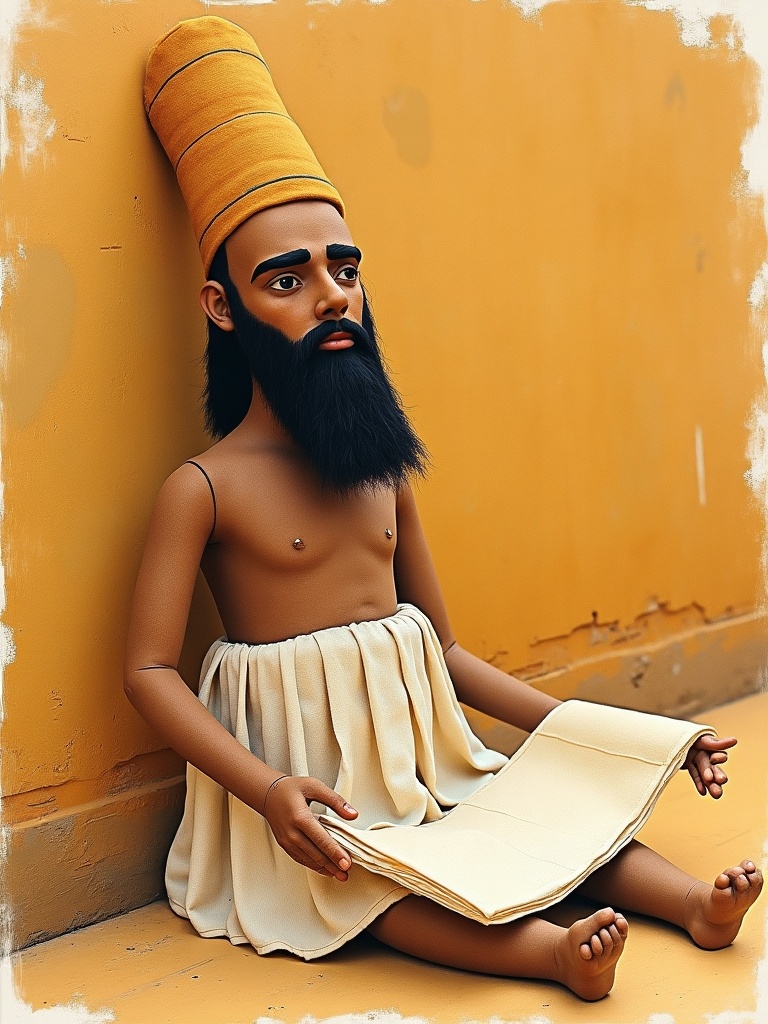
A young Egyptian who learned to read, write and reckon — the rare skill that opened every door.
Answer all three to unlock this stage.
Unlock the previous stage first.
Unlock the previous stage first.
Unlock the previous stage first.
Crafting the doll
The doll is dressed in fine white pleated linen for the scribe's kilt (shendyt) and priestly robe, with an optional leopard-skin sash, a blue-green Egyptian faience broad-collar and small faience amulets, and his signature attribute: a tiny rolled papyrus scroll with a wooden scribe's palette of red and black ink and slim reed pens. The education card explains that Imhotep is the first architect known by name, that the Step Pyramid was the world's first all-stone building, and that his fame as a healing god came centuries later. Sizes: Classic 32 / Kidogo 18–20 / Shule 28. A share of proceeds supports African STEM and heritage education for children.
How this doll is made
Imhotep belongs to Old Kingdom Memphis (c. 2670 BCE), the world of scribes, priests and the first monumental stone architecture; his look is built from fine pleated linen, papyrus, blue-green faience and the limestone of Saqqara — the materials of writing, healing and building.
- Garments 2
- Accessories 3
- Materials 2
- Techniques 3
Garments
- Shendyt linen kiltThe pleated white linen wrap-kilt of an Egyptian scribe and official; in scribe statues the kilt is drawn tight over the knees to make a flat surface for writing on the papyrus scroll.DetailsEN
- Priestly linen robe & leopard-skin sashAs high priest of Heliopolis Imhotep could wear a long fine-linen robe with a leopard-skin sash over one shoulder — the dress of a sem-priest performing sacred rites.DetailsEN
Accessories
- Open papyrus scrollImhotep is almost always shown seated with an unrolled papyrus across his lap, inscribed with his own name as 'the eldest son of Ptah' — the scribe-sage's eternal emblem.DetailsEN
- Scribe's palette & reed pensA rectangular wooden palette with two wells holding cakes of red and black ink and a slot for slim reed pens or brushes — the main working tool of every Egyptian scribe.DetailsEN
- Faience broad-collar & amuletA wide blue-green faience bead collar (wesekh) and small healing amulets — votive Imhotep bronzes carry inscriptions wishing 'life', a prayer for health and well-being.DetailsEN
Materials
- PapyrusThe reed-paper of ancient Egypt: the triangular stalk's white pith is cut into strips, layered crosswise, pressed and sun-dried into smooth writing sheets that were rolled into scrolls.DetailsEN
- Limestone of SaqqaraThe Step Pyramid was raised from rock-cut limestone instead of mud-brick and cased in gleaming white limestone — the first time stone was used for a building on this scale.DetailsEN
Techniques
- Papyrus-makingStrips of pith are soaked so their natural sugars act as glue, laid in two crosswise layers, then pressed or hammered until the cells merge and dry into one strong sheet — no added adhesive.DetailsEN
- Dry-stone monumental architectureImhotep stacked stone mastaba-like tiers into a six-step pyramid about 60 m high, inventing large-scale stone construction and the form that led to all later Egyptian pyramids.DetailsEN
- Scribal writing & observational medicineScribes wrote with reed pens in red and black ink on papyrus; the medical tradition tied to Imhotep's name records injuries by examination, diagnosis and prognosis rather than by magic alone.DetailsEN
How it's made
Every doll is sewn by hand from natural materials — built to last a lifetime and to be repaired, not replaced. Here is the shopping list and the work steps. Sizes: Classic 32 cm (heirloom) · Kidogo 18–20 cm (toddlers, no small parts) · Shule 28 cm (school edition).
Shopping list
- Natural cotton or linen for the body (skin tone), ~0.5 m
- Wool or cotton stuffing — no plastic
- Cotton thread and embroidery floss in matching colours
- Garment fabric in this doll's colours (see the fabrics above)
- Yarn for the hairstyle
- Beads, cowrie shells and trims as shown
- Sharps and embroidery needles, pins, fabric scissors, fabric marker
Work instructions
- Trace and cut the body pattern at your chosen size (Classic 32 cm / Kidogo 18–20 cm / Shule 28 cm).
- Sew the body pieces right sides together, leave an opening, turn and stuff firmly with natural fibre, then close by hand.
- Embroider the face gently and with dignity — no plastic parts for the toddler line.
- Make the hair from yarn following the chosen hairstyle and attach it securely.
- Cut and sew the garment from this doll's fabric, then dress the doll.
- Add the beadwork, shells, trims and any attribute by hand.
- Check every seam and reinforce it — the doll should be lifelong and repairable, with no loose small parts for small children.
Origin & Ethics
How we know this
Solid but partly legendary: Imhotep's existence as Djoser's chancellor and the builder of the Step Pyramid is well attested by inscriptions, and his role as the first named architect is widely accepted. His reputation as a master physician, his supposed authored medical texts, and his status as a god of medicine are later traditions — the deification is documented only from roughly the Late Period (c. 525 BCE), some two thousand years after he lived. We present the verified history plainly and flag the legend as legend.
Imhotep is an ancient historical figure with no living family or royal house, so consent is a matter of scholarly and cultural respect rather than personal permission. This record follows mainstream Egyptology (Britannica, the British Museum, the Metropolitan Museum of Art and World History Encyclopedia) and the UNESCO World Heritage framing of Memphis and its Necropolis, and was reviewed for dignity and historical honesty — distinguishing the documented official from the later deified legend.
Sources
- Britannica — Imhotep (Egyptian architect, physician & statesman)
- World History Encyclopedia — Imhotep
- Wikipedia — Imhotep (titles, deification, sources)
- Britannica — Step Pyramid of Djoser
- British Museum — bronze figure of Imhotep as a seated scribe (EA63800)
- UNESCO World Heritage Centre — Memphis and its Necropolis – the Pyramid Fields from Giza to Dahshur
- Metropolitan Museum of Art — Statue of Seated Imhotep (Ptolemaic Period)
- Metropolitan Museum of Art — Statuette of a Scribe (papyrus scroll, scribe's pose)
- Metropolitan Museum of Art — Scribe's Palette and Brushes (Late Period)
- Metropolitan Museum of Art — Papyrus-Making in Egypt (essay)
- Wikipedia — Edwin Smith Papyrus (oldest surgical treatise)
- The Archaeologist — The Secrets of Ancient Egyptian Papyrus Making