Strategy & Daring
Hannibal Barca
Hannibal Barca (247–183 BCE) was a general of Carthage , the great North African trading city on the coast of modern Tunisia . Son of the commander Hamilcar Barca, he grew up in the long rivalry between Carthage and Rome for the western…
- People
- Carthaginian (Punic)
- Country
- Tunisia
- Region
- North Africa
- Era
- 247–183 BCE
- Theme
- Strategy & Daring
Make your own
Design your Hannibal Barca
Pick a garment, a hairstyle and a scene, enter the PIN and generate a fresh image of Hannibal Barca with AI.
Each image is generated live with fal.ai.
Generated images
No images generated yet — be the first.
Tradition & Origin
Hannibal Barca (247–183 BCE) was a general of Carthage, the great North African trading city on the coast of modern Tunisia. Son of the commander Hamilcar Barca, he grew up in the long rivalry between Carthage and Rome for the western Mediterranean.
★ Over the Alps with elephants
In 218 BCE, at the start of the Second Punic War, Hannibal did the unthinkable: rather than fight Rome at sea, he marched an army of tens of thousands — and 37 war elephants — across the Pyrenees and over the snowbound Alps to invade Italy from the north. He then beat Rome again and again — at the Trebia, at Lake Trasimene, and above all at Cannae (216 BCE), where his battle plan annihilated a Roman army far larger than his own. He kept an army in Italy for sixteen years without losing a major battle.
Honesty: tactics are not the whole war — Hannibal never took the city of Rome. Recalled to defend Carthage, he was beaten at Zama (202 BCE) by Scipio, then driven into exile; Rome destroyed Carthage utterly in 146 BCE. On "African": Carthage was a North African city, but its ruling families descended from Phoenician settlers — so historians debate the label. We present him honestly as a North African of Carthage whose Numidian (African) cavalry won his battles.
He crossed mountains no army was meant to cross. He won every battle but the last. Cleverness can humble a giant — but it cannot win a war alone.
Values & Capabilities
Capabilities
◆◆◆◆◆ shows how central a gift is — five diamonds mark a signature strength, fewer mark a supporting one.
At Cannae he deliberately weakened his own centre so the Romans pushed in; his cavalry smashed their wings, then swung behind to seal the trap, encircling a far larger army. It is still taught at military academies as the textbook encirclement.
He took an entire army, baggage and war elephants over the Alps in winter to attack from the one direction Rome thought impossible.
He swam rivers ahead of his men and slept on the bare ground as they did, holding a multi-ethnic army loyal for sixteen years far from home.
Before Cannae he seized the Aufidus River — the only water for miles — so the larger Roman force fought thirsty in the August heat.
Cut off in enemy country, outnumbered and unsupplied, he never lost a pitched battle for sixteen years — yet never took Rome itself.
Development
1 of 3 stages unlocked
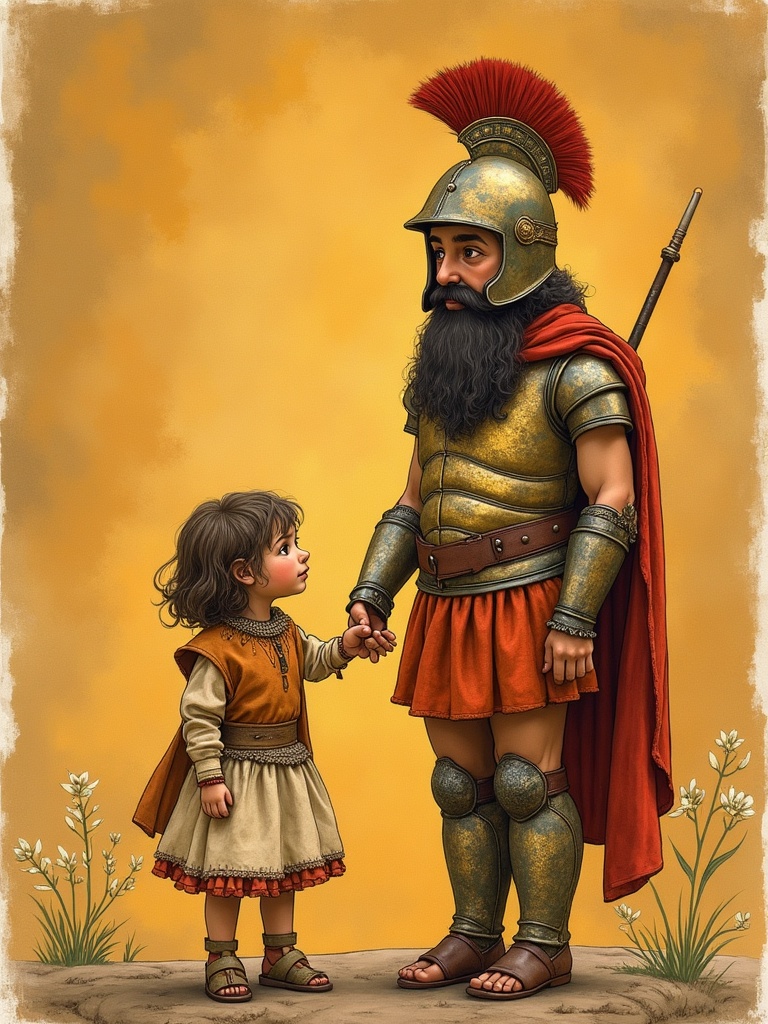
Young Hannibal in his father’s camp, learning the trade of command.
Answer all three to unlock this stage.
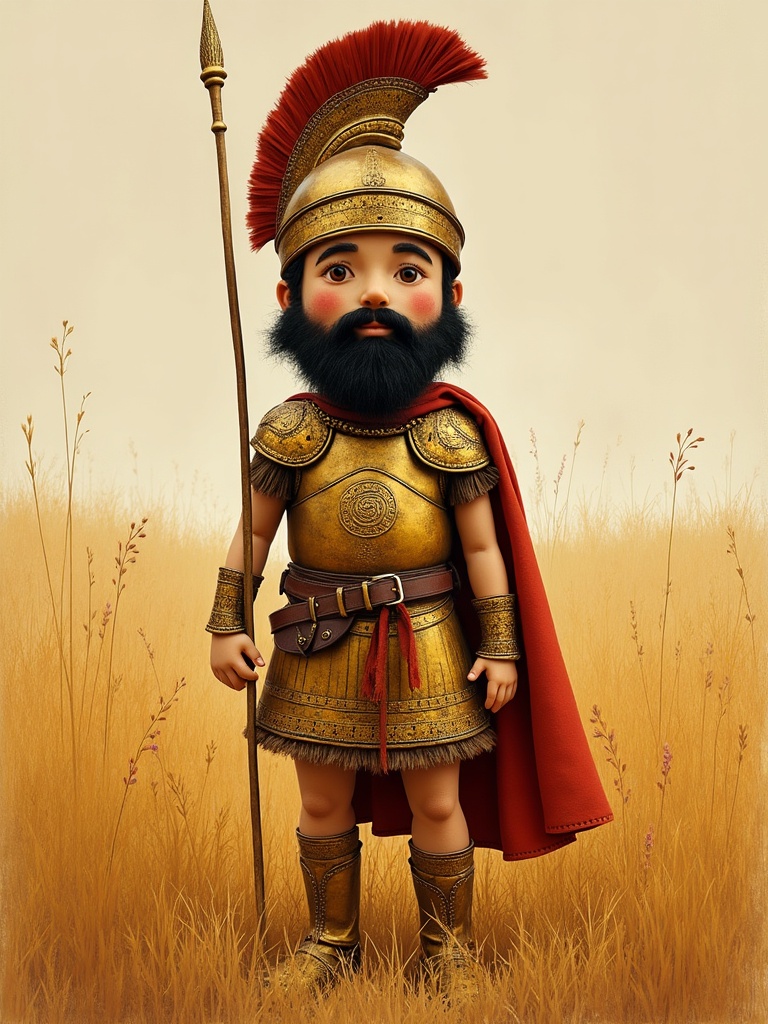
Unlock the previous stage first.
Make & Learn
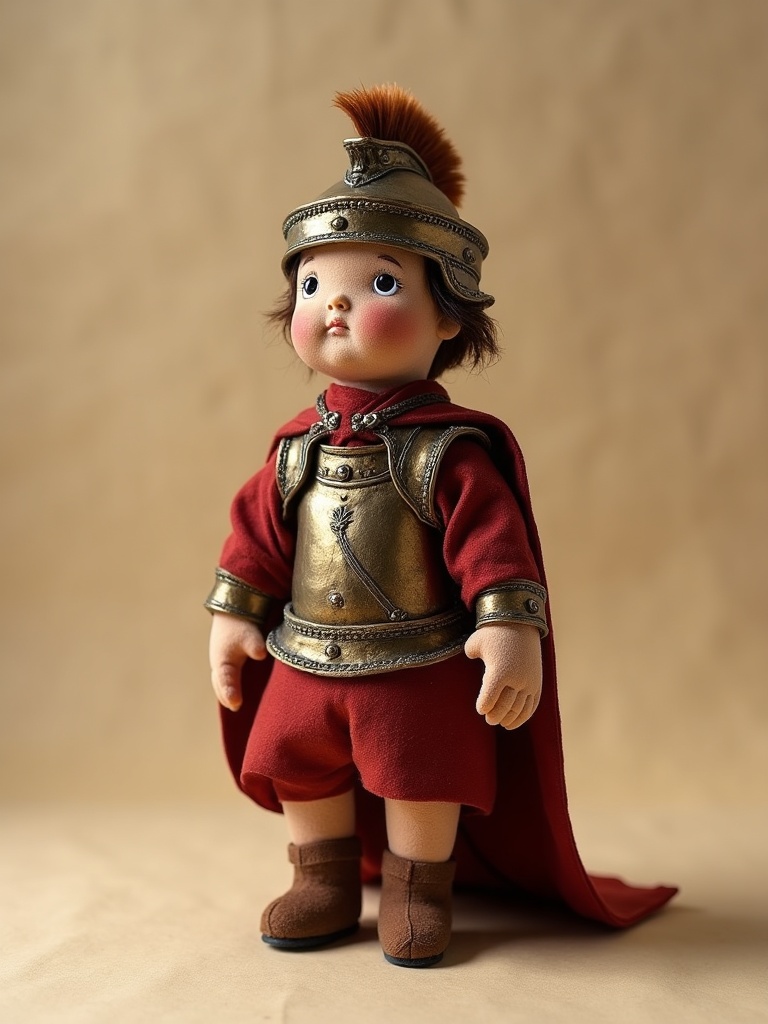
Garment: a bronze-look cuirass (felt/leather) over a deep-red tunic, a crested helmet, a cloak. Signature attribute: a small war elephant and a battle map. Education card: the Alps crossing and the Cannae encirclement (with a simple diagram), Carthage as a North African power, and the honest debate over claiming Hannibal as "African." Sizes as standard. Proceeds → Tunisian/Carthaginian heritage (the ruins of Carthage).
How it's made
Every doll is sewn by hand from natural materials — built to last a lifetime and to be repaired, not replaced. Here is the shopping list and the work steps. Sizes: Classic 32 cm (heirloom) · Kidogo 18–20 cm (toddlers, no small parts) · Shule 28 cm (school edition).
Shopping list
- Natural cotton or linen for the body (skin tone), ~0.5 m
- Wool or cotton stuffing — no plastic
- Cotton thread and embroidery floss in matching colours
- Garment fabric in this doll's colours (see the fabrics above)
- Yarn for the hairstyle
- Beads, cowrie shells and trims as shown
- Sharps and embroidery needles, pins, fabric scissors, fabric marker
Work instructions
- Trace and cut the body pattern at your chosen size (Classic 32 cm / Kidogo 18–20 cm / Shule 28 cm).
- Sew the body pieces right sides together, leave an opening, turn and stuff firmly with natural fibre, then close by hand.
- Embroider the face gently and with dignity — no plastic parts for the toddler line.
- Make the hair from yarn following the chosen hairstyle and attach it securely.
- Cut and sew the garment from this doll's fabric, then dress the doll.
- Add the beadwork, shells, trims and any attribute by hand.
- Check every seam and reinforce it — the doll should be lifelong and repairable, with no loose small parts for small children.
Origin & Ethics
How we know this
Very well documented through Polybius and Livy — but no contemporary Carthaginian account survives, so the story reaches us mostly through Rome, his enemy (a built-in media-literacy lesson). Name the brutality of the Punic Wars and Carthage’s destruction (146 BCE) honestly; present the "African/Phoenician" debate openly.
Committee: Tunisian heritage & antiquities bodies, classical historians, the Carthage museums. 5-step protocol; frame him as a strategist, not a glorifier of war.