The Ten
Der Baumeister von Groß-Simbabwe
Between the 11th and 15th centuries grew in the highlands of present-day Zimbabwe a city of stone: Great Zimbabwe , capital of the Kingdom of Zimbabwe. The name comes from the Shona — Dzimbabwe , „House of Stone". [6] At its peak in the…
- People
- Shona
- Country
- Zimbabwe
- Region
- Southern Africa
- Era
- 11th–15th c.
- Theme
- Craft & the Nameless
Make your own
Design your Der Baumeister von Groß-Simbabwe
Pick a garment, a hairstyle and a scene, enter the PIN and generate a fresh image of Der Baumeister von Groß-Simbabwe with AI.
Each image is generated live with fal.ai.
Generated images
No images generated yet — be the first.
History & Meaning
①Tradition, Work & the House of Stone
Between the 11th and 15th centuries grew in the highlands of present-day Zimbabwe a city of stone: Great Zimbabwe, capital of the Kingdom of Zimbabwe. The name comes from the Shona — Dzimbabwe, „House of Stone".[6] At its peak in the 14th century, up to 18,000 people lived here; the entire site covers around 730 hectares.[5]
The Great Enclosure — Building without mortar
The centerpiece is the Great Enclosure: an outer wall of up to 11 metres high and 250 metres in circumference, made from an estimated 900,000 granite blocks — and not a single drop of mortar holds them together.[5] Every stone was hewn and layered so precisely (a tapering construction method for stability) that the joints have withstood wind and rain for eight centuries.[5][6] Inside stands the enigmatic Conical Tower, about 10 meters high and massive — perhaps a symbol of a granary and thus of prosperity and fertility.[2] The walls sweep in curves rather than rigid grids — craftsmanship and beauty in one.
The Zimbabwe Bird — soul in stone
Atop tall pillars perched eight soapstone birds, about 40 cm high, with features of both human and bird at once — probably a sign of royal and spiritual power.[7] This Zimbabwe Bird is today the nation's heraldic emblem: When Zimbabwe became independent in 1980, it took the name of the ruins and the bird as its symbols — and so reclaimed the heritage of its builders.[6]
Gold that crossed the sea — the bridge to Zuwena
Great Zimbabwe was rich through gold, ivory and trade. His routes reached from here to the Swahili Coast — via the ports of Sofala and Kilwa, south of Zanzibar — and onward to India and China (Chinese porcelain, Persian glass and Indian beads were found on site).[8] This closes a circle in our collection: the gold that made Zuwena's kanga world on the Indian Ocean wealthy came in good part from the Builder's highlands.
⚖️ The lie that is an object lesson
When European colonizers "discovered" Great Zimbabwe in the 19th century, they refused to believe that Africans could have built such a thing. They invented stories: that the Queen of Sheba, King Solomon, or the Phoenicians had erected it.[9] These claims were driven by a racist unwillingness to grant Black Africans such an advanced civilization. Modern archaeology has clearly refuted them: radiocarbon dating, soapstone birds, local danga granite and pottery prove — the Shona built it.[3][9] For children this is one of the most important lessons of all: Some lies about Africa are stubbornly persistent — and the truth is literally set in stone.
But everyone knows his work — it still stands, after 800 years.
So it is with all who build things that endure.
⑤Transfer to the Present
How does the Master Builder become a lesson for a child in 2050?
Stone upon stone, without mortar
Precision that lasts 800 years.
Engineering, architecture, craftsmanship, STEM. Africa mastered structural engineering while Europe was still stuck in the Middle Ages. A root for civil engineers, craftspeople, and tinkerers.
The patience of generations
Building for the grandchildren.
Sustainability, long-term thinking, climate responsibility. Whoever builds for 800 years thinks like a good ancestor. Exactly the mindset 2050 needs.
The quiet dignity
Created greatness without fame.
The value of invisible work. Carers, builders, sewers, nurturers — the world rests on unsung hands. This figure teaches us to see and honor them. The heart of the project.
The stone that does not lie
The work refuted the lie.
Self-confidence, anti-racism, truth. Against every "you can't do that" stands a proof carved in stone. African children inherit a foundation of pride.
The master builder's promise to a child: "Perhaps no one will ever know your name. But build well all the same. What you make with love stands longer than any fame."
Abilities & Development
Abilities
The highest art of building: stacking 900,000 blocks so precisely that they hold entirely without any binding agent — for 800 years. In the game: whoever holds the Builder can erect something that survives all storms.
Great Zimbabwe grew over more than 300 years — no single person saw it completed. He teaches: Some works are built for the grandchildren, not for oneself. True greatness requires patience that reaches beyond one's own life.
He was not only a mason, but an artist: from soft soapstone he created birds with a soul, which became the symbol of an entire nation. He teaches that craft and art can be one.
His city grew rich because it mined gold and traded across the sea — as far as India and China. He teaches that the work of one's hands can connect an entire world.
He built great things without writing his name on them. His strongest lesson: You don't have to be famous to be important. The work counts, not the fame.
Through the years
③Life Stages (of the Craft)
Since this figure is an archetype, the three stages show the path from apprentice to master to sage — the life arc of every craft, just as a sewing grandmother passes through it.
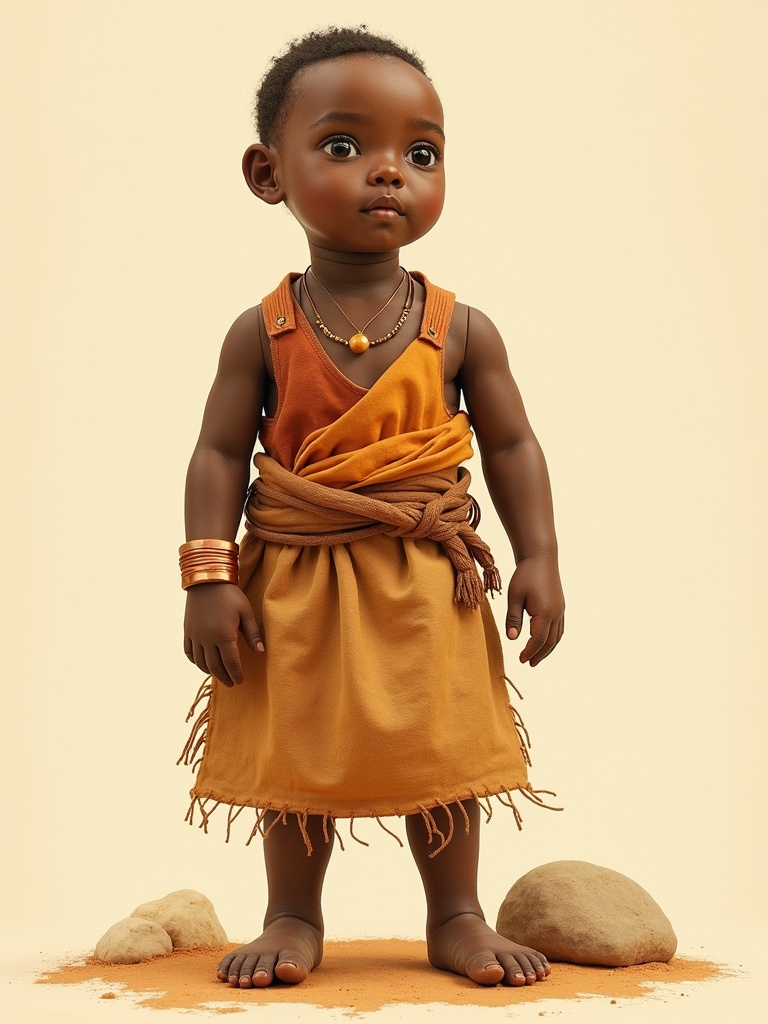
A young person who carries stones and watches the masters layer them — learning, marveling, with his own first attempts. Simple work clothes, a small hammerstone. Gift: Stone upon stone (in the making).
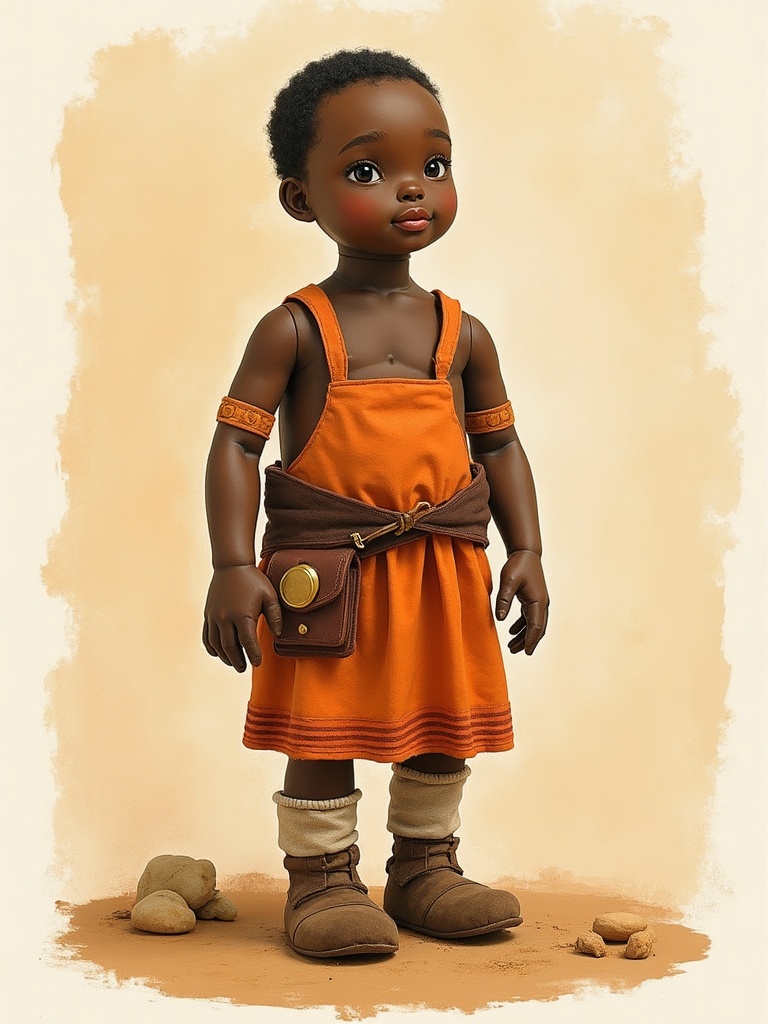
In full mastery: he hews granite, checks the joint with his hand, shapes a sweeping wall. Tools, measuring cord, pride in the work. Signature gift united with The Bird of Stone.
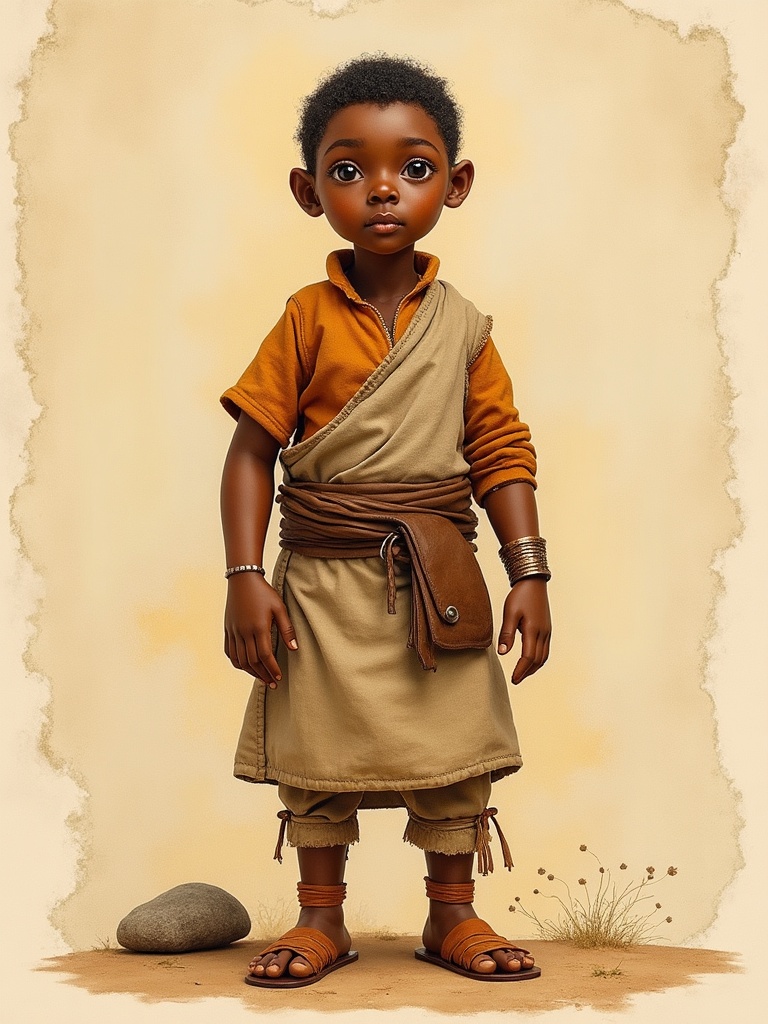
Grown old, he teaches the young and passes on his knowledge — like a grandmother who passes on sewing. Dignified, with a soapstone bird in his hand. A gift united with the patience of generations.
These stages are the most direct bridge to the heart of the project: Apprentice → Master → Sage who passes it on. It is exactly this arc that turns the grandmothers into „living libraries" — the master builder tells it in stone.
Make & Learn
⑦Fabrics & Production Notes
Real natural fibers, honest craftsmanship, lifelong repairability — and with this figure a tiny masterpiece: a real little soapstone bird.
The Materials List
The Robe: Plain Dignity
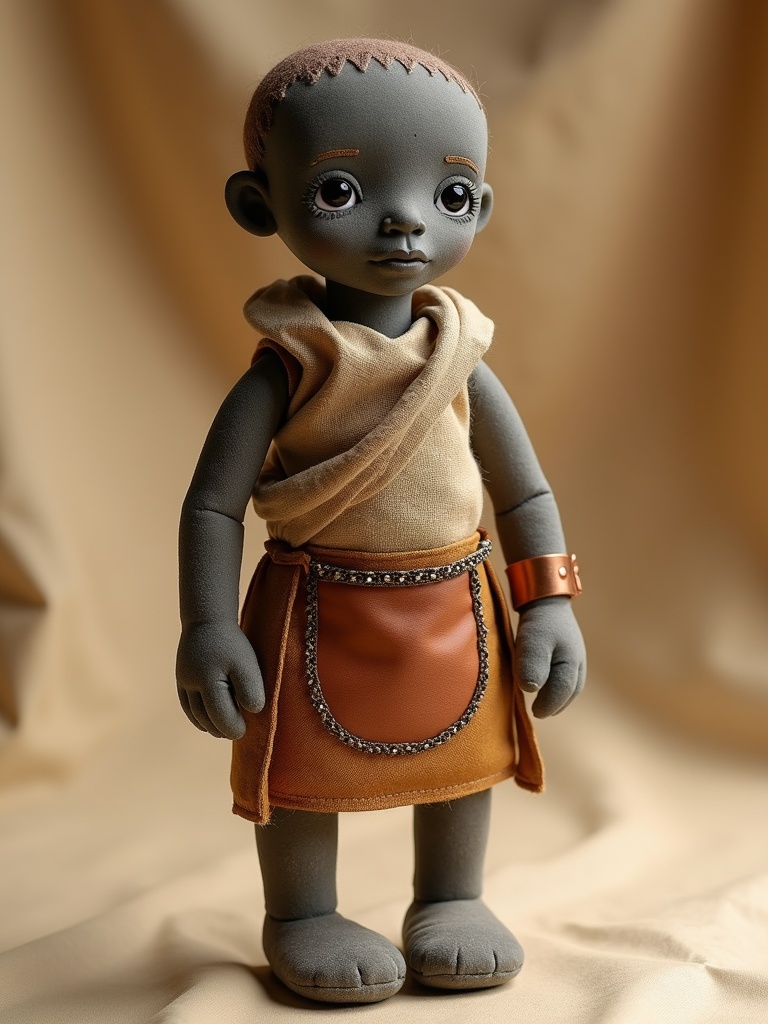
Unlike the magnificent royal robes, the Builder deliberately wears plain, dignified work clothing: a wrapped earth/granite cloth of 100% cotton, a small leather/felt apron, a copper bracelet. The simplicity is the statement — dignity lies in skill, not in pomp. Granite-gray „dust" tones on the hands can be embroidered on.
The Signature Attribute: the Soapstone Bird
The centerpiece: a tiny, real soapstone bird (or of wood/felt), modeled on the Zimbabwe Bird — ideally crafted by a Shona sculptors' cooperative made. This way every doll carries a real piece of Zimbabwean craftsmanship and creates income for living stone artists. Plus a mini granite block and a blunt hammerstone (felt/wood). No small, swallowable parts in the school/toddler line.
Signature & Education Card
Embroidered into the hem: „Vakavaki" („the builders") instead of a personal name — and the name of the seamstress. Enclosed is an Education Card about Great Zimbabwe, the drystone-walling technique and the history of the refuted colonial lie. Optional QR thread to the history page.
Production Stages & Effort
Work garb, apron, real mini soapstone bird, granite block, education card. Plainer than the royal figures — and special for precisely that reason.
Simplified garment, wooden bird instead of soapstone. The most affordable entry point of the Ten.
Washable, reinforced seams, sturdy wooden bird. With an educational card for history/technology lessons.
How it's made
Every doll is sewn by hand from natural materials — built to last a lifetime and to be repaired, not replaced. Here is the shopping list and the work steps. Sizes: Classic 32 cm (heirloom) · Kidogo 18–20 cm (toddlers, no small parts) · Shule 28 cm (school edition).
Shopping list
- Natural cotton or linen for the body (skin tone), ~0.5 m
- Wool or cotton stuffing — no plastic
- Cotton thread and embroidery floss in matching colours
- Garment fabric in this doll's colours (see the fabrics above)
- Yarn for the hairstyle
- Beads, cowrie shells and trims as shown
- Sharps and embroidery needles, pins, fabric scissors, fabric marker
Work instructions
- Trace and cut the body pattern at your chosen size (Classic 32 cm / Kidogo 18–20 cm / Shule 28 cm).
- Sew the body pieces right sides together, leave an opening, turn and stuff firmly with natural fibre, then close by hand.
- Embroider the face gently and with dignity — no plastic parts for the toddler line.
- Make the hair from yarn following the chosen hairstyle and attach it securely.
- Cut and sew the garment from this doll's fabric, then dress the doll.
- Add the beadwork, shells, trims and any attribute by hand.
- Check every seam and reinforce it — the doll should be lifelong and repairable, with no loose small parts for small children.
⑥Ten Name suggestions
Since the figure is nameless, these Shona names are a loving suggestion — every child may give their own master builder one. Many carry meanings around building, giving and staying. To be confirmed with Shona authorities before use.
Nice for the classroom: Because this figure has no historical name, children may give her one — and explain why. A whole lesson about appreciation and the meaning of names.
⑧Curriculum mapping & Subjects
The Master Builder is primarily anchored to the curricula of Zimbabwe/southern Africa, but is valuable worldwide — especially in the STEM field and in anti-racism education. He makes African engineering tangible.
Dry-stone wall without mortar
Statics, precision, engineering.
Technology / Physics / Mathematics (STEM). How does a wall hold together without mortar? Gravity, friction, tapering construction — African engineering you can touch.
The refuted lie
Colonial denial vs. evidence.
History / Values / Media Studies. How do prejudices arise? How do you refute them with evidence? Source criticism & anti-racism using a concrete case.
The Zimbabwe Bird
Soapstone sculpture.
Art / Crafts. Shape a bird yourself from soft stone (e.g. soap); symbol & national coat of arms — craft as art.
Gold all the way to Kilwa & China
Indian Ocean world trade.
Geography / History. Trade routes from the highlands to the coast; connection to Zuwena/Zanzibar — Africa as a hub of world trade.
Children build a tower out of nothing but stacked stones/blocks — and discover why the tapering construction holds up. Learning objective: statics, gravity, engineering thinking.
Children examine "evidence" and expose the colonial lie with real findings. Learning objective: source criticism, anti-racism, scientific thinking.
Children name the people in their lives who do important things and are never praised (often the grandmother!). Learning objective: appreciation of invisible work, gratitude.
Origin & Ethics
How we know this
On honesty: This figure is the only one of the Ten that does not portray a named historical individual, but is deliberately an archetype — it honors the nameless builders of Great Zimbabwe. The structure and its Shona authorship are archaeologically unambiguously attested (★★★★★); what we do not know are the names and life histories of individual builders — this gap is not filled with invention, but is honored as a deliberate core of the figure. The "quote" is a modern, paraphrased voice in the spirit of Shona remembrance, not a historical quotation. The Kingdom of Zimbabwe, too, was a society with the hierarchies of its time. Since Great Zimbabwe is a national symbol & UNESCO World Heritage Site and the Zimbabwe Bird is protected, the final approval rests with the Zimbabwean cultural, community, and craft authorities.
⑨Elder Approval & Sources to Watch
A special note: Since this figure is an Archetype and not a named human being, this is less about the dignity of an individual than about the dignity of a whole people and its heritage. Great Zimbabwe is the national symbol of Zimbabwe — its depiction belongs under the blessing of Zimbabwean and Shona authorities.
The Approval Body
The five-step protocol
Contact through official channels (National Museums and Monuments of Zimbabwe, UNESCO World Heritage Site Great Zimbabwe, Shona sculptor cooperatives). Presentation of the vision, the 42% rule, veto right.
Hand over this compendium as a draft — particularly the archetype idea, the depiction of the Zimbabwe Bird and the narrative of the colonial lie, for review.
Cultural heritage authorities for the World Heritage Site & the Bird, the Shona community for dignity, sculptors for the soapstone Bird, historians for facts.
Written approval per element. The Zimbabwe Bird is a national symbol & sensitive — its reproduction only with explicit consent.
Shona sculptor cooperatives & community funds receive a share (42% also for the maker of the Bird); a portion of the proceeds supports the preservation of the World Heritage Site.
Most sensitive areas: the Zimbabwe Bird as a protected national symbol (reproduce only with consent), the dignified portrayal of the artisan (master craftsman, never “labour slave”), and the correct, clear narrative of the colonial denial (fact, not opinion) — as well as the honest labeling that this is an archetype figure is.
Sources to observe
Sources
- Great Zimbabwe was built by the Shona-speaking ancestors of today's Shona — documented through archaeology, orality & cultural continuity; the builders are individually nameless. sciencenewstoday.org: The Great Zimbabwe Ruins' Original Builders.
- The massive conical tower (~10 m, solid) as a possible symbol of granary/prosperity; curving, symbolic architecture. sciencenewstoday.org: Great Zimbabwe, Stone City of Africa.
- Early foreign theories refuted; locally quarried granite & dry-stone technique; builders = ancestors of the Shona, Bantu speakers. tvi.show: The Builders of the Great Enclosure.
- (Context: significance & location in Masvingo; national symbol of pride.) zimbabwetravelhub.com: Great Zimbabwe Ruins Guide.
- Largest stone structure south of the Sahara; Great Enclosure (wall up to 11 m, perimeter ~250 m), ~900,000 granite blocks, without mortar; up to ~18,000 inhabitants in the 14th c. afrodeities.org: Great Zimbabwe — Who Really Built It.
- "Dzimbabwe" = "House of Stone"; construction from ~1100, heyday 1200–1450; name & bird national symbols from 1980. zimbabwetravelhub.com; avacarts.com.
- Eight soapstone Zimbabwe birds (~40 cm) on columns, signs of royal/spiritual power; five were looted during the colonial era. avacarts.com: History of Zimbabwe Shona Stone Sculpturing; thinkafrica.net.
- Trade in gold, ivory; routes via Sofala & Kilwa as far as India/China; imported porcelain, glass, beads found on site. thinkafrica.net: Kingdom of Zimbabwe; mysticryst.com.
- Colonial denial (Sheba, Solomon, Phoenicians) out of racist reluctance; radiocarbon, soapstone birds, danga granite & pottery prove Shona authorship. thingsevolve.substack.com: Great Ruins of Zimbabwe.