Story & Identity
Chimamanda Ngozi Adichie
Born in Enugu in 1977 and raised on a university campus in Nsukka — in a house once lived in by Chinua Achebe — Chimamanda Ngozi Adichie grew into one of her generation's most resonant voices, insisting that no people should ever be reduced to a single story.
- People
- Igbo
- Country
- Nigeria
- Region
- West Africa
- Era
- 1977–present
- Theme
- Story & Identity
⚖ A respectful concept
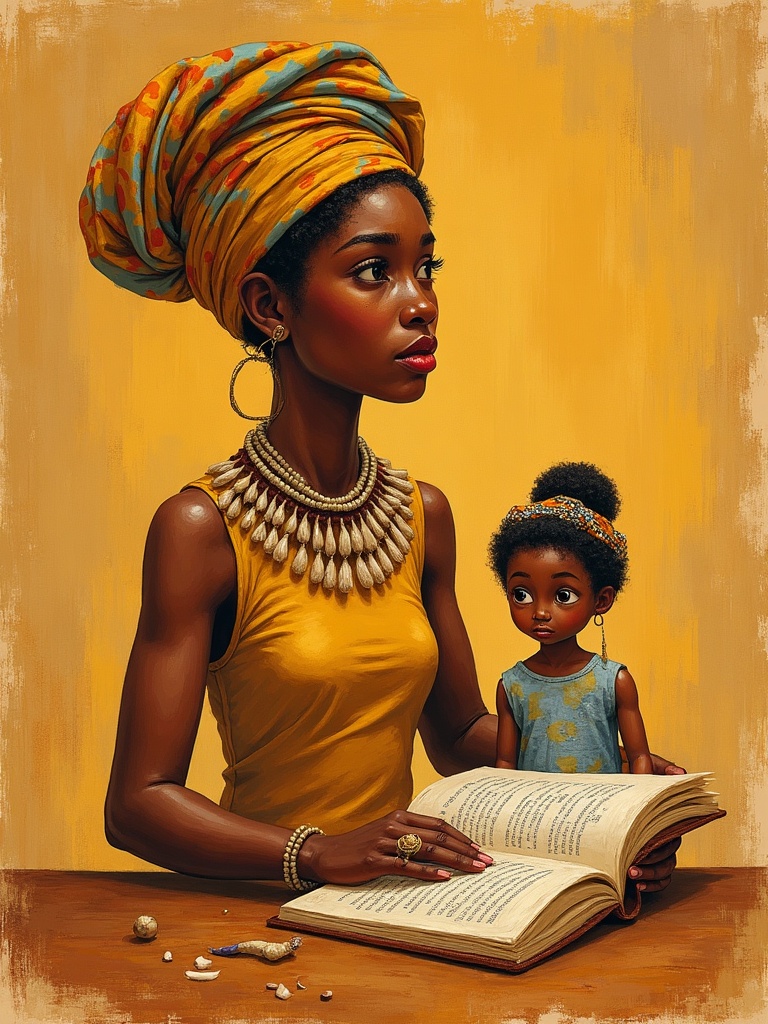
Chimamanda Ngozi Adichie is a living author. This doll is a respectful homage, not a likeness of her face or body, and would only ever be produced with the consent of Ms. Adichie and her representatives. Every quotation used here is documented from her published talks and essays with a source; nothing is invented or put in her mouth. The image prompts deliberately specify 'respectful homage, no exact likeness', and the figure shown is a draft idea, not a finished product.
Make your own
Design your Chimamanda Ngozi Adichie
Pick a garment, a hairstyle and a scene, enter the PIN and generate a fresh image of Chimamanda Ngozi Adichie with AI.
⚖ AI homage concept — not a likeness of the real person.
Each image is generated live with fal.ai.
Generated images
No images generated yet — be the first.
Tradition & Origin
Born in Enugu in 1977 and raised on a university campus in Nsukka — in a house once lived in by Chinua Achebe — Chimamanda Ngozi Adichie grew into one of her generation's most resonant voices, insisting that no people should ever be reduced to a single story.
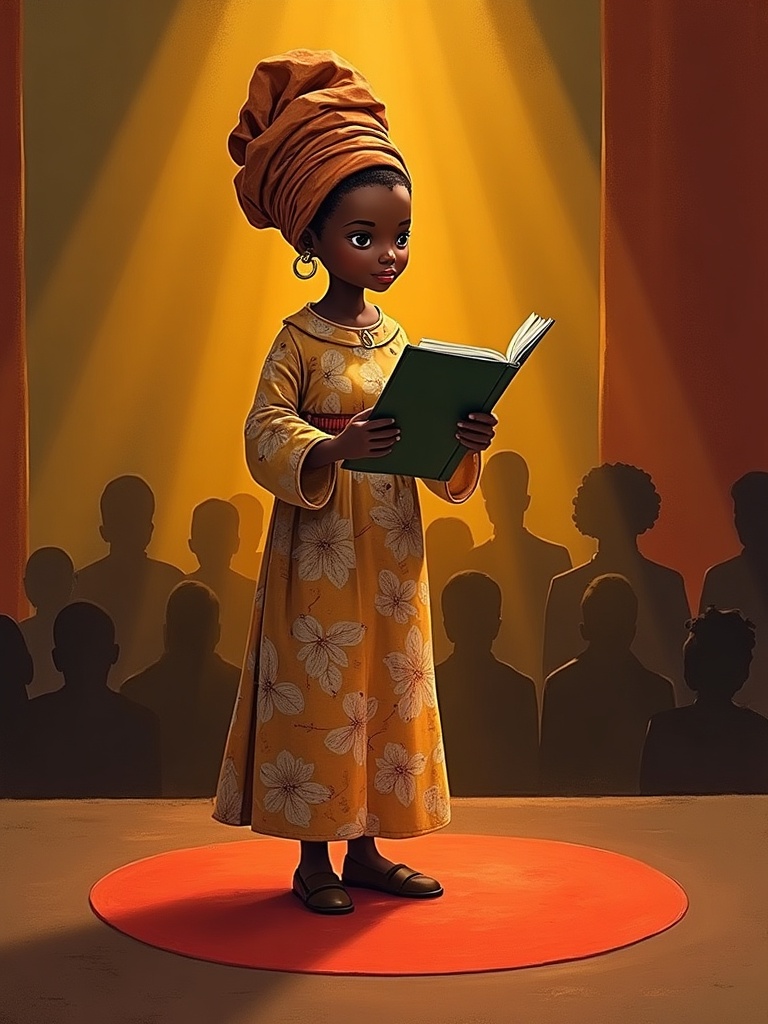
Her 2009 TED talk is among the most-watched in TED history — each figure ≈ 5 million viewers.
DetailsENChimamanda Ngozi Adichie was born on 15 September 1977 in Enugu, Nigeria, into an Igbo family, and grew up in the university town of Nsukka, where her father was a professor at the University of Nigeria. The family lived on campus in a house that had once been occupied by the writer Chinua Achebe — a literary inheritance Adichie would carry forward, becoming widely described as one of the most original novelists of her generation.
Her fiction maps the textures of Nigerian life and the wider world. Purple Hibiscus (2003) announced her gifts; Half of a Yellow Sun (2006), set against the Biafran War, won the Orange Prize for Fiction in 2007 and was later named the prize's "Best of the Best." Americanah (2013), a sweeping story of race, migration and return, won the U.S. National Book Critics Circle Award, and her short-story collection The Thing Around Your Neck deepened her global readership. In 2025 she returned to the novel with Dream Count.
Beyond the page, Adichie reshaped public conversation through two landmark talks. Her 2009 TED talk "The Danger of a Single Story" became one of the most-viewed talks in TED's history, warning how repeated, narrow narratives flatten whole peoples into stereotype. Her 2012 TEDxEuston talk "We Should All Be Feminists" became a global rallying cry — published as a book in 2014, sampled by Beyoncé in the 2013 song "***Flawless," and, in 2015, distributed by Sweden to every 16-year-old student in the country.
Timeline
- 1977Born in Enugu, Nigeria; raised in the university town of Nsukka in Igbo country.
- 2003Publishes her debut novel Purple Hibiscus, winning the Commonwealth Writers' Prize.
- 2006Half of a Yellow Sun appears, drawing on the Nigeria–Biafra war; wins the Orange Prize in 2007.
- 2009Delivers the TED talk 'The Danger of a Single Story', later watched by tens of millions.
- 2012Gives the TEDx talk 'We Should All Be Feminists', published as a book in 2014 and sampled by Beyoncé.
- 2013Publishes Americanah, winner of the US National Book Critics Circle Award.
Did you know?
- Adichie grew up on the University of Nigeria campus in Nsukka, in a house previously occupied by Nigerian writer Chinua Achebe.DetailsEN
- Her novel Americanah (2013) won the U.S. National Book Critics Circle Award for Fiction.DetailsEN
- Beyoncé sampled Adichie's "We Should All Be Feminists" talk in the 2013 song "***Flawless," carrying her words to a worldwide audience.DetailsEN
One voice from Nsukka, reminding the world that every people deserves more than a single story.
Values & Capabilities
Capabilities
◆◆◆◆◆ shows how central a gift is — five diamonds mark a signature strength, fewer mark a supporting one.
She teaches that one story about a people is never the whole story, and that the missing stories matter most.
She shows that the same stories that can wound a people can also heal and lift them up.
She turned four years of research into Half of a Yellow Sun, keeping the memory of the Nigeria–Biafra war alive.
She made a clear, gentle case that girls and boys deserve the same chances — and the world listened.
She wears Nigerian designers on the world's biggest stages, turning local cloth into a banner of pride.
Development
1 of 5 stages unlocked
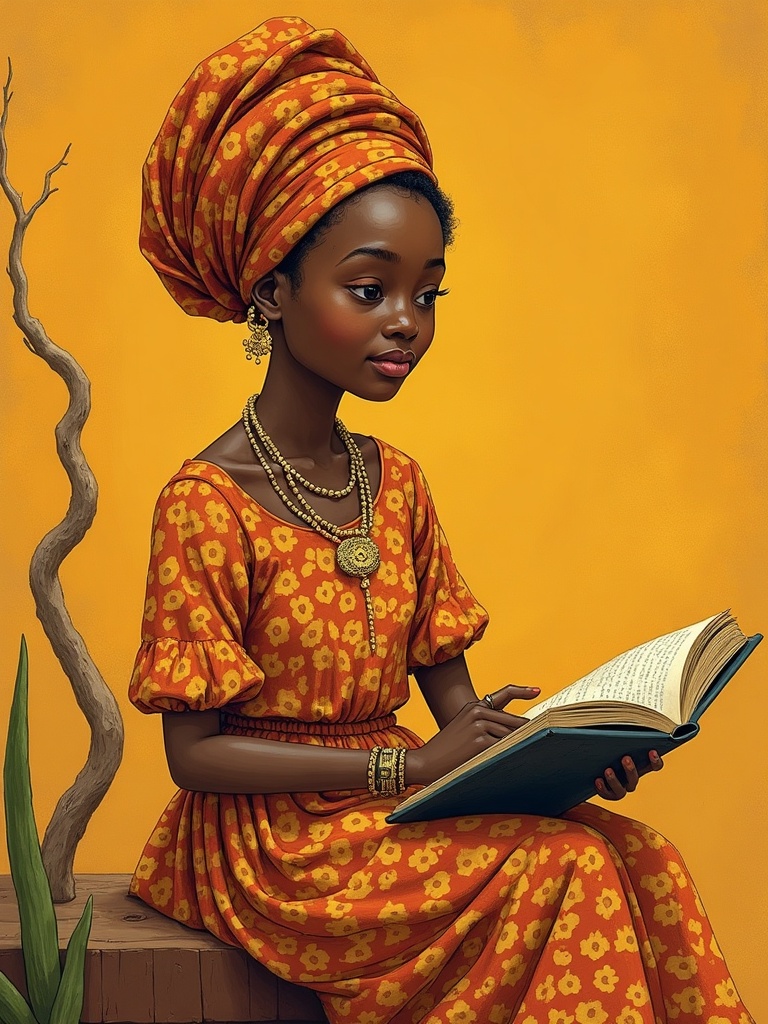
A professor's daughter who grew up surrounded by books on a Nigerian university campus and dreamed in stories.
Answer all three to unlock this stage.
Unlock the previous stage first.
Unlock the previous stage first.
Unlock the previous stage first.
Crafting the doll
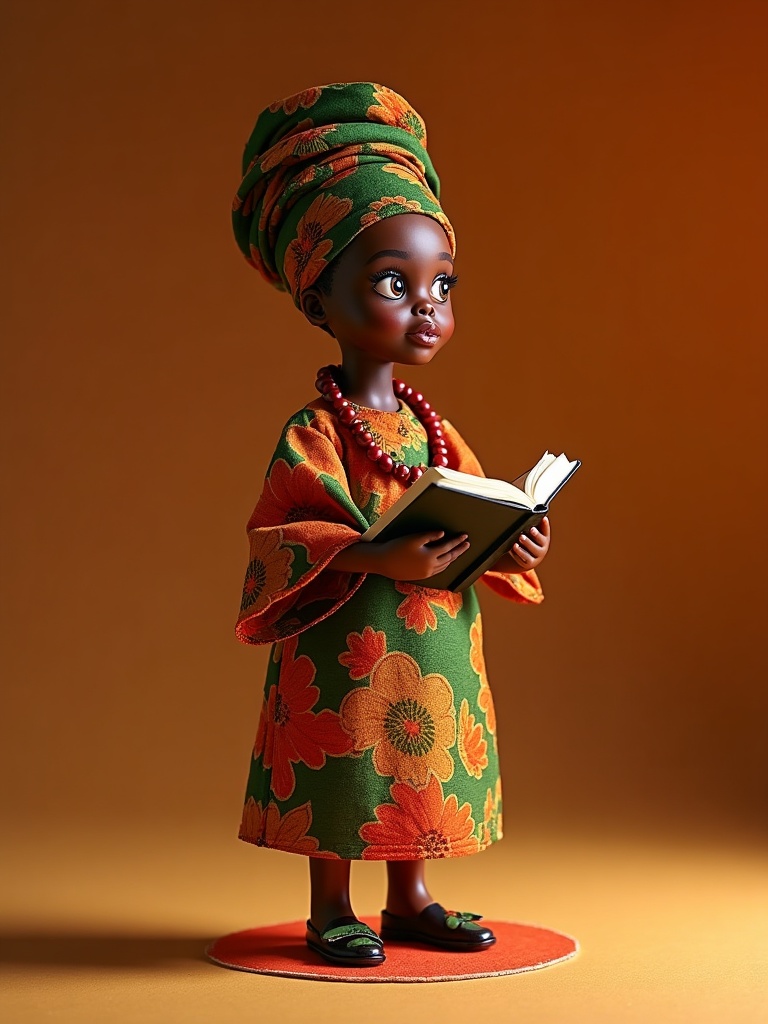
The doll is sewn from bright Nigerian ankara (Dutch-wax cotton) for the iro wrapper, buba blouse and sculptural gele headwrap, with optional hand-woven aso-oke for a ceremonial set; her signature attribute is a small stitched open book, alongside deep red-orange Igbo coral beads at the neck and wrists. An education card explains the difference between wax-print ankara and woven aso-oke and tells the story of 'the danger of a single story'. Sizes: Classic 32 / Kidogo 18–20 / Shule 28. A share of proceeds supports children's libraries and reading programmes in Nigeria.
How this doll is made
This homage grounds the doll in Chimamanda Ngozi Adichie's celebrated personal style — bright Nigerian ankara wax-print iro and buba with a sculptural gele headwrap, Igbo coral beads, and her 'Wear Nigerian' love of hand-tailored local designers — together with the books and pen that are the storyteller's own accessories. Respectful homage, no exact likeness.
- Garments 2
- Accessories 3
- Materials 2
- Techniques 3
Garments
- Ankara iro & bubaA wrapper (iro) tied at the waist with a loose blouse (buba), sewn from ankara wax-print cotton in bold green, gold and red prints — the everyday-to-festive Nigerian look Adichie wears with pride.DetailsEN
- Aso-oke ceremonial setA hand-woven aso-oke wrapper and blouse with metallic thread, the prestige cloth of Nigerian celebration, used for the doll's ceremonial variant.DetailsEN
Accessories
- Gele headwrapA tall, sculptural headwrap of stiff patterned cloth, folded and tied into an artful fan — a canvas for artistry that crowns the Nigerian woman's look.DetailsEN
- Igbo coral beads (ihe olu / jigida)Deep red-orange coral beads worn at the neck and wrists (and waist beads, jigida) — the treasured jewels of Igbo celebration and adornment.DetailsEN
- Open book & storyteller's penA small stitched open cloth book and a slim pen, the working tools of a novelist — the author's own most fitting 'accessories'.DetailsEN
Materials
- Ankara / Dutch-wax cottonPrinted cotton patterned by a wax-resist process so the design reads on both sides; originally Dutch-made for Indonesia, it became a signature 'African' cloth in West Africa.DetailsEN
- Aso-oke & coralHand-woven aso-oke cloth (cotton/rayon with metallic thread) and natural red coral beads — the premium materials of Nigerian and Igbo ceremonial dress.DetailsEN
Techniques
- Wax-resist (ankara) printingMolten wax is applied to cotton with copper stamps or rollers to resist the dye, then the cloth is dyed and the wax removed, leaving bright patterns on both faces.DetailsEN
- Gele tyingA long stiff cloth is pleated, folded and wrapped around the head and tucked, then shaped into a fan or crown — a skill passed down through generations of Nigerian women.DetailsEN
- Aso-oke handloom weavingNarrow strips of cloth are woven on a traditional loom — often with shimmering thread — then sewn edge-to-edge into wrappers, blouses and headties for ceremonies.DetailsEN
How it's made
Every doll is sewn by hand from natural materials — built to last a lifetime and to be repaired, not replaced. Here is the shopping list and the work steps. Sizes: Classic 32 cm (heirloom) · Kidogo 18–20 cm (toddlers, no small parts) · Shule 28 cm (school edition).
Shopping list
- Natural cotton or linen for the body (skin tone), ~0.5 m
- Wool or cotton stuffing — no plastic
- Cotton thread and embroidery floss in matching colours
- Garment fabric in this doll's colours (see the fabrics above)
- Yarn for the hairstyle
- Beads, cowrie shells and trims as shown
- Sharps and embroidery needles, pins, fabric scissors, fabric marker
Work instructions
- Trace and cut the body pattern at your chosen size (Classic 32 cm / Kidogo 18–20 cm / Shule 28 cm).
- Sew the body pieces right sides together, leave an opening, turn and stuff firmly with natural fibre, then close by hand.
- Embroider the face gently and with dignity — no plastic parts for the toddler line.
- Make the hair from yarn following the chosen hairstyle and attach it securely.
- Cut and sew the garment from this doll's fabric, then dress the doll.
- Add the beadwork, shells, trims and any attribute by hand.
- Check every seam and reinforce it — the doll should be lifelong and repairable, with no loose small parts for small children.
Origin & Ethics
How we know this
This record is highly reliable: the biography, novels, prizes and TED talks are well documented, and every quotation is taken verbatim from her published talks and essays with a source. There is no legend here. The only sensitivity is the rights issue of depicting a living person, addressed above — the look is homage, not likeness, and the doll is a draft concept, not an authorised product.
Because Chimamanda Ngozi Adichie is a living author, this figure is presented strictly as a respectful homage and would only be manufactured and sold with the documented consent of Ms. Adichie and her representatives; her likeness is not reproduced. The cultural dress and adornment were checked against Igbo and wider Nigerian textile and craft sources (ankara wax print, aso-oke weaving, gele-tying and coral-bead traditions) so the heritage is honoured rather than caricatured.
Sources
- Encyclopaedia Britannica — Chimamanda Ngozi Adichie (born 1977 Enugu; Purple Hibiscus, Half of a Yellow Sun, Americanah; TED talks; MacArthur 2008)
- Chimamanda Ngozi Adichie — official site, About page (biography, education, works)
- TED — Chimamanda Ngozi Adichie: The danger of a single story (2009 talk + transcript)
- Wikipedia — The Danger of a Single Story (talk, themes, quotations)
- Wikipedia — Half of a Yellow Sun (2006 novel, Biafra war, Orange Prize 2007, Best of the Best)
- Wikipedia — Purple Hibiscus (2003 debut, Commonwealth Writers' Prize)
- Chimamanda Ngozi Adichie — 'Why Can't a Smart Woman Love Fashion?' (Elle essay, on fashion and feminism)
- Refinery29 — Why You'll See Chimamanda Ngozi Adichie Wearing Only Nigerian Fashion Brands (2017 Wear Nigerian campaign, designers)
- MOMAA — Ankara Fabric: Patterns, Meaning & How to Style African Wax Print (Dutch-wax origin, wax-resist technique)
- River & Mara — Spotlight on African Print Fashion: Transforming Iro and Buba with Gele (iro wrapper, buba blouse, gele headwrap)
- The Guardian Nigeria — What is the Traditional Dress in Nigeria? (aso-oke weaving, adire, George brocade, coral beads)
- NaijaGlamWedding — Igbo brides' traditional attire (coral beads / jigida, George wrapper, ichafu headtie)