The Ten
Amina von Zazzau
Amina was born around 1533 as the daughter of Queen Bakwa Turunku — the first female ruler of Zazzau, one of the most powerful Hausa city-states in northern Nigeria. [5] Even as a child her character revealed itself: tradition tells that…
- People
- Hausa
- Country
- Nigeria
- Region
- West Africa
- Era
- ≈1533–1610
- Theme
- Warrior & Wall-Builder
Make your own
Design your Amina von Zazzau
Pick a garment, a hairstyle and a scene, enter the PIN and generate a fresh image of Amina von Zazzau with AI.
Each image is generated live with fal.ai.
Generated images
No images generated yet — be the first.
History & Meaning
①Tradition, Life & the Walls
Amina was born around 1533 as the daughter of Queen Bakwa Turunku — the first female ruler of Zazzau, one of the most powerful Hausa city-states in northern Nigeria.[5] Even as a child her character revealed itself: tradition tells that her grandmother caught her as a little girl with a dagger in her hand — an early sign of her warrior nature.[1] While other girls learned other things, Amina trained with the royal guard and the cavalry of Zazzau. At 16 she was appointed Magajiya — the heir to the throne.[1]
The Hausa — traders, dyers, "the blue people"
The Hausa were renowned craftsmen and traders: along the trans-Saharan routes they traded in salt, gold, leather, kola nuts and fabrics, connecting West Africa with North Africa.[1][8] Their hallmark was the deep-blue indigo cloth — which is why other peoples called them "the blue people". In Kano the Kofar Mata dye pits have been worked for over 500 years to this day; the dyed cloth is then richly embroidered.[6][7] Added to this came leather and metalwork — and the music with the long trumpet kakaki and the great drum kuka.[7]
The warrior woman on horseback
Amina became leader of the cavalry and amassed wealth and prestige. When she took power, she led her army of roughly 20.000 personally into battle — to the north and south, all the way into the kingdoms of Nupe and Jukun.[1][3] She is credited with introducing metal armor (iron helmets, chainmail) among the Hausa — possible because the Hausa of Zazzau were skilled metalworkers.[2] Under her, Zazzau controlled the trade routes that connected the western Sudan with Egypt and Mali.[1]
🧱 The walls that bear her name
To protect her conquered cities and camps, Amina had mighty earthen ramparts erected. She had not invented this manner of building, but she made it into a system — and her walls became so famous that even today they are „ganuwar Amina" — „Amina's Walls" called.[1][2] A wall roughly 15 kilometers long around present-day Zaria dates back to her time.[2] Walls were more than protection: their size was regarded as a measure of how many hands a ruler could set in motion — a sign of power and organization.[9]
Here lies the beautiful bridge to the ninth card: Where the Builder of Great Zimbabwe built in peace and art, Amina built to protect. Two faces of the same genius — African architecture.
Amina reigned for roughly 34 years. The circumstances of her death (around 1610) are not reliably recorded — one source names a place called Atagara near present-day Idah, far from home, to which she had pushed forward the borders of her empire.[5] To this day she remains an icon: in Lagos stands a statue depicting her with a spear on horseback .[10]
and then she built walls so that the children could sleep safely.
Strength that protects.
⑤Transfer to the Present
How does Amina's life become a lesson for a child in 2050?
The Horsewoman at the Front
She led herself, out in front.
Leading from the front, being a role model. True leaders ask for nothing they would not do themselves. From class representative to entrepreneur — leading the way is an attitude.
Walls that protect
Conquer and preserve.
Protect what you build. Ambition without protection is empty. Amina teaches: Secure the good you achieve — for those entrusted to you.
The iron shield
Craft protected her people.
Technology & innovation in the service of people. She used the best craftsmanship of her time. From the chainmail shirt to protective technique — innovation that safeguards lives.
The First of Her Kind
A woman at the head of the army.
Equality, pioneering spirit. For every girl who is told "that's not for you": Amina did it 500 years ago. You can be the first.
Amina's promise to a child: "Ride out in front, even when everyone hesitates. And once you have won a land, build a wall around those you love. Strength without protection is just noise."
Abilities & Development
Abilities
Her greatest deed: She led in person, out front, on horseback — no queen in a distant palace. In play: Whoever holds Amina goes first and takes the others' fear with her.
She did not only conquer — she secured and protected. Her earthen walls still stand today. She teaches: True strength builds protection for those entrusted to one's care.
She is credited with bringing metal armor to the Hausa — she protected her warriors through the clever use of craft and technology, not just through courage.
Through her conquests she opened and secured trade routes — salt, gold, leather, kola nuts. She made Zazzau rich and connected distant worlds.
She was one of the first women in a man's world to lead the army herself as Sarauniya. She teaches girls: there is no role that could not also be yours.
Through the years
③Life Stages (historical)
The three stages follow her path — from the dagger-wielding girl, through the cavalry leader, to the queen who secures a realm.
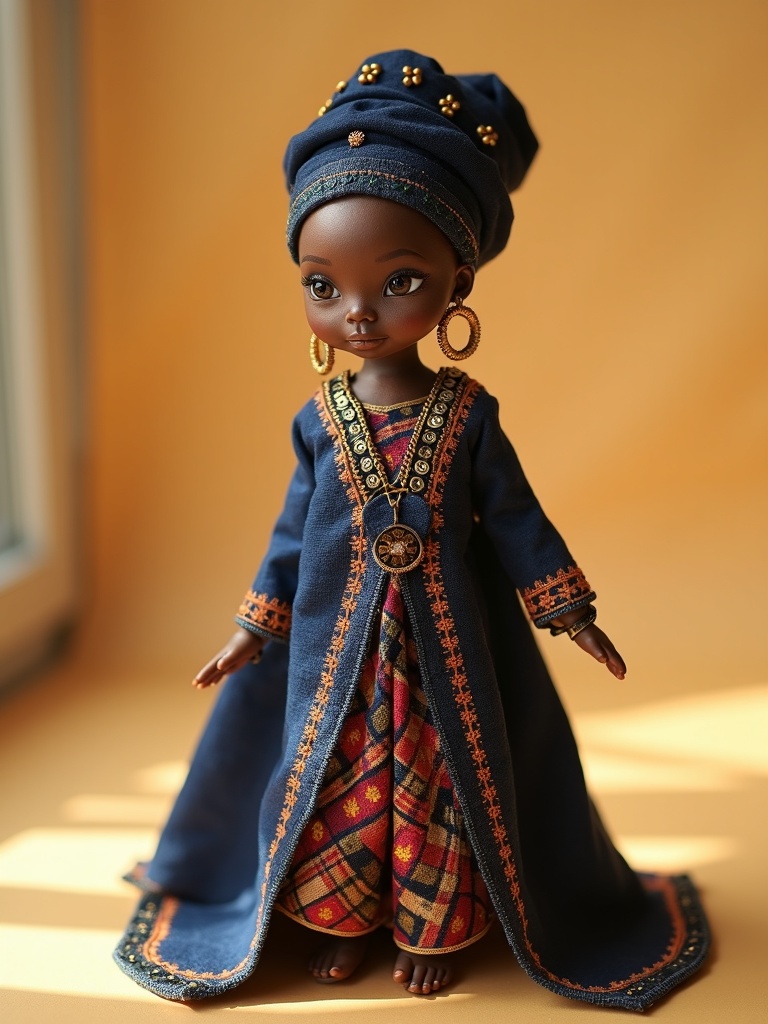
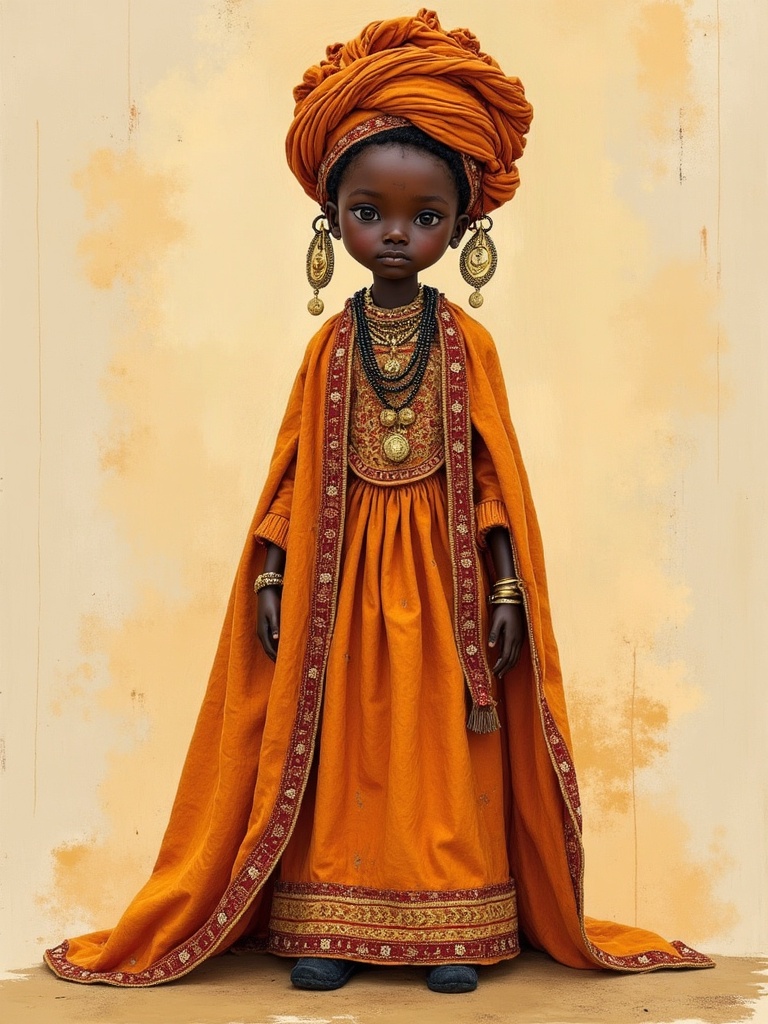
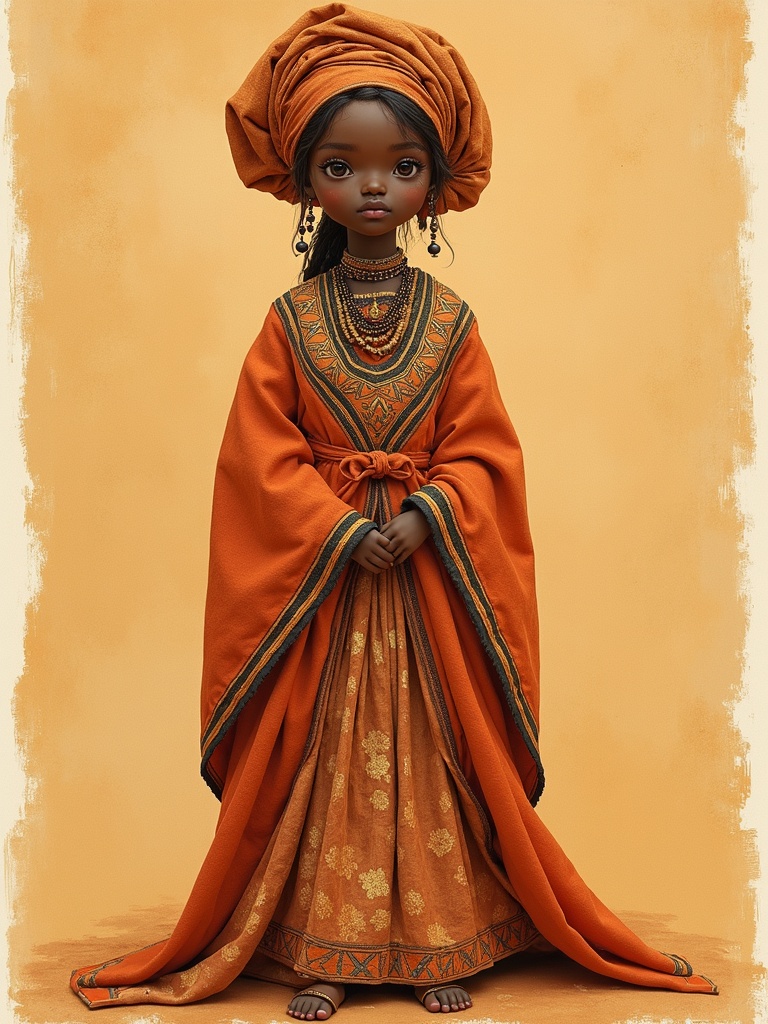
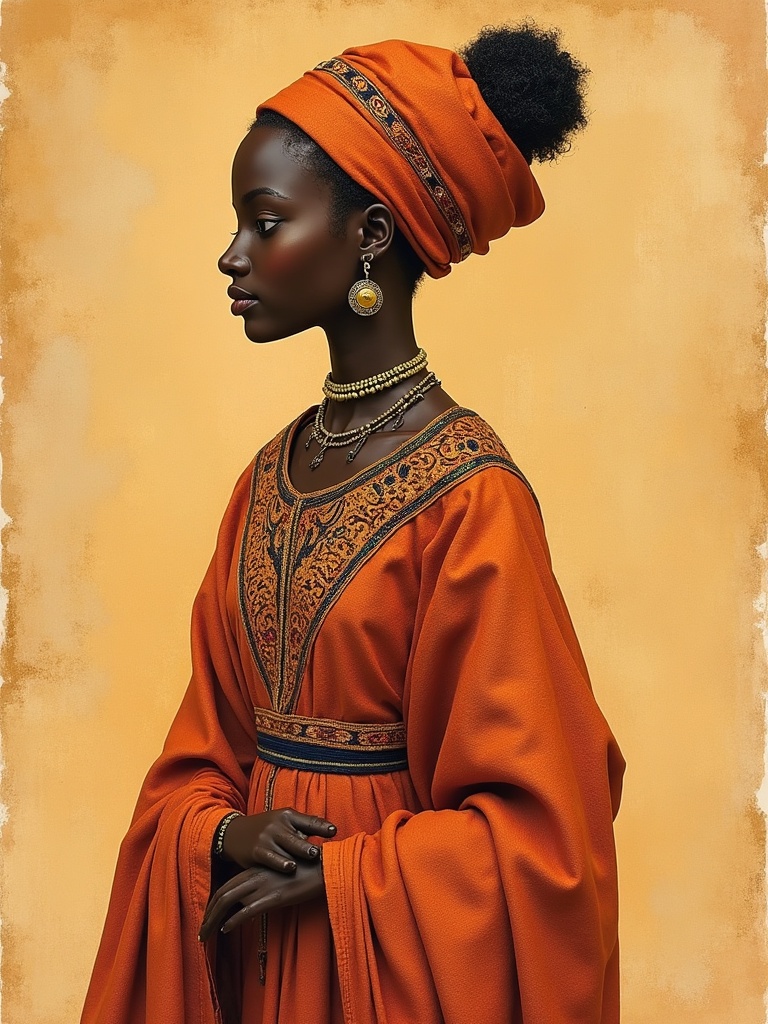
Young Aminatu, who would rather train with the cavalry than anything else — curious, brave, already wielding a wooden sword. Simple indigo cloth. Gift: The First of Her Kind (in the making).[1]
Amina high on horseback, spear in hand, at the head of her cavalry — the moment of her glory. Signature gift: The Horsewoman at the Front.[3]
Amina as queen, securing her realm: magnificently embroidered, before one of her walls, dignified and protective. Gift united with Walls that protect.[1]
Deliberate omission: Some adult legends about Amina (such as those about her lovers) do not belong in a children's figure and are left out here. The portrayal shows courage, leadership and protection — not violence for its own sake.
Make & Learn
⑦Fabrics & Production Notes
Real natural fibers, honest craftsmanship, lifelong repairability — and with Amina a luminous hallmark: real Hausa indigo.
The Material List
The Garment: Indigo & Embroidery
Amina's hallmark is the deep Hausa indigo — ideally real 100% cotton cloth, dyed in the traditional Kano dye pits — with rich Embroidery (zare) at the neckline and hems. Plus a wrapped headdress (gele/gyale). This connects the doll to a living dyeing tradition over 500 years old.[6][7] Where real indigo is too elaborate, a high-quality dyed substitute — visibly marked.
Armor, Horse & Attributes
For the warrior stage, a light, embroidered chainmail pattern and a small felt/papier-mâchéiron helmet (soft, child-safe), a blunt wooden/felt spear and a small leather/felt shield. Optionally a small sewn horse with festive adornments. Brass/gold-tone jewelry sewn on. No swallowable small parts in the school/toddler line; no pointed spear tips.
Signature & Education Card
Embroidered into the hem: „Amina" in indigo thread and the name of the seamstress. Enclosed is a biography card with life dates, the story of the „Walls of Amina" and a Hausa day-name game. Optional QR thread to the history page.
Production stages & effort
Embroidered indigo robe, head wrap, light armor, horse, biography card. The collector's and role-model figure.
Simplified indigo cloth, one decorative element, mini spear. Affordable entry point.
Washable, reinforced seams, sturdy attributes. With biography card for history lessons.
How it's made
Every doll is sewn by hand from natural materials — built to last a lifetime and to be repaired, not replaced. Here is the shopping list and the work steps. Sizes: Classic 32 cm (heirloom) · Kidogo 18–20 cm (toddlers, no small parts) · Shule 28 cm (school edition).
Shopping list
- Natural cotton or linen for the body (skin tone), ~0.5 m
- Wool or cotton stuffing — no plastic
- Cotton thread and embroidery floss in matching colours
- Garment fabric in this doll's colours (see the fabrics above)
- Yarn for the hairstyle
- Beads, cowrie shells and trims as shown
- Sharps and embroidery needles, pins, fabric scissors, fabric marker
Work instructions
- Trace and cut the body pattern at your chosen size (Classic 32 cm / Kidogo 18–20 cm / Shule 28 cm).
- Sew the body pieces right sides together, leave an opening, turn and stuff firmly with natural fibre, then close by hand.
- Embroider the face gently and with dignity — no plastic parts for the toddler line.
- Make the hair from yarn following the chosen hairstyle and attach it securely.
- Cut and sew the garment from this doll's fabric, then dress the doll.
- Add the beadwork, shells, trims and any attribute by hand.
- Check every seam and reinforce it — the doll should be lifelong and repairable, with no loose small parts for small children.
⑥Ten Name Suggestions
The real name is retained. These ten Hausa names are suitable for companion figures, sisters, or the series about Amina. To be confirmed by Hausa/Nigerian authorities before use.
Nice for the classroom: Just as with the Akan, the Hausa too have day-names (Ladi = Sunday, Talatu = Tuesday) — every child can find their own. Spellings vary; Nigerian authorities have the final say.
⑧Curriculum Mapping & Subjects
Amina is primarily docked onto Nigeria's curricula (Hausa as one of the major national languages), but can be used worldwide. She makes Hausa high culture visible and shows girls a role model for leadership in a man's world.
Warrior Queen & Conquests
Rise in a man's world.
History / Values. The Hausa city-states, female leadership, equality — African history with a strong heroine.
The Walls of Amina
Building earthen ramparts for protection.
Technology / History. How do you build a city wall out of earth? Defense, urban planning — construction technique compared to Great Zimbabwe.
Indigo & "blue people"
Dyeing & Embroidery.
Art / Chemistry. How does indigo dye? Plant dyes, resist technique, patterns with meaning — craft meets natural science.
Trans-Saharan Trade
Salt, gold, kola nuts.
Geography / Economics. Trade routes across the Sahara; Hausa cities as hubs — Africa as a connected economic world.
Children take turns in the role of leading a group AND protecting it. Learning objective: leadership as responsibility, not merely as power.
Children dye fabric with plant-based dye (e.g. red cabbage/indigo substitute) and design a pattern. Learning objective: dyeing chemistry, Hausa craft, the symbolism of colors.
Children compare Amina's earthen ramparts with Great Zimbabwe's stone walls — two African building methods. Learning objective: construction technique, materials science, cultural comparison.
Origin & Ethics
How we know this
On honesty: Amina is a historically attested yet at the same time heavily legend-embellished figure — the main sources (Kano Chronicle, Muhammed Bello's work from ~1836, oral tradition) arose in part long after her time, and even her exact dating and her status (queen or princess/gimbiya) are disputed in scholarship (hence ★★★★☆). Concrete figures are orders of magnitude. The „quote" shown is a paraphrased, modern formulation, not a historical quotation. Adult legends (for instance about lovers) are deliberately omitted for a children's figure; Zazzau too levied tribute and was involved in the slave trade of its time — not glossed over. The „abilities" and „life-stages" translate what has been handed down into the collectible-card format. Since Amina is a Nigerian/Hausa national icon, the final approval rests with the Nigerian cultural & Hausa authorities.
⑨Elder Approval & Sources to Watch
As with the other historical figures: "are we honoring with dignity?". Amina is a National icon of Nigeria and of the Hausa — her portrayal belongs under the blessing of Nigerian and Hausa authorities. A particularity: much about her is semi-legendary (based above all on the Kano Chronicle & oral tradition), which demands humility regarding the facts.
The approval board
The five-step protocol
Contact through official channels (Emirate of Zazzau, Nigerian museum commission, Kano dyers' associations, Hausa-language offices). Presentation of the vision, 42% rule, veto right.
Hand over this compendium as a draft — particularly the warlike portrayal, the covering attire and the omission of adult legends for review.
Emirate for the heroine, cultural offices for the walls, dyers/embroidery for material, historians for facts vs. legend.
Written approval for each element. Where sources are uncertain, this is openly flagged; adult legends are left out.
Indigo dyers, embroiderers & community funds share in the proceeds; part of the revenue supports the preservation & study of the „ganuwar Amina".
Most sensitive areas: the dignified, non-violence-glorifying warrior portrayal, the respect for the Muslim-influenced traditional dress, the omission of adult legends and the honest labeling that Amina's story is partly semi-legendary is (★★★★☆).
Sources to observe
Sources
- Amina (~1533–1610), warrior & ruler of Zaria/Zazzau (Hausa city-state, northern Nigeria); army of ~20,000, conquests as far as Nupe & Jukun; control of the trade routes; construction of walls around conquered cities. blackpast.org: Queen Amina.
- Introduction of metal armor (iron helmet, chainmail) among the Hausa; ~15 km-long wall around Zaria known as "ganuwar Amina"; Hausa of Zazzau as skilled metalworkers. encyclopedia.com: Amina of Zaria.
- Army of ~20,000; conquests as far as the Niger & into present-day Cameroon; fortified cities with protective walls; new trade routes into the trans-Saharan network. ourhistory.org.uk: Queen Amina of Zaria.
- (Context: Hausa history; Fulani Jihad from 1804, British conquest 1901/1904.) blackhistoryheroes.com; mrstscorner.
- Daughter of King Nikatau & Queen Bakwa Turunku (first queen of Zazzau, r. ~1536); Zaria named after her sister; earliest mention by Muhammed Bello (~1836) & in the Kano Chronicle; death ~1610 in Atagara near Idah. tangietwoods.blog; blackhistoryheroes.com.
- Hausa as "blue people" through indigo; Kofar Mata dye pits in Kano over 500 years old, still in operation today. oluwalanu.com; en.wikipedia.org: Kofar Mata Dye Pits.
- Hausa traditional dress (indigo, embroidery/zare, Babban Riga, gele/gyale), leather- & metalwork, music (kakaki, kuka); trade via city-states like Kano. rexclarkeadventures.com; nicholasidoko.com; historicalnigeria.com.
- Trans-Saharan trade of the Hausa (salt, gold, leather, kola nuts), women significant in trade & in dyeing. historicalnigeria.com: The Hausa People.
- Walls as prestige & a measure of a ruler's organizational power; protection of the markets from threats from the south. africanfeministforum.com: Queen Amina of Zaria.
- First woman as Sarauniya in a man's world; greatest expansion of the Hausa in history; Amina statue in Lagos (spear, horse); legend of having inspired the Xena series. africanfeministforum.com; encyclopedia.com.